
Lecture
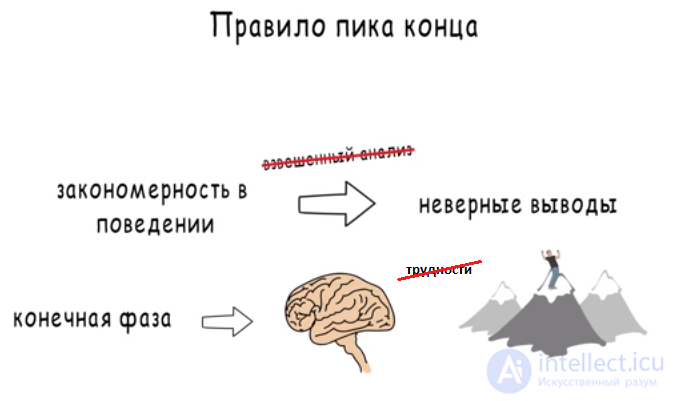
The peak–end rule is a psychological heuristic in which people judge an experience largely on how they felt at its peak (i.e., its most intense point) and at its end, rather than on the total sum or average of every moment of the experience. The effect occurs regardless of whether the experience is pleasant or unpleasant. According to the heuristic, other information aside from that about the peak and the end of the experience is not lost, but it is not used. This includes net pleasantness or unpleasantness and how long the experience lasted. The peak–end rule is a specific form of the more general extension neglect and duration neglect.
The rationale rests on the general hedonic method by which people evaluate experiences, which holds that two factors chiefly shape memories: the strongest, most salient moment of an event and its final moment. Other external and internal factors and emotions provide no relevant information for the person, so they play no role in processing. In addition to ignoring a large amount of data, the researchers' work also showed that the time interval is disregarded, a phenomenon called duration neglect.. In general, eliminating the components just mentioned promotes rapid opinion formation, since the human brain processes considerably less data. A simple example: how was your last vacation? We expect the subject to know the answer right away without thinking about it.
Overview
The peak–end rule is a development of the snapshot model of remembered utility proposed by Barbara Fredrickson and Daniel Kahneman. This model dictates that an event is evaluated not by the whole experience but by prototypical moments (or snapshots) as a result of the representativeness heuristic. The remembered value of the snapshots dominates the actual value of the experience. Fredrickson and Kahneman proposed that these snapshots are in fact an average of the most emotionally intense moment of the experience and the feeling experienced at the end. The influence of the duration of the experience on retrospective evaluation is extremely small. Fredrickson and Kahneman called this phenomenon duration neglect. The peak–end rule applies only when the experience has definite beginning and ending periods.
A 1993 study titled "When more pain is preferred to less: Adding a better end," conducted by Kahneman, Fredrickson, Charles Schreiber and Donald Redelmeier, provided evidence for the existence of the peak–end rule. Participants took part in two versions of the same unpleasant experience. The study by Kahneman, Fredrickson, Charles Schreiber and Donald Redelmeier, titled "When more pain is preferred to less: Adding a better end," provided groundbreaking evidence for the peak–end rule. Participants were subjected to two different versions of the same unpleasant experience. In the first trial, subjects immersed one hand in water at 14 °C for 60 seconds. In the second trial, subjects immersed the other hand in water at 14 °C for 60 seconds, but then kept the hand immersed for another 30 seconds, during which the temperature was raised to 15 °C. The subjects were then asked to choose which trial to repeat. Contrary to the law of temporal monotonicity, subjects were more likely to choose to repeat the second trial, despite the longer exposure to uncomfortable temperatures. Kahneman et al. concluded that "subjects chose the long trial simply because they liked the memory of it better than that of the alternative (or disliked it less)." The work of Nobel laureate Daniel Kahneman and his fellow psychologists provides the most extensive development of this topic. In addition, the research on cognitive behavior by the psychiatrist Aaron T. Beck serves as the basis for the fullest and most comprehensive understanding and treatment of the problem.
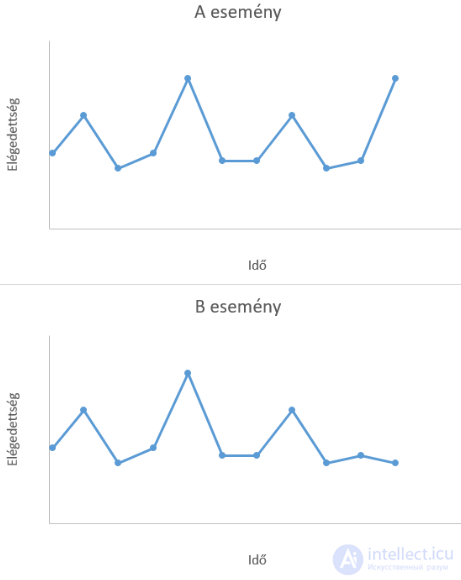
Figure. Interpretation of the peak–end effect using a diagram.
Similarly, a 1996 study by Kahneman and Redelmeier assessed patients' opinions of uncomfortable colonoscopy or lithotripsy procedures, and compared the remembered experience with real-time results. They found that patients consistently rated the discomfort of the experience based on the intensity of pain at the worst (peak) and last (end) moments. This occurred regardless of the duration or of differences in the intensity of pain during the procedure.
Another study by Kahneman and Ziv Carmon identified a boundary condition for the peak–end rule. Participants interacted with a computer program that made them wait for service while they rated their satisfaction with the wait. Kahneman and Carmon found that what participants felt in the final moment of the experience was a good predictor of their responses when they were asked to evaluate their experience retrospectively. For example, participants who felt very dissatisfied for most of the experience but were satisfied in the last few seconds (because the waiting queue moved faster than expected toward the end) rated the experience as satisfactory. Kahneman and Carmon concluded that real-time experience based on expectations is not taken into account after the fact if those expectations are not met.
A third study by Kahneman, Redelmeier and Joel Katz confirmed and extended the findings of the 1996 study. Colonoscopy patients were randomly divided into two groups. One underwent a colonoscopy procedure in which the scope was left in place for three additional minutes without being moved, creating a sensation of discomfort but no pain. The other group underwent a typical colonoscopy procedure. Kahneman et al. found that, when asked to evaluate their experience retrospectively, patients who underwent the longer procedure rated their experience as less unpleasant than patients who underwent the typical procedure. Moreover, patients in the prolonged-discomfort group were much more likely to return for follow-up procedures, because the less painful ending led them to rate the procedure more positively than those who faced the shorter procedure.
People remember more emotional events better than less emotional ones. The exact reason for this is unclear, but it has been demonstrated for decades in a wide variety of studies and experiments. In addition, people are not always aware that the events they remember are emotionally more intense than the "average" event of that kind. This failure to correct for the atypicality of extreme memories can lead people to believe that these extreme moments are representative of the "set" being evaluated. Boston Red Sox fans who were asked to recall any game they had seen the Red Sox win, for example, tended to recall the best game they could remember. They realized that this game was not representative of past Red Sox victories only if they were explicitly asked to recall the best game they could remember, as shown by their subsequent emotional forecasts. This tendency toward stronger emotional experiences is evident in nostalgic preferences. People who were asked to recall a TV show or a movie from the past tended to recall the most enjoyable show or movie they could remember, and used this extreme example to evaluate all the shows of that era, unless they could also spontaneously recall shows or movies that were worse than the first show or movie they remembered.
People show serial position effects in that they have better memory for both the beginning and the end of a sequence, phenomena known as the primacy bias and the recency bias, respectively. In work by Garbinsky, Morewedge and Shiv (2014), evidence was found that for extended hedonic experiences, better memory for the end of the experience than for its beginning (recency > primacy) can be attributed to memory interference effects. For example, when a person eats potato chips, forming a new memory of the chips just eaten makes it harder to recall the taste of the chips eaten earlier. Garbinsky and colleagues found that (1) recency effects were better at predicting than primacy effects how much people recalled enjoying a small meal (e.g., eating 5 or 15 chips); (2) people had worse memory for the first bite of food than for the last bite of food, but (3) providing people with ratings of the first bite prompted them to use their enjoyment of the first bite as much as their enjoyment of the last bite when evaluating their overall enjoyment of the meal.
To make sound decisions, one must consider not only the final act of an event but the whole process.
Because most consumer interactions have a beginning and an end, they fit the peak–end model. As a consequence, negative occurrences in any consumer interaction can be neutralized by establishing a firmly positive peak and end. This can be achieved by playing music that customers like, handing out free samples, or paying an employee to hold the door for visitors as they leave. As Scott Stratten suggested: "A truly great salesperson who helps with an exchange can erase a negative experience along the way. The long wait in line and the bad music in the fitting room are forgotten." However, as research by Talia Miron-Shatz shows, retrospective evaluations of a day's experience do not seem to follow the peak–end rule, which calls into question the rule's applicability to consumer–business interactions that last roughly all day, such as a hotel stay.
Another business application is pricing strategy in marketing practice. The peak–end rule suggests that the reference price, an internal price benchmark, is formed as a weighted average of the maximum observed price and the most recent price. Among all four reference price models (the peak–end model, the extrapolative expectations model, the adaptive expectations model and the rational expectations model), the peak–end model is the most plausible representation of consumers' cognitive processes at the individual level.
De Maeyer and Estelami suggest that periodically raising a brand's price above the desired level can restore the reference price for the brand. However, because of its inherent risks, this tactic can be effective only under certain circumstances. First, the tactic should be used sparingly and for a short period of time. If a brand changes its price level too often, it can confuse buyers and may be considered "unreliable." A long period of an exceptionally high price can distort consumers' perception of the brand's prices and lead to a loss of consumers. Second, the tactic is best suited to frequently purchased products (e.g., food, music, perfume), where the frequency of sales minimizes the effect of the sales lost during the peak-price period.
In another study, Nasiry and Popescu examine the effect of a low peak price and its interaction with loss aversion in optimal pricing strategies. They found that deep discounts can permanently undermine future demand, because the lowest prices remain substantial in the process of memory anchoring. Companies should therefore avoid deep discounts in order to preserve the price perception of their brand. They also pointed to a limitation of the temporary price-increase strategy as short-lived, since these high prices affect the reference price only in the following period.
In 2006, a study was conducted at the University of Canterbury in Christchurch, New Zealand, that analyzed the influence of the peak–end rule on the perception of happiness on vacation. The study showed that participants' overall remembered happiness was approximately predicted by the peak–end rule, although it was actually better predicted by their happiness during the "most memorable or most unusual 24 hours." Nevertheless, the length of the vacation appeared to have little effect on remembered happiness. The results of the study can be applied to choosing a more cost-effective vacation length.
The peak–end rule is particularly important with respect to medical procedures, since it suggests that longer procedures that include a period of lesser discomfort are preferable to shorter procedures. In particular, the rule "suggests that memories of painful medical treatment are likely to be less unpleasant if pain relief is gradual than if relief is sudden." In addition, the quality of the remembered procedure can substantially affect the future of medicine. If people remember necessary but burdensome procedures more positively, they are more likely to return for repeat procedures later in life. However, taking the influence of the peak–end rule into account when evaluating medical procedures is problematic, because adding a period of reduced pain to a procedure still adds pain. Although it certainly produces a better memory of the process, the patient still endures more pain than is strictly necessary. Doctors and patients are forced to face a choice between objectively less painful forms of treatment and forms of treatment that will be remembered more favorably. Kahneman argues that "it is safe to assume that few patients would agree to subject themselves to pain for the sole purpose of improving their memory in the future."
The peak–end rule also applies to educational practice, especially to peer assessment. A study conducted by Hoogerheide and her team analyzes the influence of the peak–end rule on children's experience of receiving peer feedback. The result shows that the peak–end rule probably influences how children perceive and remember the feedback, as well as their learning outcomes and motivation.
The study contains two experiments with different overall tones, one positive and one negative. In each experiment, students received two versions of feedback of different lengths. In the overall negative feedback, the extended version contains an additional moderately negative comment at the end. Similarly, the extended positive feedback ends with an additional moderately positive comment. In both experiments, students reported that the extended feedback was remembered as more pleasant and less difficult. Based on the result, Hoogerheide advises teachers to structure feedback by ending with the best part of the assessment. When the feedback is negative overall, it is better to end with the most pleasant or most easily acceptable part of the negative comments. Likewise, positive feedback should end on a high note rather than on the most unpleasant part.
Although the peak–end rule may be less general in human eating behavior than in other contexts, research has identified several contextual factors that it influences. For example, the peak–end rule works for evaluating food when the price is low. Conversely, when it comes to expensive food, people tend to rely on their initial experience rather than on the peak or final experience. One possible reason is that people who pay high prices form higher expectations of the service than people who pay low prices. If their high expectations deviate from the actual experience at the outset, the evaluation of the service as a whole may be determined primarily by the initial experience. Those who pay a low price may not have great expectations and therefore perceive the peak as much higher than high-price payers do. Thus, when evaluating the overall experience, they are more likely to be influenced by the peak rule.
The theory was formed in a pizza study in which people chose to pay either 4 or 8 dollars for their pizza buffet. For those who paid 4 dollars, the taste of the last and the peak slices largely predicted the overall evaluation of the taste of the food. By contrast, for those who paid 8 dollars, the first slice was more important for predicting overall enjoyment. Thus, to satisfy customers' needs as fully as possible, restaurants with higher prices should first of all offer consumers their best food. In a buffet setting, they could put up signs to highlight the more popular items or place the most popular items first. In restaurants with lower prices, serving tasty desserts at the end can increase overall customer satisfaction.
The effect of the peak–end rule in eating behavior also depends on personal factors, such as the level of restraint in food choices. Robinson et al. found that for unrestrained eaters, the key moments of the eating experience have a disproportionately large influence on the remembered enjoyment of the meal. However, restrained eaters' judgments about food are influenced not by the peak or the end of the recent eating experience but by other cognitive factors, such as semantic knowledge and beliefs about food that have already been formed.
Criticism of the peak–end rule usually arises from the reduction of a complex mental evaluation to a simplified scheme. A 2008 study found some support for the peak–end rule, but also found that it is "not an exceptionally good predictor" of remembered experienced value, and that the happiness of the most memorable part of an experience predicts the remembered happiness better than the happiness of the peak or the end. In addition, the extreme effect of peaks fades faster over time, so that peaks are recalled less positively and lows less negatively. Episodic memory lasts only a few weeks; at some point the mental accounting switches to semantic memory, which leads to a potential overvaluation of the "end" and a reduced weight of the peak. Moreover, the memories available for evaluation may change because of a decay effect associated with memory or because of different goals at the time of recall. Goal orientation or initial expectations may also influence the evaluation of the peak or the end point, so that the end point is overvalued as the culmination of the goal. Finally, Ariely and Carmon suggested that the evaluation of past events is influenced by feelings at the time of evaluation.

Comments