
Lecture 7 min.
An impeller, or rotor wheel, is a driven rotor used to increase the pressure and flow rate of a fluid. It is the opposite of a turbine , which extracts energy from a flowing fluid and reduces its pressure.
An impeller is a bladed machine enclosed in a ring. It has various applications: as a fan, in aviation (fenestron) and in model aviation, as a pump, turbine or for mixing liquids.
Strictly speaking, propellers are a subclass of impellers in which the flow enters and exits axially, but in many contexts the term "impeller" is used for rotors that are not propellers, where the flow enters axially and exits radially, especially when creating suction in a pump or compressor .
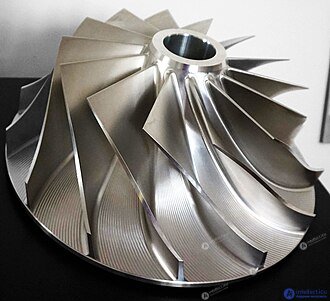 Impeller of a three-stage air compressor
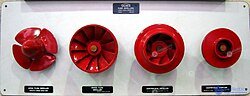
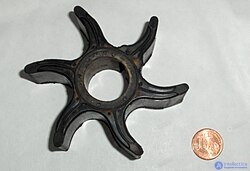
An impeller is the rotating component of a centrifugal pump that accelerates the fluid outward from the center of rotation, thereby transferring energy from the engine driving the pump to the fluid being pumped . [ 2 ] [ 3 ] The acceleration creates the outlet pressure when the outward motion of the fluid is constrained by the pump casing. An impeller is usually a short cylinder with an open inlet (called the "eye") to receive the incoming fluid, vanes to move the fluid radially, and a splined , keyed or threaded bore for mounting the drive shaft.
It is sometimes cheaper to cast an impeller and its shaft as a single piece than separately. Such a combination is sometimes called simply a "rotor".
An open impeller has a hub with vanes attached and is mounted on a shaft. The vanes have no walls, which makes open impellers somewhat weaker than closed or semi-open ones. However, because no side plate is attached to the inlet side of the vane, the stresses on the vanes are significantly lower. [ 4 ] In pumps, the fluid enters the impeller opening, where the vanes add energy and direct it to the discharge nozzle. A small clearance between the vanes and the volute casing or back plate prevents most of the fluid from flowing back. Wear of the bowl and vane edge can be compensated for by adjusting the clearance to maintain efficiency over time. [ 5 ] Because the internal parts are visible, open impellers are easier to inspect for damage and to maintain than closed ones. They are also easier to modify to change the flow characteristics. Open impellers operate over a narrow range of specific speeds . Open impellers are usually faster and easier to service. Open impellers are commonly used for small pumps and for pumps handling suspended solids. [ 6 ] Sand does not become lodged as easily as with the closed type.
A semi-open impeller has an additional back wall, which gives it greater strength. Such impellers can pass mixed solid-liquid mixtures, but at the cost of reduced efficiency.
The design of closed impellers includes additional front and back walls on both sides of the vanes, which increases their strength. This also reduces the axial load on the shaft, increasing bearing life and reliability and reducing shaft cost. However, this more complex design, including the use of additional wear rings, makes closed impellers more difficult to manufacture and more expensive than open ones. The efficiency of a closed impeller decreases as the wear-ring clearance increases in service. However, adjusting the clearance in the impeller bowl does not affect vane wear as critically as it does with an open impeller. [ 4 ] Closed impellers can be used over a wider range of specific speeds than open impellers. [ 5 ] They are commonly used in large pumps and clean-water systems. These impellers cannot handle solids effectively and are difficult to clean when clogged. [ 6 ]
The design of the screw impeller corresponds more closely to an axial progressive channel, which allows solids to move freely as the impeller rotates. [ 7 ] [ 8 ]
The main part of a centrifugal compressor is the impeller. An open impeller has no shroud, so it can run at higher speeds. A compressor with a closed impeller can have more stages than a compressor with an open impeller.
Some impellers resemble small propellers , but without large blades. Among other uses, they are employed in waterjet engines to propel high-speed boats.
Because impellers do not have large blades to turn, they can rotate at much higher speeds than propellers. Water passing through the impeller is guided by the housing, forming a jet of water that pushes the vessel forward. The housing usually tapers into a nozzle to increase the water velocity, which also creates a Venturi effect, in which the low pressure behind the impeller draws more water toward the blades, tending to increase the speed.
For efficient operation, a tight fit between the impeller and the housing is necessary. The housing is usually equipped with a replaceable wear ring , which wears as sand or other particles are thrown by the impeller against the side of the housing.
Vessels that use impellers are usually steered by changing the direction of the water jet.
Compare with propeller and aircraft jet engines .
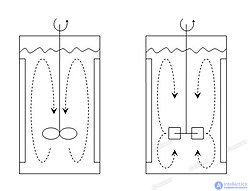
In stirred tanks, agitators are used to mix liquids or suspensions. This makes it possible to combine materials in the solid, liquid and gaseous states. Mixing liquids in a tank is very important when there are gradients of parameters such as temperature or concentration.
There are two types of impellers, depending on the flow pattern they produce (see figure):
Radial-flow impellers essentially generate shear stress in the fluid and are used, for example, to mix immiscible liquids or, in general, when a deformable phase interface must be broken up. Another application of radial-flow impellers is the mixing of very viscous liquids.
Axial agitators essentially provide bulk movement of the fluid and are used in homogenization processes, where increasing the volumetric flow rate of the fluid is important.
Impellers can be further divided into three main subtypes:
Propellers are elements that generate axial thrust. These elements produce a very high degree of swirl in the vessel. The flow pattern generated in the fluid resembles a spiral.
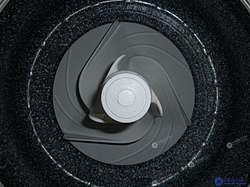
In some designs of top-loading washing machines, impellers are used to agitate laundry during washing .
In the fire services of the United Kingdom and many Commonwealth countries, a stylized image of an impeller is used as an insignia. Officers wear one or more of these badges on the epaulettes or collar of the firefighter uniform, which is the equivalent of the stripes worn by members of the army and police .
Air pumps, such as Roots rotary blowers , use meshing impellers to move air through a system. Applications include blast furnaces, ventilation systems and superchargers for internal combustion engines.
Impellers are an integral part of the axial pumps used in ventricular assist devices to augment or fully replace cardiac function.

Comments