
Lecture 2 min.
The ground effect (also called the surface effect or wing-in-ground effect) is a sharp increase in the lift of a wing and in other aerodynamic characteristics of an aircraft when flying close to a screening surface (water, ground, etc.). It was discovered in the mid-1920s.
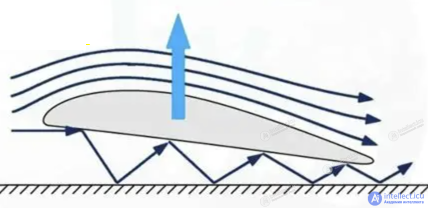
The ground effect is the same as an air cushion, except that the air is compressed not by special devices but dynamically by the oncoming airflow. Thus, the wing of a ground-effect vehicle generates lift not only through the reduced pressure above the upper surface (as on conventional aircraft) but also through the increased pressure beneath the lower surface, which can be created only at very low altitudes, that is, at heights numerically smaller than the aerodynamic chord of the wing.
The ground effect arises because the air disturbances propagating from the wing reach the Earth's surface, are reflected, and manage to reach the wing again. Consequently, the pressure under the wing rises owing to the reflected air mass.
The wider the wing and the lower the flight speed and altitude, the stronger the ground effect. For example, the maximum range of the Ivolga ground-effect aircraft at an altitude of 0.8 m is 1150 km, while at an altitude of 0.3 m with the same load it is already 1480 km.
Traditionally, for aircraft flight speeds right near the ground, the height at which the ground effect acts is taken to be half the wing chord. The ground effect is most pronounced on hang gliders because of their low flight speed (of the order of 10 m/s) and large wing chord, while for sufficiently large ekranoplans the flight altitude using the ground effect can reach 10 m or more.
The center of pressure of the ground effect (the point of application of the lift due to the ground effect) is located closer to the trailing edge, while the center of pressure of the lift arising from the asymmetry of the body in the airflow is closer to the leading edge. Therefore, the greater the contribution of the ground effect to the total lift, the further aft the center of pressure shifts. Changing only the altitude or only the speed leads to trim (balancing) problems. Roll causes a diagonal shift of the center of pressure. Considering the above, it is clear that piloting an ekranoplan requires specific skills.

Comments