
Lecture 14 min.
Scenario analysis is a strategic thinking method aimed at exploring possible futures under conditions of high uncertainty. Unlike traditional forecasting, it does not try to predict a single most likely course of events; instead, it offers several logically grounded scenarios, each reflecting a different combination of key factors and trends. This approach helps organizations and government bodies prepare better for unexpected changes, make strategic decisions more resilient, and identify hidden risks and opportunities.
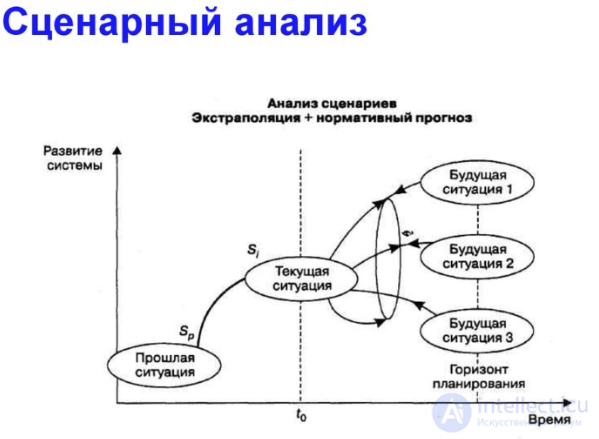
Scenario analysis is especially relevant in situations where the future cannot be predicted accurately, yet decisions with long-term consequences must still be made. It helps manage uncertainty, build flexible strategies, and adapt to a rapidly changing environment. The method is widely used in business — for assessing market risks, investment planning, and innovation development; in public administration — when developing policies related to demographics, security, and sustainable development; in energy — for modeling the transition to renewable sources; in climate research — for assessing the impact of different warming scenarios; and in technology — when analyzing the consequences of digitalization, the development of artificial intelligence, and cyber threats.
Origins: Shell and strategic planning in the 1970s
Development of approaches: from linear forecasts to multi-scenario models
Influence on modern foresight methods and strategic thinking
The history of scenario analysis dates back to the 1970s, when Royal Dutch Shell first applied the method to strategic planning amid instability in the oil market. Unlike traditional linear forecasts, which assumed one main direction of development, Shell developed several alternative scenarios that took into account various political, economic, and technological factors. This allowed the company to be better prepared for the 1973 oil crisis and strengthened its market position.
Over time, the approach to scenario analysis has evolved significantly. From simple "optimistic–pessimistic" variants, it moved to more complex multi-scenario models incorporating systems analysis, cross-disciplinary data, and qualitative narratives. Modern methods include building scenario matrices, using critical uncertainties, and integrating with strategic foresight tools — long-term forecasting and future modeling.
Scenario analysis has had a significant influence on the development of strategic thinking in business, public administration, and scientific research. It has become an integral part of decision-making under uncertainty, contributing to flexible strategies that are resilient to external shocks and change.
Not a forecast, but an exploration of possible futures
Accounting for key factors of uncertainty
Building logically consistent scenarios
The role of creativity and systems thinking
Scenario analysis rests on a number of key principles that distinguish it from traditional forecasting. First of all, it is not an attempt to predict the future but an exploration of the many possible ways it may unfold. This approach makes it possible to consider a broad range of factors and prepare for different scenarios, including unexpected or improbable ones. The focus is on key uncertainties — those variables that can significantly influence the course of events but whose behavior cannot be predicted accurately. These may be political decisions, technological breakthroughs, changes in consumer behavior, or natural disasters.
Each scenario must be logically consistent, internally coherent, and realistic within the given conditions. This requires careful analysis of the interrelationships between factors and assessment of their possible consequences. Creativity plays an important role in scenario analysis: scenarios should not be formulaic or limited by current ideas about the future. On the contrary, they should stimulate new thinking and reveal hidden risks and opportunities. Systems thinking helps to see the big picture, take into account the interaction of different elements, and build scenarios that reflect the complexity of the real world.
The process of conducting scenario analysis includes several sequential stages, each of which plays an important role in producing high-quality and useful scenarios. It all begins with defining the purpose of the analysis — it is necessary to understand which decisions will need to be made, which time horizons are being considered, and which aspects of the future are most critical. Next, the influencing factors are collected and analyzed, often using structured methods such as PESTEL, SWOT, or STEEP, in order to identify the political, economic, social, technological, environmental, and legal drivers of change.
At the next stage, key uncertainties are identified — those variables that have a high degree of impact and, at the same time, low predictability. They form the basis for building the scenario matrix, most often in a 2×2 format, where each axis represents one of the critical uncertainties. This makes it possible to develop four basic scenarios covering different combinations of future conditions.
After that, each scenario is described in detail: it is given a name, and a narrative is developed that includes the logical progression of events, key turning points, and possible consequences. Visualizing scenarios — through diagrams, charts, or maps — helps convey their essence to stakeholders more effectively. The final stage is assessing the strategic implications: which risks and opportunities arise in each scenario, which actions may be effective, and which strategies will prove robust regardless of which scenario unfolds. This stage makes it possible to integrate scenario analysis into real management and planning processes.
Identifying the purpose and subject of the analysis
Collecting and analyzing influencing factors (PESTEL, SWOT, STEEP)
Identifying key drivers and uncertainties
Building a scenario matrix (for example, 2×2)
Describing the scenarios: names, narratives, visualization
Assessing consequences and response strategies
The stages of conducting scenario analysis form a sequential process aimed at producing well-founded and diverse models of the future. It all begins with identifying the purpose and subject of the analysis — it is necessary to define clearly which problem or strategic task will be examined, over what time horizon, and for which stakeholders. Next, influencing factors are collected and analyzed using methods such as PESTEL, SWOT, or STEEP, which make it possible to identify the political, economic, social, technological, environmental, and legal drivers of change. On the basis of this analysis, key drivers and uncertainties are identified — those variables that have a high degree of impact on the future but remain difficult to predict.
The next step is building the scenario matrix, often in a 2×2 format, where each axis represents one of the critical uncertainties. This makes it possible to develop four basic scenarios covering different combinations of conditions. Each scenario is given a name, accompanied by a narrative — a description of the logic of how events unfold, key turning points, and possible consequences — and visualized with diagrams, charts, or maps, which makes it easier to understand and communicate. The process concludes with an assessment of consequences and response strategies: risks and opportunities are analyzed, recommendations for action in each scenario are developed, and strategies that are robust across different futures are identified. This stage makes it possible to integrate the results of scenario analysis into real management and planning processes.
Pessimistic, optimistic, baseline, and extreme
Wild cards and black swans
Short-term vs. long-term scenarios
Scenario analysis makes use of several types of scenarios, each of which offers its own way of thinking through possible futures. The most common classification includes pessimistic, optimistic, baseline, and extreme scenarios. A pessimistic scenario describes the worst-case course of events, with maximum risks and negative consequences. An optimistic scenario, by contrast, reflects the most favorable development, in which the best opportunities are realized. A baseline scenario is built on current trends and assumptions and represents the most likely course of events. An extreme scenario models rare but potentially devastating or transformative events.
A special category consists of so-called wild cards and "black swans" — unexpected, low-probability, but highly significant events capable of radically changing the course of history. They cannot be predicted with high accuracy, but they should be taken into account in scenario analysis as potential turning points.
Scenarios also differ by time horizon: short-term scenarios (1–3 years) are oriented toward operational planning and response, whereas long-term scenarios (10–30 years or more) are used for strategic thinking, assessing resilience, and preparing for fundamental change. The choice of scenario type depends on the goals of the analysis, the level of uncertainty, and the area of application.
Business: strategic planning, investment, innovation
Government: climate policy, demographics, security
Technology: AI development, digitalization, cyber threats
Scenario analysis is widely applied across many fields thanks to its ability to model complex and uncertain futures. In business, it is used for strategic planning, assessing investment risks, and developing innovative solutions. Companies use scenarios to analyze market trends, consumer behavior, the competitive environment, and technological change, which allows them to adapt to different possible developments and make better-informed decisions.
In public administration, the scenario approach is applied in shaping climate policy, forecasting demographic change, and ensuring national security. It helps governments account for long-term risks, develop sustainable strategies, and respond to global challenges such as migration, climate change, and geopolitical instability.
In the technology sphere, scenario analysis is used to assess the consequences of the development of artificial intelligence, digitalization, and cyber threats. It makes it possible to model the impact of new technologies on society, the economy, and the labor market, and to develop measures to ensure digital security and the ethical adoption of innovation. Thanks to its flexibility and interdisciplinary nature, scenario analysis is becoming an important tool for managing the future.
Pros:
Increases the resilience of decisions
Stimulates strategic thinking
Helps identify hidden risks and opportunities
Cons:
Complexity and labor intensity
Risk of subjectivity
Does not guarantee accuracy
Scenario analysis has a number of significant advantages, which is why it is widely used in strategic planning and management. First of all, it increases the resilience of the decisions made, allowing organizations to consider different possible developments and adapt to unexpected changes. The method stimulates strategic thinking, encouraging participants to go beyond conventional assumptions and consider alternative perspectives. In addition, scenario analysis helps identify hidden risks and opportunities that might go unnoticed when using traditional approaches.
However, the method also has certain limitations. Applying it requires significant resources — time, expertise, and organizational effort — which makes the process complex and labor-intensive. Scenarios can be subject to subjectivity, especially if they are built on opinions and assumptions not backed by data. Finally, scenario analysis does not guarantee accuracy: it does not predict the future but only models its possible variants, so the results should be used as guideposts rather than as final forecasts.
Excel, PowerPoint, Miro (for visualization)
Foresight tools: Scenario Manager, Futures Platform
AI and Big Data in scenario modeling
A wide range of tools and software is used to conduct scenario analysis, helping to structure the process, visualize scenarios, and integrate data. At the basic level, general-purpose office applications such as Excel, PowerPoint, and Miro are used. Excel makes it possible to organize input data, build scenario matrices, and perform calculations; PowerPoint is used to prepare presentations and scenario narratives; and Miro is used to create interactive diagrams, maps, and visual boards for collaboration.
For more advanced analysis, specialized foresight tools such as Scenario Manager and Futures Platform are used. They provide ready-made templates, trend databases, and tools for building scenarios and assessing their consequences. These platforms are particularly useful when working with large teams and within long-term strategic planning.
Modern technologies are also being actively adopted in scenario modeling. Artificial intelligence and Big Data make it possible to analyze huge volumes of information, uncover hidden relationships, and build scenarios based on real data. Machine learning can be used to generate alternative scenarios, estimate probabilities, and automate part of the analytical process. Thus, scenario analysis tools are becoming ever more flexible, scalable, and integrated into the digital environment.
Involve a multidisciplinary team
Review scenarios regularly
Integrate into strategic processes
For scenario analysis to be successfully adopted in strategic planning practice, it is important to follow a set of recommendations that ensure its effectiveness and sustainability. First of all, it is necessary to involve a multidisciplinary team that includes specialists from different fields — economics, politics, technology, ecology, and others. This makes it possible to take diverse viewpoints into account, improve the quality of the analysis, and avoid a narrow interpretation of the future. Teamwork promotes a deeper understanding of the relationships between factors and the development of comprehensive scenarios.
The second important element is regular review of scenarios. The world is changing rapidly, and scenarios that are relevant today may become outdated within a few months. Continuously updating data, reassessing key uncertainties, and adapting scenarios to new conditions keep them relevant and of practical value. This is especially important in conditions of high turbulence and technological shifts.
Finally, scenario analysis must be integrated into the strategic processes of the organization or the state. It should not exist as a standalone exercise but should become part of decision-making, policy development, investment planning, and risk assessment. Only then can the scenario approach genuinely influence the resilience and adaptability of strategies, ensuring preparedness for different possible futures.
Scenario analysis as a tool for sustainable development
The importance of flexibility and adaptability in an age of uncertainty
Scenario analysis is a powerful tool for sustainable development, enabling organizations, governments, and expert communities to make decisions under uncertainty and in rapidly changing circumstances. It not only helps anticipate possible risks and opportunities but also fosters a culture of strategic thinking based on flexibility, systems thinking, and readiness for a variety of possible futures. In an era of global challenges — from climate change to technological shifts — the ability to adapt becomes a key success factor.
The flexibility and adaptability built into the scenario approach make it possible not merely to react to change but to actively shape sustainable strategies capable of withstanding pressure from the external environment. Scenario analysis teaches thinking in terms of multiplicity, taking alternative viewpoints into account, and building decisions that are resilient to unexpected turns. That is why it is increasingly in demand in strategic management, innovation development, and long-term policy making.

Comments