
Lecture 40 min.
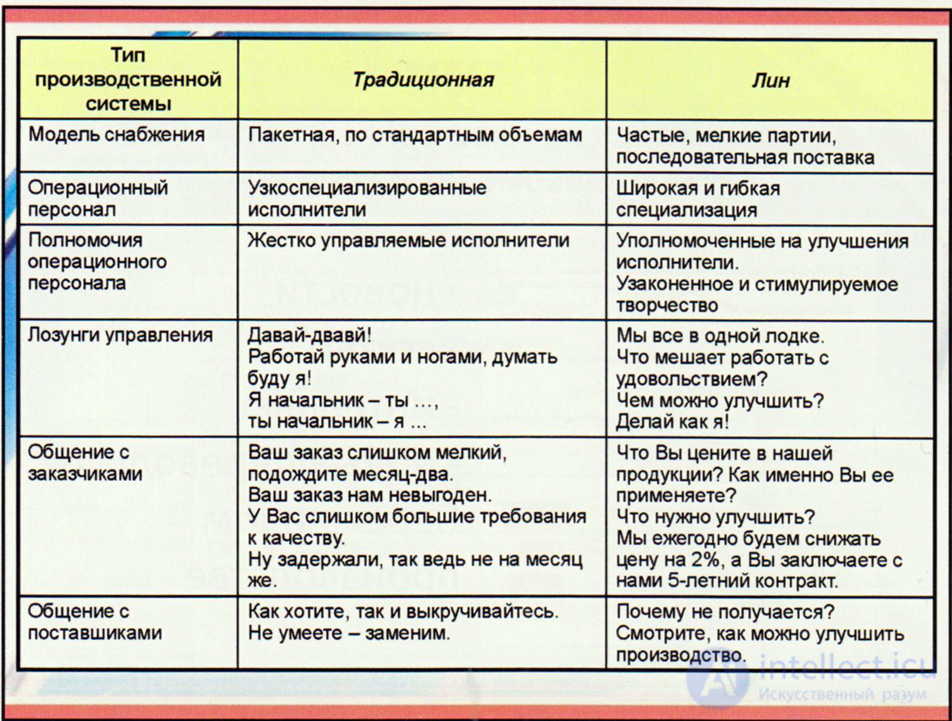
Lean production (Lean production, also Lean manufacturing; Lean means "thin, slim, without fat") is a management concept that, according to researchers J. Womack, D. Jones and D. Ross , was created at the Japanese company Toyota and is based on a relentless drive to eliminate all types of waste. Lean production involves every employee in the process of business optimization and maintains a maximum focus on the customer.
Lean is a breakthrough approach to management and quality management that delivers long-term competitiveness without significant capital investment. Lean production is a system for organizing and managing product development, manufacturing, and relationships with suppliers and customers, in which products are made in exact accordance with customer demand and with less waste than in mass production in large batches.
The goal of the concept of lean production is to eliminate all types of waste and achieve maximum resource efficiency through gradual, continuous improvement of all of the organization's business processes, aimed at increasing customer satisfaction
The goals of lean production are:
Lean production is the American name for the Toyota Production System. The creator of lean production, Taiichi Ohno, began his first experiments in production optimization back in the 1950s. In those postwar years Japan lay in ruins and the country needed new cars. But the problem was that demand was not large enough to justify buying a powerful production line like Ford's. Many different types of vehicles were needed (passenger cars, light and medium-duty trucks, and so on), but demand for any particular type was small. The Japanese had to learn to work efficiently, producing many different models under conditions of low demand for each one. No one had solved such a task before, because efficiency was considered exclusively in terms of mass production. In fact, this is where the term lean was born; it was coined over a mug of beer by John Krafcik, one of the American consultants. After all, what else would you call a system capable of efficiently producing many kinds of products at low unit costs? Lean, that is, "economical".
The starting point of lean production is customer value.
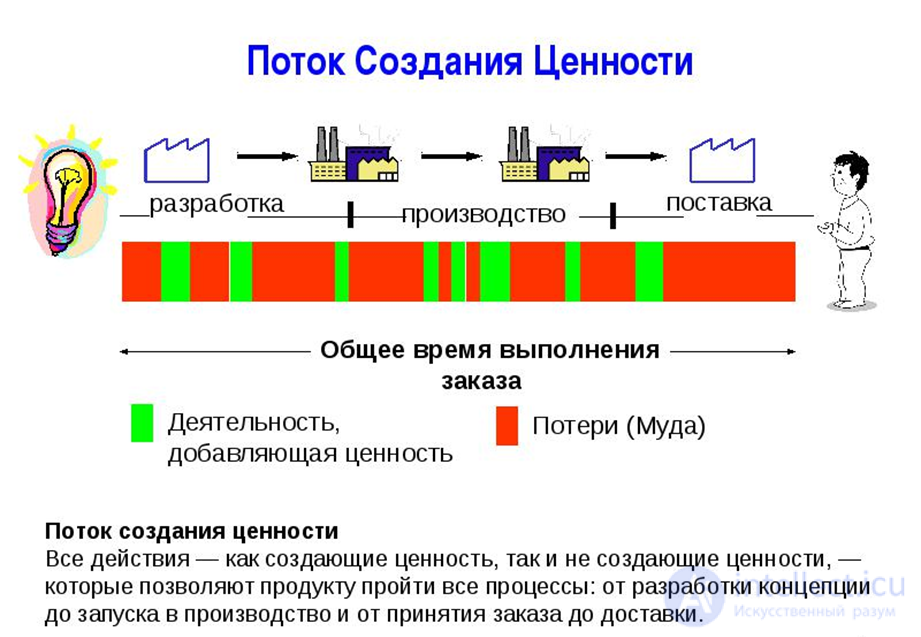
From the end customer's point of view, a product (or service) acquires real value only when the elements of the product (or service) the customer needs are directly processed and/or manufactured. The heart of lean production is the process of eliminating waste, which the Japanese call "muda". Muda is a Japanese word meaning waste, that is, any activity that consumes resources but creates no value. For example, the customer has absolutely no need for the finished product or its parts to sit in a warehouse. Nevertheless, in a traditional management system, warehousing costs, as well as all costs associated with overproduction, shortages and other indirect costs, are passed on to the customer.
According to the concept of lean production, all of an enterprise's activities can be classified as follows: operations and processes that add value for the customer, and operations and processes that do not add value for the customer. Thus, everything that does not add value for the customer is classified, from the lean production point of view, as waste and must be eliminated .
According to the Lean Enterprise Institute, implementing the approaches of the lean production concept reduces, on average: production cycle time by 50%, work-in-process inventory by 60%, rework by 70%, required floor space by 30%, and equipment changeover time by 65%.
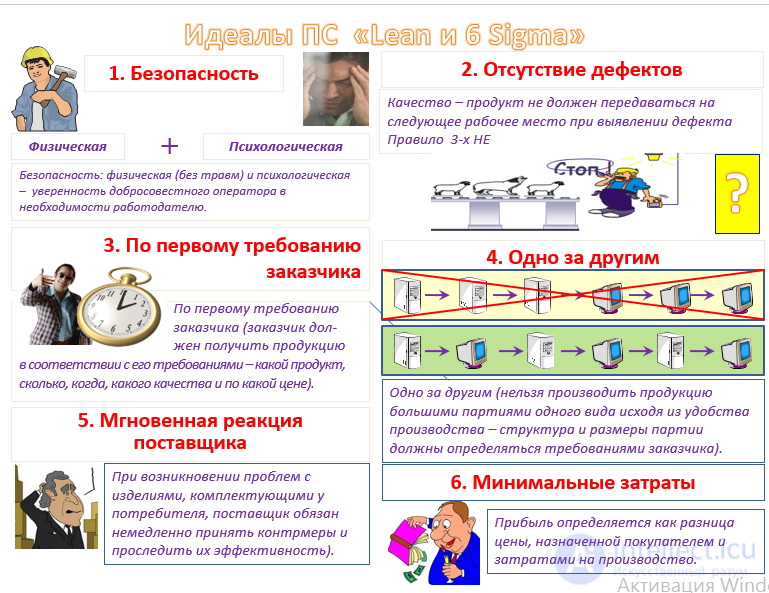
Taiichi Ohno (1912-1990), the founding father of the Toyota Production System and therefore of lean production, who was a fierce fighter against waste, identified seven types of waste:
In total, 7 types of waste
Subsequently, one more type of "muda" was added:
Jeffrey Liker, who together with Jim Womack and Daniel Jones actively studied Toyota's production experience, identified an eighth type of waste in his book "The Toyota Way":
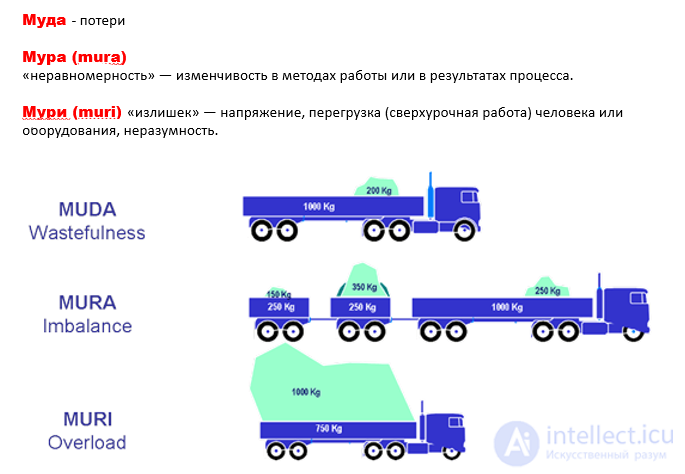
Chet Marchwinski and John Shook point to two more sources of waste, mura and muri, which mean "unevenness" and "overburden" respectively:
In many cases, managers are able to eliminate unevenness by leveling the schedule and paying close attention to the pace of work.
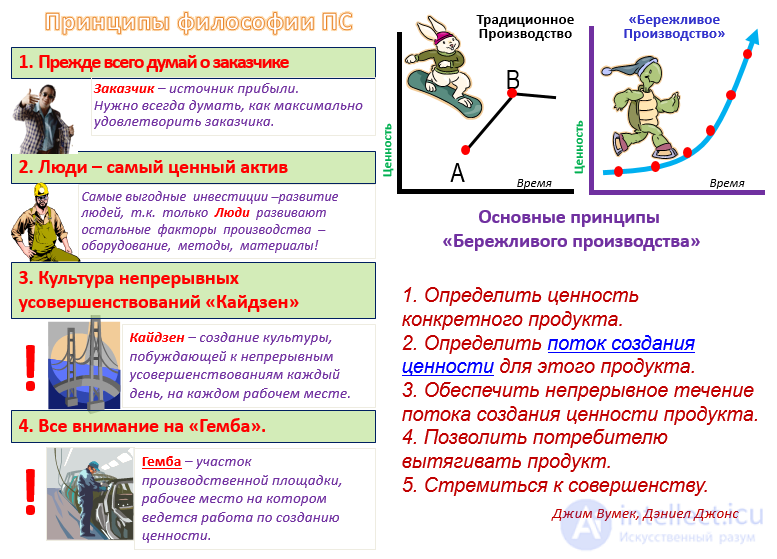
In their book "Lean Thinking: Banish Waste and Create Wealth in Your Corporation", Jim Womack and Daniel Jones set out the essence of lean production in the form of five principles:
Other principles:
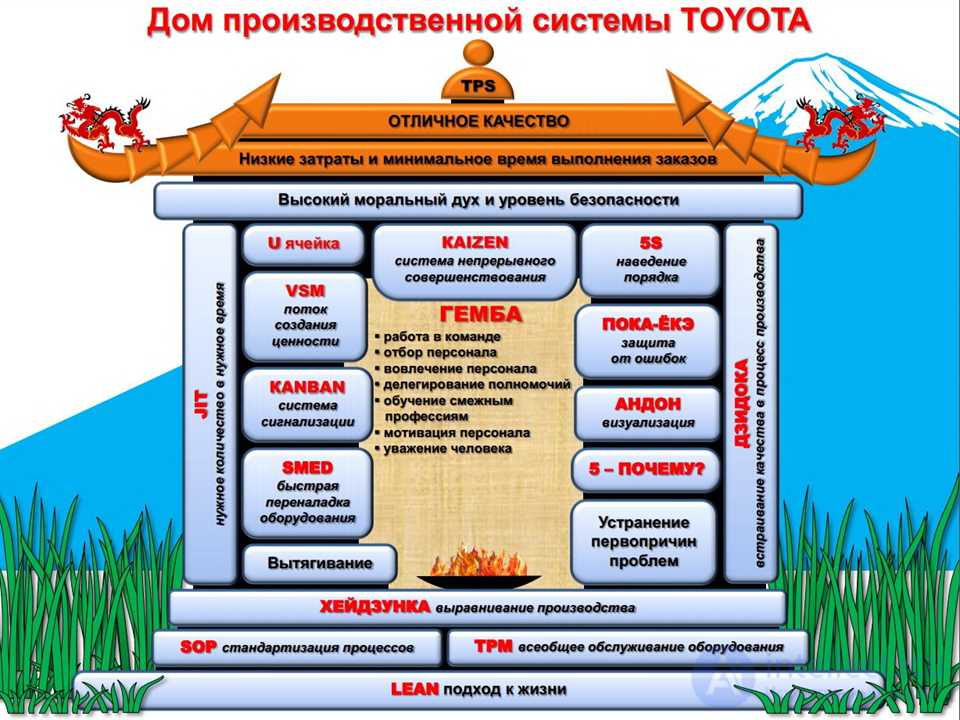
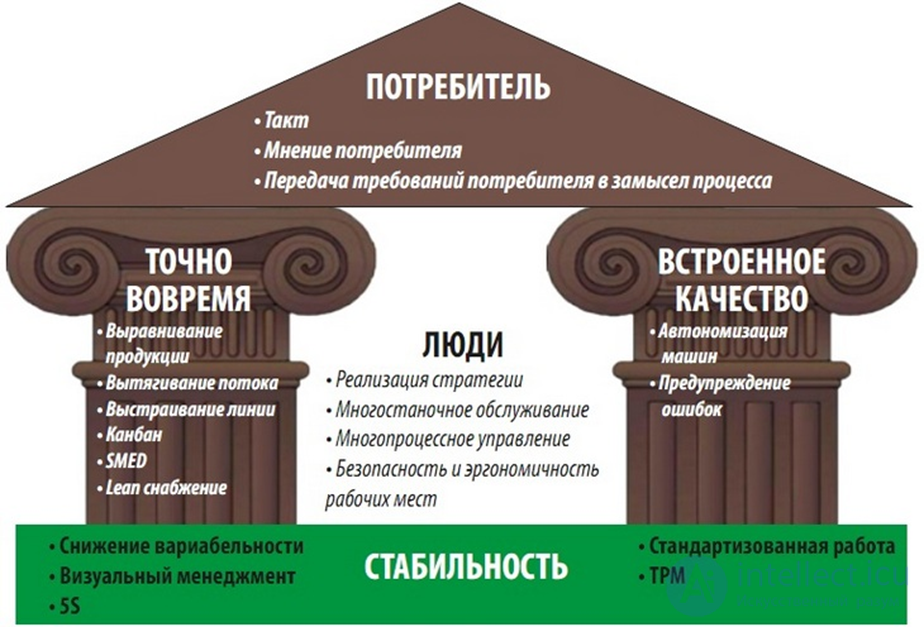
Taiichi Ohno wrote that the Toyota Production System stands on two "pillars": the jidoka system and just-in-time . Just-in-time means "pull", that is, the idea that the next production stage requests the items it needs from the previous one, and until this happens, nothing is produced. Subsequently, consultants identified many elements within the lean production concept, each of which represents a particular method, and some of which (for example, kaizen) themselves claim the status of a concept :
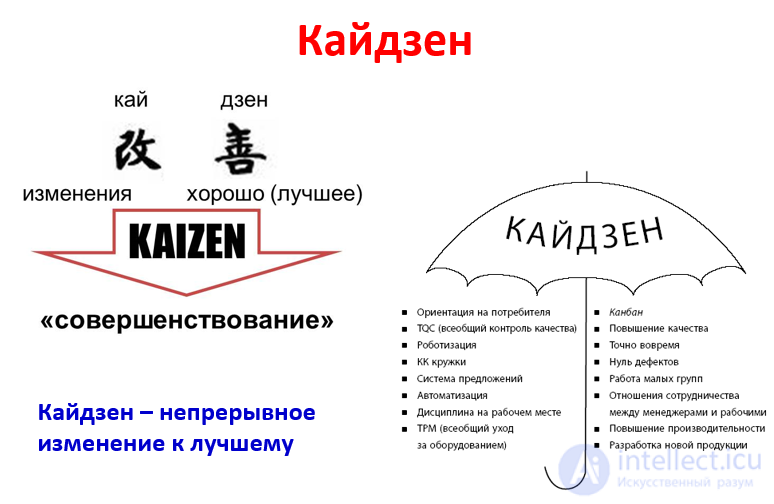
Kaizen is a long-term strategy that involves continuous improvement by every employee, regardless of their functions and position.
"The main role in the production process belongs to people.
A company's competitiveness depends directly on how well its employees are able to detect errors and correct them."
Toshio Horikiri
President of Toyota Engineering Corporation
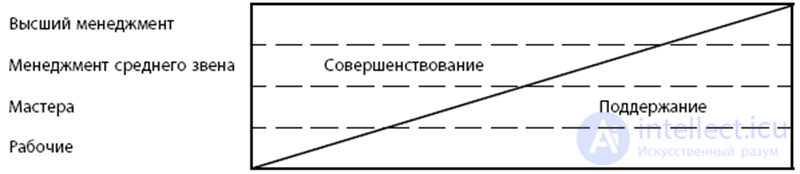
Kaizen and management
The two main components of management are maintenance and improvement.
|
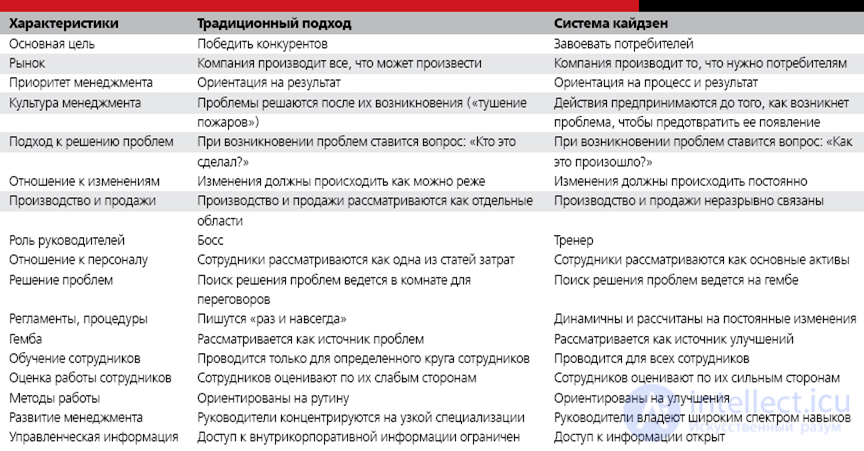
The old image of the employee |
The new image of the employee |
|
Working "from bell to bell", painfully waiting for the workday to end. |
Doing quality work and making rational use of one's skills. |
|
Discussing with others the "hard life", foolish bosses, inflated quotas, and a small salary. |
Observation, analysis, conclusions, discussing problems with colleagues, and a constant search for opportunities to improve. |
|
Working only when explicitly told it is necessary. A complete lack of initiative. |
A desire to understand the essence of the work and its purpose. A wish to feel like a necessary element of the production system. Performing one's functions creatively. |
|
A desire to avoid any responsibility or to "pass the buck" to someone else. |
Conscious responsibility is the key to strong work discipline and stable employment relationships. |
|
No need for training. Training is seen merely as a means of raising one's salary, not of expanding one's capabilities. |
Training is a path to developing abilities and gaining new opportunities, a way to reach a new round of self-improvement and improvement of production. |
The PDCA cycle
Plan
Do
Check
Act
The SDCA cycle
Standardize
Do
Check
Act
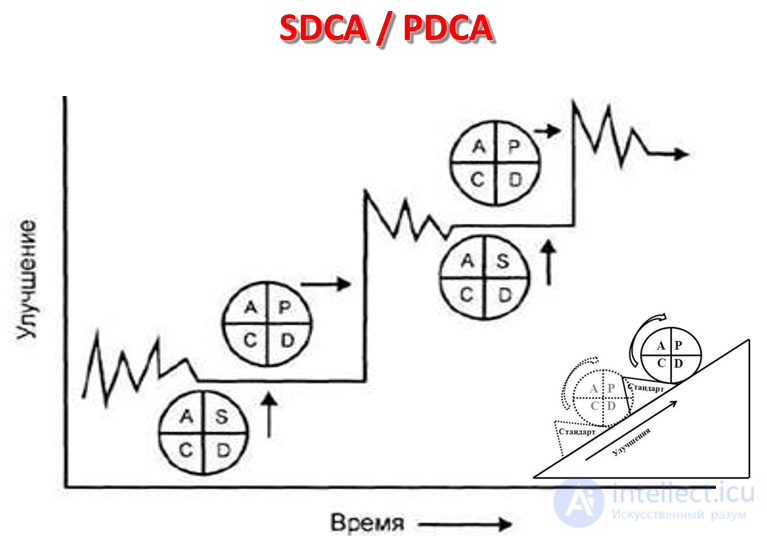
By following the PDCA cycle in your day-to-day activities — when implementing improvements and when planning and carrying out any work — you can significantly increase the efficiency of your work.
It is important to remember that in most cases a rollback in implementing improvements occurs after the second stage (Do), because after the first visible results, a person is left with the false impression that the work is complete, when in fact it is only half done.
As a rule, the work does not get as far as verification, let alone standardization and dissemination of the results
|
Step |
Description of actions |
Result |
|
P |
Plan. At the initial planning stage, we identify the problem as such and describe it, working through all the available information. Or, since in most cases we are pursuing improvement rather than solving problems, we formulate an idea for improving something. Also at the planning stage, all the necessary information is collected: measurable data that characterizes the problem or improvement and can be used to assess how effectively the work was done (whether the problem is solved and the improvement implemented). Information on the causes of the problem is gathered (5 Whys), and the goals of the given improvement are formulated. Priorities are set for the tasks that are most important and most influential for achieving the goal, and a plan for implementing the improvement (a plan for solving the problem) is developed. |
Problems identified Control indicators defined Priorities set for implementing the proposals A plan for achieving the goal developed |
|
Step |
Description of actions |
Result |
|
D |
Do. The next stage consists of carrying out the planned work, as well as continuously monitoring results against the defined indicators. Long work plans can be tracked at short intervals, for example weekly or daily |
Monitoring of plan implementation Monitoring of results against the indicators |
|
Step |
Description of actions |
Result |
|
C |
Check. The check stage is no less important than all the others, yet in practice there are constant examples of it simply being skipped. After getting the first results in the "Do" stage, there is unfortunately a great temptation to relax, celebrate the results, and wait until the situation returns to its initial state. This must not be allowed under any circumstances. At this stage, the achievement of goals should be assessed based on an analysis of the indicators. If the values of the established indicators are not reached for some reason, then there is an error in the previous stages: the action plan was drawn up incorrectly or was not fully implemented. If such discrepancies are found, it is necessary to return to the planning stage and go through the cycle again. Also at the check stage, deviations from the plan are analyzed, the discrepancies that have arisen are eliminated, and problems are resolved. Once a positive result is achieved, the work is formally completed and a report is prepared. |
Assessment of goal achievement against the indicators Analysis of deviations from the indicators Report on the results of the work performed |
|
Step |
Description of actions |
Result |
|
A |
Act. The "Act" stage is sometimes translated as "implement", "standardize", etc., but the wording "act" is more accurate in terms of understanding. At this stage, the execution of the plan and the achievement of the goals set at the planning stage are confirmed. If the goals are successfully achieved, the results are standardized; otherwise, a new way of solving the problem or implementing the idea is sought. Also at this stage, the implemented solutions are rolled out to other areas, processes, workplaces, and so on. |
Checklist for evaluating results Standardization when results are successful Rollout to other areas |
Overall, applying lean manufacturing principles can deliver significant benefits. Prof. A. S. Vikhansky asserts that using lean tools and methods makes it possible to substantially improve enterprise performance and labor productivity, raise product quality and strengthen competitiveness without significant capital investment. .
Taiichi Ohno is considered the founding father of lean manufacturing. He began working at Toyota Motor Corporation in 1943, integrating the best practices from around the world. In the mid-1950s he began building a distinctive system of production organization, called the Toyota Production System (TPS). The Toyota system became known in its Western interpretation as Lean production, Lean manufacturing, or simply Lean. A significant contribution to the development of lean theory was made by Taiichi Ohno's associate and assistant, Shigeo Shingo, who created, among other things, the SMED method. . The ideas of lean manufacturing had been voiced earlier by Henry Ford, but business did not embrace them because they were far ahead of their time. The world's largest companies successfully use Toyota's experience: Alcoa , Boeing , United Technologies ( USA ), Porsche ( Germany ) and many others. The first person to spread the philosophy of Kaizen around the world was Masaaki Imai . His first book, "Kaizen: The Key to Japan's Competitive Success", was published in 1986 and translated into 20 languages.
The lean concept was first applied in discrete manufacturing industries, above all in the automotive industry. It was then adapted to continuous production, and later to retail , services, utilities, healthcare, the armed forces and the public sector.
Gradually, lean manufacturing has moved beyond the enterprise. Lean is now used to optimize services, the interaction between customer and supplier, and the processes of product delivery and servicing. The spread of Lean ideas is helped by regular international and regional conferences, many of which are held on the initiative of the Lean Enterprise Institute (USA) and the Lean Enterprise Academy ( England ). In many countries the spread of lean manufacturing receives government support. In a period of intense competition and deepening crisis, enterprises around the world have no other path than to use the best management technologies in the world to create products and services that satisfy customers as fully as possible in terms of quality and price.
Lean in healthcare. According to expert estimates, roughly 50% of medical staff time is not used directly to meet patients' needs . There should be a shift to personalized medicine , in which the patient receives care "at the right moment and in the right place". Medical facilities should be arranged so that patients do not have to spend time on numerous trips and waiting in other places. At present this leads to significant financial costs for patients and reduced treatment effectiveness. In 2006, on the initiative of the Lean Enterprise Academy ( United Kingdom ), the first conference in the EU on implementing Lean in healthcare took place .
Lean postal service. In the Danish postal service , as part of lean manufacturing, large-scale standardization of all the services offered was carried out to raise labor productivity and speed up mail delivery. To identify and control postal services, "current-state value stream maps" were introduced. An effective incentive system for postal employees was developed and implemented.
Lean logistics . The synthesis of logistics and the Lean concept made it possible to create a pull system that unites all the firms and enterprises involved in the value stream, in which inventory is replenished in small batches. Lean logistics uses the Total Logistics Cost (TLC) principle.
Lean office. Lean methods are increasingly used not only in manufacturing but also in offices ( lean office ), as well as in local and central government bodies. [10]
Lean home. Using Lean technology in everyday life makes it possible to make daily living environmentally friendly and to reduce energy consumption to a minimum. The passive house is a typical example of lean living. A passive house, or more precisely an energy-efficient house, is a house in which heating costs are about 10% of normal energy consumption, which makes it practically energy independent.
Lean construction is a Lean management strategy in the construction industry aimed at improving the efficiency of all stages of construction.
Lean software development is the adaptation of Lean principles to software development.
Seven main types of mistakes have been identified: [11]
Today lean manufacturing is used by almost 100% of Japanese companies, 72% of US companies, 56% in the United Kingdom, 55% in Brazil, 42% in Mexico, whereas in Ukraine only a handful of companies practice lean manufacturing. [12]
Lean manufacturing is impossible without a lean culture. What matters most in it is the human factor and teamwork. Substantial support for this is provided by the emotional intelligence (EQ) of employees , which is developed through coaching . A particular corporate culture also corresponds to a Lean culture .
1. Sort
Remove unneeded items
2. Set in order: create "homes" for everything needed
Define a place for everything
3. Shine: keep things clean
Clean thoroughly enough to allow careful inspection
4. Standardize
Create 5S standards
5. Sustain and improve
Maintain and encourage improvements
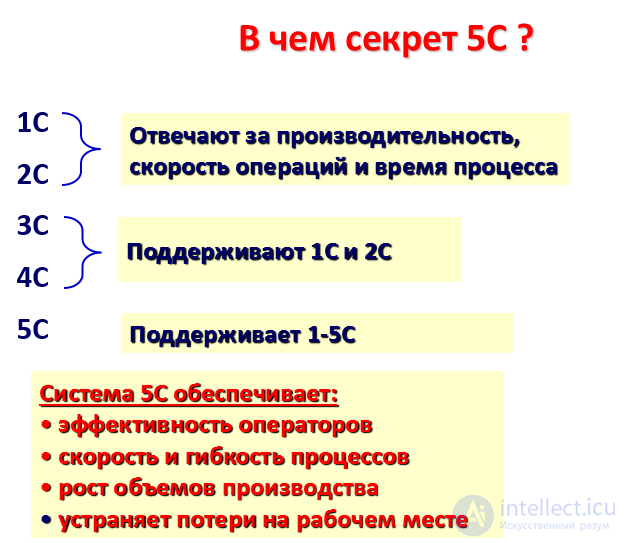
Why do we need 5S?
Lean Manufacturing Terminology
Production cycle time is a metric that reflects the speed and throughput of the flow under consideration, i.e. how quickly raw material (a blank, etc.) entering the flow passes through it and comes out as a finished product. The main measure of flow speed is the amount of work in process (inter-operation inventory), which is converted into minutes and seconds in calculations. The main factor limiting flow speed is a large amount of work in process (inventory), while the fastest and correspondingly most economical is a leveled one-piece flow.
The stop line principle is a stopping principle, or, translating the name literally, "line stop". Implementing the "stop line" principle makes it possible to minimize losses, or more precisely, to stop in time the damage they could cause. The emergence of this principle, like many others, was made possible by Toyota, which was the first to give operators the right to stop the conveyor in the event of a defect, a serious malfunction, or a situation threatening workers' health. Stopping the flow requires the quality issue to be resolved.
Autonomation (jidoka) is the introduction of human intelligence into machines that can independently detect the first defect, then stop immediately and signal that help is needed.
Visual inspection — an assessment of product quality by means of examination or by touch.
Queue time — the time a product or service sits idle in a queue waiting for the next stage of production or design, document processing or a phone call.
Lead time — the time from placing an order to its fulfillment and delivery to the customer.
Takt time — the interval or frequency at which the customer demands the ordered product from the supplier (manufacturer). Takt time sets the pace of production, which must match the actual demand exactly.
Cycle time — the time an operator needs to perform all of their actions before repeating them again. When the cycle time of every operation in the process becomes exactly equal to the takt time, one-piece flow is achieved.
Value-added time — the time of operations or actions that give a product or service the properties the customer is willing to pay for.
Production cycle time — the time it takes a product, material or workpiece to pass through the process or value stream, from the start of the first production operation to the end of the last.
Total Productive Maintenance (TPM) — a set of philosophy, methods and tools aimed at keeping equipment constantly operational in order to ensure the continuity of production processes.
Pull — a production system in which an upstream supplier (or internal supplier) produces nothing until the downstream customer (or internal customer) signals a need for it. The opposite situation is called push. See also Kanban.
Production leveling (also called production smoothing, heijunka) — a production system aimed at smoothing out peaks and troughs in production load and at eliminating overproduction. It is closely linked to production sequencing and line balancing. It is used to level production by product type and volume over a fixed period of time.
Push — a system of producing items and "pushing" them to the next operation without regard for the customer's needs. The opposite of pull.
Gemba — the enterprise, shop floor, area or place where a physical product is made (where value for the customer is directly created). It can also be an office where services are provided or development work is carried out.
Jidoka — see autonomation.
Spaghetti chart (spaghetti diagram) — the path a product (or operator) traces as it moves through the value stream. The name arose because this path is completely chaotic and resembles a plate of spaghetti.
Road map — a step-by-step plan of action for achieving a specific goal or solving a current problem.
Pacemaker process — any process in the value stream that sets the pace for the entire stream. As a rule, it is located closer to the "customer end" of the value stream. An example is the final product assembly line.
Inventory — an accumulation of materials waiting to be processed or moved between the processes (stages) of the flow. Physical inventory is classified by its location in the value stream and by its functional purpose.
Inventory by location: raw materials, supplies, work in progress, finished goods.
Inventory by purpose: buffer, safety, shipping.
Buffer inventory — intended to keep the production process running continuously in the event of an unplanned increase in demand for the parts concerned.
The inventory level is calculated by analyzing statistics on deviations (maximum downtime of production areas) caused by unplanned increases in demand for parts.
Safety inventory (reserve inventory) — intended to keep the production process running continuously in the event of unforeseen circumstances: equipment failure, delivery of defective products, delays in transit, and so on. The level is calculated by analyzing the customer's maximum downtime (usually over 3 months) caused by the supplier's failure to deliver parts or by a defective shipped batch.
Shipping inventory — products located at the end of the production line and prepared for dispatch to the customer.
Activity-based costing (ABC) — a management accounting system that attributes product costs on the basis of the quantity of resources used (including production space, raw materials, machines, equipment and labor) in designing, ordering and manufacturing that product.
Kaizen — continuous improvement of operations with the involvement of all personnel in ongoing work to reduce waste (muda), embodied in concrete forms, methods and technologies and oriented toward people.
Kaikaku — a radical (fundamental) improvement of a process aimed at achieving a set goal or eliminating waste (muda).
Kanban — Japanese for "card" or "signboard". A tool of the pull system that gives the instruction to produce or withdraw (transfer) items from one process to another. It can take the form of tags, cards, containers or electronic messages. It is used in the Toyota Production System to organize pull by informing the preceding production stage that it needs to start work.
Value stream mapping, VSM — the process of studying and visually depicting the material flow and the accompanying information flow during value creation, as materials move through the processes from supplier to customer.
The process consists of the following steps: 1. Selecting a stream. 2. Describing the current state of the stream. 3. Describing the future state of the stream. 4. Drawing up a plan (road map) for achieving the future state of the stream.
Milk run — a parts delivery system (for example, for repairs) in which a truck that constantly follows the same route can stop at certain points and deliver a part that is needed.
Coaching — a training methodology built on the principle of "learning by doing." The method comes down to a more experienced mentor creating opportunities for the learner to acquire the necessary knowledge on their own, rather than through the direct transfer of knowledge from teacher to student. The system helps people and enterprises achieve their goals. A coach is an instructor, teacher, or trainer who has mastered and applies coaching methods.
Overall Equipment Effectiveness (OEE) — the key indicator of the Total Productive Maintenance system, reflecting how effectively equipment is used.
Red tags — a tool for visualizing problems and anomalies at the Gemba (or in the office), used in the form of cards that may show: the sequential number of the problem (from the list of problems); the date the tag was placed; the full name of the employee who identified the problem, or any other information relevant to the problem. Red tags are traditionally used in the first step of 5S (the Five "S") to mark unnecessary items in the work area and in storage locations.
Multi-machine working — work in which a single operator runs several machines of different types at once, and also carries out training and equipment maintenance.
Monument — any object (machine) or process whose scale (size) is such that incoming parts, projects, or orders have to wait in a queue to be processed. A monument, as a rule, serves more than one value stream, with a long order lead time and slow changeover, and works in large batches.
Muda — see Waste.
Mura, or "unevenness" — variability in work methods or in process results.
Muri, "excess" — strain and overburden (overtime work) of people or equipment; unreasonableness.
Work-in-progress (WIP) — materials and goods located between stages and within processing (value-adding) operations.
Continuous flow — organizing the work of a material flow on a "one after another" or "hand to hand" principle, without stops or interruptions.
Obeya (from Japanese, "room" or "space") — a project management tool that promotes effective and fast communication and is actively used at the development stage. It works on the principle of a "war room," with extensive use of visualization and teamwork.
Greenfield (primary production) — setting up a newly created production operation at a new, relatively isolated site that has not previously been used for production purposes ("in an open field"). The opposite of brownfield (secondary production), which is set up at a site where production was previously carried out ("plowed land").
Operation — an action (or actions) performed by one machine on one product; differs from a process.
Batch-and-queue — a mass production practice. It consists of making large batches of parts, which are then placed in a queue for the next operation in the production process. Differs from single-piece flow.
Changeover — installing a new type of tool on a metalworking machine, changing the paint in a dyeing unit, loading a new batch of plastic and changing the mold in an injection molding machine, installing new software on a computer, and so on. The term is used whenever equipment must be prepared to produce a different type of product (perform a different job).
Material Requirements Planning (MRP) system — a computerized system used to determine the quantities of materials and the times when they will be needed in production. The MRP system uses: the master production schedule; a bill of materials listing everything required to produce each product; and information on the current inventory levels of those materials, in order to draw up a schedule for production and delivery of each of them. Manufacturing Resource Planning (MRP II) extends MRP by making it possible to plan equipment production capacity, optimize financial flows, and model and evaluate different variants of production plans. The MRP system is a push-type system.
Poka-yoke — "mistake-proofing" — a special device or method that makes it simply impossible for a defect to occur. Another name for poka-yoke is baka-yoke — "fool-proofing."
Value creation flow indicators — a set of performance metrics that the flow team measures and uses to monitor improvement activity on the flow in the short and long term.
Waste (muda) (synonym: Muda) — any activity (or condition) that consumes resources but does not create value for the customer.
There are seven main types of waste: overproduction of materials or information (when demand for them has not yet arisen); waiting for the next production stage; transportation of materials or information; excess processing steps (required because of equipment shortcomings or process imperfections); holding any inventory beyond the minimum necessary; motion of people during work (for example, in search of parts, tools, documents, help, etc.); and production of defects.
Employees' creativity waste — the source of all forms of waste; it is the most difficult to assess, but it is key to building a system of continuous improvement of operations.
Flow — the movement of materials and information as they are transformed into a product or service for the customer. Wherever there is a product (service) for the customer, there is a flow. Any activity can be transformed into a flow.
Single-piece flow — a method of working in which a machine or process (for example, design, order entry, or production) handles no more than one item at a time. Differs from the batch-and-queue method.
Value stream — all the actions currently required to convert raw materials and information into a finished product or service.
Right-sized tool — an object (a design, planning, or production tool) that fits easily into the production flow within a single product family, so that waste from unnecessary transportation or waiting no longer occurs. Differs from a Monument.
Product line — a set of products or items that, within the chosen flow boundaries, follow the same path and sequence of processes. This set consists of items with similar characteristics and similar parameters (cycle time) for passing through similar processes.
Process — a series of individual operations (actions) by which a project is created, an order is processed, or a product is manufactured.
Process villages — places where equipment of the same type is grouped or similar processes are carried out, for example, where grinding machines are located or order processing takes place. In contrast to cells.
Five whys — a method of finding the cause of any problem, in which, to find the root cause of the problem, one must ask "why?" at least five times, and in particularly complex situations more than five times. Only after the root cause of the problem has been determined can one begin to develop and implement measures to eliminate (solve) the problem. This requires observing the principle that the problems lie not in people but in processes and the system. A solved problem is a problem that never recurs.
Five Ss (Five Ss, 5S, the 5S system) — a system for organizing the workplace (workspace) effectively, based on visual control. It includes five principles, each of which begins with the letter "S".
Sort (seiri) — separate the necessary tools, parts and documents from the unnecessary ones so that the latter can be put away (removed).
Set in order (seiton) — arrange (and label) parts and tools in the workplace so that they are convenient to work with.
Shine (seiso) — keep the workplace clean, above all to identify and eliminate problems as early as possible.
Standardize (seiketsu) — perform the first three Ss regularly, every day, to keep the workplace in excellent condition.
Sustain and develop (shitsuke) — make performing the first four Ss a habit, a routine part of the work.
Policy deployment — see hoshin kanri.
Production smoothing — see production leveling (heijunka).
Level selling — a system of long-term relationships with the customer, aimed at obtaining information from them about future purchases, which allows production to be planned better and thereby eliminates unexpected sales "spikes".
Product family — a set of products that can be produced one after another in a production cell. Products in the same family are said to be made on "one platform".
Sensei — a teacher, a master in a particular field (in this case, in the field of lean production).
Perfection — the complete absence of waste (muda), so that all activities in the value stream truly create value.
Standard costing — a cost accounting system in which costs are charged to a product based on the number of machine-hours and labor-hours spent by the entire production over a certain period of time. Standard costing encourages managers to produce unneeded products or the wrong mix of products in order to minimize the unit cost of a product through full utilization of machines and workers.
Standard (in the Lean concept) — unlike traditional approaches, a standard is the best way of performing an activity, using methods that are the most effective in terms of reducing waste, ease of execution and speed of work. These methods are tested in practice in advance, set out clearly in a simple and understandable form using visualization tools, and communicated through training to all employees who perform the activity.
In the ordinary sense, a standard (from the English standard — norm, model) is a model or reference taken as a baseline for comparison with other similar objects, and not always the best one.
Standardization — a production management system that involves all personnel and uses a set of rules, actions and procedures aimed at identifying and eliminating waste, as well as at creating a system of continuous improvement in a company's operations. In the ordinary sense, a standard is the process of describing (on paper) and formalizing procedures and processes in a company's activities.
Standard work — a tool for analyzing and understanding waste during an operation (process). It is an exact description of each action, including cycle time, takt time, the sequence in which particular elements are performed, and the minimum amount of inventory needed to do the work.
Standard Operating Procedures, SOP — documents describing the steps (elements) of a procedure that must be followed. They usually consist of text, graphics/drawings and photographs that make the procedure easier to understand.
Statistical Process Control (SPC) — the use of statistical tools to help control the quality of an operation.
Supermarket (dispatch area, warehouse, staging area, rack) — an organized pull-based inventory management system that uses the Kanban tool and a fixed (standardized) stock level with a set minimum and maximum.
Raw materials — material assets held at the enterprise (in processes) that have not undergone processing.
Just-in-time (JIT) — a system in which items are produced and delivered to the right place at exactly the right time and in the right quantity. The key elements of a just-in-time system are flow, pull, standard work (and a standard level of work in process) and takt time. JIT systems eliminate idle time and the accumulation of materials between operations.
Transactional processes — processes in which the transfer of materials, knowledge, information or services takes place between two individuals or between an individual and equipment. Most processes that do not involve manufacturing products usually fall into this category.
Front loading — feeding and unloading materials on a production or service line from the operator's front side. It removes the need for the operator to turn around to pick up and move parts.
Blitz breakthrough (kaizen blitz) (Rapid Improvement of Processes, RIP) — a lean production tool used to achieve immediate results in improving target performance indicators at a specific production area. The tool is applied through hands-on week-long events at the production site and involves radical (physical) changes to the layout of the area and/or the organization of the process.
Hoshin kanri (hoshin kanri) (synonym: policy deployment) — a method by which top management develops a company management strategy, in which resources are directed toward the goals that are a priority for the business. Using a system of tables and/or a matrix diagram similar to the one used in quality function deployment, three to five key goals are selected and the other goals are ignored. To work on the selected goals, projects are created, and the ways of carrying them out are discussed at a lower management level. Hoshin kanri makes it possible to unify and concentrate resources and to develop specific, measurable indicators by which progress toward the key goals is regularly tracked. Another name for hoshin kanri is policy deployment (policy structuring).
Heijunka (synonym: production smoothing) — see Production leveling.
Value (customer value) — defined by the customer as the correct and expected quality, quantity, price and delivery time. Value is the set of properties of a product or service for which the customer is willing to pay the supplier, because these properties give the customer a subjective feeling that the thing (service) they need has been delivered (provided) in the right quantity, with the right quality, at the right time and in the right place (they produce a feeling of satisfaction).
PDCA cycle (Deming cycle) — a cycle for improving any process or activity. Plan, Do, Check, Act.
SPDA cycle — a cycle for standardizing and stabilizing any process or activity, applied in sequence with the PDCA cycle. Standardize, Do, Check, Act.
Chaku-chaku — a method of implementing continuous one-piece flow in which the operator, moving through the cell from machine to machine, takes the finished part from one machine and loads it into the next, and so on. In Japanese this literally means "load-load".
Cells — an arrangement of equipment and/or operators in relation to one another within a limited area. It is a way of laying out different types of equipment that allows production operations to be performed in a clear sequence without interruptions, without unnecessary transportation, in the smallest possible batches (as a rule, as one-piece flow). The usual cell configuration is in the shape of the letter "U". This arrangement helps organize continuous one-piece flow and flexible allocation of people (one operator can serve several machines at the same time). materials or information; unnecessary processing steps (excess processing stage) (required because of equipment shortcomings or an imperfect process); the presence of any inventory beyond the minimum necessary; the motion of people during work (for example, in search of parts, tools, documents, help, etc.); the production of defects. — is the process of describing (on paper) and formalizing procedures and processes in a company's activities.
[[b8593]]

Comments