
Lecture 4 min.
ARIS (Architecture of Integrated Information Systems) was developed in the 1990s by Professor A.-W. Scheer
The ARIS methodology was developed at IDS Scheer AG, Germany. Today the market for business process modeling tools includes software of the same name, ARIS, which consists of several modules.
The ARIS methodology was developed with the following goals:
The ARIS methodology integrates existing standards and specifications for describing processes and data, for example IDEF3, ERD, DFD, UML, etc.
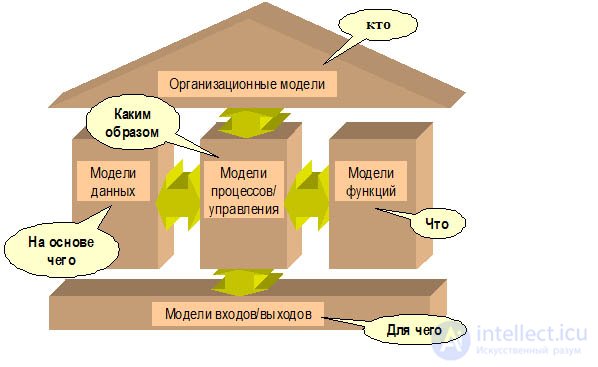
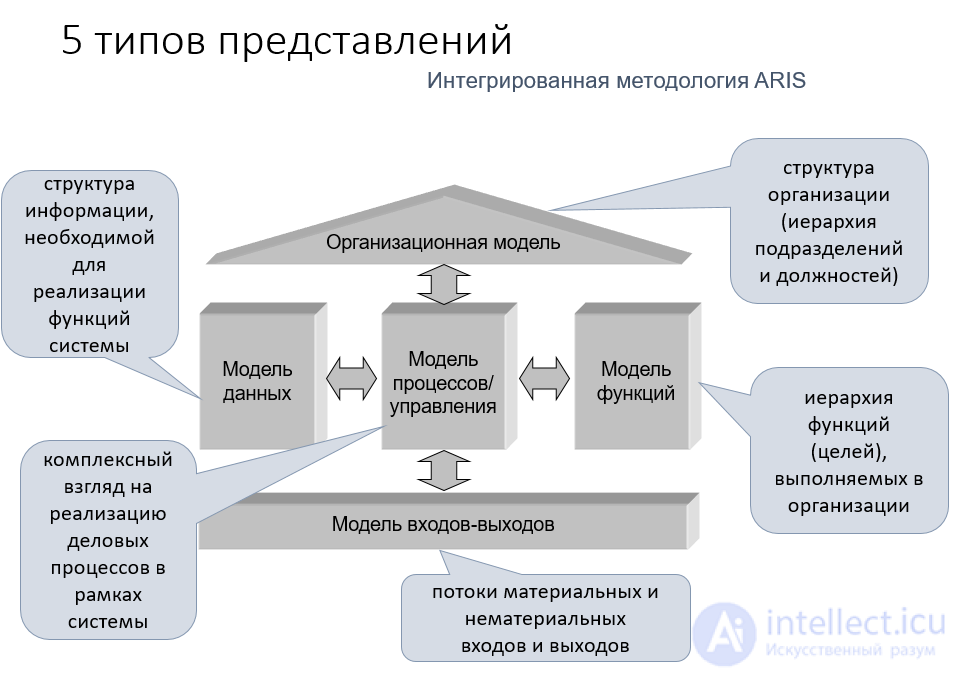
The approach to process description based on the ARIS methodology involves viewing an organization's activities from four perspectives: organizational structure, data (flows and structure), functions (functional hierarchies), and control and management (summary business process models describing inputs and outputs).
The ARIS methodology includes a large number of different notations that allow flexible models of an organization to be created. The most significant and most widely used ARIS notations include:
The advantage of the ARIS methodology (from a formal point of view) lies in its comprehensiveness, which shows in the interrelation of models built in different notations. ARIS makes it possible to describe an organization's activities from different perspectives, and the resulting models will be linked to one another to a certain degree.
The main models used in the ARIS environment are:
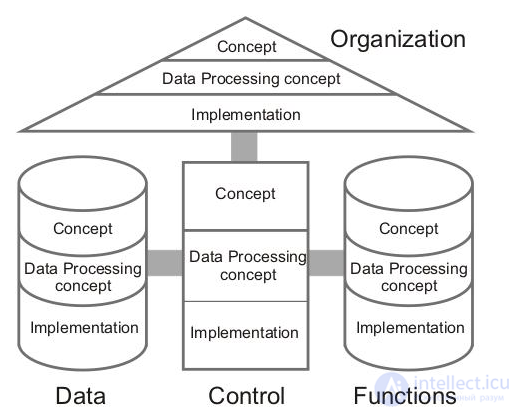
An illustration of the structured ARIS approach to a reengineering project
In the ARIS methodology, any organization is viewed from five perspectives: organizational, functional, data processed, business process structure, and products and services. Each of these perspectives is further divided into three sublevels: requirements definition, design specification, and implementation description. Around 80 types of models are proposed for describing business processes, each belonging to one aspect or another. ARIS provides a visual toolset to make the models easy to grasp. The toolset also ships with a set of reference models developed in advance for typical processes in various industries. The general principle of the toolset is the ability to integrate models of different types within a single repository through decomposition (detailing) of objects. Thus, any organization can be described using a hierarchy of models, from the general level, for example top-level processes using the VACD (value added chain diagram) model, down to the level of procedures and the resource environment of functions.
Among the many possible description methods, the following can be singled out:

Comments