5S, a workplace organization methodology
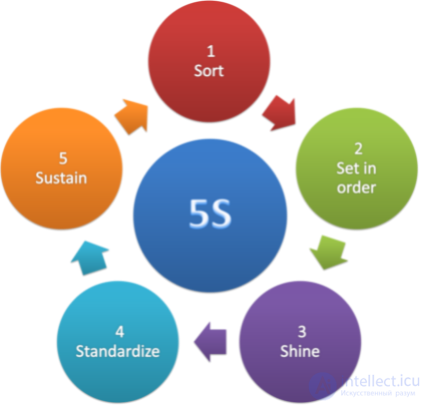
5S is a system for organizing and rationalizing the workplace (work space) and one of the tools of lean manufacturing. It was developed in postwar Japan. It consists of 5 steps:
- Seiri (整理), "sorting" (necessary vs. unnecessary) — clearly separating necessary items from unnecessary ones and getting rid of the latter;
- Seiton (整頓), "setting in order" (orderliness) — arranging and storing necessary items in an orderly and precise way so that they can be found and used quickly and easily;
- Seiso (清掃), "shining" (cleaning) — keeping the workplace clean and tidy;
- Seiketsu (清潔), "standardizing" (establishing norms and rules) — a necessary condition for carrying out the first three rules;
- Shitsuke (躾), "sustaining" (literally, "discipline" or "training") (self-discipline) — instilling the habit of precisely following established rules, procedures and process operations.
The goals of 5S are to reduce the number of accidents, raise product quality and reduce defects, create a comfortable psychological climate and motivate people to work, unify and standardize workplaces, and increase labor productivity by reducing the time spent searching for items within the work space.
The concept implies that every employee of an enterprise — from the cleaner to the director — follows the 5 rules; the main advantage is that these actions do not require the application of new management technologies and theories.
The 5S Steps

In developing the Japanese management system, the work of A. K. Gastev and the Central Institute of Labour (CIT) was used. Diagram "Correct placement of tools" from a CIT leaflet, 1924
Step 1. Sort
All materials, equipment, documents and tools are sorted into three categories:
- always needed — materials that are being used in the work at the moment;
- sometimes needed — materials that may be used in the work but are not required at the moment;
- not needed — defective items, unused tools, containers, foreign objects. During sorting, unneeded items are marked with a "red tag" and then removed from the work area.
Step 2. Set in Order
The placement of items must meet the requirements of:
- safety;
- quality;
- work efficiency.
Four rules for placing items:
- in a visible place;
- easy to take;
- easy to use;
- easy to return to its place.
Step 3. Shine
The work area must be kept perfectly clean.
Sequence of actions:
- divide the line into zones and create diagrams and maps showing workstations and equipment locations;
- designate a special team to which the cleaning zone will be assigned;
- determine when cleaning will take place:
-
- morning: 5–10 min. before the start of the working day;
- lunchtime: 5–10 min. after lunch;
- end of work: after work stops, during downtime.
Step 4. Standardize
This principle requires formal, written codification of the rules for maintaining the workplace, the work technology and other procedures. It is necessary to create work instructions that include a step-by-step description of the actions for maintaining order. In addition, new methods of control and of rewarding outstanding employees should be developed.
Step 5. Sustain
Developing the habit of caring for the workplace in accordance with existing procedures, as well as steadily improving the system itself.
Key points:
- Observing the operation of equipment and the workplace in order to make their maintenance easier.
- Using "before" and "after" photographs to compare what things were like with the final result.
- Organizing audits to assess the effectiveness of the 5S program's implementation.
Implementation
One popular implementation method proposes dividing the rollout into 5 stages :
- learning the principles and adopting the system;
- putting things in order and delegating responsibility;
- regularity of actions and periodic monitoring;
- consolidating procedures and strengthening requirements;
- continuous improvement.
At each stage, the achievement of certain indicators is recorded for each of the five components of 5S, which gives the implementation a systematic form and reduces staff resistance to change. This approach ensures fuller involvement of all employees in the process.

See also
- Ergonomics
- Lean manufacturing
- Kaiden
- Just-in-time
- Japanese aesthetics
- Just-in-time production
- Kaikaku
- Kaizen
- Kanban
- Lean production
- Muda
- Gogyo (traditional Japanese philosophy)


Comments