Vocabulary (lexis) is the branch of linguistics that studies the lexical stock of a language, that is, the set of words and lexical units used in a given language. Lexis is concerned with words, their meanings, their structure, and the ways new words are formed in the language. Lexis (from Ancient Greek τὸ λεξικός "pertaining to a word; word; turn of speech") is the lexical stock of a language, the totality of words (more precisely, lexemes) of a particular language or part of a language. Vocabulary is the central part of a language, naming, shaping and conveying knowledge about objects and phenomena. Vocabulary is studied by the science of lexicology, as well as by semasiology and onomasiology.
Here are some key aspects related to vocabulary:
-
Lexical units: Vocabulary includes all the words and expressions that exist in a language. These may be individual words (for example, "дом" (dom, 'house'), "солнце" (solntse, 'sun')), as well as phrases, idioms and other lexical units.
-
Word meanings: Lexicology studies the meaning of each word in the context of the language. Meaning may be lexical (semantic), grammatical (how the word is used in a sentence) and stylistic (what associations the word evokes).
-
Morphology: Vocabulary is also related to morphology, that is, to the formation and inflection of words. This includes affixation (prefixes and suffixes), conjugation and declension of words.
-
Dictionary databases: Vocabulary includes dictionary databases that contain information about words, their pronunciation, meaning, grammatical characteristics and examples of usage.
-
Semantics: The study of semantics, that is, of word meanings and their relations to one another, is also important for lexicology. This includes synonymy (words similar in meaning), antonymy (words opposite in meaning) and many other aspects.
The systematic nature of vocabulary is manifested not only in the fact that its units can be distributed into semantic fields (cf. the designation of time, space, color, motion, kinship, etc.), categorial classes (classes of polysemous words, synonyms, antonyms, etc.), and oppositions such as native ~ borrowed, active ~ passive, common ~ restricted, neutral ~ stylistically marked, etc., but also in the very character of the use of lexical units, which has its own regularities. What draws attention first of all is that lexical units that are identical or close in content and belong to one semantic field or class are used in the same or a fairly similar way, showing fully or substantially coinciding collocability with other words, cf., for example, full and partial synonyms: "орфография" — "правописание" (orfografiya — pravopisaniye, 'orthography' — 'spelling'), "друг" — "товарищ" (drug — tovarishch, 'friend' — 'comrade'). By contrast, words with meanings far removed from each other, for example "необходимость" (neobkhodimost', 'necessity') and "барабан" (baraban, 'drum'), do not show a common characteristic collocability.
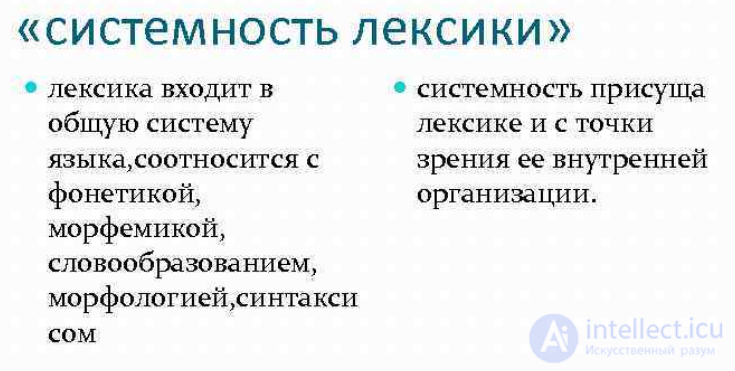
FEATURES OF THE SYSTEMATIC NATURE OF VOCABULARY
- Divisibility of the system as a whole into sets that have an internal organization and can themselves be divided.
- Semantic connections and interactions between the words belonging to these sets.
- Connection and interaction of the lexical groups themselves.
- Organization of lexical-semantic groups (LSG) according to a systemic principle
SYSTEMIC CONNECTIONS OF THE WORD
Word – class of words
From the standpoint of origin
- Native Russian words
- Borrowed words
From the standpoint of sphere of use
- Common vocabulary
- Vocabulary of restricted use
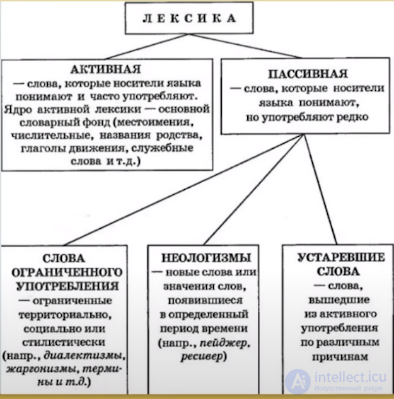
From the standpoint of active and passive vocabulary
- Active vocabulary
- Passive vocabulary
From the standpoint of stylistic differentiation
- Neutral vocabulary
- Stylistically marked vocabulary
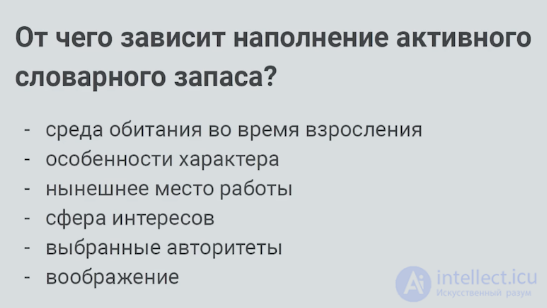
Figure: dependence of the growth of the active vocabulary
Word – word
- Syntagmatic relations
- Derivational relations
- Paradigmatic relations
Layers of vocabulary
The vocabulary of every language consists of two large layers: common vocabulary (understood by all native speakers of the language, also known as the standard language) and special vocabulary, within which the following can be distinguished:
- Professional terminological vocabulary, used to describe activities, work situations and phenomena in a particular professional field.
- Socially restricted (social dialect) vocabulary: jargon (argot and slang).
- Territorial dialect words, or dialectisms (words current in a particular part of the language's area of distribution).
- Obsolete words: historicisms and archaisms.
etc.
Stylistic differentiation of vocabulary
Stylistically, vocabulary is divided into neutral and stylistically marked. Stylistically neutral words make up the greater part of the vocabulary and can be used in texts of any style. Stylistically marked vocabulary is usually used only in certain situations, and in others appears inappropriate or even incomprehensible. Thus, for example, there is vocabulary characteristic of the scientific, colloquial and official-business styles, as well as vernacular and obscene vocabulary, etc .
Phraseological units
A special layer of the language consists of phraseological units: fixed word combinations that are syntactically a single whole, which may be nominal (железная дорога (zheleznaya doroga, 'railway', lit. 'iron road'), золотой запас (zolotoy zapas, 'gold reserve')), verbal (пить горькую (pit' gor'kuyu, 'to drink heavily', lit. 'to drink the bitter'), шить дело (shit' delo, 'to frame someone', lit. 'to sew a case')) or adverbial (спустя рукава (spustya rukava, 'carelessly', lit. 'with sleeves down'), забегая вперёд (zabegaya vperyod, 'running ahead', i.e. 'anticipating')). Phraseological units also include fixed phrases: proverbs (без труда не выловишь рыбку из пруда (bez truda ne vylovish' rybku iz pruda, 'without effort you cannot even pull a fish out of the pond')), sayings and catchphrases, as well as speech stereotypes and clichés .
Vocabulary in terms of the plane of content
In terms of the plane of content, vocabulary has the following subdivisions:
- Content words (having a nominative function and serving as members of a sentence) and function words (lacking such functions, for example prepositions, conjunctions, particles, articles, etc.)
- Concrete words (having referential meaning) and abstract words (having generalized meaning).
- Synonyms: words that sound different but have a similar meaning, for example лавка (lavka, 'bench; shop') and скамья (skam'ya, 'bench'), большой (bol'shoy, 'big') and огромный (ogromnyy, 'huge').
- Antonyms: words having opposite meanings: большой (bol'shoy, 'big') and маленький (malen'kiy, 'small').
- Hyponyms and hypernyms: words whose lexical meanings stand in a species-genus relation: кошка (koshka, 'cat') → млекопитающее (mlekopitayushchee, 'mammal') → животное (zhivotnoe, 'animal').
Vocabulary in terms of the plane of expression
In terms of the plane of expression, the following can be distinguished in vocabulary:
- Homonyms: words pronounced and spelled identically but unrelated in meaning: коса (kosa, 'braid', a type of hairstyle), коса (kosa, 'scythe', an agricultural tool), коса (kosa, 'spit', a narrow strip of land surrounded by water).
- Homographs: words spelled identically but pronounced differently: за́мок (zámok, 'castle') and замо́к (zamók, 'lock').
- Homophones: words pronounced identically but spelled differently: плот (plot, 'raft') and плод (plod, 'fruit').
- Homoforms: different grammatical forms that coincide in pronunciation and spelling: мой (moy, 'my', belonging to me) and мой (moy, 'wash!', the imperative of the verb мыть (myt', 'to wash')).
- Paronyms: words similar in outward form but having different meanings: экономный, эконом (ekonomnyy, ekonom, 'thrifty, steward')
Lexical-semantic relations
- polysemy: the relation between different but interconnected meanings of one word
- polysemy based on similarity: metaphor
теплый приём (teplyy priyom, 'warm reception'), стена дождя (stena dozhdya, 'wall of rain'), копна волос (kopna volos, 'mop of hair'), глазное яблоко (glaznoe yabloko, 'eyeball', lit. 'eye apple')
- polysemy based on contiguity: metonymy
for example:
- author of a work – the work (А. С. Пушкин умер в 1837 г. – читать Пушкина (A. S. Pushkin umer v 1837 g. – chitat' Pushkina, 'A. S. Pushkin died in 1837 – to read Pushkin'))
- container – contents (светлый класс – класс слушал учителя (svetlyy klass – klass slushal uchitelya, 'a bright classroom – the class listened to the teacher'))
- material – an article made of it (золото высокой пробы – завоевать на Олимпиаде золото (zoloto vysokoy proby – zavoevat' na Olimpiade zoloto, 'high-carat gold – to win gold at the Olympics'))
- synecdoche: part for whole and whole for part (взять ракетку – первая ракетка страны; закрыть рот – в семье семь ртов (vzyat' raketku – pervaya raketka strany; zakryt' rot – v sem'e sem' rtov, 'to pick up a racket – the country's top racket [player]; to shut one's mouth – there are seven mouths [people to feed] in the family'))
- homonymy – the relation between words that are unrelated in meaning but coincide in form (рысь1 (rys', 'lynx') – an animal of the cat family and рысь2 (rys', 'trot') – a horse's gait)
- homoforms are forms of different words that coincide in sound and spelling (стекло (steklo, 'glass') noun, nominative singular – стекло (steklo, 'flowed down') verb, past tense, neuter singular)
- homophones are different words that coincide in sound but differ in spelling (съезд – съест, порог – парок, в лесу – в лису (s"ezd – s"est, porog – parok, v lesu – v lisu, 'congress – will eat up, threshold – little steam, in the forest – into the fox'))
- homographs are different words that coincide in spelling and differ in pronunciation (stress) (атлАс – Атлас, мукА – мУка (atlAs – Atlas, mukA – mUka, 'satin – atlas, torment – flour'))
- homomorphemes are morphemes that coincide in form but differ in meaning (горошИНа, соломИНа – баранИНа, свинИНа (goroshIna, solomIna – baranIna, svinIna, 'a single pea, a single straw – mutton, pork'; the suffix -ин- denotes a single item in the first pair and meat in the second))
- paronymy – the relation between words that are unrelated in meaning but close in form, more often words with the same root (компетенция – компетентность, лирический – лиричный, главный – заглавный (kompetentsiya – kompetentnost', liricheskiy – lirichnyy, glavnyy – zaglavnyy, 'competence [sphere of authority] – competence [qualification], lyric [of lyric poetry] – lyrical [emotional], main – title [as in title role]'))
- synonymy – the relation between words that are identical or close in meaning
- euphemisms – "softened" names for concepts and objects (уход (ukhod, 'departure') = death, потолстеть (potolstet', 'to grow stout') = 'to put on weight', убрать (ubrat', 'to remove') = 'to kill')
- Synonyms can be linguistic or contextual (that is, synonymous only in a given text).
- Synonyms often form whole synonymic sets. The simplest and stylistically neutral word in such a set is called the dominant. For example: умереть (dominant) – уйти в мир иной – почить – сдохнуть – окочуриться – … (umeret' – uyti v mir inoy – pochit' – sdokhnut' – okochurit'sya, 'to die – to pass into the other world – to rest in peace – to croak – to kick the bucket').
- antonymy – the relation between words opposite in meaning
- with different roots (новый – старый, вблизи – вдали, надеть – снять (novyy – staryy, vblizi – vdali, nadet' – snyat', 'new – old, nearby – far away, to put on – to take off'))
- with the same root (одеть – раздеть, внести – вынести (odet' – razdet', vnesti – vynesti, 'to dress – to undress, to carry in – to carry out'))
Classification of vocabulary
- The vocabulary of the Russian language from the standpoint of its origin
- native Russian vocabulary
- borrowed vocabulary
Exoticisms – borrowed words denoting realia that do not exist in Russian culture (паранджа, чалма, вигвам (parandzha, chalma, vigvam, 'paranja [women's veil], turban, wigwam'))
Barbarisms – borrowed words not assimilated by the language ("Того, что модой самовластной / в высоком лондонском кругу / зовётся vulgar… Не могу… / Люблю я очень это слово /, Но не могу перевести…" (Togo, chto modoy samovlastnoy / v vysokom londonskom krugu / zovyotsya vulgar... Ne mogu... / Lyublyu ya ochen' eto slovo, / No ne mogu perevesti..., 'That which, by imperious fashion, in the high London circle is called vulgar... I cannot... I am very fond of this word, but I cannot translate it...') (Pushkin, "Eugene Onegin"))
- The vocabulary of the Russian language from the standpoint of its active / passive composition
- active vocabulary: words that are current for present-day speakers of the language
- passive vocabulary: words rarely used in everyday communication, not always understood by native speakers
- archaisms – obsolete names for present-day objects and phenomena (десница (desnitsa, 'right hand'), сей (sey, 'this'), рыбарь (rybar', 'fisherman'), дружество (druzhestvo, 'friendship; society'))
- historicisms – words that have gone out of use because the objects they denoted have disappeared (латы, князь, ландо, ендова (laty, knyaz', lando, yendova, 'armor, prince, landau [carriage], yendova [wide-mouthed drinking vessel]'))
- Neologisms – words that appeared in the language relatively recently and have not yet become familiar
- common-language (general)
- individual-authorial (occasionalisms) – words coined by an author "for the occasion", used only once in a particular text (in Mayakovsky паспорт (pasport, 'passport') "штыкастый, молоткастый" (shtykastyy, molotkastyy, 'bayonet-like, hammer-like'), in L. Leonov "свежеобруганный" (svezheobrugannyy, 'freshly berated'))
- A word may be obsolete or new in only one of its meanings. For example, the words мед (med, 'mead; honey'), щи (shchi, 'cabbage soup') have become obsolete in the meaning "drink", while the word железо (zhelezo, 'iron') is new in the meaning "computer components" as opposed to software.
- Occasional words sometimes become established in the language. This happened, for example, with the word стушеваться (stushevat'sya, 'to fade into the background; to become embarrassed'), which was introduced into circulation by F. Dostoevsky.
- The vocabulary of the Russian language from the standpoint of its sphere of use
- common national vocabulary: words in general use for all speakers of Russian
- vocabulary of a restricted sphere of use
- dialect vocabulary: words used in a particular territory and characterized by specific features (горище (gorishche, 'attic'), кочет (kochet, 'rooster'))
- terminological vocabulary: words (terms) denoting concepts of various fields of science and technology (суффикс, синус, инверсия, меридиан (suffiks, sinus, inversiya, meridian, 'suffix, sine, inversion, meridian'))
- professional vocabulary: semi-official words used by people of a particular profession (баранка (baranka, 'steering wheel', lit. 'bagel'), ляп (lyap, 'typo; blunder'))
- jargon vocabulary: words used for informal, everyday communication by certain social groups (бабки (babki, 'money'), аська (as'ka, 'the ICQ program')).
- argot: words used by certain social groups (thieves, card sharps, drug addicts) for closed communication within the group, to set themselves apart from the rest of society (баян (bayan, 'syringe', lit. 'accordion'), трава (trava, 'drug', lit. 'grass')).
- The vocabulary of the Russian language from the standpoint of its stylistic differentiation
- stylistically neutral vocabulary: words widely used in all styles of speech (идти, новый, книга (idti, novyy, kniga, 'to go, new, book'))
- stylistically marked vocabulary
- vocabulary of written (bookish) speech
- scientific vocabulary: used in scientific texts (альтернатива, тождественный, выявить (al'ternativa, tozhdestvennyy, vyyavit', 'alternative, identical, to identify'))
- elevated vocabulary: used in journalism and oratorical speech (беззаветный, беспримерный (bezzavetnyy, besprimernyy, 'selfless, unprecedented'))
- official-business vocabulary: used in official documents and in clerical-administrative speech (местожительство, абонент, заёмщик (mestozhitel'stvo, abonent, zayomshchik, 'place of residence, subscriber, borrower'))
- vocabulary of spoken speech
- colloquial vocabulary: words used in informal, relaxed communication, which do not go beyond the bounds of the standard language (чистюля, зубрёжка (chistyulya, zubryozhka, 'neat freak, rote learning'))
- vernacular vocabulary: words with a stylistically lowered, coarse and even vulgar tone, which lie outside the standard language (дылда, покамест, заграбастать, околеть (dylda, pokamest, zagrabastat', okolet', 'beanpole, meanwhile, to grab, to croak'))
Changes in vocabulary
The vocabulary of any living language is in constant flux: neologisms continually enter the language and obsolete words gradually drop out. The following ways of enriching vocabulary are distinguished:
- Compounding – the creation of new words from components already existing in the language: thus, from the stems пар (par, 'steam') and воз(ить) (voz(it'), 'to carry') that existed in Russian, the two-stem word паровоз (parovoz, 'steam locomotive') was formed in the 19th century, denoting what was then a new concept.
- Derivation (semantic) – the acquisition of new meanings by existing words (see Polysemy): thus the existing word ворота (vorota, 'gate'; an opening in a wall or fence closed by means of leaves) acquired a new meaning as a sports term (a special structure on a sports field into which the ball or other sports projectile must be directed, i.e. 'goal').
- Conversion – the transition of one part of speech into another without the use of affixes: thus the adverb хорошо (khorosho, 'well') was converted into the noun хорошо (khorosho, 'good', a school grade).
- Borrowings from other languages, words such as компьютер (komp'yuter, 'computer'; from English computer) or энциклопедия (entsiklopediya, 'encyclopedia'; from Latin encyclopaedia, which in turn came from Ancient Greek ἐγκύκλιος παιδεία).
- Creation of abbreviations: such as вуз (vuz, 'higher education institution'; from высшее учебное заведение (vysshee uchebnoe zavedenie)) or БРЭ (BRE, 'Great Russian Encyclopedia'; from Большая российская энциклопедия (Bol'shaya rossiyskaya entsiklopediya)).
- Artificially created words: for example, лилипут (liliput, 'Lilliputian'; invented by Jonathan Swift).
-
Vocabulary is one of the most important components of a language, and it plays a decisive role in shaping the meaning of utterances. Lexical knowledge of words and their meanings is the foundation for understanding and productive use of a language.
See also
- Lexicology
- Polysemy
- Dynamics of the lexical stock of a language
- Phraseology
- [[b7206]]
See also


Comments