
Lecture
Intent analysis (from English intention, i.e. purpose, aim) or analysis of intentions is a theoretical and experimental approach that makes it possible, by studying a speaker's public speech, to uncover the hidden meaning of their utterances, intentions and goals that influence discourse, and that cannot be accessed through other types of analysis.
An intention is a person's purpose
Intent analysis focuses on the intentional characteristics of speech that are directly related to the course of communication. The method enables the researcher to describe both typical and other intentions, including unconscious ones, which are perceived by the participants in communication and constitute the psychological reality of communication. Intent analysis involves the study of natural speech material taken directly from everyday life. For example, by the hidden tape recorder method, in which speech produced during a conversation is recorded on tape or another storage medium and then transcribed according to a special system: pauses, overlapping turns and other features of oral speech are taken into account.
Cognitive intentions: - perceptual intentions represent the psychotherapist's efforts to perceive the client's sensations, feelings and experiences; - operational intentions provide a cognitive understanding of the client's situation; - reflexive intentions reflect the psychotherapist's aim to express thoughts, feelings, sensations, etc. related to the context of psychological counselling and the client's situation.
Dialogic intentions: - contact intentions help establish contact between the psychotherapist and the client; - non-contact intentions interrupt the psychotherapeutic contact.
Helping intentions: - developmental intentions promote the client's development, personal growth and self-actualization; - essential intentions stimulate the disclosure of the client's individuality and the client's acceptance of their essence.
The method is fairly young and was developed by the Laboratory of Speech Psychology and Psycholinguistics of the Institute of Psychology of the Russian Academy of Sciences. It is used to elucidate the inner meaning of political propaganda texts.
The method is based on the idea that socialized adults, when entering into communication, usually do not so much naively express what they think as construct their speech accordingly and strive to achieve goals that are at times complex, are sometimes concealed by the speaker, and, in order to produce the desired effect, hide behind ostensible intentions. A speaker's intentional orientations form a rather complex structure and are aimed at influencing listeners. Moreover, intentions take a variety of forms of expression, which does not prevent them from being organized according to the laws of language in such a way that listeners can perceive their general orientation and also sense different emotional attitudes in the utterances: approval, censure, threat and the like. The study of intentional forms offers a key to understanding the ways in which verbal influence and inducement operate. Therefore, especially in the case of important oral or written speeches, a good knowledge of the rules of the intentional structuring of verbal utterances will be of considerable help to the author of a text and discourse. The intent analysis method is psychosemantic by nature, and hence designed for subjective evaluation of the perceived utterances. The methodological organization of the work consists in a step-by-step evaluation by experts (one or several) of the author's utterances taken from some selected text. The evaluation criteria remain unchanged throughout the study: what prompted a given utterance, what its goal orientation is, and why the speaker needs it at all. At the same time, one must understand that the method is not free of subjectivity and therefore requires careful elaboration. It is therefore best to conduct the study with a group of three or four expert judges. In the event of any discrepancies, this makes it possible to make agreed adjustments to their judgments, and also to obtain additional data on "zones of indistinguishability" or "difficult distinguishability" of intentions. A useful aid may be a working dictionary of intentions compiled on the basis of clear cases. In some cases it is useful to reformulate the utterances under analysis, while necessarily preserving the meaning of the original.
Intent analysis is aimed at investigating the current state of consciousness. It reconstructs intentions, i.e. the orientation of the speaker's consciousness at the moment of speaking, in an actual communicative situation.
To reconstruct the subtext, "revealing not only what a person formally said, but also what they wanted or meant to say, i.e. the motive and goal of their speech, which determine its inner meaning"
The intent analysis method involves the use of mental maps, which in structure are in many respects analogous to semantic spaces.
To create a mental map, at the first stage a set of discussed objects is singled out in the text under analysis. The basis for singling them out is the significance of the objects for the author of the analyzed text
The criterion of significance is the level of detail in the description of an object: all objects with more than two descriptors are singled out (in some cases, to increase the resolving power of the analysis, objects with fewer descriptors may also be singled out)
A text as a means of communication between an author (speaker) and a reader (listener) contains communicative intentions with a two-component structure. The expression of an intention presupposes:
Intent analysis allows the researcher to reconstruct these intentions on the basis of a text, written or oral.
During intent analysis of a text, its qualitative content is taken into account, that is, not what the author is talking about (cf. content analysis), but what they are trying to convey. For example, in the question "Вы еще хотите с нами поиграть?" (Vy yeshchyo khotite s nami poigrat'?, 'Do you still want to play with us?') intentions of threat or encouragement toward the subject may be hidden, depending on the context. Thus the list includes accusations, threats, debunking, counteraction, demonstration of force, encouragement, praise, etc. Intent analysis, as a rule, includes two stages: a) detection of intentions; b) expert evaluation of the intentions underlying the expression. If no obvious intention can be traced, then by the start of the second stage the text is reformulated according to the following procedure:
As a rule, at the second stage the semantic units are reduced to subject-predicate structures, "propositions" . That is, intent analysis is supplemented by propositional analysis. A proposition is a minimal, well-structured unit of meaning. One sentence may contain more than one proposition. For example, the sentence "Киев поддерживает Грузию в вооруженном конфликте с Россией" (Kiyev podderzhivayet Gruziyu v vooruzhyonnom konflikte s Rossiyey, 'Kyiv supports Georgia in its armed conflict with Russia') contains two propositions:
As we can see, the nodes of the propositions are predicates (at war, supporting), expressed, as a rule, by verbs. The arguments are Kyiv, Georgia, Russia.
It is advisable to apply intent analysis to texts of a conflict-oriented nature, in particular political and propaganda texts and media texts such as pre-election speeches, since one of the key aspects of this method is the author's evaluation, positive or negative, of the objects described. In an advertising text, by contrast, a negative evaluation of the object (a product or service) is absent. Conflict texts contain a so-called triangle: we – they (in-group – out-group) – a third party. Each of these components is assigned its own characterization. The we block is usually characterized positively, while reproaches, condemnation, threats, etc. are directed at the they block; that is, they represent the enemy/opponent. The third party is ordinary people (the populace), who are either encouraged or reproached by them.
One variant of the intent analysis procedure, when applied to the kinds of texts described above, is to identify at the first stage the set of objects under discussion, as well as the links and relations between them. The basis for singling out an object is its significance, which manifests itself in frequency, that is, in the level of detail of its description and the number of features (predicates) mentioned.
At the second stage, each feature (predicate) is assigned a specific value on the following factors: morality, dynamism, competence.
At the final stage, the results are summarized as a list of the most frequently mentioned objects (as a rule, a person or group of people), followed by evaluation on bipolar scales: morality – immorality, dynamism – passivity, competence – incompetence, for example "+1", "0", "-1". Finally, the researcher compares the individual results of the intent analysis with the results obtained by other experts. If the evaluations coincide, one can claim that the procedure is correct and the expert judgments are adequate.
Example 2: intent analysis of a politician's speech
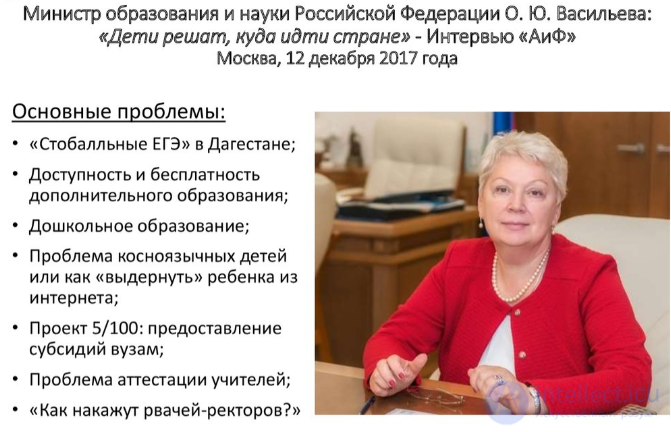
Intent analysis of public speeches by representatives of government bodies
|
Categories |
Intentions |
|
Excerpts from the text |
|
Informative block |
surprise, question |
|
|
|
|
disagreement/ |
2 |
Today there are still 400 students per such specialist. An unacceptable situation!.. Won't this turn out to be yet another bureaucratic stage? — No, it won't... |
|
|
agreement/ |
3 |
That is indeed so. We have an instruction from the President... A huge number of the textbooks currently approved contain a mass of errors... ... |
|
|
rejection/ |
|
. |
|
|
expression of sympathy |
1 |
There is a wise saying: "If we renounce the past, we have no heart; if we do not look to the future, we have no head." That is why I am sure that we must in no case give up the good things that existed in Soviet schools .. |
|
Emotive block of intentions |
self-presentation
|
2 |
In our time, school was a second home; after lessons we socialized there and took part in clubs... |
|
|
attracting attention (reasoning) |
1 |
And this decision is quite expected...
|
|
|
reassuring the audience |
3 |
An unacceptable situation! And we will certainly resolve it. .. The Ministry of Education and Science of Russia is preparing decisions on targeted support for the accessibility of supplementary education for low-income and large families... We are starting to build nurseries for children from 2 months to 3 years... |
|
|
justification |
2 |
That is how children grow up who are not at all stupid but say little.... This problem exists not only in Russia but throughout the world... |
|
|
forecast, truth claims
|
4 |
The task of the Ministry of Education and Science of Russia is to form a network of universities competitive at the global and national level and to return domestic education to leading positions in the world... In addition to flagship universities, by 2020 it is planned to create in every federal subject university centres for the innovative, technological and social development of the regions. .. By the end of 2017, a total of about 40 children's technology parks are planned to be opened... It is on them that our future, yours and mine, will depend in 10-15 years.....
|
|
Manipulative block
|
demonstration of force
|
1 |
Education performs strategic tasks important for the country. After all, it is also upbringing, it is the building of the future of our state...
|
|
|
intimidation
|
1
|
And what measures will be taken? — The toughest. Up to and including dismissals.
|
|
Volitional-directive block of intentions
|
inducement to positive action
|
5
|
Science, its progress and the future require deep knowledge. And the modern school also needs to move in this direction..... We send out from it an already grown-up person. And he must be educated and well brought up... Therefore every change in the education system must be thoughtful and carefully worked out... growing people must be attended to from morning till night, their interests taken into account, and one must communicate with them constantly. .. over the last decade the quality of teacher education has dropped sharply. And it is important to change this situation |
|
|
inducement to negative action
|
|
|
|
|
warning of consequences
|
1 |
They are supported by the Government of the Russian Federation, and in accordance with them, universities that do not show substantial progress may be deprived of state support... |
|
|
deflection of accusations
|
1 |
No, it won't. This year we conducted a voluntary experiment in 15 regions with teachers of mathematics and the Russian language. They themselves were interested in obtaining an independent assessment of their knowledge of their subject |
|
Control-reactive block of intentions |
approval/ praise
|
1 |
This is, of course, a large-scale project. But we have experience in implementing such projects. |
|
|
gloating/ sarcasm
|
1 |
The fact that as of 1 December this year 7.4 million of our preschool-age children from 2 months to 7 years are receiving preschool education is also a real result of the work carried out under the MRSDO measures. |
|
|
criticism
|
1 |
The ratio of a lecturer's salary to a rector's salary of 11 times or more that exists today in some places is, excuse me, abnormal.
|
|
|
irony
|
|
|
|
|
exposure
|
1 |
We understand that not all universities included in the project will achieve it, so the new version of the government resolution describing the rules for granting subsidies to universities in the 5/100 project provides for a procedure for terminating state support. |
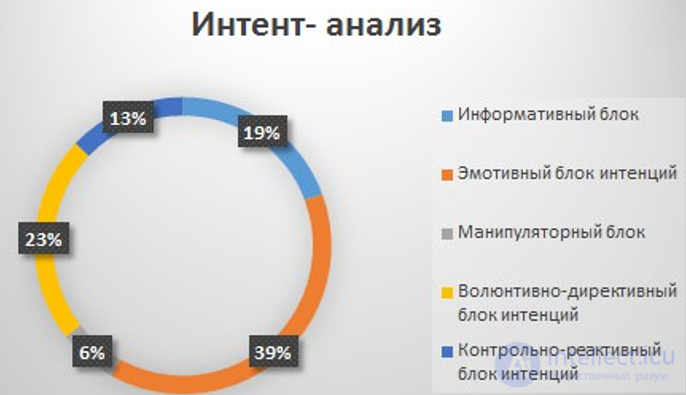
Research by the Laboratory of Speech Psychology and Psycholinguistics of the Institute of Psychology of the Russian Academy of Sciences has established that, in face-to-face communication, the interlocutors' intentional state serves to a considerable extent as an indicator of the speech partner and of the current communication. Moreover, together with the intentions that arise in the course of interaction (to answer, to clarify, to confirm), the flow of conversation is also influenced by more general aspirations, which take shape outside the dialogue in connection with the communicants' practical activity. Subjects' intentional orientations are one of the most important psychological foundations on which discourse is then built. To a large extent they determine how and what exactly is said, and how interaction proceeds with a whole audience or with just a single interlocutor.
N. D. Pavlova, analyzing the dialogues of A. V. Karaulov's television programme "Moment of Truth" and comparing the discourses, identified the specific features of the dialogic intentions of the host's interlocutors, as well as their influence on the development of the conversation.

Comments