
Lecture 7 min.
An optical neural network is a physical implementation of an artificial neural network with optical components. Early optical neural networks used a photorefractive volume hologram to interconnect arrays of input neurons to arrays of output neurons, with synaptic weights proportional to the strength of the multiplexed hologram. The volume holograms were further multiplexed using spectral hole burning to add one dimension of wavelength to the space and achieve four-dimensional interconnects of two-dimensional arrays of neuron inputs and outputs. This research led to extensive studies of alternative methods that use the power of optical interconnection to implement neural connectivity.
Some artificial neural networks that have been implemented as optical neural networks include the Hopfield neural network and the Kohonen self-organizing map with liquid-crystal spatial light modulators. Optical neural networks can also be based on the principles of neuromorphic engineering, creating neuromorphic photonic systems. Typically, these systems encode information in the networks using spikes, mimicking the functionality of spiking neural networks in optical and photonic hardware. Photonic devices that have demonstrated neuromorphic functions include (among others) vertical-cavity surface-emitting lasers, integrated photonic modulators, optoelectronic systems based on superconducting Josephson junctions, or systems based on resonant tunneling diodes.
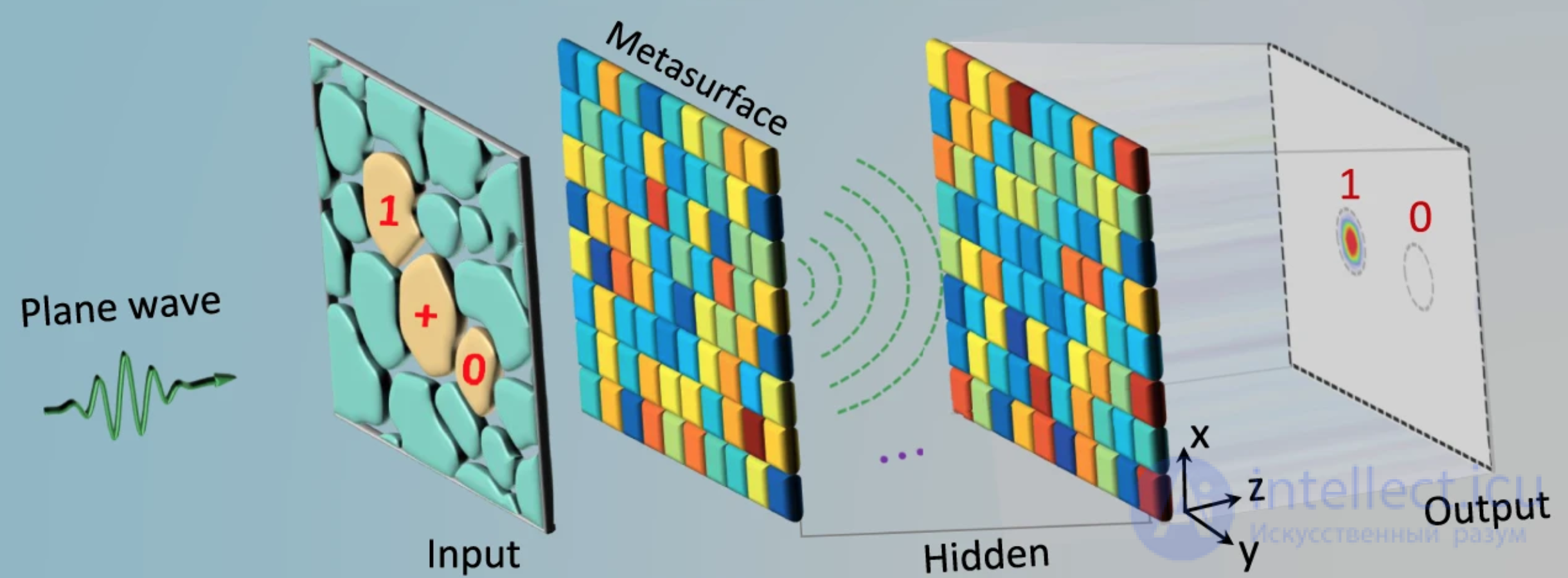
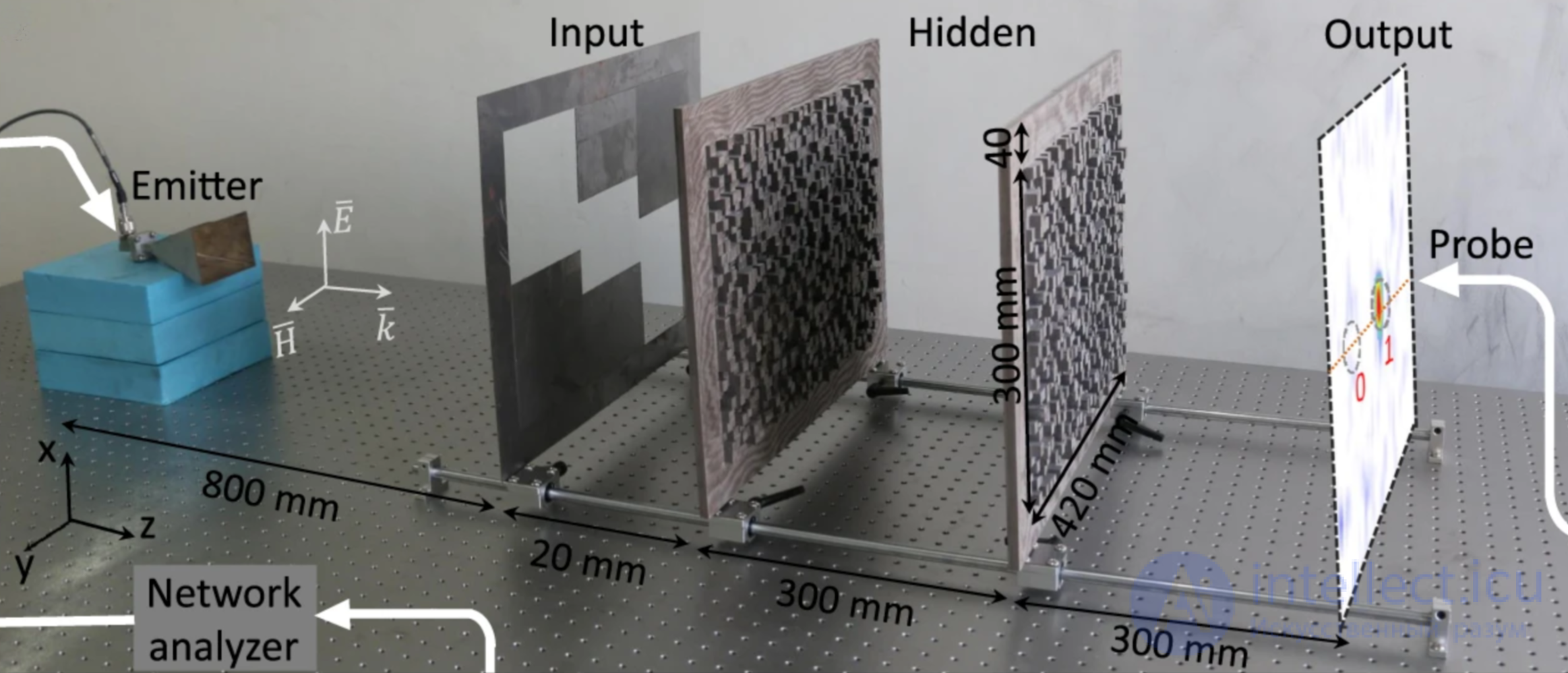
Diagram of an optical neural network functioning as a logic gate (top), and its implementation at microwave frequencies (bottom). The intermediate diffractive metasurfaces function as hidden layers .
Biological neural networks function on an electrochemical basis, whereas optical neural networks use electromagnetic waves. Optical interfaces to biological neural networks can be created with optogenetics, but this is not the same as optical neural networks. In biological neural networks there are many different mechanisms for dynamically changing the state of neurons, including short-term and long-term synaptic plasticity. Synaptic plasticity refers to the electrophysiological phenomena used to control the efficacy of synaptic transmission: long-term plasticity for learning and memory, and short-term plasticity for brief transient changes in the efficacy of synaptic transmission. Implementing this with optical components is challenging and ideally requires the use of advanced photonic materials. Desirable properties of photonic materials for optical neural networks include the ability to change the efficiency of light transmission depending on the intensity of the incoming light.
As computer vision has grown in importance across various fields, the computational cost of these tasks has increased, making the development of new approaches to accelerate processing even more important. Optical computing has emerged as a potential alternative to GPU acceleration for modern neural networks, especially given the impending obsolescence of Moore's law. Consequently, optical neural networks have attracted increased attention from the research community. Two main approaches to optical neural computing are currently being explored: those based on silicon photonics and those based on free-space optics. Each approach has its advantages and disadvantages; although silicon photonics can provide higher speed, it lacks the massive parallelism that free-space optics can provide. Given the significant parallelism capabilities of free-space optics, researchers have focused on exploiting its advantages. One implementation, proposed by Lin et al., involves training and fabricating phase masks for a handwritten digit classifier. By stacking 3D-printed phase masks, light passing through the fabricated network can be read out by a photodetector array of ten detectors, each representing a digit class from 1 to 10. Although this network can provide classification in the terahertz range, it lacks flexibility, since the phase masks are fabricated for a specific task and cannot be retrained. An alternative free-space optics classification method, proposed by Kang et al., uses a 4F system based on the convolution theorem to perform convolution operations. This system uses two lenses to perform the Fourier transforms of the convolution operation, which allows data to be passively transformed into the Fourier domain without energy consumption or latency. However, the convolution kernels in this implementation are also fabricated phase masks, which limits the device's functionality to only certain convolutional layers of the network. In contrast, Li et al. proposed a method that involves splitting the kernel into blocks in order to exploit the parallelism of the 4F system, using a digital micromirror device (DMD) instead of a phase mask. This approach allows users to load different kernels into the 4F system and perform inference of the entire network on a single device. Unfortunately, modern neural networks are not designed for 4F systems, since they were developed mainly in the CPU/GPU era. This is mainly because they tend to use lower resolution and a large number of channels in their feature maps.
In 2007, there was one model of an optical neural network: the programmable optical array/analogic computer (POAC). It was implemented in 2000 and was reportedly based on a modified joint transform correlator (JTC) and bacteriorhodopsin (BR) as a holographic optical memory. Full parallelism, a large array size and the speed of light are the three advantages that POAC offers for implementing an optical convolutional neural network. In recent years these have been studied with their practical limitations and considerations in mind, leading to the development of the first portable version of POAC.
The practical details – the hardware (optical schemes) and the software (optical templates) – have been published. However, POAC is a universal programmable array computer with a wide range of applications, including:
Taichi from Tsinghua University in Beijing is a hybrid optical neural network that combines the energy efficiency and parallelism of optical diffraction with the tunability of optical interference. Taichi offers 13.96 million parameters. Taichi avoids the high error rates typical of deep (multilayer) networks by combining clusters of diffractive units with fewer layers with arrays of interferometers for reconfigurable computing. Its encoding protocol splits large network models into submodels that can be distributed across several chiplets in parallel.
In testing with the Omniglot database, Taichi achieved an accuracy of 91.89%. It was also used to generate music by Bach and images in the style of Van Gogh and Munch.
The developers claimed an energy efficiency of up to 160 trillion operations per second per watt (TOPS W −1) and an area efficiency of 880 trillion multiply-accumulate operations per mm² (mm −2), or 10³ times more energy efficient than the NVIDIA H100, and 10² times more energy efficient and 10 times more area efficient than previous ONNs.
Recently, a temporal dimension was introduced into a diffractive neural network by means of femtosecond laser lithography of perovskite hydration. The temporal behavior of a neuron can be modulated by a femtosecond laser at the nanoscale, which makes it possible to create a programmable holographic neural network with a time-evolution function, meaning that its functionality can change over time under the influence of hydration stimuli. An in-memory temporal inference function was demonstrated, imitating the evolution of human brain functions, meaning that the functionality can change over time from simple classification of digit images to more complex classification of images of digits and clothing items. This is the first case of introducing a temporal dimension into an optical neural network, laying the foundation for the future development of brain-like photonic chips.

Comments