Physical Hardware for Artificial Neural Networks

Lecture 4 min.


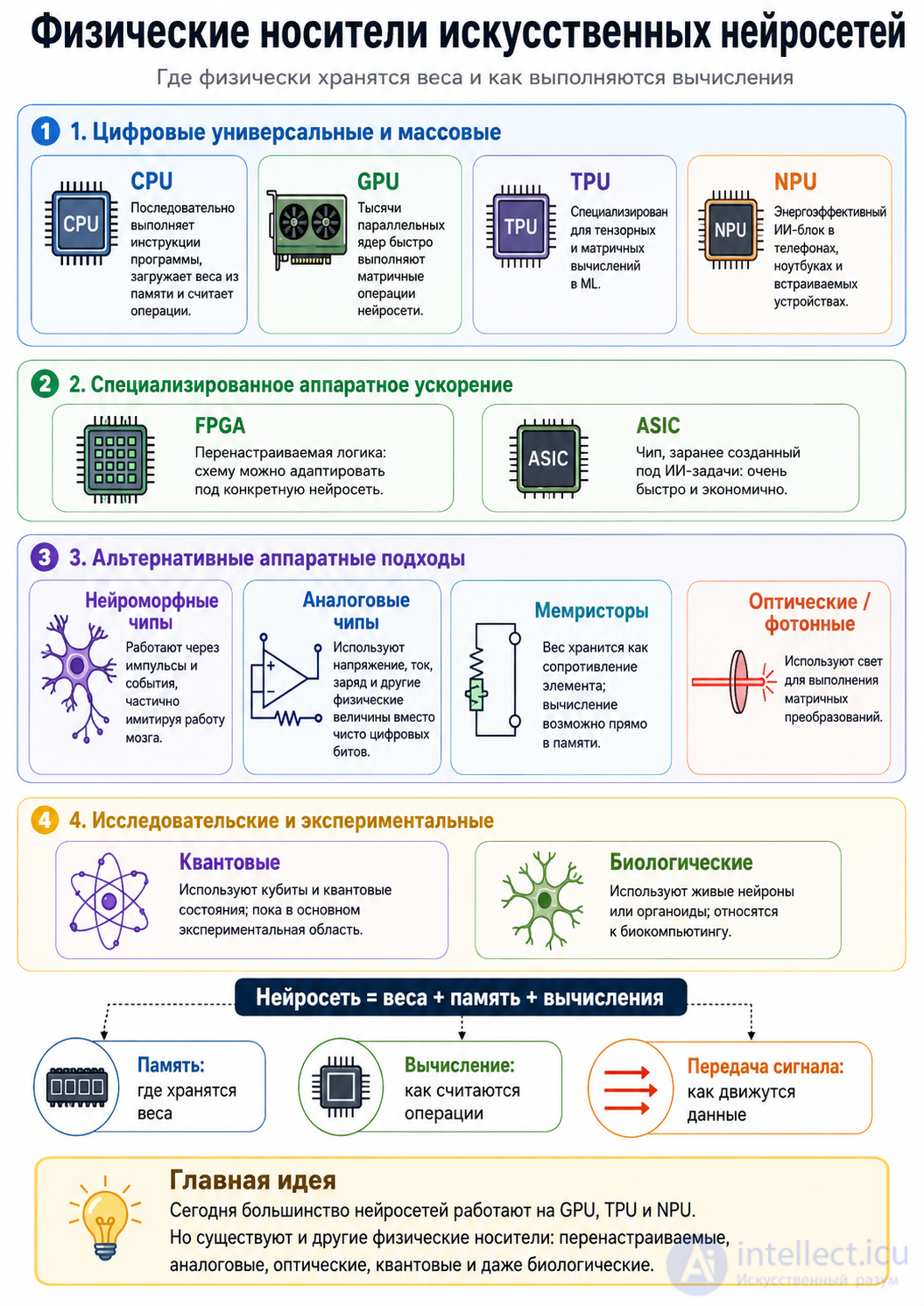
The physical carriers of artificial neural networks are the hardware or physical medium where the network's weights are actually stored and where neuron computations and signal transmission are actually carried out.
Physical Hardware for Artificial Neural Networks

Main types of physical carriers of ANNs

1. Ordinary processors: CPUs based on semiconductor transistors

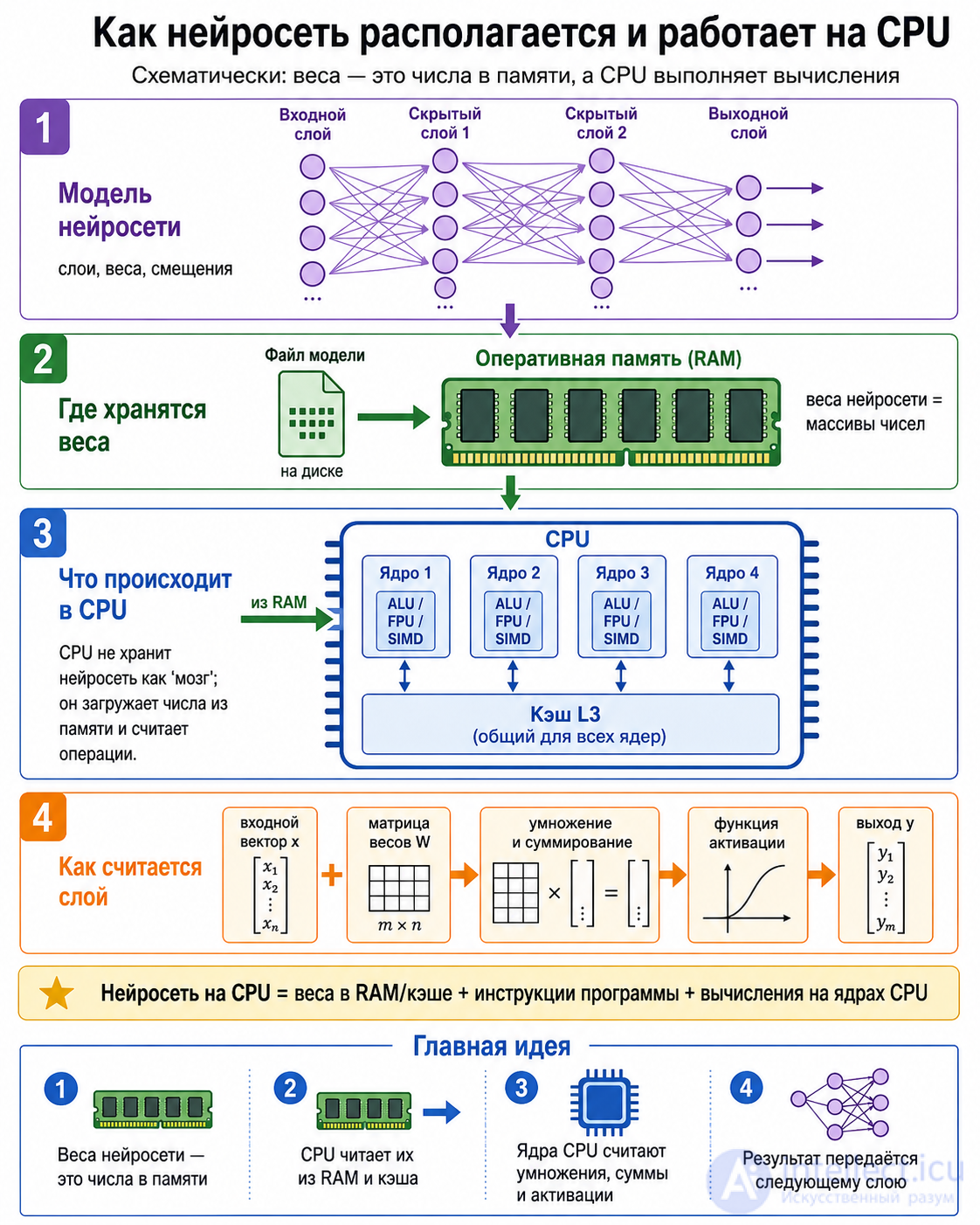
A neural network can run on an ordinary central processor of a computer.

Examples:

  • Intel Core
  • AMD Ryzen
  • Apple M-series CPU
  • server Intel Xeon / AMD EPYC

A CPU is suitable for small models, program logic and data preparation, but for large neural networks it is usually slower than a GPU.
Physical Hardware for Artificial Neural Networks

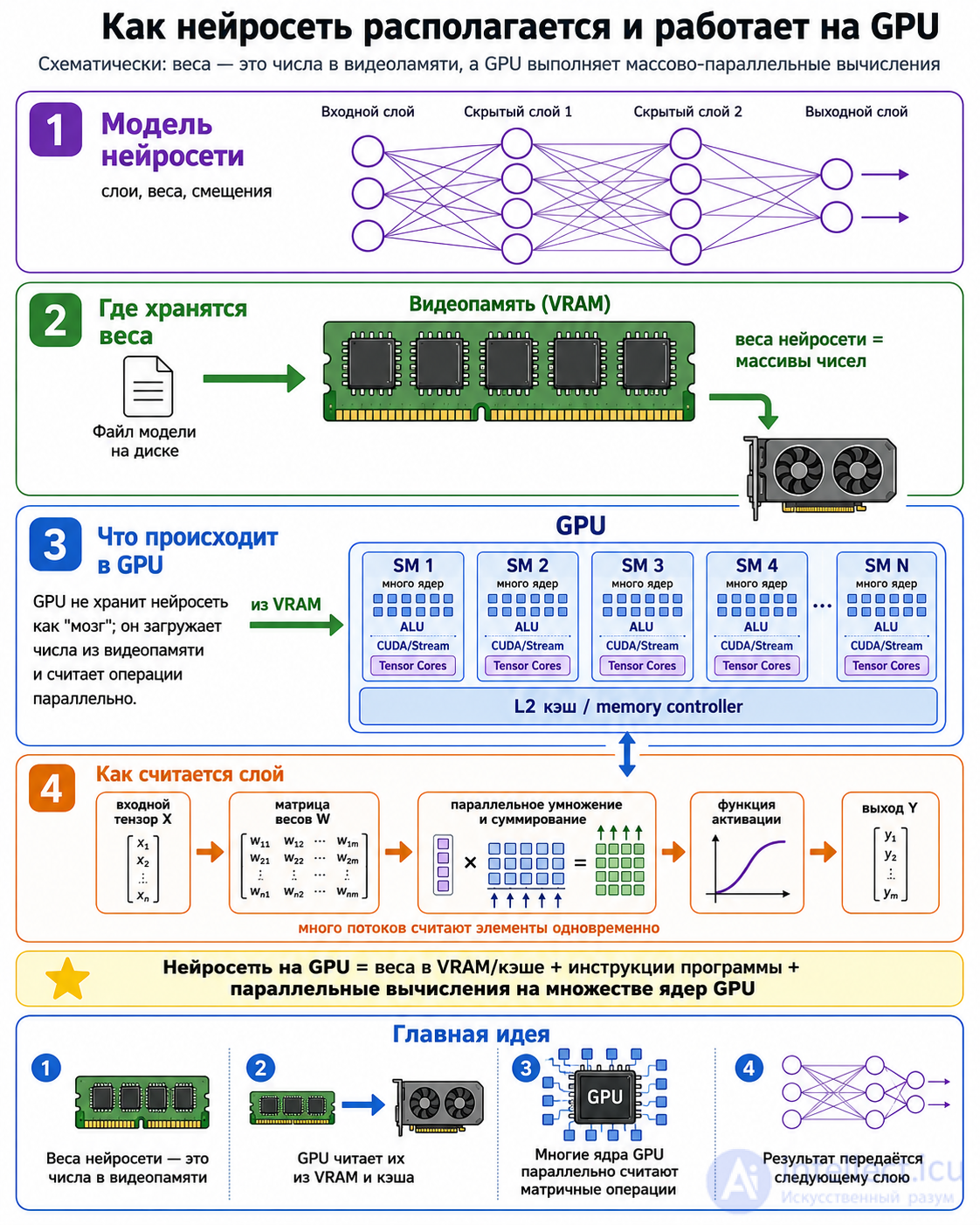
2. Graphics cards: GPUs based on semiconductor transistors

The most widespread carrier for training and running large neural networks.

Examples:

  • NVIDIA H100 / H200 / B200
  • NVIDIA RTX 4090
  • AMD Instinct MI300
  • Google GPU/TPU clusters

A GPU is well suited because neural networks require a huge number of parallel matrix computations.
Physical Hardware for Artificial Neural Networks

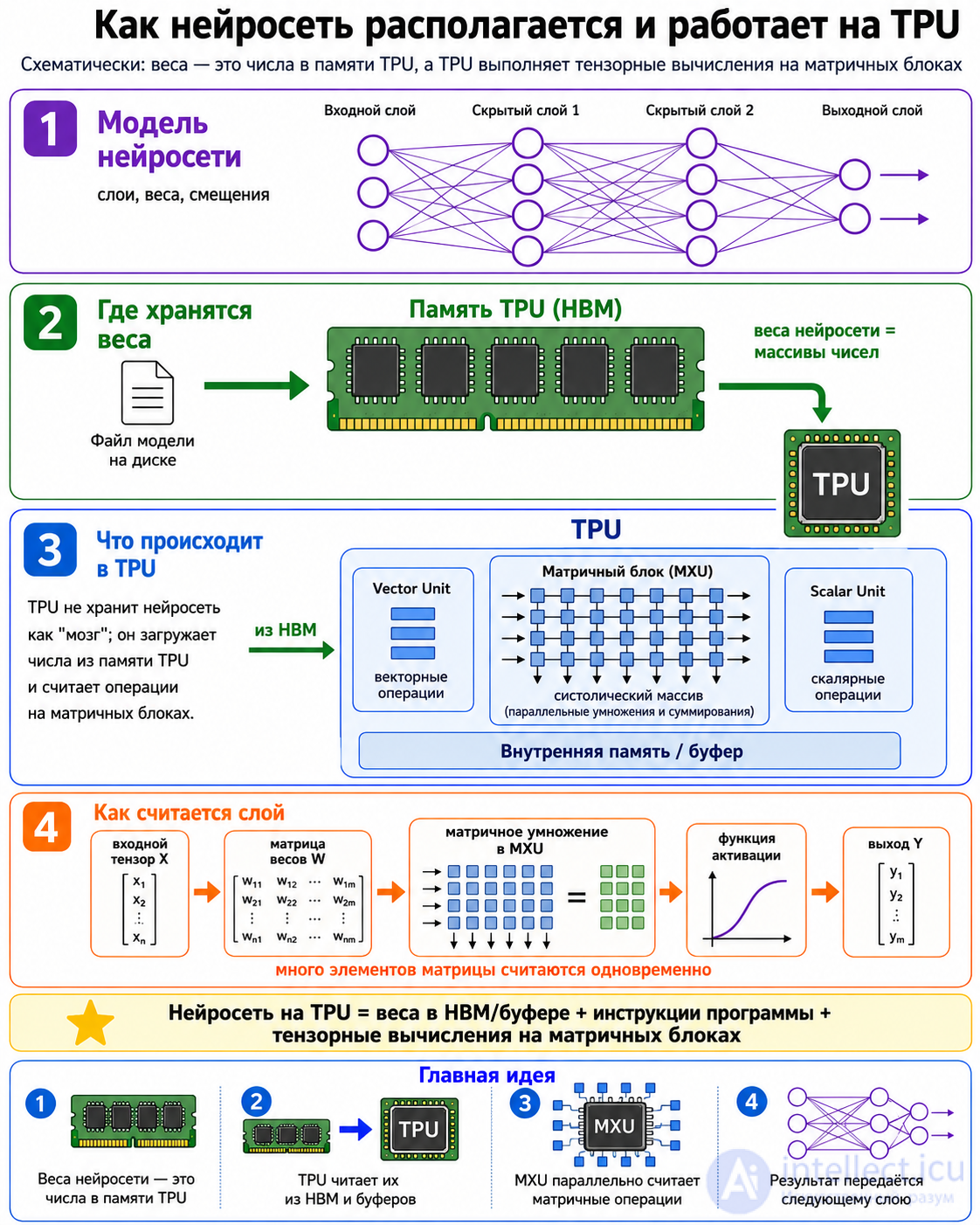
3. TPUs: tensor processors based on semiconductor transistors

Specialized chips for neural networks, especially from Google.

  • Google TPU

They are optimized specifically for machine learning operations: matrices, tensors, multiplications, transformers.
Physical Hardware for Artificial Neural Networks

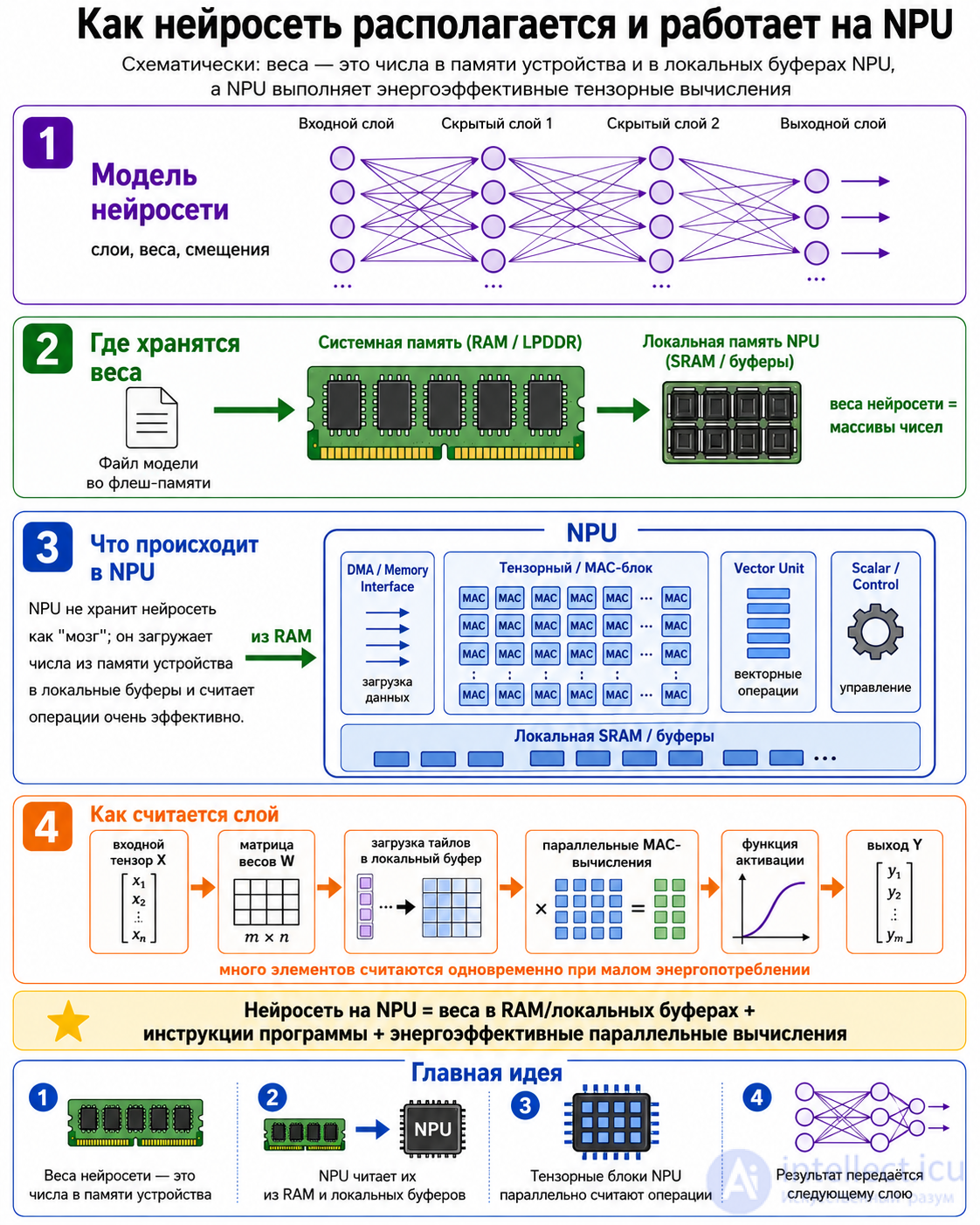
4. NPUs / AI accelerators based on semiconductor transistors

These are special AI blocks inside phones, laptops and microcontrollers.

Examples:

  • Apple Neural Engine
  • Qualcomm Hexagon NPU
  • Intel NPU
  • AMD Ryzen AI
  • Huawei Ascend

They are used for speech recognition, photo processing, local LLMs, cameras, AR and generative features.
Physical Hardware for Artificial Neural Networks

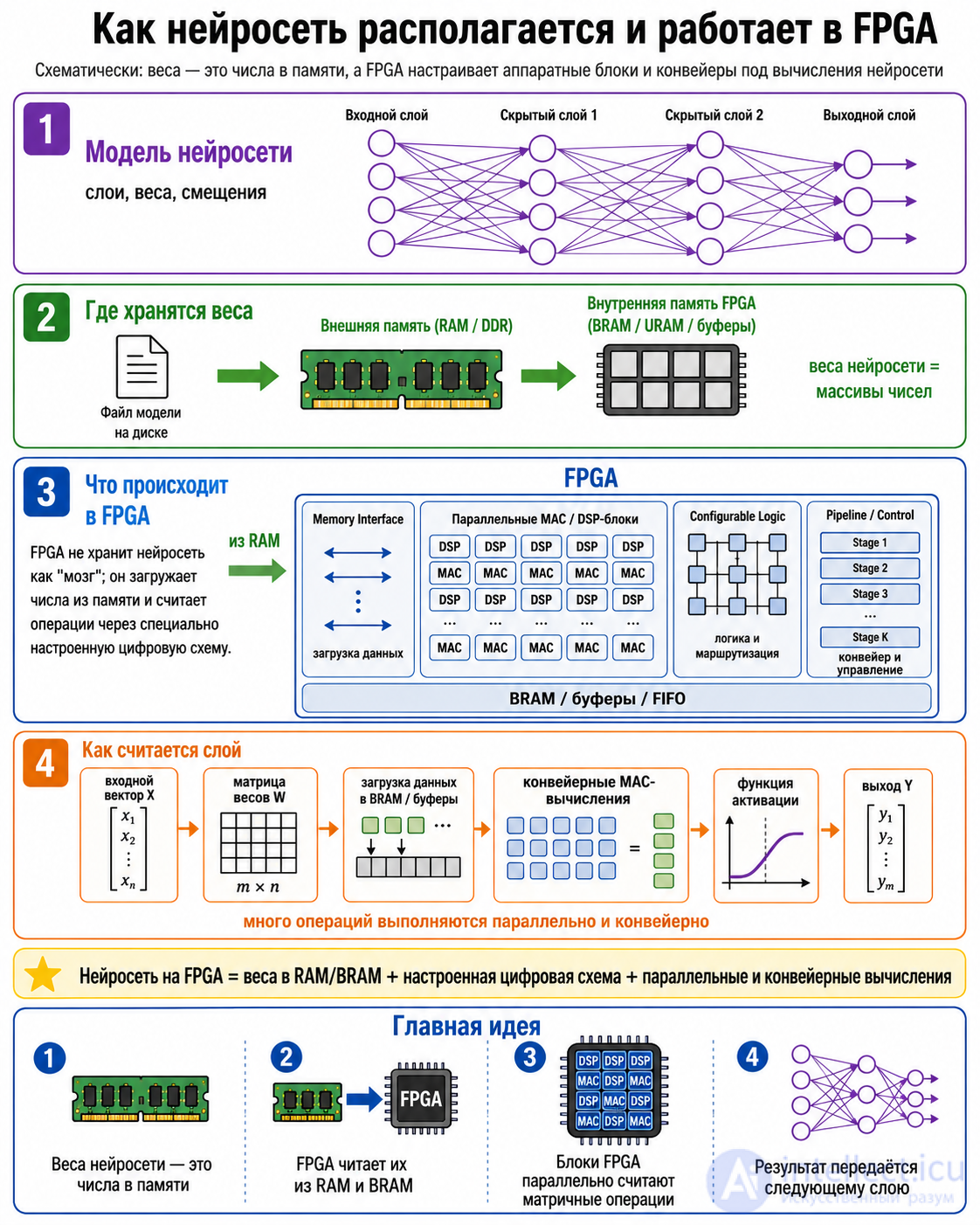
5. FPGAs based on semiconductor transistors

Programmable chips that can be configured for a specific neural network.

  • Xilinx FPGA
  • Intel FPGA

Pro: you can build a very efficient circuit for a specific task.
Con: harder to program than a GPU.
Physical Hardware for Artificial Neural Networks

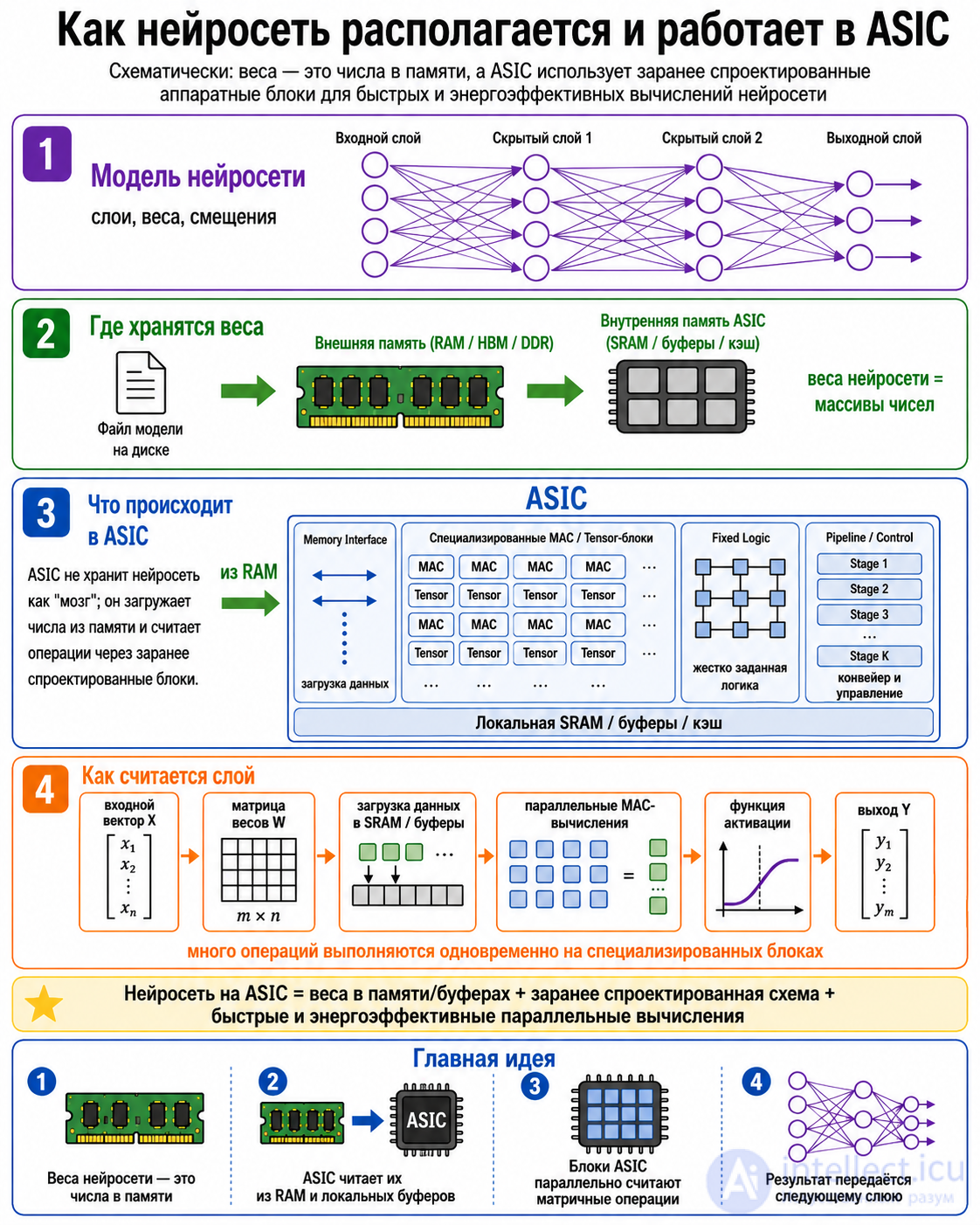
6. ASIC chips for neural networks based on semiconductor transistors

These are specialized microchips built only for AI.

Examples:

  • Google TPU
  • Tesla Dojo
  • Cerebras WSE
  • Graphcore IPU
  • Groq LPU

An ASIC is faster and more energy-efficient than general-purpose chips, but less flexible.
Physical Hardware for Artificial Neural Networks

Physical Hardware for Artificial Neural Networks

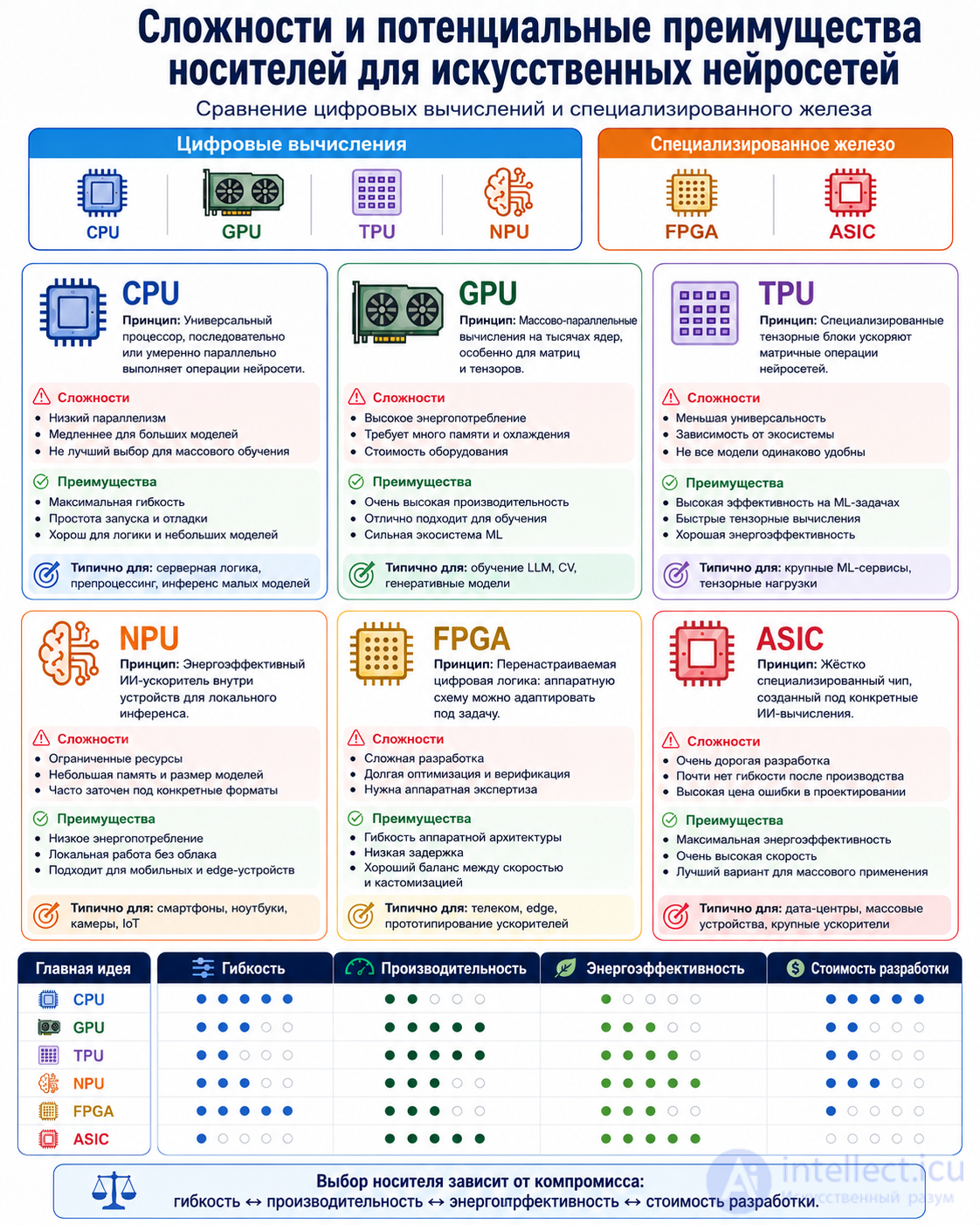
Fig. The complexity and benefits of using different types of carriers of artificial neural networks

7. Neuromorphic chips based on semiconductor transistors, but with an architecture close to how the brain works

These are chips that try to imitate the work of the brain more physically: pulses, events, spikes.

Examples:

  • Intel Loihi
  • IBM TrueNorth
  • BrainChip Akida

They are used for spiking neural networks. This is closer to biological neurons, but for now less widespread than GPUs.

Physical Hardware for Artificial Neural Networks

8. Optical / photonic carriers

Instead of electrons, photons (light) are used.

The idea:

  • light beams perform the computations
  • lenses/waveguides implement matrix operations

Potential advantages: high speed and low power consumption.
For now these are mostly experimental and specialized solutions.

Physical Hardware for Artificial Neural Networks

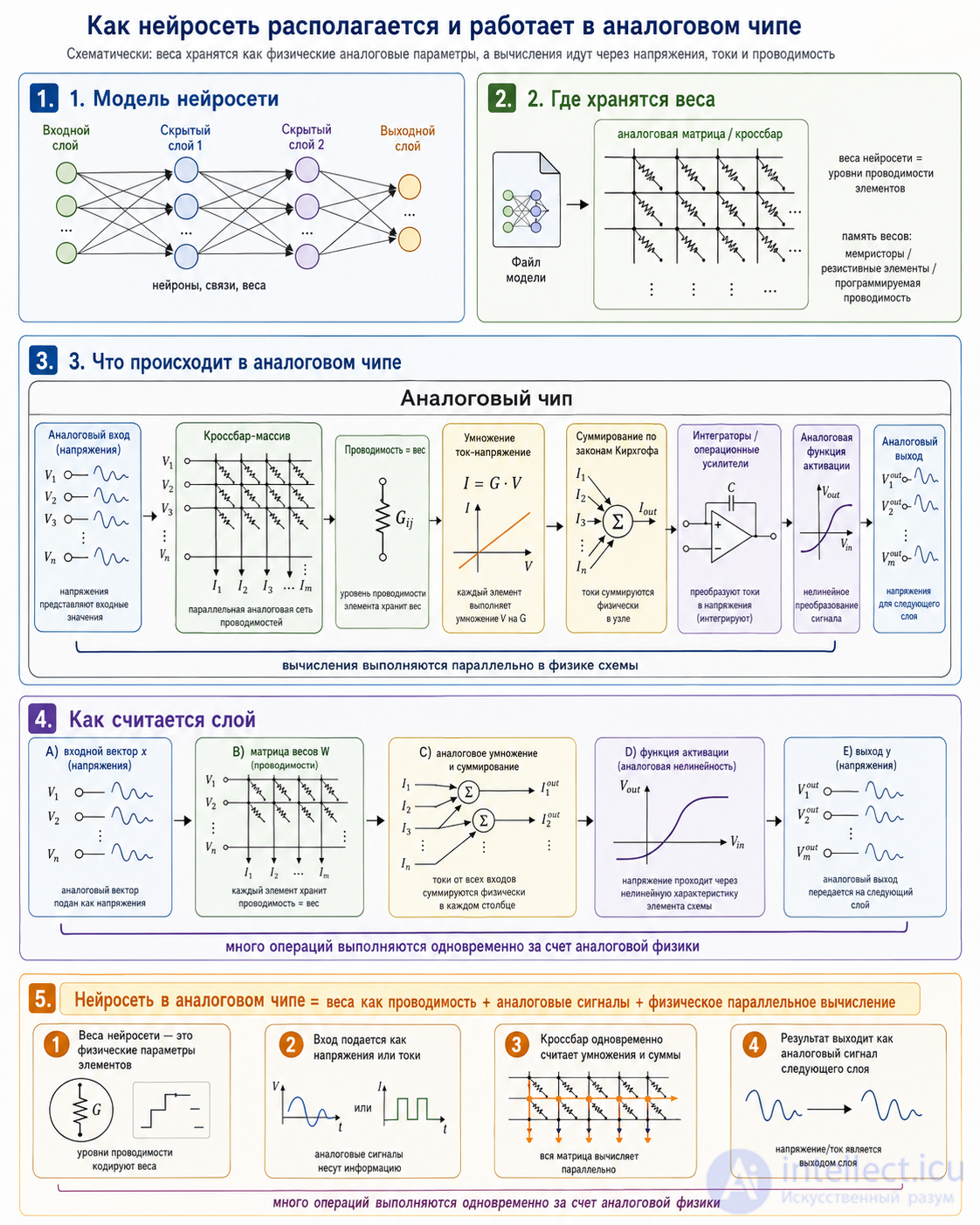
9. Analog chips

Computations are performed not with digital 0s and 1s, but with physical quantities:

  • voltage
  • current
  • resistance
  • charge

For example, the weights of a neural network can be stored as the conductance level of an element.
Physical Hardware for Artificial Neural Networks

10. Memristors and resistive memory

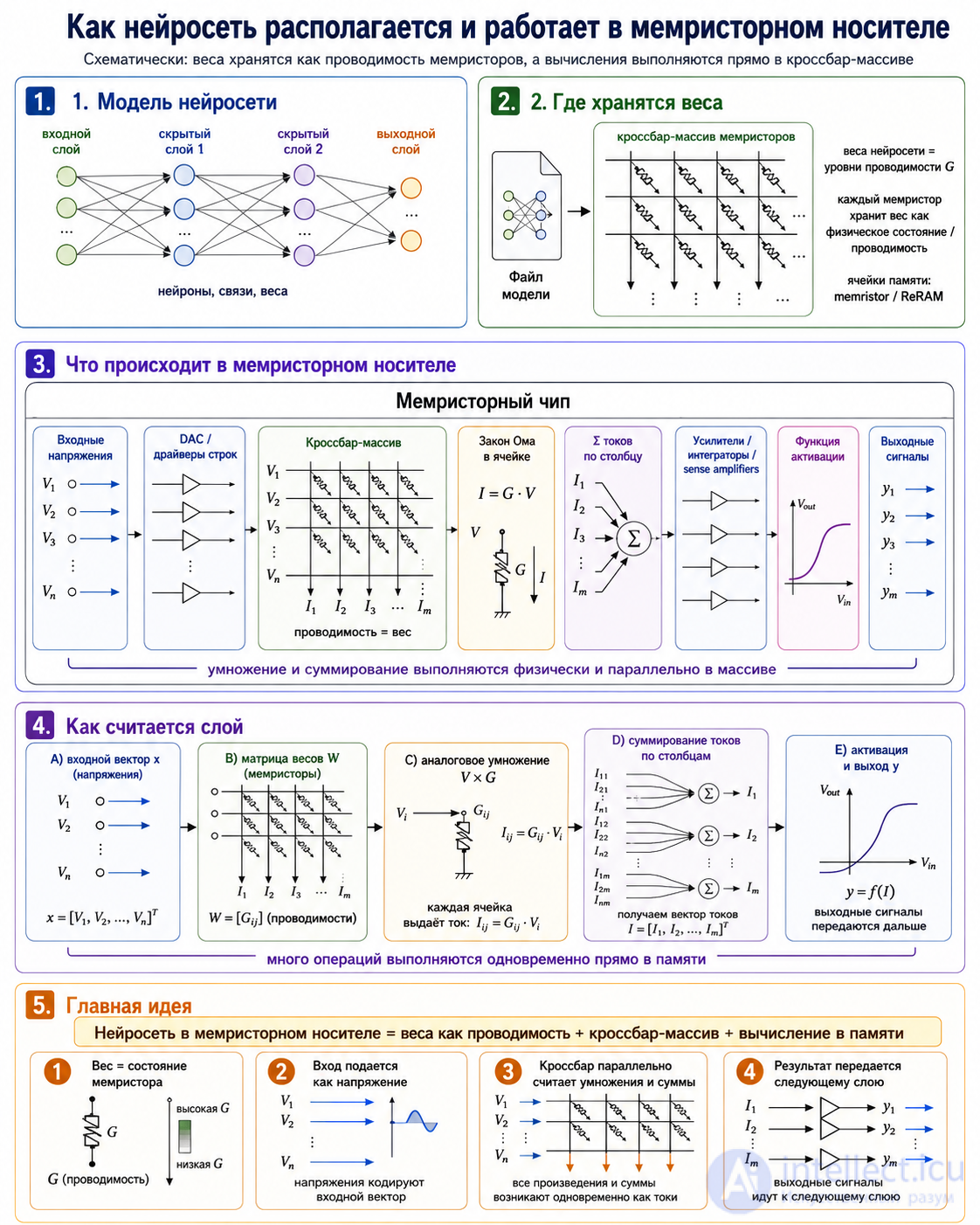
A memristor can store a neural network "weight" as a physical resistance.

Roughly speaking:

  • low resistance = large weight
  • high resistance = small weight

This is promising for hardware neural networks, where memory and computation are located almost in the same place.
Physical Hardware for Artificial Neural Networks

11. Quantum carriers

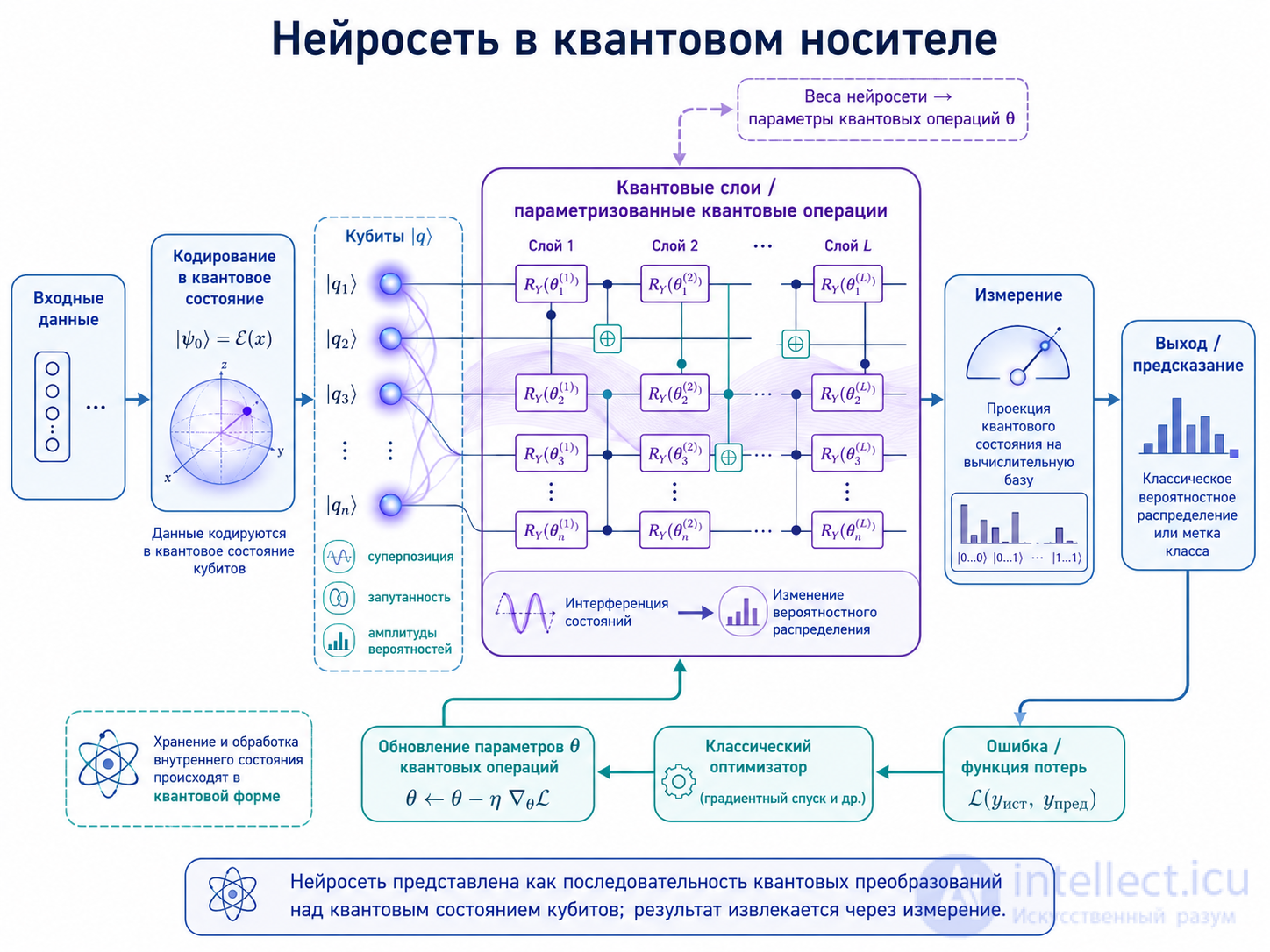
Qubits and quantum states are used.

  • superconducting qubits
  • ions
  • photonic qubits

Quantum neural networks are for now mostly a research area, not a mass technology.
Physical Hardware for Artificial Neural Networks

12. Biological and hybrid carriers

Experimental systems where computations are performed on living neural cultures or "brain + computer" hybrids.

Examples of ideas:

  • neurons in a Petri dish
  • brain organoids
  • bioelectronic interfaces

This is not ordinary AI in the industrial sense, but rather the field of biocomputing.

Physical Hardware for Artificial Neural Networks

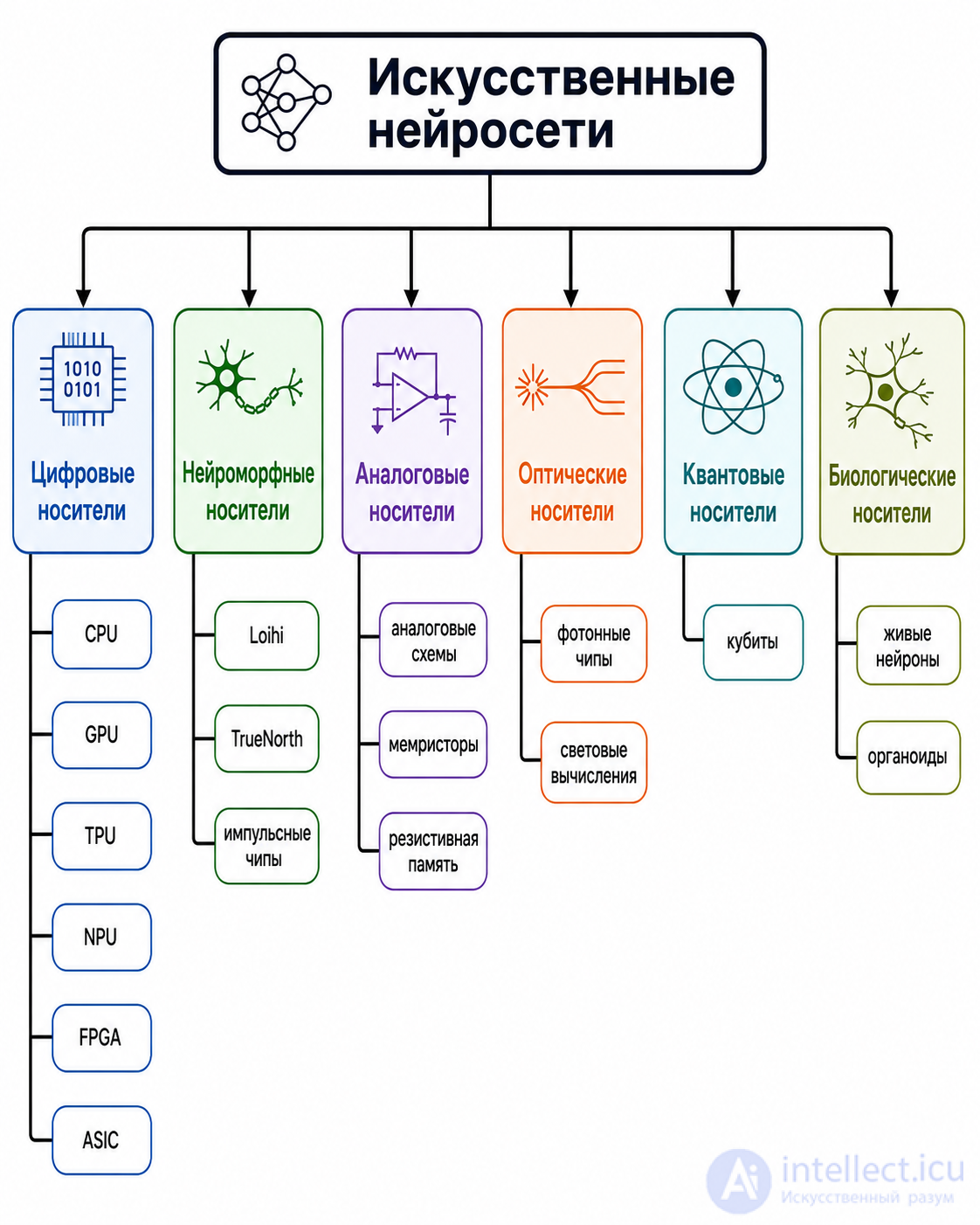
Classification of neural network carriers

Physical Hardware for Artificial Neural Networks

Conclusions

Today most artificial neural networks physically exist as:

weight numbers in computer memory + computations on a GPU / TPU / NPU

CPUs, GPUs, TPUs, NPUs, FPGAs and ASICs today are almost always physically implemented as semiconductor chips built on transistors, most often using CMOS technology.

That is, a modern neural network is not a "brain in a box", but a huge set of numbers that is stored in memory and processed by specialized processors.

See also

  • [[b7740]]
  • [[b45]]
  • [[b7947]]
  • [[b1927]]
  • [[b14252]]

Comments

To leave a comment

If you have any suggestion, idea, thanks or comment, feel free to write. We really value feedback and are glad to hear your opinion.
To reply

Lectures and tutorial on "Computational Neuroscience (Theory of Neuroscience) Theory and Applications of Artificial Neural Networks"

Terms: Computational Neuroscience (Theory of Neuroscience) Theory and Applications of Artificial Neural Networks