
Lecture
By now you should have a good enough understanding of MongoDB to see where it might fit into your existing system. There are so many new, competing data storage technologies that it's easy to get lost trying to decide which one to use.
A frequently touted advantage of document-oriented databases is that they're schemaless. This makes them far more flexible than traditional relational databases. I agree that being schemaless is good, but not as the main advantage many people claim it to be.
Schemalessness is often seen as license for chaotic data organization. There are domains and data sets that really are very hard to model in terms of a conventional relational database, but I see those more as edge cases. Schemalessness is tempting, but most data should be well-structured. Sure, it can sometimes be convenient, especially for adding new functionality, but in practice that can just as easily be solved by adding new optional fields.
An area MongoDB is especially well suited for is logging. There are two aspects of MongoDB that make writes fast. First, you can issue a write command and move on without waiting for it to return or for the write to actually complete. Second, with the journaling introduced in version 1.8 and some improvements made in version 2.0, it became possible to control write behavior with respect to data durability. These settings, along with how many servers must receive your data before a write is considered successful, are configurable on a per-write basis, giving you a great deal of control over how your writes are performed and how durable they are.
 //limit the collection size to 1 megabyte
db.createCollection('logs', {capped: true, size: 1018576})
Once our capped collection reaches a size of 1 megabyte, the oldest documents start being removed automatically. You can also set not a collection size but a maximum number of documents, using the max option. Capped collections have a number of interesting properties. For example, you can modify a document, but it can't grow in size. Insertion order is also preserved, so there's no need to add an extra field for chronological sorting.
Before version 1.8, MongoDB didn't guarantee data durability on a single server. So a server failure could lead to data loss. The solution was always to run MongoDB across several servers (MongoDB supports replication). One of the most important features added in MongoDB 1.8 was journaling. To enable it, add journal=true to the mongodb.config file we created when we first set up MongoDB (and restart the server for the changes to take effect). You'll most likely want journaling enabled (in future releases it will be on by default). Despite the slight performance gain you can get by disabling journaling, doing so carries a certain risk. (On the other hand, some applications can tolerate losing a bit of data.)
Durability is brought up here because a lot of effort has gone into achieving it on a single server. Sooner or later you'll come across mentions on Google of Mongo being unreliable as a data store. However, that information is now outdated.
I hope full-text search makes it into MongoDB in a future release. With array support, basic full-text search would be quite simple to implement. For serious applications you'll most likely need to use something like Lucene or Solr. Of course, the same is true for relational databases.
MongoDB doesn't support transactions. There are two alternatives: one is elegant but limited in its use, and the other is cumbersome but flexible.
The first alternative is the set of atomic operations. They're great as long as they solve your problem. We've already seen some of these, such as $inc and $set. There are also commands like findAndModify, which can update or delete a document and return it automatically.
For most data-processing tasks, MongoDB uses MapReduce. There are, of course, some basic aggregate functions, but for anything serious you'll need MapReduce. We'll look at MapReduce in more detail in the next chapter. For now, you can think of it as a very powerful, more flexible alternative to group by (which, admittedly, understates what it can do). One advantage of MapReduce is that it can run in parallel when working with large volumes of data. However, MongoDB's implementation is based on JavaScript, which is itself single-threaded. What follows from that? For processing large amounts of data, you'll most likely need to rely on something else, such as Hadoop. Fortunately, these two systems complement each other so well that a MongoDB adapter for Hadoop exists.
Of course, parallelizing data processing isn't the only clear-cut area where relational databases have the edge. Future releases of MongoDB are planned to improve handling of huge data volumes.
One especially powerful MongoDB feature is its support for geospatial indexes. This lets you store x and y coordinates on documents and then find documents near ($near) given coordinates, or within ($within) a rectangle or a circle. It's easier to grasp visually, so I recommend watching the five-minute walkthrough of MongoDB's geospatial features if you want to dig deeper.
You probably already know that MongoDB is considerably younger than most relational databases. That's definitely something to take into account. How much it matters depends on your requirements and how you implement them. You can't ignore the fact that MongoDB is a young technology, and the available tooling isn't yet very diverse (though tooling for mature relational databases can sometimes be pretty awful too). For example, the lack of support for floating-point decimal numbers will obviously be a problem (though not necessarily an insurmountable one) for systems dealing with money.
There are upsides too: good drivers exist for most languages, the protocol is modern and simple, and development is moving along quite fast. MongoDB runs on production servers at many companies, so concerns about the technology's maturity will soon be a thing of the past.
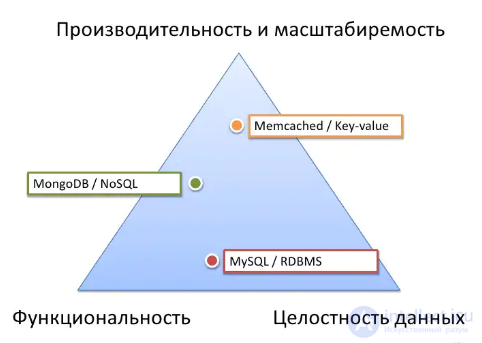
The point of this chapter is that MongoDB is, in most cases, capable of replacing a relational database. It's much simpler and easier to understand; it's faster and places fewer constraints on application developers. The lack of transactions can be a serious and legitimate concern. But when people ask where does MongoDB fit in the ecosystem of modern storage engines?, the answer is simple: squarely in the middle.

Comments