
Lecture
Music (from Ancient Greek μουσική) — an art form in which sounds, organized in a particular way, are used to create some combination of form, harmony, melody, rhythm, or other expressive content. Music is commonly regarded as a cultural universal, present in all human societies. Its definitions vary considerably in content and approach. Researchers agree that music is defined by several specific elements (pitch, timbre, duration, form, and others), yet there is no consensus on how these elements themselves should be defined. The creation of music is usually divided into musical composition, improvisation, and performance, while various aspects of the musical art are studied within academic disciplines (such as musicology and music theory), criticism, philosophy, and psychology. Music may be performed using a wide range of instruments, including the voice for singing.
In some musical traditions, performance or composition may be improvised to a greater or lesser degree. Music can be composed, sequenced, or otherwise created for indirect reproduction by mechanical or electronic means — for example, by a music box, a barrel organ, or digital audio software on a computer. Music is performed in public and private settings, including at events such as festivals and concerts, and it may also serve as accompaniment or a soundtrack to a film, television show, opera, or video game. Playing music back is the principal function of the portable audio player and the CD player, and a universal feature of radios and smartphones.
Beyond mere entertainment, music often plays a key role in social events, religious rituals, rites of passage, celebrations, and cultural occasions. The music industry includes songwriters, composers, performers, sound engineers, producers, tour organizers, and distributors of musical instruments, accessories, and scores. Compositions, performances, and recordings are evaluated and analyzed by music critics, music journalists, and musicologists, as well as by amateurs.
Musical art and creativity are powerful forms of self-expression that make it possible to convey a wide range of emotions and ideas. Like other art forms, music has the capacity to affect a person — awakening feelings, evoking memories, or prompting reflection. In creating music, composers and performers use melody, rhythm, harmony, and timbre to convey their inner essence and evoke a response in the listener.
Creativity in music involves not only the composition of new works but also the interpretation of works that already exist. In improvising or adapting a piece, a musician brings their own emotions and individual style to the performance, allowing listeners to perceive the work from a fresh new perspective. Musical creativity can be either an individual process or a collective one, in which a group of musicians interact and create something greater than the sum of their individual contributions.
Music can convey emotion through various elements. Melody often evokes an emotional response — be it joy, sadness, delight, or unease. Rhythm, with its pulse and dynamics, can lend a work vitality or tension. Harmony, which brings together notes and chords, creates an atmosphere that sustains emotional perception — ranging from joy and lightness to anxiety and tragedy. The timbre of each instrument or voice adds distinctiveness and can alter the perception of a work, lending it depth or lightness.
Musical creativity is also often bound up with other art forms. Music in film, theater, and dance creates striking scenes that heighten the spectacle and emotional significance of what is happening. Sound design can completely transform the perception of a scene, making it tense, comic, or solemn. Music embedded in a visual context helps convey to the viewer or listener moods and meanings that words alone cannot express.
Music and creativity are not confined to professional works alone. They can be a form of self-expression for anyone — whether playing a musical instrument, singing in the shower, writing songs, or listening to music to evoke or change a mood. This access to art helps a person better understand their own emotions and experiences, and it also cultivates empathy, allowing them to feel what others feel.
The Greek word «μουσική» is a feminine adjective. Its feminine gender is explained by its agreement with feminine nouns such as Ancient Greek τέχνη (craft, the professional activity of the Muses; compare the later «technique») or Greek ἐπιστήμη (the science of the Muses, knowledge of matters pertaining to the divine activity of the Muses). The adjective μουσική was later substantivized; in Ancient Rome the word musica is attested both as an adjective (feminine, as in the phrase ars musica) and as a noun (music).
In nineteenth-century literary Russian, the stress in the Russian word for music settled on the first syllable — «mÚzyka» — although Pushkin and, later, the composers of the Mighty Handful occasionally used the archaic stress on the second syllable — «muzÝka».
In Old Russian, up until the eighteenth century, the word musikiíya (from Greek μουσική) and its derivatives were used in the same sense — for instance, the adjective «musikiysky», as in Nikolai Diletsky's treatise «The Grammar of Musikiyskoe Singing». The adjective «musikiysky» is occasionally used for archaic stylization in nineteenth-century literary works as well — for example, «musikiyskie orudiya» (that is, musical instruments) in Nikolai Gogol's essay «Life».
At the early stages of human development, music was almost exclusively applied in character. Hence the «canonicity» of musical style and the limited expression of individual authorial character within it. In the professional creative work of mature musical cultures, music gradually freed itself from direct dependence on words, dance, and ritual context. Beginning in the late Middle Ages (the fifteenth century), and especially during the Renaissance, Europe saw the first development of forms of so-called autonomous music (in Heinrich Besseler's term, «presentational» music — that is, music intended solely for listening); there took shape an independent logic of compositional thinking, and the profession of composer itself became distinct. In the modern era (beginning with the Baroque), the «applied» component continued to exist in the form of so-called program music, but alongside it there arose ideas of the «immanent essence» of music, one of the most popular in the nineteenth century being the idea of absolute music. In the work of the twentieth-century avant-garde, the «autonomous» vector of music's history reached yet another culmination — composers gave their works titles that ruled out any association with familiar genres and forms (for example, Webern's «Five Pieces for Orchestra», Boulez's «Structures», Ustvolskaya's «Composition No. 2», and so on), or else the titles attached to their works were purely conventional in character.
It is assumed that anatomically modern humans emerged around 160,000 years ago in Africa. Around 50,000 years ago, people had settled every continent habitable by humans. Since all the peoples of the world, including the most isolated tribal groups, possess some form of music, historians have concluded that music must have been present among the earliest humans in Africa, before their dispersal across the planet. It is assumed that after arising in Africa, music has existed for at least 50,000 years and gradually became an inseparable part of human life across the entire planet.
Music transmitted through oral tradition is conventionally termed prehistoric, or primitive. Examples include Native American and Australian Aboriginal music. The prehistoric era in music ends with the transition to the written recording of musical works. One of the oldest known musical works, recorded on a cuneiform tablet and discovered during excavations at Nippur, dates to approximately 1900–1600 BCE. The tablet's decipherment was published in 1986 by Professor Anne Draffkorn Kilmer of the University of California, Berkeley. According to the researcher, the tablet contains fragmentary instructions for performing and composing music in harmonies of thirds, written using a diatonic scale[10].
One of the oldest musical instruments known to scholars is the flute. In particular, a specimen of a flute was discovered alongside sculptures dated to 35,000–40,000 BCE.
On the walls of the pyramids, in ancient papyri, and in the collections «Pyramid Texts» and the «Book of the Dead» there are lines from religious hymns. «Passions» and «mysteries» are also found there. A popular subject was the «passion» of Osiris, who died and was resurrected each year, as well as women's laments sung over the dead Osiris. The performance of songs could be accompanied by dramatic scenes.
Music played an important role in the life of the ancient Egyptians. The significance of music in Ancient Egypt is attested by the wall reliefs of ancient Egyptian temples and tombs depicting musicians. The oldest musical instruments of the Egyptians were the harp and the flute. During the New Kingdom period, the Egyptians played bells, tambourines, drums, and lyres imported from Asia. Wealthy people held receptions to which professional musicians were invited.
Musical education was considered one of the most important elements for the development of the human soul. Musicians and singers played a prominent role in Greek theater. It is believed that it was in Ancient Greece that music reached the highest flowering of any culture of the ancient world. The very word «music» is of Ancient Greek origin. In Ancient Greece, a regular connection between pitch and number was noted for the first time, a discovery that tradition attributes to Pythagoras. Music, as a subject of education and upbringing and as a component of public life, was of enormous importance to the Greeks and, more broadly, to all of later European civilization.
In Greek mythology, the patroness of musicians was the muse Euterpe. By tradition, she was depicted holding a syrinx. Musicians also worshipped the god Apollo (Phoebus), who was the patron of all the arts as well as of medicine.
Asian music encompasses a range of musical cultures and includes Arab, Central Asian, East Asian, and South Asian music, as well as the music of Southeast Asia. Some of these musical traditions trace their origins back to remote antiquity.
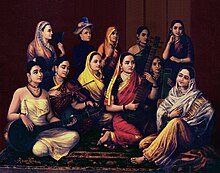
Indian women dressed in traditional regional attire play musical instruments popular in various parts of India
Indian classical music is one of the oldest musical traditions in the world. Sculptures of the Indus Valley civilization depict dances and ancient musical instruments, such as a flute with seven holes. Excavations conducted by Mortimer Wheeler uncovered stringed instruments and drums at Harappa and Mohenjo-daro. The Rigveda, an ancient Hindu text, contains elements of present-day Indian music and also uses musical notation to indicate meter and manner of chanting[ Indian classical music (marga) is monophonic and is based on a single melodic line, or raga, rhythmically organized through talas. The poem «Silappatikaram» explains how new modes can be created by modal shifting of the tonic from an existing scale. Modern Hindi music has been influenced by traditional Persian music and the Afghan Mughals. Carnatic music, popular in the southern states, is predominantly spiritual in character; most songs are devoted to Hindu deities. The repertoire also includes songs focusing on love and other social themes.

Indonesia is the homeland of the tuned gong chime, with numerous variants especially widespread in Java and Bali
Indonesian music originated with the migration of Bronze Age cultures to the Indonesian archipelago in the second and third centuries BCE. Traditional Indonesian music employs percussion instruments such as the gendang and gongs. Individual musical traditions have developed unique and complex instruments, such as the stringed sasando from the island of Rote, the Sundanese angklung, and the elaborate, refined orchestras of the Javanese and Balinese gamelan. Indonesia is the homeland of the «tuned gong chime» — a general term for a set of small, high-sounding kettle-shaped gongs. The gongs are typically arranged in the order of the musical notes, fastened convex side up on cords stretched across a low wooden frame. The most popular form of Indonesian music is the gamelan — an ensemble of tuned percussion instruments that includes metallophones, drums, gongs, bowed lutes, and the bamboo suling flute.
Chinese classical music, which encompasses both traditional art music and court music, spans roughly three thousand years. It has its own unique systems of musical notation, as well as its own tuning and pitch conventions, instruments, and styles (genres). Chinese music is based on the pentatonic and diatonic scales, using a scale of twelve notes to the octave (5 + 7 = 12), similar to music shaped by the European tradition.

The talking drum is a popular instrument in West Africa
African music has undergone considerable evolution over the centuries, and its present-day traditional forms differ markedly from its earliest ones. The development of music was not confined to particular ethnic groups; the creative approach of individual musicians has always played an important role. The principal sources for the study of African music history include archaeological finds, rock art, oral traditions, and the accounts of travelers and researchers.
The musical influence of Black Africa had already spread into North Africa by 8000–3000 BCE, when Neolithic cultures along the rivers were forming early musical and dance traditions. One of the oldest visual pieces of evidence is a dance scene found on the Tassili n'Ajjer plateau (c. 6000–4000 BCE). Migrations and cultural exchange contributed to the spread of musical instruments and styles across the continent. Instruments such as the dundun talking drums and the likembe lamellophone were adapted to new conditions and needs. Interaction with other cultures, including the influence of European colonizers, also left its mark on African music. Comparatively new genres emerged, among them highlife in West Africa, Congolese rumba], taarab in East Africa, and various musical styles of Southern Africa.

Musicians from Plateau State, Nigeria, with local musical instruments: a xylophone made from horns, drums, and a handmade guitar
The musical similarities between distant regions pose a challenge for researchers, since neighboring territories can have very different styles. For example, the polyphonic singing style of the Baoulé people of Côte d'Ivoire so closely resembles the polyphonic singing style of several peoples of eastern Angola that the resemblance is immediately recognized by members of both cultures, despite the geographical distance between them.
The transatlantic slave trade brought about the spread of African music to the New World, where instruments such as the friction drum were modified and, in some cases, further developed. Sacred music, such as that of the Candomble religion in Brazil, traces back to the eighteenth- and nineteenth-century Yoruba forms of orisha worship. Urbanization and the spread of Christianity in the nineteenth and twentieth centuries gave rise to new musical genres, spurring the development of African church music («Nkosi Sikelel' iAfrika», African gospel, the Congolese version of the Latin mass, Missa Luba), as well as protest songs, which often adapt the texts of religious hymns and secular songs to rally opposition to political oppression («We Shall Overcome», «Amazing Grace»).
African diaspora music and dance, shaped to varying degrees by African musical traditions, had a marked influence on American music, including such genres as Dixieland, blues, and jazz, as well as many Caribbean genres such as calypso and soca. Many genres of Latin American music — cumbia, salsa, rumba, conga, samba — were founded on the music of enslaved Africans and, in turn, influenced African popular music[.
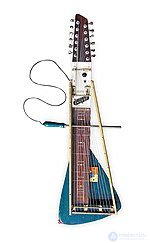
Landman's Moodswinger (2006) — a zither with a third bridge for overtones, an example of an experimental musical instrument
In the 19th century, one of the principal means by which the public became acquainted with new musical works was the sale of sheet music. Middle-class music lovers performed these pieces at home on the piano or other popular instruments such as the violin. With the advent of 20th-century music, the invention of new electrical technologies such as broadcasting, together with the mass availability of gramophone records, meant that sound recordings heard on the radio or on a record player became the primary means of encountering new musical compositions[27]. As radio and phonographs used for reproducing and disseminating music spread, listening to musical works became far more accessible. Operas, symphonies, and big-band performances could now be heard right in the living room of anyone who owned a radio set or record player. In the 19th century, access to new music had been largely confined to members of the middle and upper classes, who could read music and play the piano or other instruments. The advent of radio and record players opened up the possibility of listening to music to people of low income as well, who could not afford to attend the opera or symphony concerts. These devices also made it possible to hear works from different regions of the country and the world, even if people could not afford to travel to those places, which contributed to the spread of musical styles.
Twentieth-century academic music was characterized by the exploration of new rhythms, styles, and sounds. The horrors of the First World War affected many art forms, including music, and composers began to explore darker and harsher sounds. Traditional musical styles, such as jazz and folk, were used by composers as a source of ideas for classical music. Igor Stravinsky, Arnold Schoenberg, and John Cage were among the influential composers in 20th-century academic music. The invention of sound recording and the ability to edit music led to the emergence of new subgenres of classical music, including the acousmatic and musique concrète schools of electronic composition. Sound recording had a major impact on the development of popular music genres, since it made it possible to widely distribute recordings of songs and bands. The advent of multitrack recording had a major impact on rock music, since it allowed for far more than simply recording a band's performance. Using a multitrack system, a band and its music producer could layer many instrumental tracks and vocals on top of one another, creating new sounds that would be impossible in a live performance.
Jazz developed and became an important musical genre over the course of the 20th century, and in its second half the same happened with rock music. Jazz is an American musical art form that arose in the early 20th century in African American communities in the southern United States as a result of the fusion of African and European musical traditions. The style's West African origins are evident in its use of blue notes, improvisation, polyrhythm, syncopation, and swung rhythm.

A selection of electric guitars and amplifiers in a store
Rock music is a genre of popular music that took shape in the 1950s under the influence of rock and roll, rockabilly, blues, and country. The foundation of the rock sound is most often the electric guitar or acoustic guitar, reinforced by a strong rhythmic emphasis set by the rhythm section. Alongside the guitar and keyboards, the saxophone and the blues harmonica often serve as solo instruments. In its «pure» form, rock is distinguished by its use of «three chords, a bright, expressive rhythm, and a memorable melody». The traditional rhythm section in popular music includes rhythm guitar, electric bass guitar, and drums. Some bands use keyboard instruments such as the organ, piano, or, starting in the 1970s, analog synthesizers. In the 1980s, pop musicians began using digital synthesizers, such as the DX7, electronic drum machines such as the TR-808, as well as synthesizer bass devices (such as the TB-303) or keyboard synthesizers for bass sounds. In the 1990s, the music industry began to actively use increasingly diverse computerized equipment, instruments, and software, such as digital audio workstations. By the 2020s, software synthesizers and music apps for computers had opened up opportunities for amateur producers to create and record music, such as EDM, right at home. They can add sampled and digital instruments, as well as edit recordings digitally. In the 1990s, bands in genres such as nu metal began to include DJs in their lineups. DJs create music by manipulating recorded music using DJ mixers
The theoretical aspects of music are studied by musicology.
Music theory seeks answers to questions about what rules music obeys, what underlies it, and what must be learned in order not only to perform music competently but also to understand it. In the direct perception of music, on the one hand, and its rational analysis, on the other, universal categories (characteristic of any music) can be distinguished — harmony, rhythm, and form. While rhythm and form are also inherent in other art forms, pitch structure (harmony) is a unique property found only in music. Melody and polyphony, although not as universal as harmony, rhythm, and form, take on enormous significance in a number of specific musical textures.
Applied theory, drawing on research material, aims to create and improve methods of teaching music that make it possible to master performance practice and train the perception of music. The basic skills include solfège — sight-reading music, analyzing and notating music by ear, reading various types of scores and orchestrations, the art of improvisation, and the fundamentals of composition.
Music is built from musical sounds. They possess a definite pitch (the pitch of the fundamental tone typically ranges from C of the subcontra octave to D of the fifth octave (from 16 to 4000–4500 Hz). The timbre of a musical sound is determined by the presence of overtones and depends on the sound source. The loudness of a musical sound does not exceed the threshold of pain. A musical sound has a definite duration. The physical peculiarity of a musical sound is that the sound pressure within it is a periodic function of time.
Musical sounds are organized into a musical system. The basis for constructing music is the scale. Dynamic shadings are subordinate to a loudness scale that has no absolute values. In the most commonly used duration scale, adjacent note values stand in a 1:2 ratio (eighth notes relate to quarter notes as quarter notes relate to half notes, and so on (for example, rhythmic division).
A musical tuning system is the system of pitch relationships among sounds adopted in a given practice of tuning musical instruments, characterized by the assignment of specific sounding frequencies to notes. There are many different tuning systems, for example, the Pythagorean or meantone systems. Modern musical instruments with a fixed tuning generally use equal temperament.
When an instrument is tuned, different notes are assigned different sounding frequencies. This assignment of frequencies can be carried out in various ways. For example, just intonation is characterized by a perfectly pure-sounding fifth on the first degree of the principal key, but the other fifths then sound less pure, and some — frankly out of tune (the wolf fifth). If the sounding frequencies of the notes are altered slightly, it becomes possible to improve the sound of intervals that, while not perfectly pure, nevertheless sound acceptable to the ear (as, for example, on an equally tempered piano).
The overwhelming majority of modern musical styles make extensive use of the simultaneous sounding of tones, which is called a sonority. The sonority of two sounds is called a musical interval, and that of three or more sounds — a chord. In the compositional-technical sense, harmony refers to the combining of sounds into sonorities and their regular succession. Harmony is also the name of the branch of musicology that studies these regularities.
By acoustic quality and psychological perception, a distinction is drawn between consonances and dissonances: the former are euphonious, and the sounds of a consonance seem to the ear to merge into a single multi-voiced complex, while the latter are sharper and more tense, and the sounds of dissonant sonorities do not merge together to the ear. The opposition of dissonances and consonances, and the resolution of dissonances into consonances, is a key feature of musical harmony in the Baroque, Classical, and Romantic periods. In a number of avant-garde musical movements, however, the opposition between consonances and dissonances is dissolved.
|
|||||||||||||||||||||||||||||||
|
|||||||||||||||||||||||||||||||
|
Many musical cultures have developed their own systems for fixing music by means of written signs. The predominance of seven-degree diatonic modes in European music is the reason why, over the course of its evolution, seven notes came to be singled out, whose names derive from the Latin hymn to St. John the Baptist — do, re, mi, fa, sol, la, ti. These notes form a seven-degree diatonic scale, whose sounds can be arranged in fifths, with the intervals between adjacent degrees making up a major or minor second. The names of the notes extend to all octaves of the scale.
The remaining 5 sounds of the 12-degree row can be obtained by continuing the circle of fifths or by constructing an analogous 7-degree scale from another note. To denote these sounds, accidentals are conventionally used — the sharp and the flat, which alter the pitch of a note by a small musical interval — one semitone.
By their structure, musical works are conventionally assigned to various musical forms (for example, sonata form, variation form, and so on).
Any musical material, organized according to specific principles into a finished whole, acquires a form — a musical form. There are numerous classifications of the forms of musical works. In the most general case, the technique of musical writing is used for categorization: the predominance of one technique or another, as revealed by analysis of a work, allows it to be assigned to one form or another. A distinction is drawn among monodic forms (melody without accompaniment), polyphonic forms (multi-voiced, contrapuntal), and homophonic forms (harmonic). A connection can be traced between this division into forms and the difference in their origins. Thus, while the origins of monodic forms lay in the chanting of various texts, the development of homophonic forms was grounded in the development of instrumental music. Homophonic forms have very often retained names inherited from earlier forms, such as rondo and sonata.
At a higher level of musical perception, form becomes the bearer not only of a work's technical characteristics. From the standpoint of a composer creating music according to a particular conception, or of a theorist capable of taking in the full breadth of the musical field and subjecting it to analysis, form acquires the ability to encompass aesthetic characteristics as well. Telling in this respect is the distinction between the "form of music" and "form in music."
Musical works can be conventionally divided by genre, movement, and style. The criteria for such a division may include rhythm, the instruments used, technique, and other parameters.
Style is closely bound up with the character of a musical work, that is, with how the work is perceived by the listener and what impression it creates. Accordingly, determining whether a work belongs to a given style requires considering the musical work as a whole. What is assessed includes the material of the work itself — harmonic, melodic, polyphonic, rhythmic. The form in which this material is embodied is also assessed. The concept of style also includes instrumentation, that is, a direct assessment of the musical instruments used for performance, since the choice of one instrument or another can also strongly affect perception.
One common division into styles is by composer and by era. For example, the harmonic, melodic, polyphonic, and rhythmic material characteristic of Bach makes it possible to speak of a "Bach style," since it is possible to note its unmistakable difference from the material of other composers. Likewise, a given era, possessing distinctive traits in its music, allows for the introduction of the concept of the style of that era (for example, the musical style of the 18th century, and so on). The character of musical writing is of great importance for defining style.
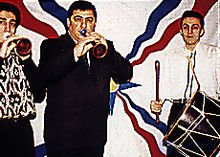
Assyrians playing instruments: the zurna and the davul
By the method of sound production, instruments are classified as string, wind, keyboard, percussion, electronic, and so on. According to the classification system developed by Hornbostel and Sachs in the early 20th century, instruments are divided according to two main criteria: the source of the sound (membrane, string, air column, and so on) and the method of sound production (bowed, plucked, reed, and so on).
The physical basis of a musical instrument that produces musical sounds (with the exception of digital electrical devices) is a resonator. This may be a string, a column of air within a certain volume, an oscillating circuit, or some other object capable of storing the energy supplied to it in the form of oscillations. The resonant frequency of the resonator determines the fundamental tone (first overtone) of the sound produced. An instrument can produce as many sounds simultaneously as there are resonators mounted within it. Sounding begins the moment energy is introduced into the resonator. The resonant frequencies of the resonators of some instruments can often be changed smoothly or discretely while the instrument is being played. Damping can be used to forcibly stop the sound.
Zoomusicology — is the study of the music of non-human animals, or of the musical aspects of sounds produced by non-human animals. As George Herzog (1941) asked, «do animals have music?» François-Bernard Mâche, in his book «Musique, mythe, nature, ou les Dauphins d'Arion» (1983), a study of «ornitho-musicology» using the technique of paradigmatic segmentation analysis from Nicolas Ruwet’s «Langage, musique, poésie» (1972), shows that birdsong is organized on the principle of repetition-transformation. Jean-Jacques Nattiez (1990) argues that «it is ultimately the human being who decides what is musical and what is not, even when the sound has no human origin. If we accept that sound is not organized and conceptualized (that is, not created so as to form music) solely by its producer, but also by the mind that perceives it, then music is a uniquely human entity»

Song sparrow
The best-known form of music found in non-human animals — is birdsong. Birdsong differs from ordinary sounds. A call, for instance, usually just conveys a direct message. A bird's alarm call, for example, may be used to draw attention to an approaching predator. A song, on the other hand, contains more repetition and generally has a clear structure with a distinct beginning, middle, and end. In many songbird species, songs appear to be used both to attract potential mates and to mark and defend territory. Young songbirds have been observed to acquire the ability to sing by imitating adult birds. There appears to be a critical period for song learning. In one experiment, birds raised in isolation (which included isolation both from other birds and from the vocalizations of other birds) were compared with those raised in a colony, without such isolation. Using fMRI scanning and blood-oxygen-level-dependent (BOLD) measures of brain activity, it was found that birds raised in isolation showed no apparent preference between their own song and a repeated song. Birds raised in colonies, meanwhile, showed a stronger response to playback of their own song.
Several species of birds can mimic the songs of other birds, or even mechanical sounds. These include, with varying degrees of success, starlings, mockingbirds, thrashers, crows and ravens, parrots, mynas, blue jays, lyrebirds, Lawrence's thrushes, Acrocephalus, marsh warblers, and others. Mozart kept a starling that could mimic some of his musical works.
Music created by artificial intelligence (AI) is a relatively new but rapidly developing field within musical art. Modern algorithms and programs that use machine learning and neural networks are able to analyze vast arrays of data on existing musical works and, on this basis, generate new compositions that can be just as expressive as works written by human composers.
Artificial intelligence can create music in a wide variety of styles, from classical and jazz to pop, rock, and electronic music. In this process, AI studies the patterns, structures, harmonies, rhythms, and tempos of various musical styles, and then generates new works using these elements. This makes it possible to create compositions that may resemble the works of well-known composers, or be entirely unique, unlike anything found in nature.
A distinctive feature of AI-created music is its capacity for endless variety and rapid adaptation. For example, AI can be trained on the music of one era and then switch to a different style or genre, producing works that surprise and inspire. Programs such as OpenAI’s MuseNet and Jukedeck allow users to enter parameters such as style, mood, instruments, and the length of a composition in order to obtain the desired result.
Music created by AI is also used for commercial purposes, for example, to produce background music for videos, advertisements, and games. Such pieces can be generated in real time, making it possible to provide adaptive, individualized musical solutions for a variety of needs. AI is also frequently used for compositions that must accompany visual projects, such as animations or films, where the musical score has to match rapidly changing conditions.
On the other hand, the use of AI in music raises important questions about creativity, copyright, and the role of the human being in art. Although AI can create music that sounds remarkable and can be complex in structure, the question arises whether it possesses a soul and the human element inherent in works created by musicians and composers. Moreover, some musicians and critics believe that AI is incapable of replacing the creative inspiration and profound understanding inherent in the human process of making music.
Nevertheless, artificial intelligence is expanding the boundaries of musical creativity, opening up new possibilities for experimentation and collaboration. Musicians can use AI as a tool for generating ideas, creating new arrangements, and experimenting with unusual musical structures. AI can become a companion, rather than a replacement, in the creative process, helping musicians push the boundaries of their own imagination.
On the whole, music created by artificial intelligence represents an exciting and innovative direction that continues to develop. It opens up new prospects for both professional musicians and music lovers, offering tools and opportunities for creating new sonic landscapes and exploring new creative horizons.

Chinese (Naxi) musicians
According to the Norwegian researchers Are Brean and Geir Skeie, the most important role of music lies in the awareness of oneself as part of a whole. This function developed over the course of Homo sapiens evolution and is transmitted at the genetic level.
In humans, listening to music may be accompanied by euphoria caused by the release of dopamine in the striatum of the brain
.
It has been established that in humans, rabbits, cats, guinea pigs, and dogs, exposure to music can alter blood pressure, increase heart rate, and reduce the rhythm and depth of breathing movements, even to the point of a complete stop in breathing. In dogs of the pinscher group of breeds these changes are more pronounced than in other dogs (blood pressure shifts by 70 mm of mercury).
In humans, according to various studies, listening to certain classical music compositions can produce a short-term (on the order of 10 minutes) improvement in spatio-temporal perception, sometimes referred to as the Mozart effect.
Extreme music leads to an increase in aggressiveness, accompanied by an elevated heart rate during listening. However, in people with heightened aggressiveness, heavy music does not produce this effect and instead evokes positive emotions, which may serve as a good way of releasing anger.
Even within a single species there are differences among animals: a certain proportion are indifferent to music, a proportion are highly sensitive and receptive to it, while some prove capable of active musical creativity.
People suffering from amusia are unable to recognize or perform music.
Like other forms of art, music has no pronounced material value, since its immaterial results manifest themselves, above all, in the spiritual life of the individual and of society. By exerting an influence on people's inner world, art is capable of creating or altering moral and spiritual values, possessing a definite content of its own. The effect of music operates on a broad front, influencing not only emotions and feelings, the psyche and bodily motor function, but also touching upon the capacities for intuition, play, contemplation, and fantasy. Hence the frequent treatment of the content of music as that of a sacred art form. The contradiction between music's evident capacity to affect a person and the impossibility of clearly expressing just what content produced that effect has led to considerable diversity in the answers given to the question of what exactly music «says» to a person, what message it contains. Art scholars, thinkers, and composers have offered the following kinds of answers:
Between these two poles there are also intermediate views that attempt to link them together, for example, that «music is a reflection of reality in a person's emotions and ideas», and a separate group of statements can be singled out that reduce music merely to sounds («music is anything that makes a sound»).
The art scholar L. P. Kazantseva offers the following definition of musical content:
In this understanding, the foundation is laid by a system of artistic representations that arise under the influence of music and that together come to form musical content proper. Being a complex product of the activity of the human psyche, these representations have as their objective side the interwoven and mutually interpenetrating concepts of the person, of the surrounding world, and of music itself. The task of music is to generate these representations and to organize them among themselves by means of musical resources and methods. The basic instrument here is intonation, which makes it possible to govern representations, arranging them in the required sequence and concentration. Skillful use of musical material makes it possible to build, out of these representations, generalizations of varying degrees — from musical images to musical-artistic themes and ideas. At the same time, an important feature of music is the continuous reorganization of the system of representations it generates, which, besides a wealth of images, also gives rise to a dynamic engagement, an ability to carry the listener along with it.
A musical work created by a composer is an embodiment of part of their inner world. In reflecting, the author reinterprets the material at their disposal, creating new images. The wealth of material used by a composer is enormous, and in some cases it may even weigh upon the creator, hindering their free creativity. Yet the author cannot exist in a vacuum: one way or another, they are from the outset a bearer of musical cultural traditions and exist within the field of already developed musical forms, styles, pitch systems, genres, techniques, the symbolism of musical instruments, the semantic roles of keys, and so on. If the experience of predecessors is not drawn upon, there is a risk that the musical content of a work will remain unintelligible to the listener, who in fact exists within exactly the same cultural atmosphere. Thus, familiar material helps a work communicate with the listener and can serve as a «delivery vehicle» for the content, the artistic ideas, that the author intends.
The emotional impact of music is one of the subjects of specialized scholarly study within the philosophy of music, the sociology of music, music psychology, music aesthetics, and music pedagogy.
The emotional impact that music has on listeners has been studied by specialists over a long period of time
Research in this area shows that the character of music's emotional impact on different people follows quite definite psychological regularities
The American music theorist Jerrold Levinson holds that, in terms of its expressiveness, musical language is just as much a semiotic system of communication as ordinary, conceptual language.
At the same time, as corresponding experiments have shown, all elements of the musical language — melody, harmony, rhythm, timbre, loudness, texture, tempo, and so on — possess considerable potential for emotional impact
Contemporary music psychologists have developed fairly effective methods for testing this impact.
At present there are two approaches to interpreting the emotional impact of music: the «cognitivist» and the «emotivist». Cognitivists maintain that music is only capable of artificially «modeling» emotions. Emotivists, by contrast, insist that the emotional reactions that music evokes in listeners are entirely real.
In the contemporary world, music and creativity have become an integral part of everyday life. Modern technologies allow people to create, record, and share music with audiences around the world. This opens up new possibilities for self-expression and interaction with others. At the same time, music and creativity remain not only a means of conveying emotion but also a powerful instrument for shaping culture, uniting people, and supporting mental well-being.
продолжение следует...
Часть 1 Musical Art and Creativity: The Emotional Impact of Music, AI Music and AI Musicology


Comments