
Lecture
Communicating emotions is a complex process that involves various channels of communication and techniques that help express feelings and evoke an emotional response in the audience. Here are the main methods that can be used:
Verbal methods of conveying emotions are based on the use of language as the primary instrument for expressing feelings, thoughts, and moods. This is the most direct and universal means of communication, since words possess a powerful capacity to evoke images, associations, and emotions in the listener or reader.
First and foremost, conveying emotion requires choosing words that evoke an emotional response. For example, instead of a neutral description of a situation, one can use emotionally charged expressions. Compare: "A pleasant day" and "A stunningly sunny morning." In the second case, the phrase sounds livelier, brighter, and colored with feeling. Such devices create an emotional connection between the narrative and the listener or reader.
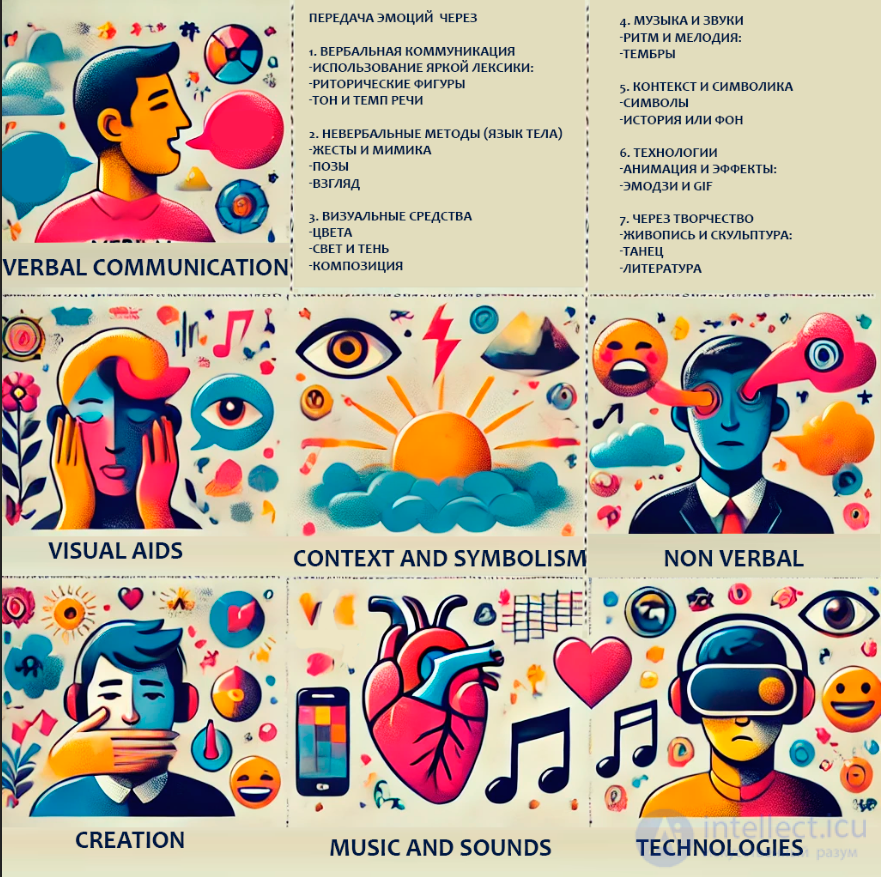
Rhetorical figures play an important role. Metaphors, hyperboles, similes, and other artistic devices heighten expressiveness. For example, "My heart was pounding as though trying to break free" — such a hyperbole allows the reader to feel the character's intense agitation. Such figures not only embellish the text but also make it livelier and more emotionally rich.
Another important aspect is intonation and pace of speech. They set the tone for communication. Intonation can convey joy, anger, sadness, or anxiety. For example, a soft, smooth tone creates an atmosphere of calm and trust, while sharp, clipped phrases may express irritation or impatience. The pace of speech also affects perception: rapid, emotional delivery conveys excitement, delight, or even panicked anxiety, while slow, drawn-out phrasing is associated with reflection or sorrow.
The emotional effect is heightened through repetition, which draws attention to key moments. For example, exclamations such as "This is incredible, simply incredible!" emphasize astonishment. In addition, pauses between words or sentences help create a dramatic effect, giving the listener a chance to absorb what has been said.
The ability to adapt speech to the context and audience is also important. The expression of emotion must be appropriate: excessive emotional intensity can alienate an audience, while its absence can leave them indifferent. Verbal conveyance of emotion is not only the ability to speak, but also the art of choosing words that will resonate in the hearts of listeners or readers.
Non-verbal methods of conveying emotions are based on the use of body language, which often proves more expressive and truthful than words. This is an intuitive mode of communication that allows feelings to be conveyed through movements, postures, facial expressions, and gestures. Such a mode of interaction is especially important when words are insufficient or altogether absent — for example, in silent observation or at a great distance, where the tone of speech loses its significance.
Facial expression is one of the most powerful forms of non-verbal emotional communication. The expression on a person's face can instantly reflect their feelings: a smile conveys joy or friendliness, furrowed brows — displeasure or concentration, and tears — grief or a profound emotional experience. The human face is a universal «screen» for emotions, easily read by those around regardless of their culture or language.
Gestures play an equally important role. Broad, animated hand movements, for example, can signal enthusiasm or excitement, while arms crossed over the chest are often perceived as an expression of closedness, defensiveness, or even hostility. Sometimes even small gestures, such as smoothing one's hair or tapping one's fingers on a table, can indicate anxiety or impatience.
Body postures also convey a wide range of emotional nuances. For example, a relaxed, open posture demonstrates confidence and calm, whereas a tense body leaning slightly forward may signal stress or readiness for conflict. A confident, upright posture expresses strength and resolve, while slumped shoulders or a bowed head convey sadness and fatigue.
Gaze plays a key role in non-verbal communication. A direct gaze into the eyes demonstrates openness, interest, or confidence, while avoiding eye contact may indicate embarrassment, insecurity, or even an attempt to conceal one's true emotions. A prolonged, intense gaze can express strong feelings such as love, hostility, or suspicion.
Movements of the body through space also carry emotional content. Sharp, quick steps signal irritation or impatience, while smooth, measured movements signal calm and relaxation. Even the distance between people during communication matters: close proximity can indicate trust or affection, while distance often signals alienation or discomfort.
Non-verbal methods of conveying emotions are a subtle interplay of details, in which every small element matters. They can sometimes contradict words, revealing a person's true feelings, especially when they are trying to conceal their emotions. For example, a smile may appear sincere, but tension in the voice or an evasive gaze will betray one's genuine state. This is precisely why body language is considered such a truthful and important tool for conveying emotions, one that helps us understand our interlocutor more deeply and establish an emotional connection.
Visual means of conveying emotions play an important role, since they act directly on visual perception, awakening feelings and creating a particular mood. This mode of conveying emotion encompasses everything connected with image, color, shape, composition, and light, and it is widely used in art, design, architecture, and even everyday life.
Color, as one of the primary visual elements, possesses powerful emotional force. Warm shades such as red, orange, and yellow are associated with energy, passion, and joy. They can convey warmth, dynamism, or anxiety. Cool tones such as blue, green, or violet, by contrast, evoke feelings of calm, sadness, or contemplation. The saturation and brightness of colors also affect perception: bright, saturated tones energize, while muted or pastel shades create a sense of tranquility.
Light and shadow help express the emotional depth of an image. Bright, even lighting conveys a sense of happiness, openness, or celebration. The interplay of light and shadow, by contrast, can create drama, mystery, or unease. For example, shadows on a character's face in a film can underscore their inner conflict or doubt, while light falling from a single direction draws attention to specific details and creates emotional tension.
Shape and line in visual images are also capable of conveying emotion. Smooth, rounded lines evoke a sense of harmony, calm, and softness, whereas sharp, angular forms are associated with tension, energy, or aggression. For example, circles and ovals are often used to express friendliness, while triangles or zigzags convey dynamism or danger.
The composition of a visual image — that is, the arrangement of elements in space — directly influences the emotions the viewer will experience. Symmetrical, balanced compositions create a sense of stability and order, while asymmetrical and chaotic ones create a sense of dynamism and unease. Open space, or the lack of it, also plays a role: minimalism conveys calm, while a dense concentration of detail can evoke tension or agitation.
The context in which a visual means is used amplifies its effect. For example, the same color or shape can evoke different feelings depending on how they are presented. Red on a festive greeting card evokes joy and warmth, but on a warning sign it is associated with threat and danger.
Visual means are capable not only of reflecting emotions but also of evoking them, acting on the viewer's subconscious. They create atmosphere, set the tone, and allow one to experience events even when they are presented in a static form. For this reason, their use requires a deep understanding of human perception and careful attention to detail.
Music and sound possess a unique ability to act directly on human emotions, evoking feelings and moods that often bypass conscious perception. They penetrate the deeper layers of the psyche, creating emotional responses that are difficult to put into words. This makes them a powerful instrument for conveying emotion in art, film, theater, and everyday life.
Melody is one of the key components of music that shapes the emotional foundation of perception. Smooth, lyrical melodies convey a sense of calm, tenderness, or sadness, whereas sharp, dynamic, ascending melodic lines create tension, excitement, or joy. A melody accompanying particular events can heighten their significance. For example, a tragic scene in a film seems even more dramatic when accompanied by a piercing melody of string instruments.
Rhythm and tempo in music also play an important role. A fast, intense rhythm energizes and creates a sense of movement and dynamism, while a slow, measured rhythm promotes relaxation or evokes a feeling of longing. The contrast between fast and slow sections within a musical piece creates emotional tension and allows the listener to feel shifts in mood.
Timbre, or the tonal color of instruments, gives a piece individuality and enhances its emotional expressiveness. For example, the violin, with its penetrating sound, is often associated with sorrow or passion, while the sound of a trumpet evokes associations with heroism or triumph. The sounds of percussion instruments add drama and tension, while the soft sounds of a flute or harp create an atmosphere of lightness and tranquility.
Harmony and tonality also affect emotional perception. Major chords and keys sound bright and joyful, conveying optimism and happiness, whereas minor tones evoke sadness, pensiveness, or anxiety. The interweaving of major and minor within a single piece creates complex emotional experiences that draw the listener deeper into the musical fabric.
Sounds themselves, outside of a musical context, carry powerful effects. For example, the sound of rain, the rustling of leaves, or birdsong evokes a sense of peace and coziness. At the same time, sharp sounds such as thunder or the screech of metal can evoke anxiety or even fear. Such sounds are often used in film and theater to create atmosphere and heighten the emotional impact on the viewer.
Music and sound are capable not only of conveying emotions but also of creating them. Listening to a piece of music can bring tears, joy, or chills, immersing a person in a profound emotional experience. The sounds of the surrounding world, when framed within a context, also become carriers of emotion — whether it is the joy of a child's laughter or the anxiety evoked by the sound of a siren.
Thus, music and sound are a universal language of emotion, understood by everyone regardless of culture or language. Their power lies in their ability to connect us with our feelings, fill space with meaning, and help express what sometimes cannot be conveyed in words.
Context and symbolism play an important role in conveying emotions, since they create depth and multiple layers of perception. Context is the surrounding environment, situation, or circumstances that frame a message or action, while symbolism involves the use of objects, images, and ideas to express feelings and ideas that are not always explicitly stated in words. Together they intensify the emotional impact, allowing a viewer, reader, or listener to become more deeply immersed in the events being experienced.
Context forms the basis for how emotions are perceived. One and the same event can be perceived quite differently depending on where, when, and under what conditions it occurs. For example, the warm light of a lamp in a cold, abandoned room evokes a sense of coziness and hope, whereas the same light in a crowded, brightly lit setting goes unnoticed and loses its emotional significance. Context helps a viewer or participant intuitively read the mood, underscoring the tone of what is happening.
Symbolism, in turn, acts on the subconscious, linking particular images or elements to deep, archetypal feelings. A red rose, for instance, is almost always associated with love or passion, whereas a wilted flower symbolizes loss or sorrow. Symbols can be either universal or culturally specific, depending on the audience. In one culture the color white may signify purity and joy, while in another it signifies mourning and grief.
Symbolism is reinforced through the polysemy of images, allowing a single element to evoke different emotions depending on interpretation. Rain, for example, can be perceived as a symbol of renewal and cleansing, yet at the same time evoke associations with loneliness and sadness. Such duality makes it possible to create a rich emotional palette that draws the viewer into the depths of their own experience.
Context and symbolism are especially effective when they work together, reinforcing one another. For example, a scene of sunset on a seashore can symbolize the end of something important, a farewell, or a transition to a new stage of life. Adding elements of context, such as a solitary figure against the backdrop of the sunset or the sound of the surf, imbues the symbolism with additional emotional nuance, evoking in the viewer a feeling of melancholy or hope.
These tools are especially valuable in art, literature, film, and theater. They allow authors to convey complex, multilayered emotions without resorting to direct description. A visual image, for instance the silhouette of a tree against a night sky, can become a symbol of solitude, aspiration, or eternity, with each viewer perceiving it in their own way, based on their own experience and mood.
Thus, context and symbolism create a space for emotional interaction between the author and the audience. They do not merely convey emotions but also engage the audience, provoking reflection and personal experience, which makes them a powerful tool for producing a profound and memorable impact.
Modern technologies have opened up new horizons for conveying emotions, turning the interaction between people and information into a deeper and more sensory experience. They make it possible to combine visual, sound, and interactive elements, creating multimodal ways of expressing and perceiving emotions. Thanks to this, technology has become a powerful tool in art, communications, marketing, and even everyday life.
One of the key features of modern technologies is the possibility of immersion. Virtual and augmented reality (VR and AR) can transport a person entirely into a created world, where they can not only see and hear but also experience emotions through interaction with the environment. For example, a virtual tour of a city with historical context can evoke a sense of nostalgia, while a game scene with a dramatic turn can produce a profound emotional experience. Virtual worlds make it possible to create entirely unique conditions in which a person can feel joy, fear, or inspiration as though they were truly living through these events.
Sound and visual design technologies also play a huge role. Modern audio systems make it possible to create three-dimensional, directional sound that intensifies the emotional impact. In cinema or games, for example, the use of spatial sound helps the viewer feel like part of the action, evoking excitement or fear depending on the situation. Visual effects created with computer graphics make it possible to convey complex emotions through dynamic, vivid, and rich scenes that could not be created by traditional methods.
Artificial intelligence technologies open up new possibilities for personalizing emotional impact. In marketing, for example, AI analyzes a user's preferences and offers content that evokes positive emotions or is associated with events that matter to them. In art and design, algorithms create works capable of evoking emotions by reflecting the style closest to the audience. Virtual assistants such as chatbots, through natural language processing, can carry on conversations that convey friendliness or empathy, making interaction with them more emotionally meaningful.
Social networks and messengers have also become a platform for conveying emotions, actively drawing on the capabilities of modern technology. GIF animations, emoji, and stickers turn text communication into a lively, emotional conversation. In addition, video call features with effects, filters, and the ability to overlay augmented reality allow users to express themselves more creatively, strengthening the emotional connection with the person they are talking to.
Another innovative approach has been the use of biometric data to convey and analyze emotions. Special devices, such as smart watches or bracelets, can register pulse, stress levels, or changes in skin conductivity, making it possible not only to analyze current emotions but also to adjust the surrounding environment to a person's emotional state. For example, a smart home can automatically turn on calming music if a person is experiencing stress, or change the lighting to create a more comfortable atmosphere.
Modern technologies do not merely expand the possibilities for conveying emotions; they also make them more individualized, interactive, and precise. They make it possible not only to express feelings but also to evoke them, creating emotional experiences that remain in memory for a long time. This makes technology an important tool for enhancing the human experience, whether in art, education, work, or personal communication.
Conveying emotions through creative work is one of the most ancient and profound ways of expressing a person's inner world. Art makes it possible to go beyond words in order to create a connection between the author and the viewer, listener, or reader on the level of feeling and experience. It is a process in which emotions are transformed into images, sounds, words, or movements in order to evoke similar responses in others.
Creative work makes it possible to give material form to the invisible: joy, sadness, inspiration, anxiety, or love. The artist, whether a writer, musician, painter, or dancer, uses their art as a bridge across which the most complex and subtle emotional states are conveyed. In painting, for example, through the choice of colors, textures, and forms the artist creates not merely an image but an atmosphere capable of evoking in the viewer a sense of delight, melancholy, or serenity.
In literature, the author conveys emotions through words, creating images that come alive in the reader's imagination. Descriptions of nature, dialogue between characters, the tone of the narrative — all of this forms an emotional background that immerses the reader in the characters' experiences. A tragedy or comedy described in a text can bring tears or laughter, because the reader feels a connection to the story, finding in it echoes of their own emotions.
Music, as one of the most universal forms of creative expression, conveys feelings through melody, rhythm, and harmony. It is capable of affecting the listener instantly, awakening joy, sorrow, or even physical excitement. In creating a work, a composer invests it with their own experiences, which then find a response in everyone who listens to that music, regardless of their cultural or linguistic background.
Dance makes it possible to convey emotions through movement. Every gesture, every change of tempo or pose expresses the mood and state of the performer. A dancer tells a story using their body, and that story is capable of inspiring, moving, or provoking reflection. Through dance, not only the performer's personal feelings are conveyed, but also collective emotions, such as triumph or the bitterness of defeat.
The art of theater and film combines many forms of creative expression to produce a powerful emotional impact. Through facial expression, voice, and movement, actors express the experiences of their characters, allowing viewers to feel their joy, pain, or fear. A director, working with the composition of the shot, light, and sound, creates an atmosphere that intensifies the emotions.
Creative work not only conveys emotions but also helps to make sense of them. The process of creating a work of art becomes, for the author, a way of expressing what is difficult to say directly. It is a form of therapy that allows suppressed feelings to be released, understood, and, perhaps, transformed into a source of inspiration.
Viewers and listeners, interacting with a work of art, undergo a unique experience. Creative work becomes a mirror of their own emotions, helping them understand themselves and their relationship to the world more deeply. It is precisely this that makes the conveying of emotions through creative work a universal and eternal process, capable of uniting people even if they have never met and belong to different eras or cultures.
Effectively conveying emotions requires a combination of several methods. The main principle is to take into account the audience, the context, and the goals, so that your emotions are understood and evoke the desired response.
Conveying emotions is a complex and multifaceted process involving a variety of means and methods, from words and body language to art, technology, and symbolism. It underlies human interaction, making it possible not only to express one's own feelings but also to understand others more deeply, find common ground, and create emotional bonds.
Each of the ways of conveying emotions — verbal expressions, nonverbal signals, visual images, music, symbols, or creative work — has unique capabilities. Some focus attention on precision and clarity, others on depth and intuitiveness. Together they form a rich arsenal of tools that help reveal and convey emotions in any context, be it personal communication, art, work, or modern technology.
Emotions conveyed through various means have an enormous influence on how we perceive the world, shaping our attitude toward events, people, and ourselves. It is a universal language that, despite differences in culture, time, or place, remains understandable to everyone. Whether it is a sincere gaze, an inspiring melody, or a moving painting — emotions create an invisible thread connecting people, and allow us to feel part of something greater.
Thus, the ability to express and understand emotions is an important aspect of human existence that brings us closer to one another. It is not only a tool of communication but also a means of self-knowledge, creativity, and interaction with the world. In every form of conveying emotions, from the simplest to the most technologically advanced, lies not only the power of impact but also the beauty of what makes us human.

Comments