•The ideal is a precise and clear language. Through style, any subject can be made beautiful. Style – an absolute way of seeing the world. Taste – an autonomous faculty with its own laws.
•Only the artificial can be beautiful. «Nature is usually wrong.» «The more we study art, the less we care for nature.» → An experience is the more valuable the more artifice it contains. → Any violence done to nature is art. The idea of beauty is born of resistance to the forces of nature. In femininity, what is prized is a distortion of nature.
•Symbolism. The poet – a decipherer of symbols. Pleasure lies in the process of guessing, in intimation. «To name an object is to destroy the pleasure of a poem.» Mallarmé, Baudelaire.
•An aesthetics of mystical revelation. Things – a source of revelation. Given the right emotional attunement, things appear in a new light. Ecstasy without God. The joy of experiencing such moments gives meaning to life. Art makes it possible to convey these sensations to others.
In the end, the distinction is best seen in their respective approaches to art. Symbolism is a body of «symbols» that exist not in order to present their own content, but to evoke greater ideas which the symbolism itself cannot express explicitly. According to Moréas, this is an attempt to link the objects and phenomena of the world to «esoteric primordial truths» that cannot be approached directly. [25] [28]
Decadence, on the other hand, is an accumulation of signs or descriptions functioning as detailed catalogues of a person's material riches, as well as a device. [25] It was Oscar Wilde who perhaps articulated this most clearly in the book «The Decay of Lying», proposing three doctrines of art, given here as a list:
- «Art never expresses anything but itself.»
- «All bad art comes from returning to Life and Nature, and elevating them into ideals.»
- «Life imitates Art far more than Art imitates Life»
He then proposed a conclusion diametrically opposed to Moréas's quest for a hidden truth: «Lying, the telling of beautiful untrue things, is the proper aim of Art.»
Decadence versus Symbolism
Symbolism was often confused with the decadent movement. Arthur Symons, a British poet and literary critic and a contemporary of the movement, at one time regarded decadence in literature as a parent category encompassing both symbolism and impressionism, as revolts against realism. He defined this common decadent thread as «an intense self-consciousness, a restless curiosity in research, an over-subtilizing refinement upon refinement, a spiritual and moral perversity.» He called all such literature «a new, beautiful, and interesting disease.»[17]Later, however, he described the decadent movement as «an interlude, half in mockery of itself,» which distracted critics from seeing and appreciating the broader and more important tendency represented by the development of symbolism.[22]
It is true that the two groups shared an ideological origin in Baudelaire, and for a time they both considered themselves part of a single sphere of new literature directed against the establishment. They worked together and met together for quite some time, as if they were part of one movement.[21] Maurice Barrès called this group decadents, but he also called one of them (Stéphane Mallarmé) a symbolist. Even Jean Moréas used both terms for his group of writers as early as 1885.[14].
It was only a year later, however, that Jean Moréas wrote his Symbolist Manifesto, in order to mark the difference between the symbolists with whom he had allied himself and the new group of decadents associated with Anatole Baju and Le Décadent .[14] [19] Even after this, there remained enough shared interests, methods, and language to blur the boundaries far more than the manifesto might suggest.[14]
In the world of visual art, distinguishing decadence from symbolism can be even harder. In fact, Stephen Romer called Félicien Rops, Gustave Moreau, and Fernand Khnopff «symbolist-decadent painters and engravers.»[23]
Nevertheless, there are clear ideological differences between those who continued to be symbolists and those who were labeled «dissidents» for remaining within the decadent movement.[24] There was often little doubt that Baju and his group were producing decadent works, but the work of the symbolists more often raises questions.[14]
On a website connected to a course at Stanford University, Dr. Petra Dierkes-Thrun's «Oscar Wilde and the French Decadents» (2014), a student named Reed created a blog post that forms the basis for much of what follows.[25]
Criticism of Decadence
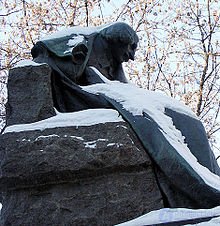
An «Art Nouveau» monument to Gogol
Decadence was criticized, on the one hand, by conservatives in art (both academicists and naturalists) and moral conservatives, and on the other hand by evolutionists and progressives of every stripe. The latter category includes, in particular, Marxist authors.
For Trotsky, the roots of decadence lay in the desire of a portion of the intelligentsia to escape from «turbulent social contradictions» into a world of pure art . According to Plekhanov's explanation, even if the literary development of Russian decadence did not yet fully correspond to the system of capitalist relations then existing in Russia, its roots should be sought in the conditions of the reaction of the 1880s and early 1890s.
The evolutionist Max Nordau reinterpreted the term «decadence» in a biological sense, using it to designate the pathological signs of psychophysical degeneration in the sphere of culture. After the publication in 1892 of Nordau's treatise of the same name, «degeneration» became a fashionable buzzword of the age. Nordau, a physician, campaigned against it on hygienic grounds .
Neo-Decadence
Decadent ideas found new relevance at the close of the twentieth century. In particular, certain traits of decadent aesthetics were inherited by gothic post-punk. A characteristic example is the album Disintegration by The Cure (1989). Music critics likewise applied the term decadence to the work of Joy Division , which released two studio albums and had a substantial influence on the formation of the gothic rock genre. The bands «Agata Kristi», «Dead Can Dance», «Obermanekin», «Piknik», and others called their own work decadence. In cinema, decadence was compared to the post-Soviet «chernukha» genre («The Green Elephant»); critics called Alexei Balabanov's film «Of Freaks and Men» (1998) «a text of the age of Petersburg decadence» .
In February 1999 the writer Marusya Klimova and the artist Timur Novikov organized the post-punk festival «Dark Nights», which was held in the concert hall of the Petersburg Zoo . A second festival took place a year later at the Petersburg club «Decadance». These provocative and noisy events became a kind of manifesto of the independent art of St. Petersburg and Moscow, tracing its origins to the Soviet-era underground[10]. Decadence, as a contemporary mood, subsequently absorbed features of glamour and gothic style. These styles, popular at the start of the century, were brought together at the decadent festivals known as «Velvet Underground».
Decadence in Painting
- Aubrey Beardsley and Harry Clarke, the canonical illustrators of Edgar Allan Poe.
- Nicolas Kalmakoff
- Sergei Lodygin
- Michael Hutter, especially his series on Carcosa and Kranzedan.
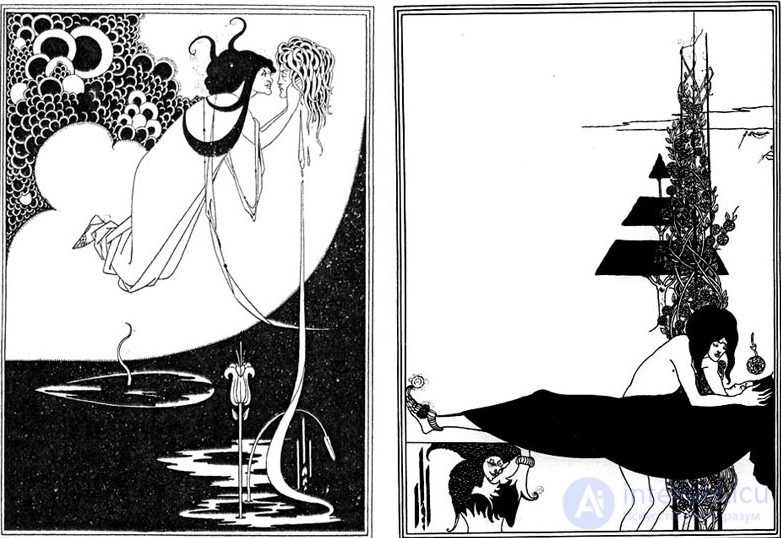
Aubrey Beardsley. «The Climax», «The Platonic Lament». 1894
Decadence in Literature
- Joris-Karl Huysmans, «Against Nature». The bible of French decadence and naturalism.
- Oscar Wilde — «The Picture of Dorian Gray». The bible of British decadence, one that also absorbed much from the example above and from Gothic novels.
- Jules Barbey d'Aurevilly, «The She-Devils» — naturalistic novellas with a healthy dose of black humor and nostalgia for the Napoleonic era.
- Alexander Grin, «The Grey Automobile» — surprisingly, for an idealist and romantic, a rather grim story about an animated wax figure.
- Characteristic attributes of the era turn up in his other works as well: for instance, «The Zurbagan Lodge of the World Theosophical Union» from the story «The Lion's Blow».
- Anatoly Umansky, «Grand Guignol» — a young hero befriends a winged, blood-drinking gargoyle — an actress from a dreadful theater (having watched the bloody performances at this theater, people would later go on to commit murders IRL). The action takes place against the backdrop of Russia in the early twentieth century.
- Alexander Chayanov, «The Tale of the Hairdresser's Mannequin, or the Last Love of the Moscow Architect M.» — similarly, a story about love for a doll.
- Sigizmund Krzhizhanovsky, «The Wandering ‘Strange’» — about a hero who travels into the micro-world by means of magic vials of potions: yellow, blue, and red, and there meets the card King of Hearts, zlydni (a kind of household evil spirit), a sandman who lives inside a clock, and the very hours, minutes, and seconds living there, who look like living creatures with stingers. On the whole, the piece is somewhat reminiscent of «Alice in Wonderland», and is moreover written in an ornate, florid language in the spirit of the avant-gardists and OBERIU. It crops up in his other works too — Krzhizhanovsky was not for nothing inspired by Gogol, Hoffmann, and Edgar Allan Poe.
- Georgy Peskov aka Elena Deysha, «Evil Eternity» — about the strange adventures of a Russian émigré prince in Paris, where he falls in love with a doll from a shop window, encounters a bearded witch-shopkeeper, and very nearly sells his soul to the devil… or does it all just seem that way to him?
- M. Bulgakov, «The Master and Margarita» — Woland's ball is done in this style.
-
- Jean Ray.
- David Lindsay, «A Voyage to Arcturus» and «The Haunted Woman». «A Voyage to Arcturus» — essentially the first swallow of the weird genre, blending religious-mystical themes with science fiction; a source of inspiration for Tolkien and C. S. Lewis.
- The action takes place mostly on the planet Tormance. Sound familiar? Quite right — Yefremov held Lindsay's work in very high regard.
- Also Hanns Heinz Ewers, a master of «black fantasy», a cabaret scriptwriter, a friend of Aleister Crowley, openly gay, and a member of the NSDAP.
- And also Stefan Grabiński, the «Polish Lovecraft»; many of his stories are tied to railways and trains.
- L. A. Lewis, «Tales of the Grotesque».
- Comte de Lautréamont aka Isidore Ducasse, «The Songs of Maldoror» — a textbook mind-warp with a villain protagonist, brimming with absurdity and strange symbolism.
- Arthur Machen, «The White People». Now that's where you'll find both «immanent mandrakes» and a «hyacinthine Pegasus»!
| « |
In here I shall also write down many of my old secrets, and a few new ones besides. But there are some I shall not write down at all. I mustn't write the real names of the days and months, which I learned last year. I mustn't mention, either, how to write the Aklo letters, or how to speak the Chian language, or how to draw the great beautiful Circles, or how to play the Mao Games, and, of course, I mustn't sing the chief songs. I can write about all these things in general, but not about how to do them. There are special reasons for that. And I mustn't tell, either, who the Nymphs are, or the Dols, or the Jilo, or what «voolas» means. All these are the most secret secrets, and I am happy when I remember who they really are, and how many wonderful languages I know. But there are things I call the most secret secrets of all the secret secrets, which I don't even dare to think about unless I am quite alone, and then I close my eyes, and put my hands over them, and whisper the word, and Alala comes. I only do this at night in my own room, or in certain woodland places that I know, but I mustn't describe them, because they are secret places. And then, besides, there are the Ceremonies, all of which are very important, though some are more important and more beautiful than the others. There are White Ceremonies, and Green Ceremonies, and Scarlet Ceremonies. The Scarlet Ceremonies are the best of all, but there is only one place where they can be properly held, though one may play at them very nicely in all sorts of places, only it is not the real thing. |
» |
| — From the heroine's diary |
- Lovecraft, too, often resorted to this style, especially in works where the mystical outweighs the science-fictional. His sonnet cycle «Fungi from Yuggoth» pushes it to the absolute limit:
| « |
In my hands there lay the key to the land of visions — of sunset spires, of twilit groves, of things that lurk beyond the edge of dimension, scorning the might of earthly laws…
|
» |
| — And this is only the beginning |
- Vladimir Solovyov, on the other hand, disliked the trope and sometimes parodied it in his verse (see the epigraph).
- Hermann Hesse's «Steppenwolf». From an opponent of decadence at the start of the book, Steppenwolf turns into its supporter by the end, embracing a life lived to the full.
- Valery Bryusov's «The Fiery Angel». It is stylized as a much earlier era (16th-century Germany), yet it is full of allusions to later literature (Goethe's «Faust», for instance) and disguised autobiographical details reflecting the realities of early-20th-century Moscow bohemia and the tangled relationship between Bryusov, Nina Petrovskaya, and Andrei Bely. As Bely himself put it on the matter:
| « |
In transposing old Cologne onto the everyday life of Moscow, Bryusov himself would at times lose the boundary between life and fiction; thus in his imagination Muscovites came to live as contemporaries of the mage of Nettesheim, of Erasmus and Doctor Faustus; the country between Cologne and Basel became the country between the Arbat and Znamenka. |
» |
| — |
Decadence in Film
- «Eyes Wide Shut» — Kubrick's adaptation of Schnitzler, with the action transposed from early-20th-century Vienna to late-1990s New York. It features a closed club reminiscent of the Bohemian Grove, and reality is scarcely distinguishable from a dream.
- David Lynch's «Mulholland Drive» — the protagonist, the actress Betty, unexpectedly runs headlong into exactly this underside of Hollywood. The most striking scene is set in the club «Silencio».
- «To Catch a Monster» — a rather second-rate imitation of «Mulholland Drive», which likewise features a closed club where actresses are (mock-)murdered onstage. The protagonist's mother takes a job there.
- «The Suicide Club, or the Adventures of a Titled Person» — a gloomy late-Victorian London, decaying aristocrats bored with life, mysterious decadent clubs where people play cards for their lives…
- «Mister Designer» — an adaptation of «The Grey Automobile», with the action moved to Russia of 1908—1914; the atmosphere of the period is very well conveyed.
- Alain Robbe-Grillet's «La Belle Captive» — a mind-bending art-house thriller in which the line between the real and the unreal is blurred to the extreme, and the setting mixes contemporary realities (nightclubs, highways, a Renault sign) with the age of decadence (spiritism, candles in antique candelabra, secret rituals at an old villa).
- Andrei Kharitonov's «Thirst for Passion» — an adaptation of stories by Valery Bryusov; it combines the atmosphere of Russian decadence with stylistic borrowings from Western thrillers and giallo.
Decadence in TV Series
- Babylon Berlin — present almost everywhere, though rather as «a testament to the era». Just consider the epic séance scene at Tristan Rot's mansion.
- Vertinsky — likewise. Rumor has it that its director, Avdotya Smirnova, «wanted to make her own Babylon Berlin».
- Penny Dreadful — séances, Egyptomania, sinister witches' covens, Grand Guignol-style theatre, demonic forces after the soul and the love of a fatal beauty… A series based on Victorian-era horror novels could hardly do without this style. Its sequel, Penny Dreadful: City of Angels, is already noir crossed with magical realism.
Decadence in Animation
- The Soviet «The Stork Caliph», of course! A textbook example straight out of the reference standard. Deliberately mannered draftsmanship, a whimsical interweaving of Near and Far Eastern motifs, an anemic, effeminate caliph and his ghastly metamorphoses under a magic powder, and the wretched animals bewitched by the evil sorcerer — simply the pinnacle of decadent style.
- Also Soviet: «Hell», by the master of grim satire Rein Raamat.
- Vladimir Samsonov's «Sonata» — an absurdist, gloomy animated film with an obscure plot, in which one can make out certain architectural and stylistic attributes of the era.
Decadence in Video Games
- Surprisingly, the Russian adventure game «Agent: Special Assignment». The plot is fairly simple (a criminal intrigue in a post-Soviet resort town with no hint of the mystical), but the aesthetic of the town clearly falls under the trope: Gothic angels, sphinxes, palm trees against an eternal autumn.
- «Petka and Vasily Ivanovich Save the Galaxy» — a White Guard brothel is a parody of the trope. The atmosphere of a decaying aristocracy pushes it to its absolute limit: there are dark-skinned waiters, palm trees, and ornate Art Nouveau sculptural compositions.
- Pathologic (Mor. Utopia): everything connected with the Utopian faction (the Kains, the Stamatins, and Olgimsky Jr.). Occultism, schizo-tech, schizo-art, a bohemian lifestyle, and grand ambitions.
- Cultist Simulator — the club «Ecdysis», on whose stage ghastly rites are conducted under the guise of ornate performances.
Decadence in Audio Dramas
- Alexander Dugin's program «Finis Mundi», half steeped in the style of the 1990s. Especially on-topic were the episodes about the notorious Jean Ray and Lautréamont.
Decadence in Music
- A meta-example. Many strands of rock music, from their origins to their arrival in the mainstream, bear a certain kinship to decadence and its aesthetic. But in most cases it is the genres prefixed «post-» and «gothic-» that are classed as twentieth-century neo-decadence.
- But it is specifically the sound tagged Neoclassical or Ethereal that is usually associated with decadence — something along the lines of Dead Can Dance, Nox Arcana, Abandoned Toys.
- Darkwave as a genre is made up of almost nothing else.
- Sopor Aeternus, Malice Mizer, and their Russian followers Otto Dix. The trope is most fully realized in Sopor's album Les Fleurs du Mal and in Malice Mizer's Merveilles (the latter featuring Gackt).
- Christian Death and other classics of death rock.
- Gothic metal as a genre is unthinkable without this trope, at least in its lyrics, cover art, and sometimes the musicians' stage costumes.
- Playing it straight — Theatre of Tragedy and Lacrimosa: for them it is a key part of their image. Downplayed — Type O Negative and Tiamat (only in the lyrics, and even there often with irony).
- Doom, symphonic metal, and prog bands indulge in this too.
- Cradle of Filth's lyrics simply revel in this aesthetic, though their music would probably send a 19th-century listener into culture shock.
- Indeed, among symphonic black metal acts (Dimmu Borgir, Illnath, Anorexia Nervosa, Hecate Enthroned…) the trope is just as popular as the snowy North, Vikings, and burning churches are among their more trve brethren. It is hard to sing about Gothic aristocrat-vampires, secret rites in occult societies, and mysticism of every sort without slipping into the corresponding style.
- Agatha Christie — also fond of this. But they used the style in moderation and often with irony.
| « |
Oh, decadence, chance encounters,
A card table, preferans, candles burning,
A record spinning on the gramophone,
The goyim sit and listen… to Sting |
» |
| — «Agatha Christie», «Decadence» |
- Obermanekin — a musical synonym for the word «decadence» in this country, widely known in narrow circles.
- Alexander Vertinsky (his Pierrot persona) — a fine poet and performer of the age when decadence was in full bloom. Though originally his image of the «weary old clown» was purely a parody.
- The trope also strongly influenced the work of Orgiya Pravednikov.
- Piknik — they don't shy away from this style either. Lyrics that aren't immediately clear, ornate musical devices, schizo-art cover art — decadence through and through. There's even an album called «Singer of Decadence».
- Alexander F. Sklyar occasionally works in this genre — the album «Witches and Bitches», set to lyrics by the aforementioned Golovin, deserves special mention.
| « |
And sinister as ash, straightening her white comb, the dead maidservant enters and passes into the study, and a painted bird circles pensively — a painted bird on a window that does not exist.
|
» |
| — More or less everything in that vein |
- Also worth mentioning is an '80s singer-songwriter known under the pseudonym Hans Sievers (the pseudonym honoring the aforementioned decadent writer Hanns Heinz Ewers and the Ahnenerbe's Secretary General Wolfram Sievers). Here, for instance, is how it sounded — and hiding behind that pseudonym was, believe it or not, none other than Alexander Dugin.
- Linda regularly drifted into this territory.
- The Kyiv indie-rock band Vivienne Mort, especially their early work, with cabaret melodies and ornate lyrics that do violence, in the most elaborate way, to literary Ukrainian, common sense, and logic. Their latest albums — «ROSA» and «Dosvid» — are simpler and more lyrical, but a hint of the trope remains.
- From the earlier Ukrainian alternative scene — Yulia Lord. Just her collaboration with Skryabin on the song «Brudna yak anhel» speaks for itself, starting with the title. And Kuzmenko himself, in the first half of his career, leaned that way too.
- «Dorevolyutsionny Sovetchik», at least in some of its songs («Apothecary's Morphine», «Maxim the Machine Gun», «Dreams of Kislovodsk»).
- Singer-songwriter Pavel Kashin cherishes this trope. Pretentious lyrics about alcohol, passion, and death are performed to mincing waltzes and tangos. To one degree or another this applies to his whole body of work, but the song «Baryshnya», set to the rhythm and tempo of a hysterical waltz, pushes it to the absolute limit:
| « |
Give me your hand, it isn't easy now
To walk on tiptoe through the clear air
A meter above the leprous earth.
I shall provide you with your soaring
Through secret vows and assurances,
Sun and wind in a glass of dry Chablis. |
» |
| — Pavel Kashin, «Baryshnya» |
- The band «AukcYon». Post-punk, psychedelia, and jazz elements. Just take a look at the cover of the album «Chainik Vina»…
- The song «Decadence» by the Belarusian band «Silver Wedding» (who play in a cabaret style). A parody.
- Very popular in j-rock and visual kei. Among music fans there's a stereotype that if a j-rock band isn't playing something poppy with wild kitsch (oshare-kei) or something in the alternative vein (Nagoya-kei), it's most likely going to be symphonic power metal, gothic metal, or art rock in the decadent style. In reality there are far more subgenres of j-rock/visual kei than that, but there's a grain of truth in the stereotype. Examples: Versailles (and all the work of guitarist Hizaki and vocalist Kamijo before and after the band), D, Moi dix Mois (and Mana's other projects), as well as hundreds of other bands. There's no listing them all.
- Versailles, admittedly, embody the aesthetic of the French Revolution more than anything else, but Kamijo's solo work (the kitschy «Moulin Rouge», for instance, or the lyrical «Mademoiselle»), as well as his work with Lareine, where he blended, without dilution, Sisters of Mercy-style gothic rock with French chanson, fit the trope perfectly.
See Also
- Absinthe
- La Belle Époque
- The Pre-Raphaelite Brotherhood


Comments