
Lecture
The problem of solid waste appeared together with humankind, but in ancient times it was, in essence, a problem of refuse, i.e. of what we now call municipal solid waste (MSW). Only later were solid industrial wastes (SIW) added to it, which usually also include the waste of agricultural production.
Attempts to combat the accumulation of waste were noted even in deep Antiquity. Thus, on Crete, 3000 years BC, solid waste was placed in pits and covered in layers with earth. Among the Romans, the Code of Justinian I (6th century) for the first time recorded measures protecting citizens from the accumulation of refuse. But, on the whole, the Romans limited themselves to dumps around cities and villages. Such a practice was the main one in other countries as well — until the 19th century.
The first steps toward waste recycling were taken in New York in 1895...1898, on the initiative of G. Waring — the commissioner of the street-cleaning department. He installed trash bins differing in shape and color for the various waste components.
But to this day the main method of waste removal remains its deposition in dumps without any treatment (attempts to spray disinfectants in the USA only aggravated the harm from dumps), or in special landfills with partial measures to protect the environment.
Every year in the Russian Federation about 7 billion tons of all kinds of waste are generated, of which only 2 billion tons, or 28.6%, are used. Moreover, the fight against one type of waste often generates another. Thus, when refuse is incinerated at special plants, extremely harmful substances are released into the atmosphere, while capturing them produces components no less harmful, in the form of sludge, ash, etc.
About 80 billion tons of solid waste have accumulated in dumps and storage sites across the country's territory, of which more than 1.4 billion tons are toxic. Each year about 10 thousand hectares of land are officially allocated just for dumps and landfills of municipal solid waste.
The situation with solid waste that has developed in the Russian Federation represents a real threat to public health and reflects one facet of the ecological crisis the country finds itself in.
By waste, according to N.F. Reimers, one understands, in the general case, types of raw material unsuitable for producing a given product, unusable residues, or substances and energy. Below only solid wastes are considered, which are subdivided into industrial (SIW) and municipal (MSW).
Industrial waste (or production waste) is the residue of raw materials, materials, and semi-finished products formed during the manufacture of products or the performance of work, which have wholly or partly lost their consumer properties. With a certain degree of convention, consumption waste can also be attributed to SIW — articles and machines that have lost their consumer properties as a result of physical or moral wear.
Municipal (household) waste — solid substances not utilized in daily life, formed as a result of the wear of household items and of human life itself. Recently the solid component of municipal wastewater — its sediment — has also been included in MSW.
1 - The most important characteristic of waste is its density p. Low initial density limits the possibilities for transporting solid waste and
|
Type of waste |
Mass, |
Composition of waste, in % |
|||||
|
W |
C |
|
O. |
S |
|
||
|
Paper, cardboard |
35.6 |
2.74 |
20.7 |
2.781 |
19.193 |
0.0547 |
0.1366 |
|
Food waste |
23.7 |
2.17 |
4.13 |
0.574 |
2.73 |
0.0248 |
0.2772 |
|
Wood |
2.5 |
0.09 |
1.43 |
0.178 |
1.26 |
0.0033 |
0.0089 |
|
Metal |
8.2 |
10.13 |
0.5 |
0.067 |
0.481 |
0.0011 |
0.0056 |
|
Textiles |
2.3 |
0.08 |
1.1 |
0.152 |
0.995 |
0.0048 |
0.0523 |
|
Leather, rubber, bone |
1.5 |
0.24 |
1.23 |
0.17 |
0.39 |
0.0062 |
0.0205 |
|
Plastics |
1.1 |
0.17 |
0.9 |
0.125 |
0.285 |
0.0045 |
0.015 |
|
Glass |
8.3 |
11.21 |
0.06 |
0.008 |
0.041 |
- |
0.0034 |
|
Other |
17.2 |
2.16 |
5.61 |
0.747 |
4.158 |
- |
0.0825 |
|
Total: |
100 |
23.99 |
35.66 |
4.802 |
29.543 |
0.1372 |
0.9022 |
largely determines the cost of collection and transport. For MSW, reference books give approximate density values from 150 kg/m3 (theaters, cinemas), 170 kg/m3 (hotels), up to 200—300 kg/m3 (residential buildings; the higher figure — with a large amount of food waste), and even 500 kg/m3 (markets). Average annual MSW values for cities are 190...230 kg/m3.
2 - It is precisely cohesiveness that causes MSW to stick to inclined grates even at large angles of inclination and a large spacing between the bars. This same cohesiveness contributes (together with the forces of gravity) to the self-compaction of MSW at rest.
Of the other parameters characterizing MSW, the specific heat capacity value is used in thermal-engineering calculations for various disposal methods. For compost this value is found by the formula:
water — 4,190; wood, cardboard, paper — 2,000...2,500; stones — 800...1,000; iron — 400; aluminum — 860. Given the known percentage mass fractions m of the components, the total heat capacity is easily calculated:
By toxicity, according to N.F. Reimers, one understands poisonousness — the ability of certain chemical elements, compounds, and biogenic substances to have a harmful effect on humans, animals, plants, fungi, and microorganisms. The toxicity of waste is considerably more difficult to determine than that of air or water, since waste acts on organisms, as a rule, indirectly — through the soil. The main parameter determining the harmfulness of a given chemical substance in soil is its maximum permissible concentration in soil — MPC(soil).
|
Substance |
MPC |
Limiting indicator |
|
Benzo(a)pyrene |
0.02 |
General sanitary |
|
Vanadium |
150 |
General sanitary |
|
Lead |
32 |
General sanitary |
|
Hexavalent chromium |
0.6 |
General sanitary |
|
Cobalt |
5 |
General sanitary |
|
Cadmium |
5 |
General sanitary |
|
Mercury |
2.1 |
Phytoaccumulative |
|
Arsenic |
2 |
Phytoaccumulative |
|
Carbophos (malathion) |
2 |
Phytoaccumulative |
|
Chlorophos (trichlorfon) |
0.3 |
Phytoaccumulative |
|
Metaphos (methyl parathion) |
0.008 |
Phytoaccumulative |
|
Gasoline |
0.1 |
Air-migration |
Waste is assigned to a hazard class by experimental or calculation methods. The experimental method is used to assign waste to hazard class V, or when it is impossible to precisely determine the qualitative and quantitative composition of waste of any (of the presumed) hazard classes. It is based on bio-testing of an aqueous extract of the waste.
Waste Hazard Classes
|
No. in order |
Degree of harmful effect of hazardous waste on the environment |
Criteria for assigning hazardous waste to a hazard class for the environment |
Hazard class of the waste for the environment |
|
1 |
VERY HIGH |
The ecological system is irreversibly disrupted. Recovery period is absent |
CLASS I EXTREMELY HAZARDOUS |
|
2 |
HIGH |
The ecological system is severely disrupted. Recovery period is at least 30 years after complete elimination of the source of harmful effect |
CLASS II HIGHLY HAZARDOUS |
|
3 |
MODERATE |
The ecological system is disrupted. Recovery period is at least 10 years after the harmful effect from the existing source is reduced |
CLASS III MODERATELY HAZARDOUS |
|
4 |
LOW |
The ecological system is disrupted. Recovery period is at least three years |
CLASS IV SLIGHTLY HAZARDOUS |
|
5 |
VERY LOW |
The ecological system is practically undisrupted |
CLASS V PRACTICALLY NON-HAZARDOUS |
At present solid waste is most often placed (deposited) on the surface of the lithosphere at authorized and unauthorized dumps or landfills (Requirements for them are summarized in the Federal Law of 22.05.98).
Authorized dumps — areas (existing sites) permitted by local executive authorities for the placement of SIW and MSW, but not equipped in accordance with regulatory requirements and operated with deviations from the requirements of sanitary-epidemiological supervision. They are temporary and are permitted until the completion of construction of landfills or waste-processing plants. Dumps also include temporary sludge storage facilities and dumps for SIW. Under the sanitary classification, dumps are Class I facilities and have a sanitary protection zone (SPZ) of at least 1 km. Within the SPZ, residential construction, the placement of sports facilities, parks, preschool institutions, schools, health institutions, food-industry enterprises, and water-supply facility complexes are not permitted.
Landfill — an environmental-protection structure for the centralized collection and neutralization of waste, ensuring protection against pollution of the atmosphere, soils, surface and ground waters, and preventing the spread of pathogenic microorganisms.
Main features of landfills:
compaction of waste, allowing the load per unit area to be increased;
layer-by-layer covering of waste;
measures to prevent the penetration of landfill wastewater into soil and groundwater;
collection of biogas (if necessary).
Work at landfills is fully mechanized, and after their closure the site is reclaimed.
The nature of the soils and the location of groundwater are very important. Clays and heavy loams are best as a landfill base. Groundwater must be at a sufficient depth (taking into account the need to stack waste to a height of at least 1 km — for economic reasons);
All measures to reduce the penetration of external moisture into a landfill can be summarized as follows:
Choice of a site with a minimum of surface and groundwater.
Slope of the cover for drainage of rainwater.
Landscaping of a completed filled section (cell).
Moisture-impermeability of the covering.
Compaction of waste to reduce leaching (alkali is formed primarily due to the inflow of external water).
6. Drainage for ground and surface water.
After a landfill is closed, the site is reclaimed for further use. The main measure is isolation with soil. But even after this, use of the site may not be permitted earlier than a year later.
The service life of a landfill can be increased in two ways: by shredding or by pressing (baling) the waste before its disposal. These methods can also be used together: shredding improves the quality of the bales. Shredding is achieved by grinding or chopping, whereby the volume is reduced (by up to 50%) and disposal is facilitated. The material becomes humus-like, and odor and fire hazard are sharply reduced.
In recent years great attention has been paid to baling waste — pressing it into large blocks, which are then deposited, incinerated, or used in construction. Baling for the purpose of incineration and construction requires preliminary sorting, while for disposal it most often requires only the removal of particularly large items of waste.
Baling allows
the service life of the landfill to be increased (compared with simple burial) by 2...3 times;
operation to be made easier (bales are stacked like bricks);
and wind-scattering of refuse is eliminated;
rodents, flies, and birds are not attracted;
there is no fire hazard (bales cannot be set alight with a blowtorch or gasoline);
water seepage into bales is practically absent (20 times less than for compacted soil);
In the overwhelming majority of cases solid waste is removed by hauling, mainly to uncontrolled dumps — fenced-off areas specially set aside in the suburbs. The waste decomposes there and often catches fire, as a result of which the air is polluted with toxic substances. In addition, harmful substances can be washed out by rain, meltwater, surface water, and groundwater and pollute water bodies and groundwater.
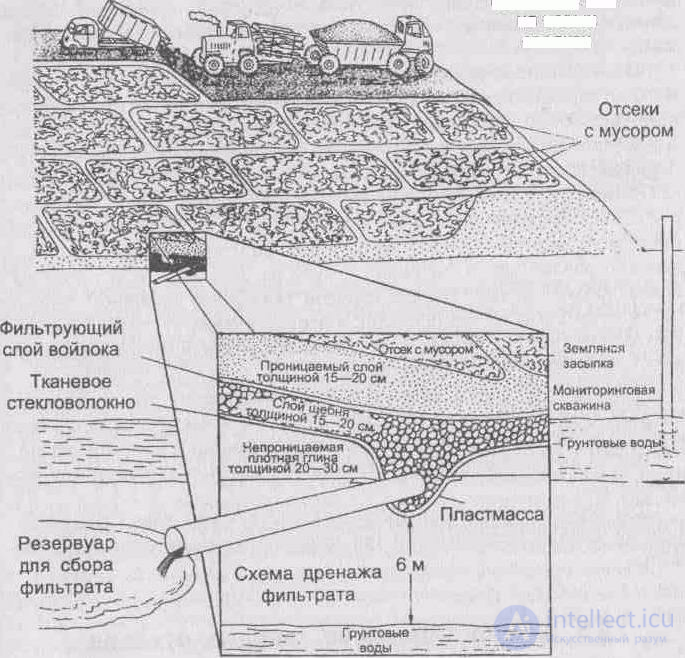
As an alternative, landfills for solid waste are used. For such a landfill a site is chosen, if possible, on clay soil, where waste can be stacked for 20-25 years or more. The base of the chosen area is made in the shape of an enormous trough about 1.5 m deep. When it is not possible to choose a site on clay soil, a water-resistant base is created artificially, and a layer of crushed stone is sometimes applied on top of a compacted clay layer 0.5 m thick, which facilitates the drainage of leachate and methane. Leachate remaining within the landfill does not pollute water bodies or groundwater. In the event of heavy precipitation, the leachate is pumped out from the bottom of the trough by pumps and sprayed over the surface of the waste being laid down. Part of the leachate evaporates, and another part penetrates inside, where it causes a slow biothermal process with a temperature rise to 30°C. Thus no more than 5% of the liquid reaches the bottom.
During the course of a day, waste is hauled to one section of the landfill and compacted by bulldozers in layers up to a height of 2 meters. The following day waste is hauled to another section, while the previous one is covered with an insulating layer of soil 0.25 m thick. Covering with soil and its subsequent compaction prevents air pollution and the spread of rodents and insects.
To reduce the area required, the landfill is loaded in multiple layers (Fig. 4.1). Design schemes allow for a height of 60 m. After the landfill is filled, its surface is covered with topsoil. The landfill is surrounded by boreholes, by means of which groundwater contamination is monitored.
Landfills can have various length-to-width ratios. Their area depends on the population of the city and the height of stacking.
Ravines and other unsuitable land can be used to site solid-waste landfills. After a landfill has been completely filled and covered with topsoil, its surface can be used for parks, gardens, playgrounds, and the like.
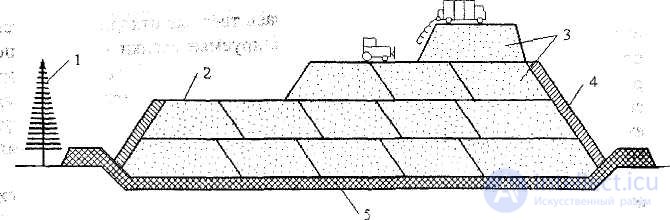
Fig. 1. Schematic cross-section of a solid-waste landfill: 1 - forest-protection belts (green zone); , 2 - intermediate insulating layer;
- waste;
- covering outer layer;
— natural and artificial water-resistant base (clay)
In household and food-industry waste sealed off from contact with air, located in the landfill mounds, an anaerobic process occurs, as a result of which biogas is released (a mixture of methane and carbon dioxide), which can be used as fuel.
The landfills considered are intended mainly for household waste. However, studies have established that part of industrial waste can be accepted at municipal solid waste landfills — namely inert, biologically oxidizable, easily decomposing organic substances, weakly toxic, and poorly soluble in water (more than 10 thousand types in all). Industrial waste is used, as a rule, for constructing intermediate insulating layers.
Let us consider the problems associated with the burial of MSW and so-called burial grounds. These include:
1) leaching of substances and contamination of groundwater;
2) formation of methane;
3) subsidence of the soil.
1 - The most serious of those listed is the first problem. As water seeps through any material, various chemical substances dissolve in it and are carried along with it. Such water, passing through waste, forms an especially poisonous leachate: in it, alongside the residues of decomposing organic matter, are present iron, mercury, lead, zinc, and other metals from rusty cans, spent batteries, and electrical appliances, as well as dyes, pesticides, detergents, and other chemicals. This poisonous solution enters underground aquifers, and from there harmful substances can also get into drinking water.
2 - The formation of methane is the second problem. Since buried refuse has practically no access to oxygen, its decomposition proceeds anaerobically, producing readily flammable methane. It can spread horizontally through the ground, penetrate the basements of buildings, accumulate there, and explode upon sparking or ignition. In the USA there are known cases of the destruction of more than 20 homes located up to 300 m from dumps, and the explosions caused casualties. In addition, methane is capable of spreading upward, poisoning roots and destroying vegetation in the process, as well as causing soil erosion. In a number of cities this problem is solved by installing «gas wells» on the site of dumps, which intercept the methane produced, and which can subsequently be used as fuel or for other purposes.
3 - Finally, over time, as waste decomposes it subsides. This forms shallow depressions in which water collects, and the entire area subsequently turns into a swamp with poisonous water.
All of the above requires new approaches to the design of burial sites.
So-called monitoring wells are installed around the perimeter of a dump for periodic control of groundwater quality
At present, as a rule, the MSW of cities is hauled to landfills, where it is stacked on the ground with a view to its subsequent mineralization. Landfills are sited outside populated areas. Each year about 10 thousand hectares of land suitable for use are alienated for landfills.
On the 16 thousand hectares of land, including fertile land, given over in our country to MSW landfills, 1 million tons of steel, 200 thousand tons of aluminum, and 4 thousand tons of scarce tin are lost every year.
More than 1.5 billion tons of toxic, environmentally hazardous waste have accumulated in Russia, stored in storage facilities, accumulators, warehouses, burial sites, landfills, dumps, and other facilities belonging to enterprises. In large cities and industrial centers the problem of utilizing and destroying toxic industrial waste, which has become a serious source of contamination of soil cover and underground aquifers that serve as sources of drinking water supply, is becoming increasingly acute.
Russia does not have a single enterprise (landfill) for the neutralization and disposal of toxic industrial waste that fully meets the requirements imposed, nor is equipment intended for these purposes manufactured.
Sites of organized storage and disposal of industrial waste often lack the necessary infrastructure to prevent the filtration of harmful substances into underground horizons, soil degradation, and air pollution. In particular, every fourth of the 10 thousand special accumulators operating in the country lacks a protective screen (lining) preventing contamination of aquifers.
Not far from St. Petersburg a powerful chemical «bomb» is stored. Hundreds of thousands of tons of particularly toxic waste containing arsenic and fluorine, mercury and lead, hydrocyanic acid and phosphorus — such is the «arsenal» of the «Krasny Bor» landfill. This landfill, intended for receiving and neutralizing industrial chemical waste, was opened in 1970 as an experiment for a period of only three years, but it is still in use today, even though its capacity has been fully exhausted.
Methods
1- The most promising appears to be the thermal method of neutralizing toxic waste. Technological processes and combustion equipment have already been developed for more than 50 enterprises, and more than 10 installations are in operation.
A technological scheme providing for the joint thermal neutralization of solid and liquid waste in rotary kilns offers broader possibilities. Chamber furnaces have been developed for waste from the production of plastics and synthetic fibers.
Since the processing of industrial waste in Europe requires significant expenditure, a certain specialization exists among countries. Spent nuclear fuel is reprocessed at specialized plants in France and Great Britain (a third such plant is being built in Germany). Almost all European countries send part of their toxic waste to Germany for disposal in depleted salt mines. Advanced technology for the destruction and processing of waste has been developed in Great Britain. The capitalist countries of Europe export about 800 thousand tons of industrial waste to Yugoslavia and Romania.
2 - The cheapest way to get rid of one's waste is export to developing countries. While processing chemical waste in Europe costs between 160 and 200 dollars per ton, exporting 1 ton of waste to Africa costs between 2.5 and 40 dollars. When exporting to African countries, individual European firms covertly shipped out significant consignments of toxic products. After these facts came to light, long-term contracts for the supply of millions of tons of toxic products to Benin and Guinea-Bissau were cancelled.
According to some reports, setting up a dump for poisonous waste on the territory or in the coastal waters of a «third world» country costs Western companies about 3 dollars per ton. And so shipments of this dangerous cargo head toward the shores of Senegal and Madagascar, Benin and Nigeria, Congo, and the Cape Verde Islands.
Recently foreign firms have wanted to site environmentally hazardous enterprises on the territory of Russia, turning our land into a dump for toxic waste. For example, one Swiss firm proposed building a «turnkey» plant for processing toxic waste on one condition: that it process 400 thousand tons of that firm's waste there every year.
In 1995, 200 tons of toxic waste were shipped to Russia from Australia disguised as cobalt-containing secondary raw material. Besides cobalt (13—15%), the «secondary raw material» produced by the Australian company «Pasminco» contained 10—24% lead, nickel, germanium, arsenic, and other highly toxic substances.
3- The main direction in eliminating the harmful effect of toxic industrial waste on the environment is its use in production cycles, i.e. the organization of low-waste production. However, in a number of cases special facilities have to be built to neutralize industrial waste.
These facilities may be under the jurisdiction of the enterprise producing the toxic waste, and are even often located on its territory.
Toxic industrial waste can be stored, processed, and neutralized centrally at landfills and processing and neutralization stations. There are two types of special landfills: those for neutralizing a single type of waste by burial or by chemical means, and complex ones — for neutralizing various types of waste. The territory of complex landfills is divided into zones for the reception and burial of solid non-combustible waste, reception and burial of liquid chemical waste and wastewater sludge not subject to utilization, burial of especially harmful waste, and open-flame destruction of combustible waste. Monitoring of the condition of surface and groundwater, as well as the cleanliness of the air, is carried out within the landfill territories and beyond their boundaries.
Industrial waste is buried in pits up to 10-12 m deep in special containers, for example, in reinforced-concrete tanks. The pits are located in impermeable soils.
The problem of neutralizing and disposing of radioactive waste
- is one of the most burning problems of nuclear power.
Let us examine the issue associated with the disposal of radioactive waste. Waste is generated at all stages of the nuclear fuel cycle: mining, raw-material processing, and manufacture of fuel elements (fuel rods). In addition, radioactive isotopes are used in medicine, biology, and industry. Owing to the high concentration of energy in nuclear fuel, the amount of waste generated, compared with other industries, is relatively small, but nevertheless there are quite a few problems here.
The very technology of extracting the waste, its concentration, pressing, and encasing in cement, bitumen, or glass blocks
- is an entire branch of the nuclear industry. Even more complex and costly is incineration technology. The flue gases produced are cleaned by adsorption and filtration methods, while the ash, contaminated with radionuclides, is subjected to cementation, bituminization, or vitrification.
The main contribution, of course, comes from nuclear power plants. Spent working channels — fuel rods — occupy a special place; they contain highly active fission fragments, as well as unburned uranium and accumulated plutonium. They represent the most active type of waste, and therefore require special treatment. Today fuel elements are disposed of, most often right on the territory of the nuclear power plant. They are stored in an aqueous medium at a sufficiently large distance from one another. In this way two goals are achieved: the heat released by the continuing radioactive decay is removed, and the emergence of a critical assembly capable of causing an explosion is precluded.
Another disposal technology. The working channel is freed from structural elements that do not have as high an activity as the nuclear fuel: casings, covers, caps, etc. Only the fuel rods remain. To make them take up less space, they are, for example, twisted into bundles, placed in a copper container, filled with lead, closed with a lid, and welded shut. Copper corrodes weakly, so the container can remain unchanged for hundreds or even thousands of years. True, over time pinholes may form in the metal and the seal may be broken. These containers are stored on the ocean floor, in deep geological formations, and in salt mines.
Salt has plastic flow properties. Under the effect of the heat released by the radioactive waste, the salt melts around the container, providing additional protection. The problem is not limited to the choice of burial site, since a repository is an engineering structure requiring control systems, ventilation, engineering and technical utilities, and so on.
On the whole, the question of where to store waste that will remain radioactive for many millennia is still far from resolved.
A more advanced method of neutralizing and using solid waste is processing it into compost. Composting consists of the natural biological decomposition of organic matter in the presence of air. The final product is a humus-like substance that can be used as organic fertilizer. Since household waste consists 60-80% of organic matter (paper, food waste), it too can be composted. Two methods of composting are currently used: field composting and processing at special plants.
In field composting, refuse is kept in a moist but well-aerated state, which leads to the decomposition of organic refuse into a humus-like mass. Rows of refuse are loosened and turned over by a special machine to accelerate composting.
Under plant conditions, a continuous composting process takes place with aerobic oxidation in a rotating inclined drum. From the receiving hopper, refuse is fed by a metering device in an even layer onto a conveyor, from which scrap metal is extracted by magnet and by hand. The mass then passes into rotating drums, built on the basis of cement kilns, in which the process of converting refuse into compost takes place. The drum is filled to 2/3 of its volume, and air is fed into it by a special fan. The waste remains in the drum for three days, during which it makes up to 2000 revolutions. The process takes place with the release of heat, owing to which the composted mass is disinfected. After additional separation of metal, the mass reaches a special device (screen), where non-compostable waste is separated out: rubber, leather, textiles, non-ferrous metals, and polymer
materials. In the process of oxidation of waste in the drum, gaseous decomposition products and foul-smelling substances are released, which are directed to the boiler-house furnace.
The compostable material passes to a shredder, where the particle size is reduced to 25 mm, and that of glass to 3 mm. In this form the compost can be used in agriculture. It contains (calculated on dry matter) about 1% nitrogen and 0.3% each of phosphorus and potassium, as well as the trace elements needed for feeding plants.
Non-compostable waste goes to a pyrolysis furnace, in which, without access to air, its thermal decomposition takes place. The result is tar, gas, and a solid carbonaceous residue — pyrocarbon. The gas and tar are used as energy fuel, while the pyrocarbon is used in the metallurgical industry.
Even with sufficient area available for new landfills, the system itself is unsustainable. In the end, humanity may end up with a landscape covered in «pyramids» of waste and hundreds of thousands of people servicing the landfills.
A way out of this situation can be secondary processing of waste — recycling. There are many methods for the secondary processing of various types of waste. Let us name the most widely used technologies:
- waste paper is shredded into pulp, from which various paper products are manufactured;
glass is crushed, melted, and made into new containers, or crushed and used instead of gravel or sand in the production of concrete and asphalt;
plastic is remelted and made into «synthetic wood», resistant to biodegradation and possessing enormous potential as a material for various fences, decking, posts, railings, and other outdoor structures;
metals are melted down and reprocessed into various parts — this saves up to 90% of the electricity needed to smelt metal from ore;
food waste and garden refuse are composted to produce organic fertilizer;
textiles are shredded and used to give strength to recycled paper products;
- old tires are remelted to manufacture new rubber products.
Besides these, there are hundreds of other industrial methods of waste processing.
Practically 30 to 50% of the organic matter present in sewage flows ends up in raw sludge, which settles out in settling tanks and at other stages of treatment. It is a thick, black, foul-smelling mass, consisting of approximately 98% water and 2% organic matter, which includes numerous pathogenic organisms. After appropriate treatment, humus can be obtained from it and used as fertilizer.
Sludge treatment is based on feeding it to bacteria and other detritivores. This can occur in two ways:
in the absence of air — anaerobic digestion;
in the presence of air — composting. I. Anaerobic digestion.
Raw sludge is placed in large sealed tanks. In the absence of oxygen, bacteria feed on the sludge (anaerobic digestion), producing biogas as a by-product. It contains carbon dioxide and substances that give the effluent a foul smell, but consists of practically 60% methane. This last circumstance makes it possible to use biogas as fuel. In practice it is used to heat the tanks themselves in order to maintain the temperature optimal for the organisms — about 38°C.
Digestion is completed in 4-6 weeks, and treated sludge — an aqueous humus solution — remains in the tanks. This solution can be used to fertilize agricultural fields and lawns directly in liquid form, since both the humus and the water rich in biogenic elements are beneficial. The treated sludge can be filtered to obtain a semi-solid humus cake, though along with the filtered water most of the biogenic elements are lost, which reduces the nutritional value of the cake.
II. Composting.
For composting, raw sludge is filtered, mixed with wood shavings or another material to improve aeration, and stacked in heaps or composting rows. Aeration is enhanced by additionally supplying air or by mechanical mixing. In the compost heaps, bacteria and other reducers and detritivores
process the organic matter into a humus-like mass. The heat released during respiration turns out to be sufficient to kill pathogenic organisms. After six or eight weeks of composting, the humus, ready for application to fields, is separated from the wood shavings.
In recent years the joint composting of municipal solid waste and sewage sludge has been increasingly developed. This technology promotes the enrichment of the compost with microflora and trace elements and makes it possible to maintain the biothermal process in an optimal regime. It is accompanied by heating of the mass to 60-70°C. In the process most pathogenic microorganisms, helminth eggs, and fly larvae are killed.
Biogas is a mixture of 65-75% methane and 20-35% carbon dioxide, along with insignificant amounts of hydrogen sulfide, nitrogen, and hydrogen. The calorific value of biogas depends on the ratio of methane to carbon dioxide and amounts to 5-7 kcal/m3; 1 m3 of biogas is equivalent to 4 kWh of electricity, 0.6 l of kerosene, 1.5 kg of coal, and 3.5 kg of firewood. Untreated biogas is used domestically for heating homes and cooking food, and is also used as fuel in stationary installations generating electricity. Compressed gas can be transported and used (after preliminary purification) as fuel for internal combustion engines. Purified biogas is similar to natural gas.
Bacterial communities
group — destroyer microorganisms causing hydrolysis of complex organic matter with the formation of organic acids (butyric, propionic, lactic), as well as lower alcohols, ammonia, and hydrogen;
acetogens, converting these acids into acetic acid, hydrogen, and carbon oxides
methanogens — microorganisms that reduce acids, alcohols, and carbon oxides with hydrogen to methane:
In methanogenesis processes the most varied raw material can be processed — various plant biomass, including wood waste and inedible parts of agricultural plants, waste from the processing industry, specially grown crops (water hyacinth, giant brown algae), liquid waste from agricultural farms, industrial and municipal effluents, sludge from treatment facilities, and even refuse from municipal dumps.
Methane tank (digester)
Methane tanks (digesters), made of metal or reinforced concrete, can have various shapes, including cubic and cylindrical. The designs and details of these installations vary somewhat, mainly depending on the type of raw material being processed.
A methane tank is a sealed vessel, partially buried in the ground for thermal insulation and equipped with devices for the metered feeding and heating of raw material, as well as a gasholder — a vessel of variable volume for collecting gas. A very important aspect of the design of methane tanks is ensuring the required level of mixing of the highly heterogeneous contents of the apparatus.
Depending on the type of starting material being digested in the methane tank, the intensity of the process, including the feed rate and completeness of processing, as well as the composition of the biogas produced, vary significantly. The material mixture is usually seeded with acetogenic and methane-forming microorganisms from the settled digested mass of a previous cycle or from another methane tank.
The temperature, and consequently the rate of the process, depends on the type of methanogenic community used. For thermophilic organisms the process takes place at 50-60°C, for mesophilic organisms at 30-40°C, and about 20° for psychrophilic organisms. At elevated temperatures the rate of the process is 2—3 times higher compared with mesophilic conditions.
Stages of Fermentation
In the course of digestion of the organic mass, in the first, so-called «acid» phase, the pH of the medium decreases as a result of the formation of organic acids. With a sharp shift of the medium's pH toward the acidic side, inhibition of the methanogens is possible. Therefore the process is conducted at pH 7.0-8.5. Lime is used against acidification. Liquid manure waste, rich in nitrogen-containing components, is diluted with chopped straw or various pomace.
The processes occurring during methane fermentation are endothermic and require an external supply of energy in the form of heat. To heat the loaded raw material and stabilize the process temperature at the required level, part of the biogas produced is usually burned. Depending on the process temperature, the amount of biogas used for heating the process can reach 30% of the volume produced.
Raw-material loading rates in existing methanogenesis processes range within 7-20% of the substrate volume relative to the bioreactor volume per day. The cycle time of the process is 5-14 days.
Thermal methods of neutralizing solid waste can, in turn, be conditionally divided into two groups: thermal destruction (pyrolysis) of waste to obtain solid, liquid, and gaseous products, and the open-flame method (incineration), leading to the formation of gaseous products and ash.
1 - In layer (bed) incineration, in the furnace of an incineration boiler, in the first zone (layer) the release of volatile products occurs; as the temperature increases, gasification of the waste occurs, followed by a layer of burning coke. Incineration should take place at a temperature of 800—1000°C.
Although incineration of raw waste is a simple and universal method of waste utilization, it has a number of drawbacks, the main one, as already noted, being a large slag residue, a high level of dioxin and acid gas formation, which are released at the gasification stage and lead to air pollution due to the high moisture content when the proportion of food waste is large (above 40%). For these reasons, in practice the furnace temperature does not exceed 550°C.
2. A more modern method of incineration — is incineration in a fluidized bed. The operating principle of fluidized-bed reactors consists in feeding combustible gases (air) through a layer of inert material (sand with particle sizes of 1—5 mm), supported by a grate. Waste entering the reactor is intensively mixed with the inert layer, which significantly intensifies heat exchange. The temperature in the reactor ranges from 800 to 990°C depending on the material of the inert layer.
The main advantages of this method include: intensive mixing of the solid phase, leading to practically complete temperature equalization, low hydraulic resistance of the bed; absence of moving and rotating parts; and the possibility of automating the neutralization process.
Pyrolysis — a thermochemical process in which the organic portion of waste decomposes and useful products are obtained under the action of high temperature in special reactors. The following variants of the method exist: oxidative pyrolysis with subsequent combustion of pyrolysis gases, and dry pyrolysis.
Oxidative pyrolysis — is the process of thermal decomposition of waste with its partial combustion or direct contact with fuel combustion products. The gaseous decomposition products of the waste mix with the combustion products of the fuel or part of the waste, so at the outlet of the reactor they have a low calorific value but an elevated temperature. The gas mixture is then burned in ordinary furnace devices. In the process of oxidative pyrolysis a solid carbonaceous residue (coke) is formed, which can subsequently be used as solid fuel or for other purposes. Oxidative pyrolysis is usually carried out at 600—900°C (waste heating temperature). When pyrolysis gases are burned, the flue gases are less contaminated with fly ash and soot than with direct incineration of waste, which simplifies the cleaning system. In pyrolysis, for example, toxic hexavalent chromium is converted into non-toxic trivalent chromium.
Dry pyrolysis — is a method of thermal waste processing that provides for its highly effective disinfection and use as fuel and chemical raw material, which contributes to the creation of low-waste technologies. Dry pyrolysis refers to the process of thermal decomposition of waste, solid or liquid fuel, without access to oxygen. Dry pyrolysis of waste produces pyrolysis gas with a high calorific value, liquid products (tar, insoluble oils, organic compounds), and a solid carbonaceous residue (pyrocarbon).
Pyrolysis makes it possible to eliminate solid and paste-like waste without preliminary preparation. It is also very important that this method makes it possible to eliminate waste with elevated moisture content, waste «inconvenient» for incineration.
But for these facilities too there exists a dioxin hazard. In Russia, systematic determinations of dioxin contamination have not been carried out.
The dioxin hazard forced the Government of the Russian Federation in 1995 to adopt a special targeted program, «Protection of the Environment from Dioxins and Dioxin-like Toxicants», which provides not only for control-monitoring measures. If a waste-incineration plant nevertheless operates on unsorted refuse (the result of bulk collection of waste from refuse chutes), then it is necessary to:
1. Ensure combustion at a temperature of not less than 920°C with a small excess-air coefficient (up to 1.6). Have a system for regulating these parameters.
Thoroughly mix the MSW in the combustion chamber and keep it in the main combustion zone with the highest temperature for at least several seconds.
Exclude the removal and uncontrolled use of slag and ash after incineration. Store them with the greatest precautions.
4. Ensure the maximum possible purification of combustion products from gaseous organic substances.
The dioxin hazard remains the main obstacle to waste incineration. Recently economic obstacles and international agreements on reducing greenhouse gases (of three or more atoms) have been added to this.
продолжение следует...
Часть 1 Lecture 5. Protecting the Environment from Solid Waste, Waste Disposal and Recycling

Comments