
Lecture
The Earth's atmosphere is the gaseous envelope surrounding the Earth. The atmosphere is considered to be the region around the Earth in which the gaseous medium rotates together with the Earth as a single whole. The mass of the atmosphere is about 5.15x10¹⁵ tons. Numerous observations show that the atmosphere has a clearly defined layered structure.
The atmosphere consists of the following main layers:
• the troposphere - the surface layer of the Earth, 8-18 km high. It contains 80% of the mass of the atmosphere. The height of the troposphere varies from 8-10 km in the polar latitudes, to 12 km in the temperate latitudes, to 16-18 km at the equator. The troposphere is turbulent (chaotic vigorous movement of air layers); water vapor and natural and anthropogenic dust are concentrated in it. As a result of condensation of water vapor on dust nuclei, clouds form and precipitation falls in the form of rain, hail and snow, and weather phenomena develop.
• the stratosphere is bounded by a height of 50-60 km above sea level. The stratosphere is characterized by weak air currents, a small amount of cloud cover, and a constant temperature (-56°C) up to 25 km, after which the temperature rises and at the level of 46-56 km reaches 0°C. In the upper part of the stratosphere, at a height of 20-25 km, the maximum concentration of ozone is observed, which absorbs most of the sun's ultraviolet radiation and protects living nature from its harmful effects. Ozone is a derivative of molecular oxygen. Ozone forms with the help of solar radiation and electrical discharges. The thickness of the ozone layer, depending on latitude and season, varies within 0.23-0.52 cm. The ozone layer is mobile. In summer there is more of it and it is higher, in winter the opposite. The largest amount of ozone is found in the zone of tropical forests, the smallest in the latitudes of the Arctic and Antarctic;
• the ionosphere reaches a height of 1000 km. It has increased ionization of gas molecules. This layer protects the biosphere from the harmful effects of cosmic radiation and affects the reflection and absorption of radio waves. Auroras arise in it;
• the exosphere - the layer of the atmosphere located above 800 km and extending to 2000-3000 km. Here the temperature exceeds 2000°C, and the speed of gas movement approaches the critical value (11.2 km/s). In this scattering sphere, hydrogen and helium atoms dominate, forming a corona around the Earth extending to a height of 20 km.
The ground-level part of the atmosphere, in which most organisms live, is a mixture of molecular, dissociated and ionized gases located at different heights, between which reactions constantly take place. The main constituent parts of the atmosphere are divided into three groups: permanent, variable and random.
The first group includes: oxygen (21% by volume), nitrogen (about 78%) and inert gases (about 1%).
The second group includes: carbon dioxide (0.02 - 0.04%) and water vapor (up to 3%).
The third group includes random components (pollutants).
The mass of the atmosphere is very small compared to the mass of the Earth, making up a millionth of it, but despite this the role and significance of the atmosphere in nature is enormous. The atmosphere provides the possibility of life on Earth: for example, a person can live about 5 weeks without food, 5 days without water, only 5 minutes without air, and without the ozone shield no more than 7 seconds. Given that a person consumes on average 1.0 kg of food, 2.5 liters of water and 12 kg of air per day, it becomes clear that clean air is the most important ecological factor in the life of living organisms.
The atmosphere regulates the thermal regime of the Earth. The average temperature of the Earth thanks to the atmosphere is 15oC; without it, daily fluctuations on our planet would be within 200°C. The atmosphere shapes the climate and weather on Earth, protects living organisms from falling meteorites, and distributes light flows. The air breaks up sunlight into millions of small rays, scatters them, creating even illumination to which most living organisms are adapted. Without the atmosphere, silence would reign on Earth, since air is a good conductor of sound. Finally, the atmosphere affects the regime of rivers and the soil-vegetation cover. Air currents participate in the formation of landscapes.
By pollution is meant the introduction into the environment, or the appearance in it, of new, usually uncharacteristic physico-chemical and biological substances and agents that have harmful effects on natural ecosystems and humans.
There are natural and artificial (anthropogenic) sources of atmospheric pollution. Natural pollution of the atmosphere occurs during volcanic eruptions, weathering of rocks, dust storms, forest fires (arising from lightning strikes), the release of sea salts, and evaporation of swamps. Aeroplankton is constantly present in the atmosphere - bacteria (including pathogenic ones), fungal spores, plant pollen, etc.
Anthropogenic pollutants are introduced into the atmosphere as a result of human activity. They are divided into:
Biological pollutants - production wastes associated with organic substances, including bacteria and viruses;
Chemical - changing the chemical properties of the environment (chemical elements, acids, alkalis);
Mechanical - not interacting with the environment (dust, soot, aerosol, etc.);
Physical - thermal, noise, light, electromagnetic, radioactive;
Microbiological - vaccine, serum, medicine of microbial origin.
By aggregate state, all pollutants are divided into solid, liquid and gaseous, with the latter making up about 90% of the total mass of substances emitted into the atmosphere.
Sources of atmospheric pollution are shown in the diagram.
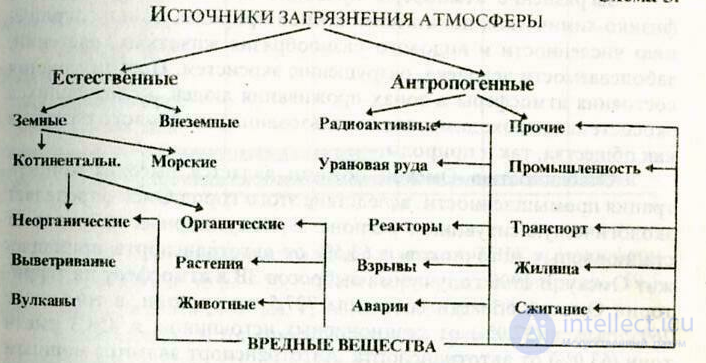
Natural sources of pollution are distributed evenly over the surface of the planet, and they are balanced by the exchange of substances. The real danger is posed by anthropogenic sources of pollution. They emit an enormous amount of poisonous substances into the atmosphere, and this amount grows every day. There are many sources of anthropogenic atmospheric pollution that cause disturbances of the ecological balance in the biosphere. However, the two most significant of them are: transport and industry. A thousand cars with carburetor engines emit about 3 tons of carbon monoxide, 100 kg of nitrogen oxides, and 500 kg of incomplete gasoline combustion compounds per day.
When burning fossil fuels (coal, oil, gas), most of the sulfur contained in them is converted into sulfur dioxide.
Industry is a source of various pollutants entering the atmosphere. Above all, these are sulfur dioxide, carbon oxides, ammonia, hydrogen sulfide, phenol, chlorine, hydrocarbons, carbon disulfide, sulfuric acid, fluorine-containing compounds, aerosol dust, heavy metals, radioactive compounds and many other harmful substances. In addition to emissions of chemical substances, serious atmospheric pollutants include emissions of large amounts of water vapor, noise, electromagnetic radiation, and thermal pollution, including emissions of heated air.
A feature of the Omsk region is a high concentration of industry, as a result of which the city of Omsk determines the ecological situation in the region: 89.4% of total emissions from stationary sources and 63.5% from motor transport belong to Omsk. In 2002, the total amount of emissions into the atmosphere on the territory of the Omsk region amounted to 660 thousand tons, including 240 thousand tons (37.0%) from stationary sources, and 420 thousand tons (63.0%) from motor transport. Motor transport is a powerful source of pollution of the surface layer of the atmosphere, surface and underground water, and soil. Exhaust gases of motor vehicles contain more than 200 toxic substances. In terms of emissions from motor transport, Omsk ranks 4th, and in terms of total emissions - 3rd after St. Petersburg, Moscow and Chelyabinsk.
In first place for industrial emissions into the atmosphere are enterprises of the electric power industry (thermal power plants, boiler houses) - 58%, followed by oil refining - 25.0%, machine building - 3.6%, chemical and petrochemical - 3.4%.
1. Thermal power plants (TPPs) and boiler houses of the city emit carbon monoxide and carbon dioxide, oxides of sulfur and nitrogen, methane, dust, soot, ash, arsenic, heavy metals, sulfurous anhydride, oxides of nitrogen and carbon, as well as acetonitrile, methanol, catalyst dust and others into the atmosphere.
The total number of pollutant emission sources at enterprises is 689, of which 456 are organized, and 53 are equipped with treatment facilities.
In 2000, more than 55.0 thousand tons of such substances entered the city's atmosphere.
2. The oil-refining industry ranks second after the electric power industry in the amount of pollutants emitted into the atmosphere of Omsk. The main air pollutants in this industry are saturated and aromatic hydrocarbons.
3. The chemical and petrochemical industry of the city is represented by such large enterprises as JSC "Omsk Kauchuk", JSC "Omskkhimprom", JSC "Omsktekhuglerod", JSC "Omskshina", the Omsk branch of JSC "Uralskiye Samotsvety", and LLC "Zavod Kolorit".
From these enterprises, pollutants such as sulfurous anhydride, carbon oxides, nitrogen dioxide, carbon, alcohols, esters, and organochlorine compounds enter the atmosphere. The largest amount of pollutants in 1998 was emitted into the atmosphere by JSC "Omskshina" - 4.8 thousand tons, and JSC "Omsktekhuglerod" - 3.1 thousand tons.
The main sources of atmospheric pollution at machine-building and metalworking enterprises are: foundries, machining shops, electroplating, painting, and welding shops and sections. Emissions from these enterprises are characterized by the presence of sulfurous anhydride, carbon monoxide, various types of dust and suspended substances, nitrogen oxides, as well as xylene, toluene, acetone and others.
Sulfur dioxide (SO,) (sulfurous anhydride) — a colorless gas with a sharp odor. It forms during the combustion of sulfur-containing fossil fuels, mainly coal, and also during the processing of sulfide ores. It is primarily involved in the formation of acid rain. Global emission of SO2 is estimated at 190 million tons per year. The maximum single-instance MPC for sulfur dioxide is 0.5 mg/m, and the average daily is 0.05 mg/m3.
Prolonged exposure of humans to sulfur dioxide initially leads to loss of taste sensation and constricted breathing, and then to inflammation or edema of the lungs, disruptions in cardiac activity, circulatory disorders and cessation of breathing. It irritates the respiratory tract, causes bronchospasm, especially in high humidity. As a result of the formation of sulfuric and sulfurous acids, carbohydrate and protein metabolism and oxidative processes in the brain, liver, spleen and muscles are disrupted, and the content of vitamins B and C decreases. A relationship has been proven between the frequency of acute respiratory infections and chronic nonspecific lung diseases in adults and children upon simultaneous exposure of the organism to sulfurous anhydride and carbon monoxide.
Hydrogen sulfide is a colorless gas, poisonous, irritating the respiratory tract and eyes. Chronic poisoning causes catarrh of the upper respiratory tract, bronchitis, headaches, hearing impairment, general weakness, digestive disorders, weight loss, anemia, and vegetative-vascular disorders. It is released during the refining of petroleum products and during the decomposition of protein substances.
Nitrogen oxides affect the alveolar tissue, which leads to pulmonary edema and complex reflex disorders; nitrates and nitrites form in the blood, which act on the arteries, causing vascular damage and hypotension, as well as leading to oxygen deficiency.
The amount of nitrogen oxides entering the atmosphere is 65 million tons per year. Of the total amount of nitrogen oxides emitted into the atmosphere, transport accounts for 55%, energy for 28%, industrial enterprises for 14%, and small consumers and the household sector for 3%.
Ammonia. High concentrations cause profuse lacrimation and eye pain, suffocation, severe coughing fits, vomiting, urinary retention, and severe disturbances of breathing and blood circulation.
Nitrogen together with the entire group of inert gases dilutes oxygen to the degree necessary for normal human breathing; without this, life on Earth would be impossible. Nitrogen at high atmospheric pressure has a narcotic effect on the body, manifested as dizziness and memory lapses. At normal atmospheric pressure, elevated nitrogen content causes phenomena of oxygen deficiency, the first signs of which appear when nitrogen rises to 83%, severe forms at 90%, and death occurs at 93% nitrogen content in the air.
Carbon dioxide in terms of its physiological action is a stimulant of the respiratory center; in large concentrations it has a narcotic effect, and also irritates the skin and mucous membranes. At high concentrations (10%, 15%), carbon dioxide causes death from suffocation due to a sharp decrease in oxygen in the air. A fatal outcome can be instantaneous at a high concentration of carbon dioxide (CO2), which occurs in abandoned wells, mines, and cellars.
Carbon monoxide - fast-acting, combines with hemoglobin 200-300 times faster than oxygen. It causes suffocation and paralysis; in severe forms death occurs. A fatal outcome can occur within a few minutes in an unventilated garage while a car engine is running.
Vinyl chloride is released upon heating (from +27"C and above) and when burning polyethylene films and plastic. It is contained in Tetra Pak cartons. It has a delayed-action carcinogenic property. The latent period can last from 10 to 15 years.
Ozone (O3) - a gas with a characteristic odor, a stronger oxidizer than oxygen. It is considered one of the most toxic of all common air pollutants. In the lower atmospheric layer, ozone forms as a result of photochemical processes involving nitrogen dioxide and volatile organic compounds (VOCs). Since VOCs include about 260 chemical compounds, the formation of ozone produces mixtures consisting of hundreds of chemical substances called photochemical "smog".
Asbestos dust contributes to cancerous tumors and pulmonary fibrosis.
Lead is released with automobile exhaust gases and is a slow-acting poison. Symptoms: fatigue, intestinal colic, pale skin, and a dark "lead line" appears along the edges of the gums. Elevated concentrations cause premature birth in pregnant women and impotence in men. Overall, lead, entering the human body, destroys nerve cells and causes paralysis.
Mercury is a poisonous substance contained in used fluorescent lamps, devices, and industrial waste. It destroys the liver and kidneys, and causes miscarriages in women. A special shop at the plant named after Baranov was engaged in the recycling of decommissioned mercury-containing devices and lamps.
Industrial dust, especially ash, contains toxic substances - arsenic, mercury, lead.
Aerosols are solid or liquid particles suspended in the air. The solid components of aerosols in a number of cases are especially dangerous for living organisms, causing specific diseases in people. In the atmosphere, aerosol pollution is perceived in the form of smoke, fog, haze or mist. A significant part of aerosols forms in the atmosphere when solid and liquid particles interact with each other or with water vapor. The average size of aerosol particles is 1-5 microns. The main source of aerosol pollution in the city of Omsk are thermal power plants, cement plants, a carbon black plant, and oil-refining and petrochemical enterprises. Aerosols contain in their composition: iron, manganese, zinc, cadmium, lead, aromatic hydrocarbons, salts of acids and other substances.
Noise - a specific atmospheric pollutant. Noise levels are measured in decibels. The threshold of audibility is 0, the rustle of leaves is 10, a whisper is 25, acoustic noise in a village is 30-55, noise in a city is 30-60 - these are the maximum permissible norms. Elevated and prolonged noise increases arterial blood pressure, causes an increase in cardiovascular diseases, reduces work capacity, and leads to insomnia.
Radioactive contamination.
The radiation background in the city of Omsk in open areas on average is within the range of 10 to 12 micro-roentgens/hour, and in enclosed spaces up to 30 micro-roentgens/hour, which corresponds to the MPC for Russia. However, in 1990-1992, forces of the State Atomic Supervision Committee, while conducting monitoring in the city of Omsk, discovered more than 200 anomalous areas where the radiation background exceeded permissible norms by a thousand times. Zones of ecological disaster were declared: the 4th railway junction, the 14th military settlement, Krasny Pakhar Street, Aviagorodok, the expanded-clay reinforced-concrete products plant, and a number of others.
The causes of radioactive contamination on the territory of Omsk are: lost sources of gamma radiation (devices); unauthorized use of metallurgical slag contaminated with cesium-137; granite crushed stone brought in for construction from the Aysarinsky quarry (Kazakhstan) containing uranium-ore material; warehouses with mineral fertilizers containing the radionuclides Ra-226 and K-40.
All types of solar radiation (from ultraviolet to infrared) reach the Earth's surface and heat it. The Earth's surface re-radiates the previously accumulated thermal energy in the form of infrared radiation into space. The re-radiated infrared radiation is intensively absorbed by certain gases (CO2, methane, NO, freons). These gases, called greenhouse gases, act in the atmosphere like glass in a greenhouse: they freely allow solar radiation to pass to the Earth, but retain the thermal radiation of the Earth. As a result, the temperature of its surface rises, and weather and climate change.
The greenhouse effect refers to the possible increase in the global temperature of the planet as a result of a change in the thermal balance, caused by the gradual accumulation of greenhouse gases in the atmosphere.
The average annual temperature over the last century has risen by about half a degree. It is possible that this is the greatest rate of global change over the past million years. Over 100 years, the level of the World Ocean has risen by 10...15 mm.
Greenhouse gases
The main greenhouse gas is carbon dioxide. Its contribution to the greenhouse effect, according to various data, is from 50 to 65%. Other greenhouse gases include methane (about 20%), nitrogen oxides (approximately 5%), ozone, freons (chlorofluorocarbons) and other gases (about 10-25% of the greenhouse effect)
|
Indicators |
Unit of measurement |
Carbon dioxide |
Methane |
Freons |
Nitrogen oxides |
|
Concentration in the pre-industrial period |
parts per million |
280 |
0.79 |
negligibly small |
0.288 |
|
Concentration in the modern period |
parts per million |
354 |
1.72 |
|
|
|
Annual growth |
% |
0.3—0.5 |
0.5-1.0 |
|
0.2—0.3 |
|
Lifetime |
years |
50—200 |
10 |
130 |
150 |
|
Activity per action |
per molecule |
1 |
25 |
11000 |
165 |
|
Share of the greenhouse effect |
% |
66 |
18 |
8 |
3 |
1. Carbon dioxide. The main anthropogenic source of CO2 entering the atmosphere is the combustion of carbon-containing fuel (coal, oil, fuel oil, methane, etc.). Currently more than 25 billion tons of CO2 are emitted into the atmosphere.
The USA accounts for 23% of CO2, Russia - 19%, Western Europe - 14%, Eastern Europe - 7%.
2. Methane enters the atmosphere during the extraction of gas, oil and coal, the production of biogas, due to the decay of organic residues in flooded rice fields, and the growth in the number of cattle (there are now 1 billion head of cattle on Earth). The concentration of methane in the air grows annually by 1.2—1.5%. It is now 60% higher than it was in the pre-industrial era. By the middle of the 21st century, a doubling of the concentration of methane in the atmosphere is expected.
3. Nitrogen oxides. With the growth in the use of nitrogen fertilizers in agriculture and as a result of the combustion of carbon-containing fuels at high temperatures at thermal power plants, nitrous oxide N2O is emitted into the atmosphere. The concentration of N2O grows by 0.3% per year.
4. The concentration of freons grows at a rate of 4% per year. Overall, by the middle of the 21st century, the greenhouse influence of CH4, N2O and freons may be equal to the effect of a doubling of the concentration of CO2 in the atmosphere.
Forecast
At present, the increase in the concentration of CO2 occurs at a rate of approximately 0.3—0.5% per year. The content of other greenhouse gases is also increasing: methane by 1%, nitrogen oxides by 0.2% per year. According to various sources, a doubling of the content of greenhouse gases, which may occur in the second half of the current century, will cause an increase in the average annual temperature of the planet of 1—3.5°C.
The increase in the concentration of greenhouse gases in the atmosphere has led to the fact that, compared with the pre-industrial period (end of the 19th century), the average air temperature on Earth has risen by 0.5-0.6°C. Over the last 100 years, the thickness of melting ice in the Arctic has decreased by one meter, and the boundary of permafrost is retreating north by 10 km annually. Scientists suggest that by 2025 the Earth's temperature could rise by another 2-2.5°C. Rapid warming of the climate will lead to melting of glaciers and a rise in the level of water in the ocean. With a sea level rise of 1 m, more than 20% of coastal land will be flooded. Many port cities will find themselves under water. Europe will lose 1/4 of its arable land, on which a third of agricultural crops are cultivated.
Global warming of the climate and the resulting rise in the level of the World Ocean is regarded by many scientists as the greatest catastrophe not only for individual ecosystems, but for the biosphere as a whole:
1. In the case of a rise in ocean level of 1.5—2 m, about 5 million km2 of land would be flooded, including the most fertile and densely populated areas. About 1 billion people live on them, and almost a third of the harvest of many agricultural crops is gathered there. Forced resettlement of peoples deep into the continents is fraught with military conflicts and social upheavals.
2. In addition to the rise in ocean level, warming of the climate will be accompanied by an increase in the degree of weather instability, a shift in the boundaries of natural zones, an increase in the number of storms and hurricanes, and an acceleration in the rate of extinction of animals and plants. The consequence of this will obviously be a sharp aggravation of the food problem.
3. A reduction in temperature differences at the poles and the equator (mainly due to stronger warming of the poles) will in turn cause thawing of permafrost soils (there are about 2 million km2 of such soils in Russia) and the release from them of enormous quantities of methane, which will intensify the greenhouse effect. -
4. Climate change may have a negative effect on people's health, both due to increased heat stress in southern regions and due to the spread of many types of diseases.
5. With a rise in ocean level of several meters, cities such as New York, London, St. Petersburg, Amsterdam, Shanghai, Tokyo, and densely populated coastal territories, where 30 to 50% of the world's population live, i.e. billions of people, will be flooded.
6. With rising temperature, the amount of precipitation will also increase. Downpours will flood the tropics. Arid zones will shift north. The area of deserts will increase. Harvests will decrease. Serious climate changes will occur in Scandinavia, Siberia and northern Canada.
7. With global warming of 2°C, the zone of continuous perennial permafrost in our country will cease to exist, and the forest-tundra zone will reach the coast of the Arctic Ocean.
8. For the territory of Russia, such warming will affect the shift of zones optimal for agriculture to the north and an increase in the flow of rivers running from north to south. Along with this, permafrost will begin to thaw in the north and east of Russia, which will complicate the preservation of construction structures erected there.
9. NASA scientists claim that the "greenhouse effect", which causes a rise in the temperature of the atmosphere at the Earth's surface, simultaneously leads to significant cooling of the stratosphere, where ozone is concentrated, which is what causes the thinning of its layer.
Total industrial carbon emissions in Russia in 1990 were estimated at 650-700 million tons. Among the most polluting
the dual-fuel system reduced their carbon dioxide release level by 40—50%.)
1. The IBRD proposes introducing an international program of payments to vehicle owners who achieve a reduction in the carbon dioxide content of exhaust, of 10 dollars for each "saved" ton of carbon dioxide. According to experts' calculations, in Russia the subsidy for each vehicle could amount to up to 3000 dollars. Moscow and other Russian cities would thus gain the opportunity to reduce emissions of carbon dioxide and other toxic substances without their own financial investment.
2. A number of ecologists have put forward the reasonable idea of a "tax on emitted carbon dioxide": a country, regardless of its level of industrial development, would receive a certain quota for tax-free production of CO2. Wealthy states would be able to buy carbon dioxide emission quotas from poorer countries. Such market relationships would help, for example, Brazil obtain funds to fight the destruction of the tropical forest.
A tax on emitted carbon dioxide could also be introduced within countries for individual enterprises and branches of industry. It would also be expedient to introduce a tax on enterprises producing sulfur and nitrogen anhydrides that destroy natural resources and property in other regions of the country and in other countries.
Sweden was the first to introduce a tax on the production of carbon dioxide, in 1990. The Ministry of Environmental Protection set the goal: to reduce CO2 emissions in the country by 2.5% by 2000. A tax was introduced on the burning of coal, oil and natural gas.
3. In Russia, a method of utilizing carbon dioxide using the latest technologies has been developed. Carbon dioxide is extracted from flue gases. The purified carbon dioxide is pumped into storage facilities (gasholders), from where it goes for further processing.
At the next stage, the carbon dioxide is mixed with water vapor and subjected to electrochemical decomposition in the process of electrolysis. As a result of the reaction at high temperature (1100-1150°C), ultra-pure oxygen is released at the anode, and a mixture of carbon monoxide and hydrogen, i.e. synthesis gas, is released at the cathode. This serves as the main raw material for the production of hydrocarbon compounds, the entire spectrum of modern synthetic materials - from synthetic gasoline and diesel fuel to polymer products (plastics, varnishes, paints, solvents, etc.). Synthesis gas can also be used in metallurgy for coke-free production of pig iron.
In the last 15—20 years, a complex and difficult-to-resolve ecological problem of acid rain (pH < 5.0) has arisen. When burning various types of fuel, as well as with emissions from various enterprises, a significant amount of sulfur and nitrogen oxides enters the atmosphere. When they interact with atmospheric moisture, nitric and sulfuric acids form. Organic acids and some compounds are mixed in with them, which together gives a solution with an acidic reaction.
According to calculations, the share of sulfur dioxide in the formation of acid precipitation is about 70%.
Acids fall onto the surface of land or bodies of water in the form of acid rain or other atmospheric precipitation. Cases have been recorded of precipitation falling with a pH of 2.2—2.3, which corresponds to the acidity of vinegar.
The total amount of SO2 and NO2 emissions in the world annually amounts to more than 250 million tons.
In Russia, foci of formation occur on the Kola Peninsula, Norilsk, Chelyabinsk, Krasnoyarsk and other regions.
The negative influence of acid precipitation is diverse: soils, aquatic ecosystems, plants, architectural monuments, buildings and other objects suffer from them to one degree or another.
The effect of acid precipitation on soils is most noticeable in northern and tropical regions. For the former, this is due to the fact that already acidic (podzolic and their variety) soils become further acidified. As a rule, they do not contain natural compounds that neutralize acidity (calcium carbonate, dolomite, etc.). Soils in the tropics, although they have a neutral and alkaline reaction, also do not contain acidity-neutralizing substances (due to intensive and constant washing by rains).
Entering the soil, acid precipitation increases the mobility and leaching of cations, reduces the activity of decomposers, nitrogen-fixers and other organisms of the soil environment. At a pH of 5 and below, the solubility of minerals in soils sharply increases, releasing aluminum from them, which is poisonous in its free form. Acid precipitation also increases the mobility of heavy metals (cadmium, lead, mercury).
The effect of acid precipitation on aquatic ecosystems is very diverse. Acid precipitation, entering water sources, increases the acidity and hardness of water. At a pH below 6, the activity of enzymes, hormones and other biologically active substances, on which the growth and development of organisms depends, is strongly suppressed. The especially negative effect manifests mainly on eggs and juveniles.
Now on Earth there are many thousands of lakes that have practically lost their inhabitants. Almost 20% of the rivers and lakes of Sweden, Norway and Canada have lost more than half of the organisms living in them. Thus, in Sweden, the most sensitive species have been destroyed in 14 thousand lakes, and 2200 lakes are practically lifeless. About 1000 lakes in the USA are noticeably acidified, and more than 3 thousand have acidity unfavorable for many inhabitants.
The effect of acid precipitation and atmospheric pollution on forests promotes the leaching of biogenic elements (especially calcium, magnesium and potassium), sugars, proteins, and amino acids from plants. Acid precipitation damages protective tissues, increases the likelihood of penetration through them of pathogenic bacteria and fungi, and promotes outbreaks in insect populations. Such effects ultimately result in a decrease in the productivity of phytocenoses, and often their mass death. Much data has been accumulated on the negative influence of acid precipitation on plants through the soil, primarily as a result of increased mobility of aluminum and heavy metals. Free aluminum damages young roots, creates foci for infection to penetrate them, and also causes premature aging of trees ("Alzheimer's disease" of trees).
The main "exporter" of acid rain in Europe in the 1980s was Great Britain. Our country receives 8 times more sulfurous gas and 7.3 times more nitrogen oxides than is carried away from its territory to other states.
To reduce emissions of sulfurous gas, the following measures are proposed.
Washing coal after grinding. This leads to the removal of 50—90% of sulfur compounds (pyrite) and to an increase in the cost of electricity by approximately 10%.
Chemical removal of sulfur - desulfurization. In this case, the costs of electricity production will increase by 15—25%. In the USA in 1991, about 50% of the coal used at thermal power plants was treated. In France and Great Britain, all coal is treated.
Replacing coal with low-sulfur fuels: oil and gas.
4. Burning coal in a fluidized bed mixed with sand and lime, which constantly, as it were, boils under the action of air blown in from below. As a result, the sulfur combines with the lime and is removed with the ash.
5. The use of scrubbers - liquid filters containing an aqueous solution of lime, for gaseous combustion products.
The ozone layer is located at a height of 20-25 km above sea level. If compressed, its thickness would be 3 mm. The stratospheric ozone layer protects people and living nature from hard ultraviolet and soft X-ray radiation in the ultraviolet part of the solar spectrum. Every percent of ozone lost on a planetary scale causes up to 150 thousand additional cases of blindness from cataracts, and increases the number of skin cancer cases by 10 thousand. It has been established that hard ultraviolet suppresses the body's immune system.
Ozone - three-atom oxygen molecules - is dispersed above the Earth at a height of 15 to 50 km; the ozone protective shell is very small: only 3 billion tons of gas, with the greatest concentration at a height of 20 to 25 km. If this shell were hypothetically compressed at normal atmospheric pressure, a layer of only 2 mm would result, yet without it life on the planet is impossible.
The launching of powerful rockets, daily flights of jet aircraft in the upper layers of the atmosphere, tests of nuclear and thermonuclear weapons, the annual destruction of the natural ozone generator - millions of hectares of forest - by fires and predatory logging, and the mass use of freon in technology and in perfume and chemical products in daily life - are the main factors destroying the Earth's ozone shield.
In recent years, "ozone holes" with an area of more than 10 million km2 each have arisen over the North and South Poles, and enormous "ozone holes" have appeared over many European countries and over Russia. The destruction of the Earth's ozone shield is accompanied by a number of dangerous obvious and hidden negative effects on humans and living nature.
The ozone hole over Antarctica was first discovered from satellites in 1979.
The area of the ozone hole is growing, and in 1999 the area of the hole increased to 27.3 million km2, which is 1.5 times larger than the area of Russia.
In March 1997, ozone holes appeared over the Leningrad, Pskov and Novgorod regions, as well as over Eastern Siberia, Yakutia and the center of Krasnoyarsk Krai.
US scientists are already predicting that if the trends of ozone destruction continue, then by 2070 the number of skin cancer patients in the USA could reach 40 million people.
In 1996, the Nobel Prize in chemical ecology was awarded to chemist-scientists Sherwood Rowland, Mario Molina from the University of California at Berkeley (USA) and Paul Crutzen from Germany for the scientific hypothesis they put forward back in 1974. Their guess was that the destroyers of ozone were chemical substances synthesized by man, which received the name chlorofluorocarbons (CFCs).
The peak of world production of ozone-depleting substances occurred in 1987—1988 and amounted to about 1.2—1.4 million tons per year. About 35% of the volume produced was accounted for by the USA, 40% by the EEC countries, 10—12% was produced by Japan, and 7-10% by our country.
The mechanism of action of freons is as follows: upon entering the upper layers of the atmosphere, these substances, inert at the Earth's surface, are transformed. Under the influence of ultraviolet radiation, the chemical bonds in CFC molecules are broken. As a result, chlorine is released, which upon colliding with an ozone molecule knocks one atom out of it. Ozone ceases to be ozone, turning into ordinary oxygen. The chlorine, having temporarily combined with oxygen, soon becomes free again and "sets off in pursuit" of the next "victim". Its activity is enough to destroy tens of thousands of ozone molecules.
Freons are able to remain in the atmosphere without decomposing for 70—100 years, so they always reach the ozone layer and destroy it. In doing so, each chlorine atom as a catalyst is capable of destroying up to 100 thousand ozone atoms. Until recently, about 1.3 million tons of ozone-depleting substances were produced in the world. About 35% of the volume produced was accounted for by the USA, 40% by the EU countries,
10—12% by Japan, 7-10% by Russia.
Among other man-made causes of ozone layer destruction is the destruction of forests, as the main suppliers of oxygen to the atmosphere. Ozone destruction has also been recorded during nuclear explosions in the atmosphere, large fires and other phenomena accompanied by the entry into the upper layers of the atmosphere of nitrogen oxides and certain hydrocarbons. It has also been established that flights of supersonic aircraft in the stratosphere and launches of space rockets destroy ozone. Just one launch of the Space Shuttle aerospace system leads to losses of 10 million tons of ozone. 300 such launches per year - and practically all the ozone would be destroyed.
In recent times, scientists have suggested a significant contribution of natural phenomena to the processes of ozone destruction and the emergence of "ozone holes". These include, for example, 11-year cycles of solar activity, the release of ozone-depleting gases (hydrogen, methane) from cracks in the Earth's crust, and the presence of peculiar rising vortices over Antarctica that promote the dispersion of ozone.
Extremely dangerous consequences of the depletion of the ozone shield for humans and many animals are an increase in the number of skin cancer and eye cataract diseases. Due to a decrease in ozone concentration of only 1%, there is an increase in the intensity of UV radiation at the Earth's surface of 15%. This, in turn, according to official UN data, leads to the appearance in the world of 100 thousand new cases of cataracts and 10 thousand cases of skin cancer, and also causes a decrease in immunity in both humans and animals.
In 1987, the governments of 56 countries, including the USSR, signed the Montreal Protocol, under which they undertook to halve the production of fluorocarbons and other ozone-depleting substances within the next decade. Later agreements (in 1990 in London, in 1992 in Copenhagen) contain a call to gradually stop the production of such substances.
By 1996, industrially developed countries had completely stopped production of freons, as well as ozone-destroying halons and carbon tetrachloride. Developing countries will only do this by 2010. Russia - one of the largest producers and consumers of ozone-depleting substances (in 1990 it produced 205 thousand tons of these substances, which amounted to about 20% of the world volume) - due to its difficult financial and economic situation, requested a delay of three to four years.
2. A new refrigeration unit, doing without freon or any other refrigerant, was tested in 1996 at the All-Russian Institute of Light Alloys (VILS). Environmentally clean production of cold was achieved thanks to the use of the Peltier effect. This French scientist established that when an electric current is passed through a semiconductor system, heat arises on one plate of the crystal, and cold on the other. In this case, the more intensively heat is discharged, the faster the cold grows. This effect was first applied in military technology (in guidance systems for combat missiles) and in space technology (cooling of laser guidance devices), but was later used in large refrigerators.
3. Russian physicists (Institute of General Physics of the Russian Academy of Sciences) proposed destroying the very source of ozone destruction, organizing a global cleaning of the atmosphere from freons by acting on it with a microwave discharge. The plasma formed selectively cleans the atmosphere of CFCs.
In 1992, a report of the UN Environment Programme was published. It stated, in particular, that by 2000 the thickness of the ozone layer could decrease by 5—10%. This will lead to an increase in viral diseases, including AIDS, skin cancer (an additional 300 thousand cases annually) and cataracts, disruption of the immune system and growth in the number of infectious diseases, as well as a decrease in agricultural harvests.
продолжение следует...
Часть 1 Lecture 2. The Atmosphere - the Inorganic Air Environment. Air Pollution.

Comments