
Lecture
Это окончание невероятной информации про .
...
the form of a film.
Biofilters are rectangular or round structures with solid walls and a double bottom: an upper one in the form of a grate, and a lower one — solid. The drainage bottom of the biofilter consists of reinforced concrete slabs with an opening area of no less than 5-7% of the total surface area of the filter. The filtering material is usually crushed stone, rock pebble, expanded clay, or slag.
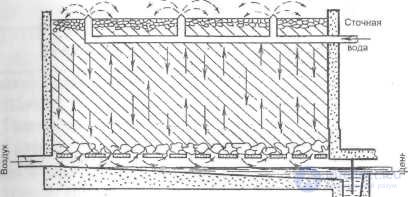
The input flow of pre-settled wastewater periodically and evenly irrigates the surface of the biofilter with the help of a water-distribution device. As the wastewater percolates through the material of the filtering layer, a series of successive processes occurs:
1) contact with the biofilm developing on the surface of the particles of the filtering material;
2) sorption of organic substances by the surface of microbial cells;
3) oxidation of substances of the effluent in the processes of microbial metabolism. Air is blown through the lower part of the biofilter in counterflow to the liquid. During the pause between irrigation cycles, the sorbing capacity of the biofilm is restored.
At present about 70% of the treatment facilities of Europe and America are trickling biofilters. The service life of such bioreactors is measured in tens of years, up to 50.
Aeration tank
Wastewater
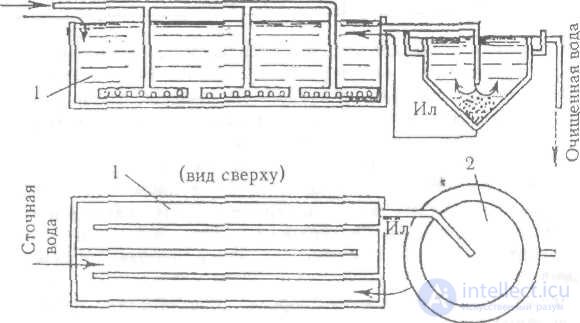
The aeration tank belongs to homogeneous bioreactors. The typical design of the bioreactor is a rectangular reinforced-concrete sealed vessel, connected to a settling tank. The aeration tank is divided by longitudinal partitions into several corridors, usually 3-4.
The process of bio-treatment in the aeration tank consists of two stages.
The first stage consists of the interaction of settled wastewater, containing about 150-200 mg/l of suspended particles and up to 200-300 mg/l of organic substances, with air and particles of activated sludge in the aeration tank for a certain period of time (from 4 to 24 hours or more, depending on the type of effluent, requirements for the depth of purification, etc.).
At the second — separation of water and particles of activated sludge occurs in the secondary settling tank. Biochemical oxidation of the organic substances of the effluent in the aeration tank at the first stage is carried out in two phases: at the first, microorganisms of the activated sludge adsorb the pollutants of the effluent, and at the second — they oxidize them and restore their oxidizing capacity.
Air is supplied to the «corridors» of the aeration tank through porous reinforced-concrete slabs or through a system of porous ceramic pipes. Protozoa consume bacteria and reduce the turbidity of effluent; among them, ciliates (Vorticella, Opercularia) are of the greatest importance.
Activated sludge is a combination of microorganisms and protozoa possessing a set of enzymes for removing pollutants from effluent. Activated sludge also has a surface with strong adsorptive capacity. The concentration of activated sludge in the aeration tank is usually 1.5-5.0 g/l.
Biological (treatment) ponds are used as an independent
treatment facility or as the final point of effluent treatment.
Treatment ponds function as independent water-treatment systems; wastewater, before entering them, is diluted with three- to five-fold volumes of process or domestic-drinking water. The average depth of the ponds is from 0.5 to 1.0 m. The «maturation» period of ponds in temperate-climate zones — is no less than one month.
Translated from Turkic, the word «Irtysh» means «earth-digger». The length of the Irtysh from its sources to its confluence with the river Ob is 4248 km, and within the territory of Omsk - 1192 km. The Irtysh in our region is a typical lowland river; the right bank is high, steep, often cut by ravines, the left is gentle, turning into a plain. The depth of the river at the pools (a section of the riverbed that is deeper compared to those below and above) is 6-15 m, at the riffles - 2-3 m, and the current speed is from 0.5 to 1.5 m/sec.
How dams and reservoirs are harmful:
a reduction in water flow (water content) as a result of the withdrawal of water for electricity generation and irrigation. As a consequence - economic losses: the carrying capacity of shipping vessels decreases: in low-water years, the level of the Irtysh falls from a mark of 3-5 m to 130-195 cm, with the cargo draft of most vessels being 260-280 cm;
the river's floodplain is not flooded, as a result of which the area of water meadows decreases, and, as a consequence, there is a shortfall in fodder for farm animals;
fish productivity decreases due to the shallowing and non-flooding of floodplains (many species of fish inhabiting the Irtysh used to come out onto the sun-warmed shallows of channels and oxbow lakes through the floodplain grass cover to spawn and give life to new offspring.
The Irtysh annually supplies the residents of Omsk with more than 360-370 million cubic meters, most of which is spent on housing and communal services (64%), on the operation of thermal power plants - power engineering (17%), the chemical and petrochemical industry (5-6%), machine building (4.6%), the oil-refining industry (4.3%), and the food industry and transport (1%). Each city resident on average uses 340-360 liters of drinking water per day (worldwide, consumption per resident = 100-150 liters per day).
Pollution of waters. It has been established that more than 400 types of substances can cause water pollution. If the permissible norm is exceeded for at least one of three harmfulness indicators: sanitary-toxicological, general sanitary, and organoleptic, the water is considered polluted. There are chemical (oil, oil products, surfactants, pesticides, heavy metals, dioxins), physical (radioactive substances: strontium-90, uranium, radium-226, cesium; heat, mechanical pollution: ingress of sand, sludge, silt; clogging with solid waste, log rafting) and biological (viruses and other disease-causing microorganisms, protozoa, fungi) pollutants.
In terms of the volume of discharge of polluted wastewater, the city of Omsk ranks 9th in Russia. From 238 to 269 million cubic meters of polluted wastewater enter the region's water bodies, depending on the volume of production, including in the city of Omsk - 200-230 million cubic meters (97.5%), of which 86% is untreated or insufficiently treated. About 100 thousand tons of pollutants enter water bodies with wastewater. The main contribution to the pollution of the Irtysh is made by housing and communal services - 86%, the chemical and petrochemical industry - 2.4%, power engineering and machine building. Power engineering and machine building also supply heavy metals: compounds of copper, iron, zinc, manganese (up to 30 times the maximum permissible concentration).
Characteristic pollutants are oil products, phenols, compounds of copper, zinc, manganese and iron.
Municipal and household wastewater contains various organic substances, as well as microorganisms, which can cause bacterial contamination. The predominant components in the wastewater of the chemical industry can be named as phenols,
oil products, surfactants, aromatic hydrocarbons, inorganic substances;
of the oil-refining industry - oil products, surfactants, phenols, ammonium salts, sulfides.
Часть 1 Lecture 3: Pollution and Protection of the Hydrosphere. Properties of Water, Pollution and Purification of
Часть 2 10. Pollution of surface and groundwater in Omsk - Lecture

Comments