
Lecture
Architecture is the art of creating a materially organized human habitat; on the one hand, it is based on the requirements of convenience, durability, and economy; and on the other, it is called upon to create aesthetically perfect buildings worthy of a socialist society.
The word "architecture" comes from the ancient Greek word "architect", which literally means "chief builder".
The goal is to create functional, safe and aesthetically expressive buildings and structures.
Architecture is a special kind of creative activity and it cannot be identified only with construction technology or only with art. It is unacceptable to neglect aesthetic requirements for the sake of industrialization of construction alone. This provision concerns civil buildings to the greatest extent, since they form the appearance of a city or town, its aesthetic integrity.
The principles of architectural design are the fundamental principles and stages on which the creation of buildings and spaces that meet functional, aesthetic and structural requirements is based.
The most important requirements for the design of housing are to ensure the correct ratio of the areas of living and utility rooms and the rational mutual arrangement of rooms, in accordance with their functional purpose and interrelations.
The most convenient living rooms are those with a width-to-depth ratio of 1:1; 1:1.25; 1:5; 1:1.75 is acceptable; 1:2 is less convenient.
The common room is intended for relaxation, family communication, receiving guests, personal activities, meals, and in one-room apartments it can have 1-2 sleeping places.
Bedrooms are intended for sleeping, studying, storing clothes, linens, and possibly books.
Kitchens are intended for cooking and other household processes, as well as for storing dishes, food and for everyday meals.
The sanitary facilities consist of two rooms: a bathroom, a washroom and a toilet.
The front ones must be at least 1.4 m wide and have an area of at least 3 m2.
Utility storage rooms in one- and two-room apartments must be at least 1 m2 in area, in three- to five-room apartments – at least 1.5 m2, and 0.8 m deep.
Intra-apartment corridors leading to living rooms must be at least 1.1 m wide when clean, and at least 0.85 m wide to other rooms. The height of the corridors must be at least 2 m.
Summer rooms of apartments are balconies, loggias, loggia-balconies, terraces.
The design solution of a building is determined at the initial stage of design by choosing the structural and construction systems and the design scheme.
The structural system is a set of interconnected supporting structures of the building, ensuring its strength, rigidity and stability.
The building's supporting structures consist of interconnected vertical and horizontal elements.
Horizontal load-bearing structures – roofs and ceilings, as a rule, act as rigid diaphragms – they absorb horizontal loads.
There are five types of vertical load-bearing structures: frame, frameless (wall), volumetric-block, barrel and shell (peripheral).
1. The frame system with a spatial frame framework is used mainly in the construction of multi-story buildings (9 or more floors).
2. Frameless system – the most common in residential construction of buildings up to 30 storeys. The load-bearing elements are the walls.
3. A volumetric block system of buildings in the form of a group of individual load-bearing columns made of volumetric blocks installed one above the other, in buildings up to 12 storeys high.
4. The trunk system is used in buildings more than 16 storeys high.
5. The shell system is inherent in unique high-rise buildings, administrative or multifunctional.
Along with the main structural systems, combined systems are widely used: with an incomplete frame; frame-diaphragm; frame-barrel; frame-block; block-wall; barrel-shell; frame-shell.
The structural scheme is a variant of the structural system according to the features of the composition and placement in space of the main supporting structures - longitudinal, transverse, etc. The structural scheme, like the system, is selected at the initial stage of design, taking into account the space-planning, structural and technological requirements.
Construction system – a comprehensive characteristic of the design solution of buildings in terms of material and technology for constructing the main load-bearing structures.
Proportionality ensures harmony and visual integrity of form.
Functionality - the space must be comfortable and fit for purpose.
Composition is the organization of elements in space to create an expressive image.
Tectonics is an artistic expression of the constructive structure of a building.
Inclusiveness - taking into account the needs of different user groups, including those with limited mobility.
A modern architectural and construction project must take into account the achievements of science, technology and advanced domestic and foreign experience. The project must also ensure high efficiency of capital investments due to the introduction of high-performance equipment, mechanization and automation of production processes, increasing the degree of factory readiness of building structures and products, using industrial construction methods, improving the space-planning and design solutions of buildings and structures. The project must also provide for a high level of urban planning and architectural solutions, rational use of land, environmental protection, seismic resistance, explosion and fire safety of facilities.
By the time they are put into operation, the constructed or reconstructed enterprises must be technically advanced and ensure the production of high-quality products.
Analysis and preparation - study of the site, climate, regulations, customer needs.
Sketch design is the creation of conceptual solutions and visualization of ideas.
Technical design – development of drawings, specifications, design solutions.
Working documentation - preparation of drawings according to the standards of Unified System for Design Documentation (ESKD), SPDS, SNiP.
Author's supervision - monitoring of construction to ensure compliance with the project.
CAD (AutoCAD, Revit, ArchiCAD) – digital modeling and drawing.
3D visualization and VR – immersion into the project before construction begins.
3D printing - creation of building models.
Graphic techniques – linear, tonal and color architectural graphics.
Eco-friendliness and sustainability.
Integration of smart technologies.
Multifunctionality and adaptability.
Preservation of cultural context.
Requirements for buildings, structures and their structural elements can be reduced to five main groups: functional, technical, architectural and artistic, economic and environmental.
Functional (technological) requirements in material architecture
Functional (technological) requirements are that any building must first of all correspond to its purpose, i.e. have the necessary operational qualities, creating the best conditions for people's life and work, for the production process to take place in it. The operational qualities of buildings, ensuring their normal operation, are determined by the composition of the premises, their volumes and areas, the quality of the interior and exterior finish, the presence and level of engineering equipment of the premises.
Technical requirements in material architecture
The technical requirements are that buildings must be strong, rigid, stable, durable, reliably protect people and equipment from harmful atmospheric influences, and meet fire safety requirements (issues of strength, rigidity, and stability of buildings and structures under the influence of various permanent and temporary loads are discussed below in the third section).
The durability of a building, i.e. the ability to maintain specified qualities over time under the established operating conditions without destruction and deformation, is largely determined by the durability of materials and structures - their frost, moisture, bio- and corrosion resistance, resistance to high temperatures, etc. If necessary, it is possible to increase the durability of materials and structures by appropriate design solutions, for example, in the case of elements made of insufficiently resistant materials - by specially protecting them. In quantitative terms, the durability of structures is determined by their service life without losing the required performance qualities.
Fire safety requirements in material architecture
An important technical requirement that has a great influence on the volumetric planning and design solution of a building is fire safety, which includes a set of measures that reduce the possibility of a fire and ensure the safety of people.
Architectural and artistic requirements in material architecture
Architectural and artistic requirements for buildings are that the building should look aesthetically pleasing in its appearance, have a positive effect on the psychological state and consciousness of people. It should be organically connected with the surrounding buildings. The appearance of a building is determined primarily by its purpose, design scheme, and urban planning conditions. The quality of the architectural composition largely depends on how clearly the main compositional core is highlighted, and the remaining elements of the composition are connected with the main compositional core into a single whole. The architectural appearance of the building should be in tune with the modern era, satisfy the aesthetic tastes of people.
Economic requirements in material architecture
Economic requirements are economic feasibility, which provides for obtaining the maximum usable area with minimal expenditure of labor, funds and time for construction. The requirement for economy should apply not only to one-time costs (during construction), but also to operating costs during the life of the building. This is achieved through rational use of resources, planning, optimal management, industrialization, typification, unification, standardization.
Industrialization of construction is usually understood as the organization of construction production using complex mechanization of the process of erecting buildings and structures, progressive construction methods with the wide use of prefabricated factory-made structures. The increase in the degree of industrialization of prefabricated construction is largely ensured by the typification of elements of prefabricated structures and the unification of the basic schemes of designed buildings and structures.
Typification is understood as a technical direction in construction that allows for the repeated construction of enterprises, buildings and structures, the manufacture of building structures and parts based on specially developed projects, taking into account progressive technological and economic indicators. Unification is understood as the establishment of an appropriate uniformity of space-planning and design solutions for buildings and structures, structures, parts, equipment in order to reduce the number of standard sizes and achieve interchangeability of parts.
Unification, as well as typification, is based on a single modular system (EMS), which is based on the gradation of the main overall dimensions of buildings on the basis of a single module of 100 mm, designated by the letter M, or an enlarged module, a multiple of M=100 mm.
When selecting the dimensions for the length or width of prefabricated structures, large modules are used (6000, 3000, 1500, 1200, 600, 300, 200 mm), respectively designated 60M, ЗОМ, 15М, 12М, 6М, ЗМ, 2М. When assigning the dimensions of the section of prefabricated structures, fractional modules are used (50, 20, 10, 5, 2, 1 mm), designated 1/2М, 1/5М, 1/10М, 1/20М, 1/50М, 1/100М.
Standardization is the final stage of unification and typification of building structures and parts. Standard structures that have been tested in operation and have become widely used are approved as standards (samples). The dimensions, shape and quality of such structures are established by standards.
Environmental requirements in material architecture
Environmental protection requirements are that the designed and reconstructed enterprises must meet the sanitary and hygienic conditions of human life and work in industrial areas, not cause pollution of the air and water basins, and, if possible, preserve the natural landscape.
To do this you need:
Game: Perform tasks and rest cool.11 people play!
Play game
The goal is to create atmosphere, gameplay and emotional engagement.
Game function → form: architecture serves mechanics (navigation, combat, exploration).
Atmosphere and narrative: architecture tells a story.
Freedom of form: no limitations of physics or budget.
Psychology of the player: managing attention, emotions, behavior.
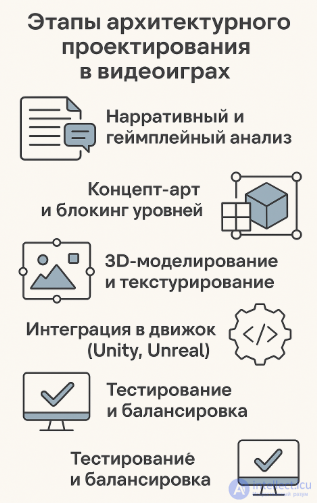
Narrative and gameplay analysis.
Concept art and level blocking.
3D modeling and texturing.
Integration into the engine (Unity, Unreal).
Testing and balancing.
Game: Perform tasks and rest cool.6 people play!
Play game
The requirements for buildings and structures in game architecture differ from those in real architecture, but they are no less complex and multi-layered. Instead of regulations and building standards, the laws of gameplay, narrative, and visual perception are in effect here. Here are the key aspects:
Game readability - the player must understand what the building does: shelter, target, trap, landmark.
Navigation – architecture directs movement: corridors, stairs, open spaces.
Gameplay integration - buildings must support mechanics: combat, exploration, stealth, parkour.
Scale and proportions are adapted to the camera and player movements (from isometric to first-person).
History through form – architecture tells about the world, the era, the culture, the disaster.
Symbolism - buildings can be metaphors: a tower as power, ruins as decline.
Multi-layered - architecture reflects layers of time: from antiquity to futurism.
Atmosphere - architecture sets the mood: anxiety, grandeur, comfort, horror.
Stylistic integrity - compliance with the visual language of the game (gothic, steampunk, arcane).
Materiality - even virtual materials should be "felt": cracks, rust, texture.
Optimization - buildings should not overload the engine: polygons, textures, lighting.
Interactivity is the ability to destroy, move, and interact.
Modularity is the reuse of elements to speed up development.
Landmarks - buildings as visual magnets that aid navigation.
Zoning - division into safe, combat, and research zones.
Dynamics - changes in architecture during the game (collapses, transformations).
Write your answers to the self-test questions in the comments, we will check, or ask your own question on this topic.

Comments
To leave a comment
Video game architecture
Terms: Video game architecture