
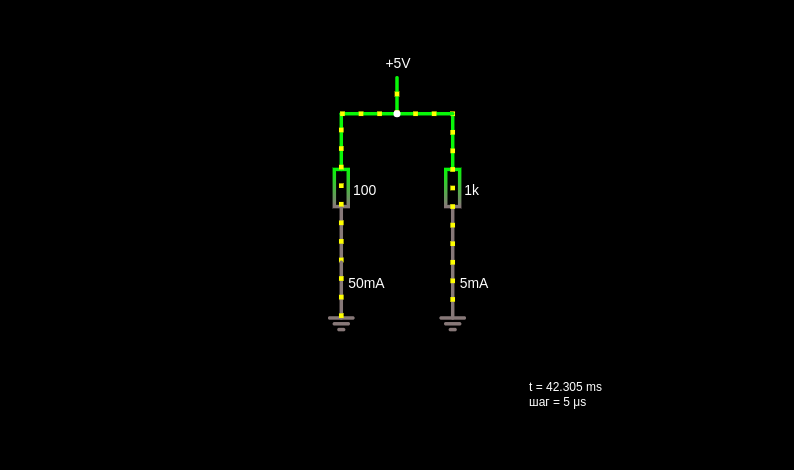
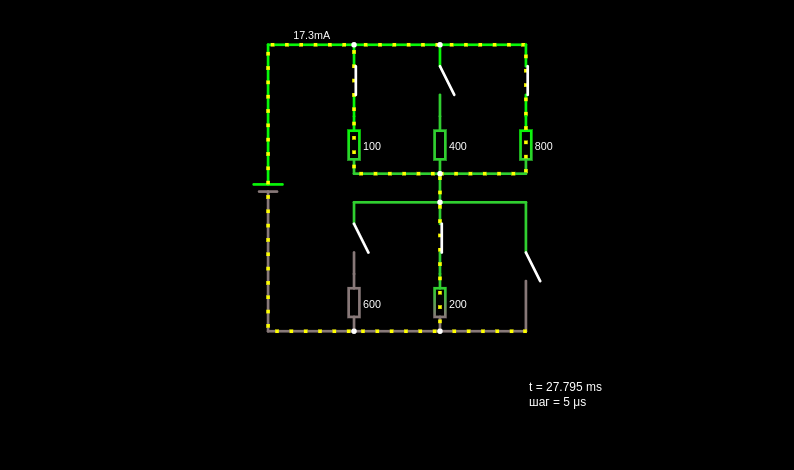
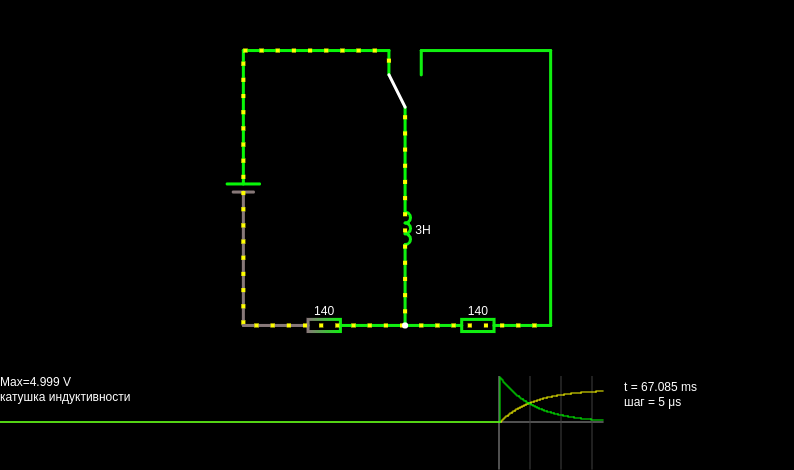
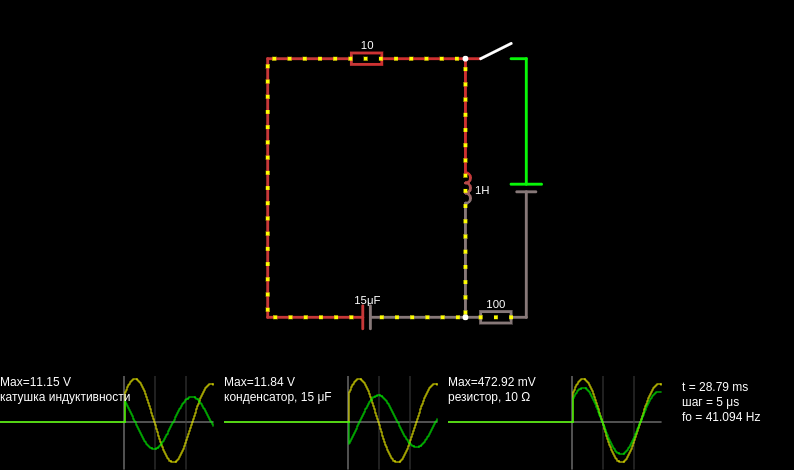
Shown here is a classic direct-current circuit with passive elements connected in series
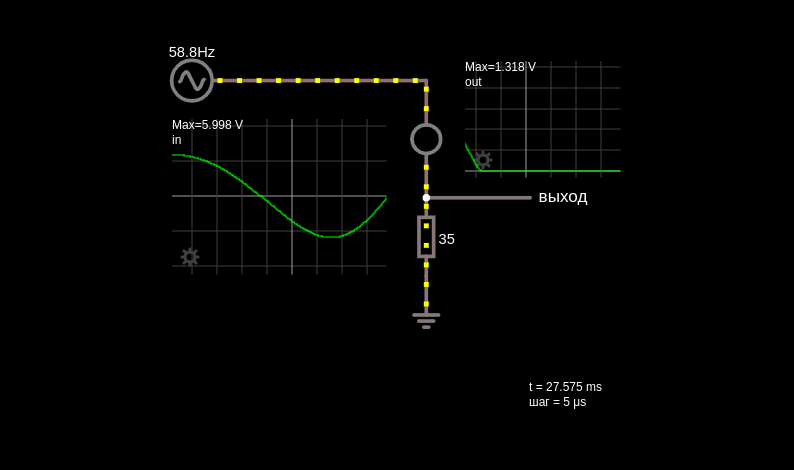
This page is a utility for simulating direct current (dc) online with specified initial values.
let's look at how such a simple DC circuit with a switch and a lamp (or LED) works:
Power source (5 V) — sets the voltage that «pushes» electrons through the circuit.
Switch — a mechanical element that either breaks the circuit (no current flows) or closes it (current flows).
Resistor (100 Ω) — limits the current so that the lamp/LED does not burn out.
Lamp/LED — converts electrical energy into light.
When the switch is open, the circuit is not closed, no current flows, and the lamp does not light up.
When the switch is closed, a complete closed loop is formed:
Electrons begin to move from the negative terminal of the source to the positive one through all the elements.
The resistor reduces the current to a safe level.
The lamp receives energy and starts to glow.
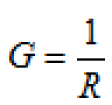
The current is calculated using the formula:
where , .
In our default example it is ~31 mA — which means the actual resistance of the lamp/LED also takes part in the calculation, and the total circuit resistance is greater than just 100 Ω.
The switch controls whether the circuit is closed.
The resistor protects the lamp.
The lamp glows only when the switch is closed.

Comments