
Lecture 18 min.
Combat toxic agents (CWAs) are toxic chemical compounds designed to incapacitate or kill enemy personnel.
Toxic agents can affect the body through the respiratory tract, the skin and the digestive tract. The combat properties (combat effectiveness) of a toxic agent are determined by its toxicity (which depends on its ability to inhibit enzymes or interact with receptors), its physicochemical properties (volatility, solubility, resistance to hydrolysis, and so on), and its ability to penetrate the biological barriers of warm-blooded animals and to overcome protective equipment.
Combat toxic agents are the main damaging element of chemical weapons.
Chemical weapons are weapons of mass destruction whose effect is based on the toxic properties of toxic agents (chemical warfare agents), together with the means of delivering them: artillery shells, rockets, mines, aerial bombs, gas projectors, gas cylinder release systems, VAPs (aircraft spray tanks), grenades and smoke canisters. Together with nuclear and biological (bacteriological) weapons, they are classed as weapons of mass destruction (WMD).
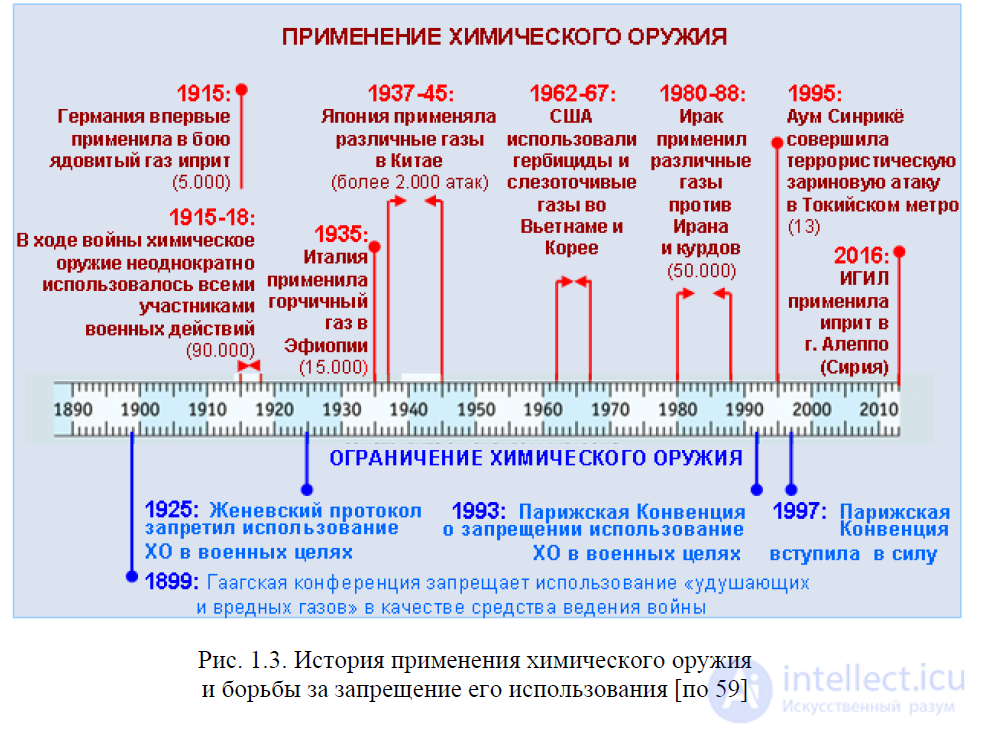
The use of chemical weapons has been prohibited several times by various international agreements:
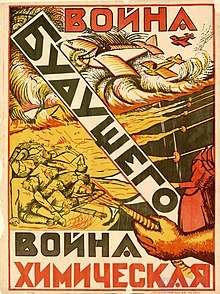
Propaganda poster "The War of the Future Is a Chemical War". Unknown artist. Perm, 1925
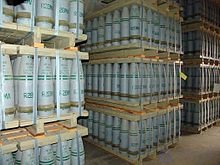
155-mm chemical artillery shells filled with distilled mustard gas, marked with two green bands and the inscription "HD GAS" (USA)
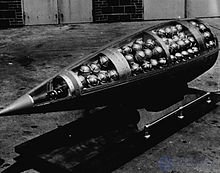
M134[en] chemical cluster warhead (cutaway) of the MGR-1 rocket with M139[en] submunitions filled with sarin

Body of an M23[en] chemical mine filled with VX, marked with 3 green bands and 1 yellow band
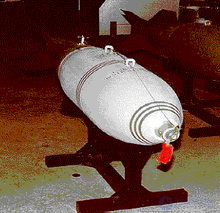
MC-1[en] chemical aerial bomb filled with sarin and marked with 3 green bands
Chemical weapons are distinguished by the following characteristics:
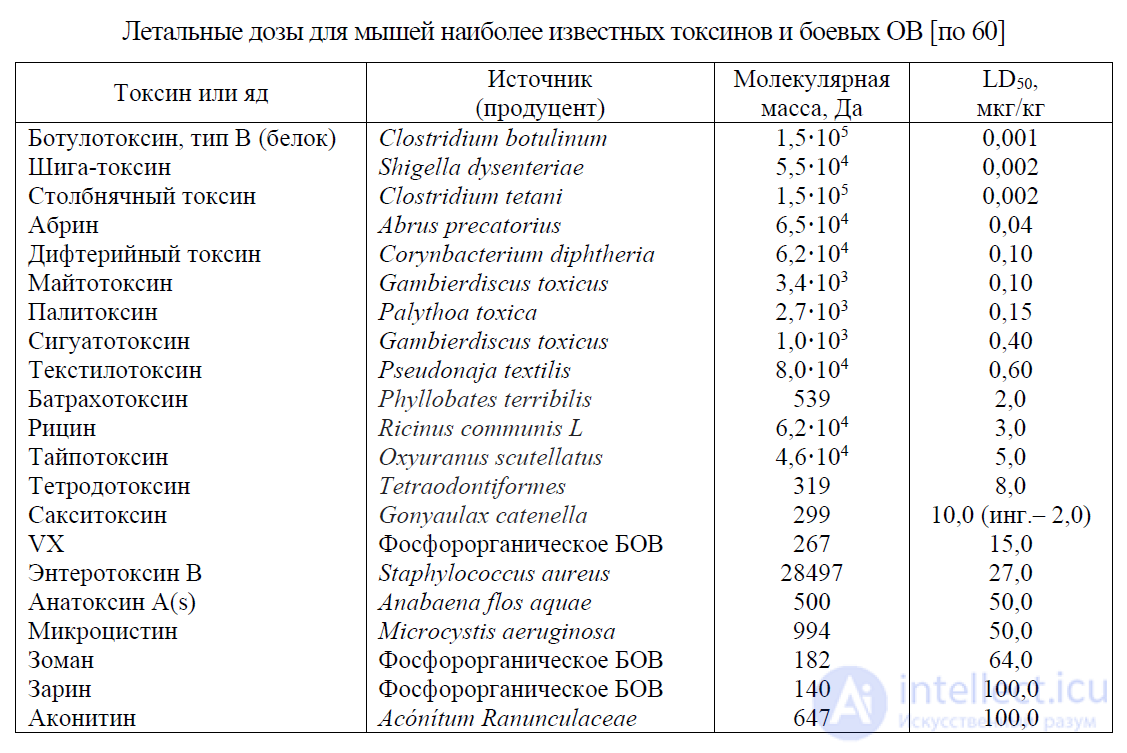
By the nature of their physiological effect on the human body, six main types of toxic agents are distinguished:
There are also known cases of the use of other chemical compounds whose original purpose was not the direct incapacitation of enemy personnel. Thus, in 1854, during the siege of Sevastopol (see Crimean War), British troops used odorants, or "stink bombs" . In the Vietnam War the United States used defoliants, which cause trees to shed their leaves, in particular "Agent Orange", which contains the extremely toxic 2,3,7,8-TCDD.
According to the tactical classification, toxic agents are divided into groups by combat purpose:
However, non-lethal agents can also cause death. In particular, during the war in Vietnam the American army used the following types of gases:
According to the American military themselves, the gases were used in non-lethal concentrations. However, as Francis Kahn, professor at the Sorbonne medical faculty, pointed out, conditions were created in Vietnam (use in large quantities in an enclosed space) in which CS gas was a lethal weapon .
By speed of action, fast-acting and slow-acting agents are distinguished. Fast-acting agents include nerve, blood and irritant agents and some psychotropic substances. Slow-acting agents include vesicant and choking agents and certain psychotropic substances.
Depending on how long they retain their damaging capacity, toxic agents are divided into short-acting (non-persistent, or volatile) and long-acting (persistent) agents. The damaging effect of the former lasts for minutes (AC, CG). The effect of the latter can last from several hours to several weeks after use.
During the First World War chemical weapons were used very widely in combat (Warsaw, Osowiec and elsewhere), but despite the deadliness of their effect they proved to have low effectiveness. Their use depended heavily on the weather and on wind direction and strength; in some cases suitable conditions for massed use had to be awaited for weeks. When chemical weapons were used during offensives, the side using them suffered casualties from its own chemical weapons, while the enemy's losses did not exceed those from a traditional artillery preparation for the attack. In the opinion of the First World War historian Sergey Gennadyevich Nelipovich, the low effectiveness of chemical weapons led to a mutual "tacit renunciation of the use of weapons of mass destruction" , and in later wars massed combat use of chemical weapons was no longer observed.
During the Great Patriotic War, as part of preparations for the possible start of chemical warfare by Germany, experiments on the use of chemical weapons on volunteers were carried out in the USSR, so that a series of posters showing chemical weapon injuries could be issued to the population. In July 1941 in Moscow, medical students (from among the volunteers) were selected, and drops of mustard gas and lewisite were applied to the skin of their left forearms. Because mustard gas and lewisite have a local analgesic effect, the volunteers felt no pain when they were applied. The volunteers stayed at the Lubyanka for several days until the traces of injury disappeared from the skin. After that, light-brown spots remained on the skin, and all the volunteers were sent home, with a ban on disclosing the experiment .
At the end of the 20th century, in view of the high level of development of troop protection against WMD, the main purpose of combat toxic agents was considered to be the exhaustion and pinning down of enemy personnel.
The most widespread are the tactical and physiological classifications of toxic agents.
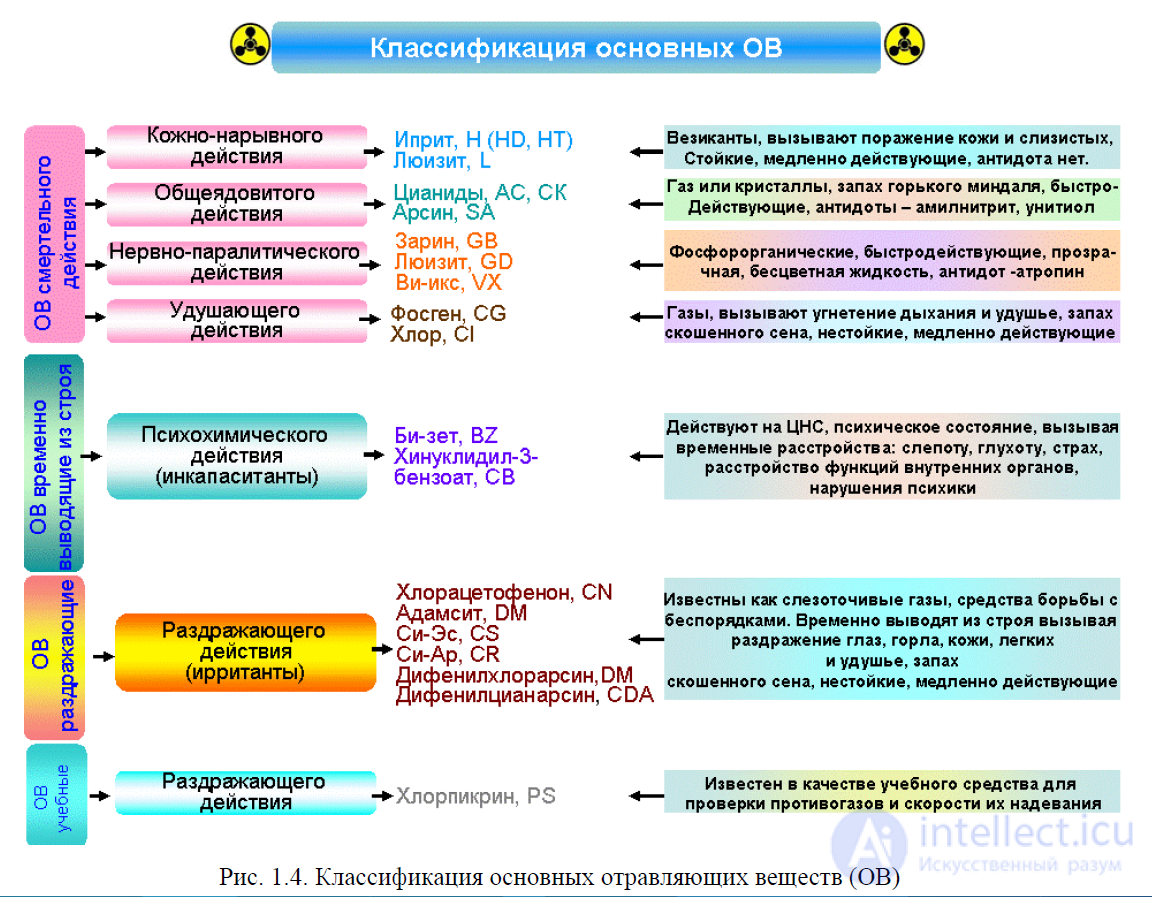
According to the physiological classification, combat toxic agents are divided into :
- agents that irritate the receptors of the respiratory tract (sternutators) and skin: adamsite, diphenylchloroarsine, diphenylcyanoarsine;
- agents that reflexively increase tear production (lacrimators): chloropicrin, chloroacetophenone, dibenzoxazepine, chlorobenzalmalononitrile, bromobenzyl cyanide;
Before turning to the third type of WMD, it is necessary to mention a class of substances occupying an intermediate position between chemical and biological weapons, which combines natural poisons and toxins. This is a very extensive group of substances of various structural types that form the basis of chemical, bacteriological and toxin weapons.
Unlike the term "toxin", which appeared in the scientific world at the end of the 19th century, the term "poison" has been known since deep antiquity. At present, in foreign and domestic scientific literature, poisons are any substances or mixtures of substances that, in small quantities, cause illness or death when they enter living organisms. Toxins are usually poisons secreted by living organisms, although for the toxins of vertebrates the term "venom" is used just as often [25, 50]. In scientific classifications of toxic chemicals that have a dangerous effect on people, this category of substances is classified as "biotoxins" — poisons of animal or plant origin. As a rule, they consist of amino acid residues, from 100 (peptides) to several hundred (proteins), and they may also be low-molecular-weight organic compounds [60, 63].
It is known that since ancient times humans have used plant and animal poisons and toxins of bacteria, fungi or algae for combat or hunting. Some of them are extremely poisonous and have a toxicity several orders of magnitude higher than that of the organophosphorus nerve-agent CWAs. For example, the lethal inhaled dose of botulinum toxin aerosol exceeds the toxicity of sarin vapor by roughly 1000 times, and the lethal dose of ricin is 80 times smaller than that of potassium cyanide and is about 1 mg for a human
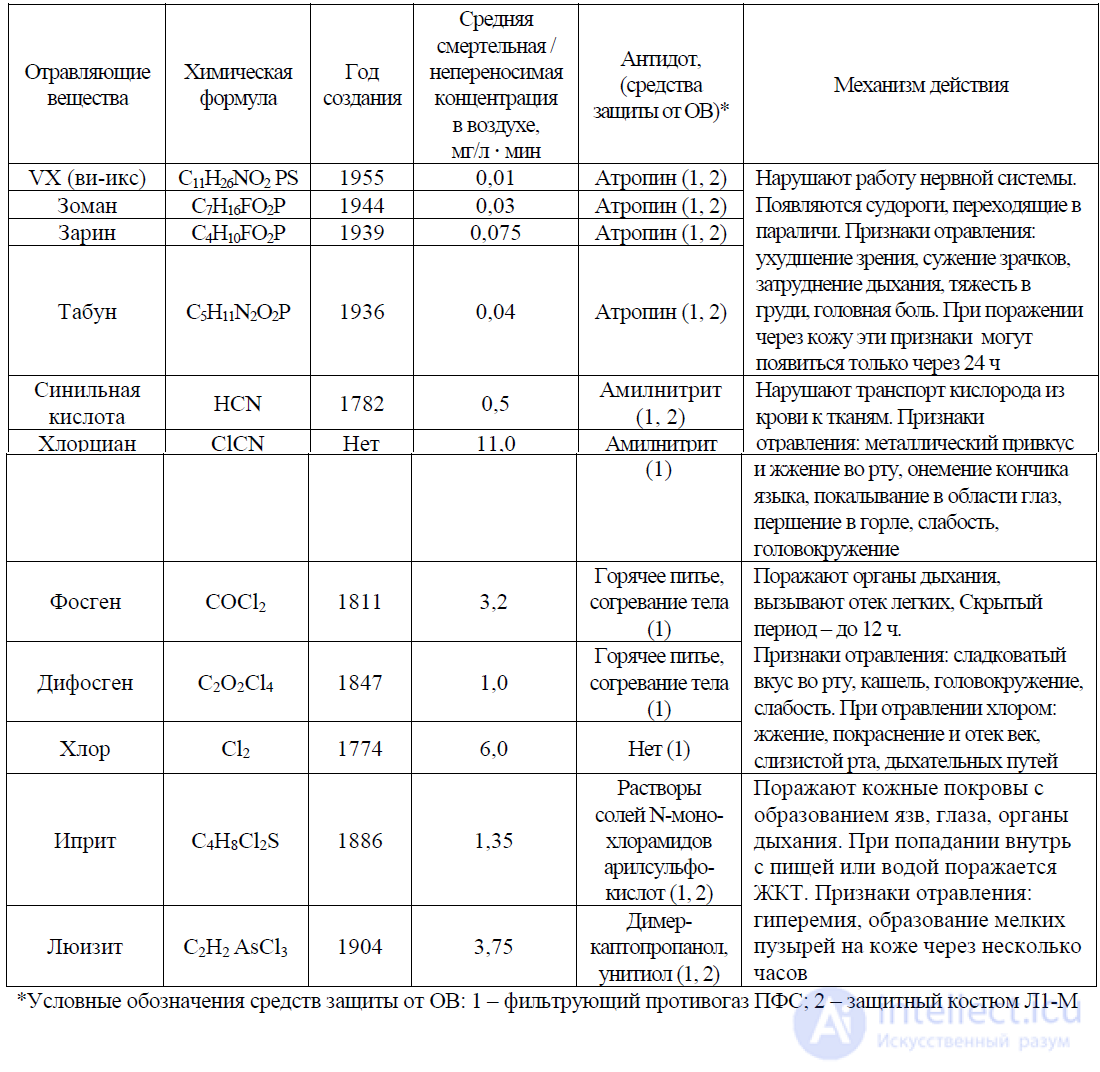
Lethal doses for mice of the best-known toxins and combat toxic agents
Subsequently, the qualitative development of production of new types of chemical weapons proceeded in the direction of reducing their toxicity, creating a group of so-called "police agents". Thus new classes of chemical agents appeared: incapacitants (temporarily disabling; the best-known substance of this group is BZ, an analogue of LSD) and irritants (irritant action), which cause tearing. These substances have proved themselves in many countries as effective means for dispersing demonstrations and conducting police operations.
The set of measures for protection against toxic agents includes their indication or detection, degassing (decontamination), disinfection, and the use of personal protective equipment (gas masks, isolating breathing apparatus, capes and suits made of rubberized fabric together with filter-type skin protection equipment, antidotes, protective creams, individual anti-chemical preparations) and collective protection (for example, facilities equipped with filter-ventilation units). It also includes special treatment of terrain, facilities and equipment, and sanitary treatment of people .
The first combat use of toxic agents took place during the First World War. They were first used in August 1914 by the French: these were 26-mm grenades filled with tear gas (ethyl bromoacetate). But the Allies' stocks of ethyl bromoacetate soon ran out, and the French administration replaced it with another agent, chloroacetone. In October 1914 German troops opened fire against the British at the Battle of Neuve Chapelle with shells partly filled with a chemical irritant, but the gas concentration achieved was barely noticeable. In February 1915 French troops began to use rifle grenades with chlorine. However, this method of combat use of poison gases was quite ineffective and did not create a significant concentration of them at the enemy's positions. The experience of the Kaiser's troops in the fighting of 22 April 1915 near the city of Ypres was much more successful: the German 4th Army launched a counterattack on the Ypres salient, forestalling the Anglo-French offensive then being prepared, and occupied most of the salient. On the first day of the fighting the German troops released chlorine from cylinders installed on their forward positions when the wind blew toward the Anglo-French trenches, and inflicted heavy casualties on the enemy, achieving a mass-casualty effect, as a result of which this instance of combat use of toxic agents became widely known. (This was actually the first experience of sufficiently effective combat use of toxic agents.)
On the Eastern Front the Germans first used toxic agents (chlorine gas) against Russian troops in May-June (Old Style) 1915 near Bolimov. In all, five chemical attacks were carried out against Russian troops near Bolimov:
The sixth gas cylinder attack was carried out by the Germans on 24 May/6 June 1915 near the village of Konopnica by the town of Rawa (now Rawa Mazowiecka), 40 kilometers south of Bolimov. 13 people were poisoned by chlorine
On 6 August 1915 German troops used toxic agents consisting of chlorine and bromine compounds against the defenders of the Russian fortress of Osowiec.
In June 1916 chemical weapons were also widely used by Russian troops during the Brusilov Offensive. 76-mm shells with charges of choking (chloropicrin) and blood (phosgene, vincennite) agents showed high effectiveness in suppressing enemy artillery batteries (in this case Austro-Hungarian) .
The first international legal instrument prohibiting the military use of toxic agents was the Geneva Protocol of 1925.
The historical note is taken from Deyne V. de, Ypres…, Liége, 1925
Under the impression of the combat use of toxic agents in the First World War, many states began feverish preparations for massed use of toxic agents in future wars. The preparations included both equipping troops with anti-chemical protective equipment and measures to protect the civilian population. In the 1920s regular drills for the civilian population on how to act under chemical attack were held in a number of countries. By the beginning of the Second World War most of the advanced states had arrived with a developed system of chemical protection. For example, in the USSR a paramilitary organization, OSOAVIAKHIM, was created.
Nevertheless, throughout the history of wars and local conflicts after the First World War, the use of combat toxic agents was sporadic and, moreover, not massed. The main reason for this was the relatively low effectiveness of the combat use of toxic agents as a means of mass destruction. The effectiveness of toxic agents in the First World War was in large part exaggerated by the psychological shock of their use as a new, previously unknown weapon. The initial lack of means of protection against toxic agents also had a strong effect. In the 1920s military calculations showed that the effect of combat use of munitions with toxic agents is much lower than that of conventional munitions (the calculation took into account the number of enemy soldiers put out of action, for example, after an hour of shelling of positions with chemical shells and high-explosive shells). The effect of toxic agents also depends largely on weather factors such as wind direction and strength, air humidity and temperature, atmospheric pressure, and so on. This makes the outcome of combat use of toxic agents almost unpredictable. Storing munitions with toxic agents is technically much more difficult than storing conventional munitions. Disposal of damaged chemical munitions in the field is impossible. All these factors, plus the now normal widespread availability of effective means of protection, made the military use of toxic agents difficult and, with rare exceptions, pointless
But the mere presence of chemical weapons in service is a powerful psychological factor for influencing the enemy and deterring him from using his own chemical weapons, forcing armies to carry out large-scale anti-chemical protection measures. The effectiveness of the effect, for all its unpredictability, on an unprepared enemy (and even more so on an unprepared civilian population) remains high, and the psychological effect exceeds the actual combat effect.
Besides their low combat effectiveness, the main deterrent is society's sharply negative attitude toward the very fact of the combat use of any weapon of mass destruction, including chemical weapons.
| Substance | US Army code | Soviet Army code | Edgewood Arsenal code |
|---|---|---|---|
| Mustard gas | H (crude) HD (distilled) VV (thickened) |
R-5 (Zaykov's mustard gas) VR-16 (thickened) |
EA 1033 |
| Phosgene | CG | R-10 | |
| Lewisite | L | R-43 | EA 1034 |
| Adamsite | DM | R-15 | EA 1277 |
| Sarin | GB | R-35 | EA 1208 EA 5823 (binary) |
| Soman | GD | R-55 | EA 1210 |
| Tabun | GA | R-18 | EA 1205 |
| 3-Quinuclidinyl benzilate | BZ | R-78 | EA 2277 |
During the storming of the "Nord-Ost" theater, an aerosol composition based on fentanyl derivatives was used.
Phytotoxic weapons

Comments