
Practice
For a bitcoin payment to be confirmed, at least 1 confirmation is needed. The number of such confirmations depends on the amount, and the recipient decides for themselves when to trust it.

for example, if the transfer amount is up to $1000 equivalent, then 3 confirmations are usually enough
if the amount is more than $1000 and up to $1,000,000, the recipient may expect to wait for 6 confirmations
if it's more than $1 million, then at least 60 confirmations are required.
However, it often happens that there are no confirmations at all.
what to do in this case?
1. wait 72 hours, during this time, depending on the fee amount, network load and other factors, your bitcoin transaction will be confirmed, however if you don't get that, then the transaction will automatically be canceled, and your money will be the same as before the transaction was created
2. it was necessary to increase the fee in advance, since transaction confirmation speed directly depends on its value
3. try to use a change to the fee of an already created transaction.
this must be supported by your wallet and the system that provides it
this option is called «possible fee replacement» (Opt-In Replace-by-Fee, or Opt-In RBF)
4. try sending the unconfirmed balance to yourself,
but with a higher fee, but this requires support
for the «child pays for parent» option (Child Pays for Parent, or CPFP)
5. if your wallet does not support the methods listed above, and your transaction has not been confirmed for more than 6 hours, then you can try using transaction accelerators
such as ViaBTC — you enter the transaction ID there and the system will raise its priority relative to other transactions. Since ViaBTC controls about 7% of the Bitcoin network's computing power, the chance of success is high
conclusions. don't forget to set an adequate fee before sending a transaction. to do this, check the network load
and the currently recommended fee rates, don't be stingy)
for example, network load can be checked using the following service
https://bitcoinfees.earn.com/
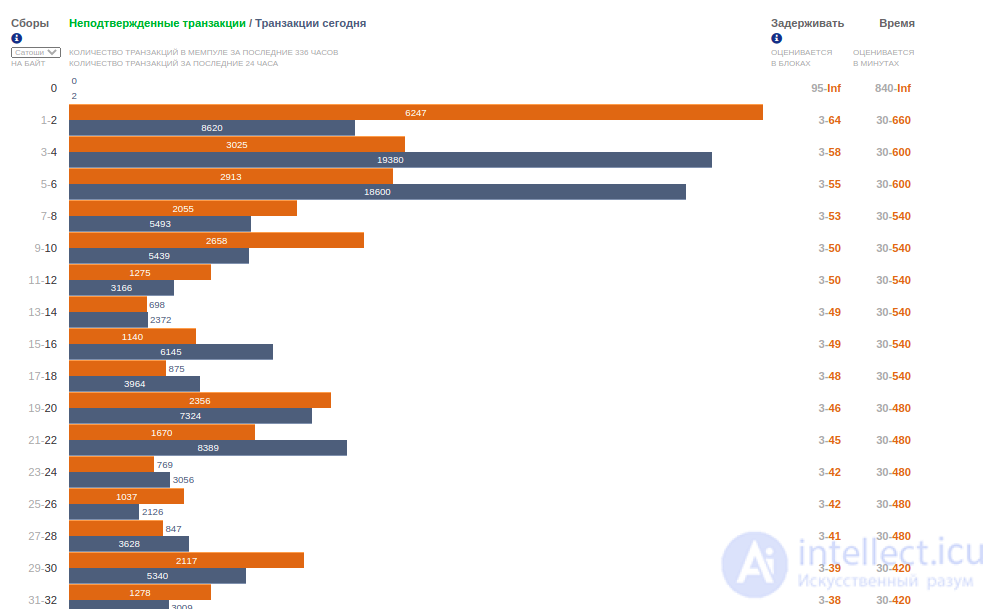
The delay shown here is the predicted number of blocks a transaction will require for confirmation. If a transaction is predicted to have a delay of between 1-3 blocks, there is a 90% probability that it will be confirmed within that range (roughly 10 to 30 minutes).
Transactions with higher fees often have zero delay, meaning they are likely to be confirmed in the next block (usually around 5-15 minutes).
Predictions are based on blockchain data from the last 3 hours, as well as the current pool of unconfirmed transactions (mempool).
First, the likely future behavior of the mempool and miners is predicted using Monte Carlo simulation. From the simulation you can see how quickly transactions with different fees might be included in the next blocks.
The predicted delay shown here is chosen to represent a 90% confidence interval.
Transaction priority must be at least 57600000 to avoid being limited. The limit is written in the code as: COIN * 144 / 250, which assumes that the transaction contains a «coin» that is 1 day old (144 being the estimated number of blocks per day) and the transaction size is 250 bytes.
As an example, take a transaction that contains 2 inputs, one of 5 BTC with 10 confirmations and one of 2 BTC with 2 confirmations; the transaction has a size of 500 bytes, so its priority will equal: (500000000 * 10 + 200000000 * 3) / 500 = 11200000
Digital money


Comments