
Lecture
A web service, or web-based service, is a software system identified by a unique web address (URL) that exposes standardized interfaces; the term is also used for a website's HTML document as displayed in the user's browser.
Web services can interact with one another and with third-party applications through messages based on defined protocols (SOAP, XML-RPC, etc.) and conventions (REST). A web service is a unit of modularity in a service-oriented application architecture.
In everyday usage, web services means services provided on the Internet. In this sense the term needs clarification as to whether it refers to search, web mail, storage of documents, files, bookmarks, and so on. Such web services can be used regardless of the computer, browser, or place from which the Internet is accessed .
Advantages
Disadvantages
Interaction between airlines and travel agencies: the former provide useful information through web services, which the latter use to find optimal offers for their clients.
From 2002 to 2009, the Google search engine provided a web service that allowed customers to search for the information they needed on the Internet just as ordinary users do (in terms of convenience, this is incomparable with, for example, automated parsing of the HTML text of Google result pages).
Amazon.com has a web service that provides various web-based services.
The MOBILESERVER web service, which uses messages based on the open SOAP (XML) and JSON protocols, makes it possible to get current data from a heat meter as of the last time its data was read.
An app store is an online store that allows third-party software development companies to offer owners of (usually) mobile devices various apps and games to install and purchase, and allows producers of other content to offer books, music, and movies as well.
Providing merchants with a web trading platform for selling online.
These services provide streaming (delivery of streaming media).
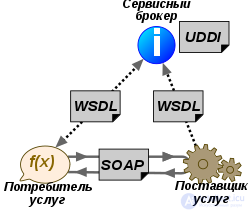
As the figure shows, three parties that interact within a web service can be distinguished. We will translate their names as
Once a service has been developed, the provider registers it in the directory, where potential requesters can find it. Having found a suitable service in the directory, the requester imports its WSDL specification from there and develops its own software in accordance with it. WSDL describes the format of the requests and responses exchanged between the requester and the provider during operation. The following standards are used to enable interaction:
There are tools that automate web service development, falling into two main groups. In bottom-up development, the implementing classes are written first, and WSDL files documenting the service are generated from their source code. The drawback of this method is that Java classes are prone to frequent changes. In the top-down approach, the WSDL is prepared first, and a skeleton of the Java class implementing the service is generated from it. This path is considered harder, but it leads to cleaner solutions that are better protected against changes. As long as the format of the messages exchanged between the requester and the provider does not change, changes on either side do not break the interaction. This technique is sometimes called "contract first", because the starting point is the WSDL (the "contract" between the requester and the provider).
There is also web service development based on an SDK for document recognition (OCR).
Web services are deployed on application servers. Some application servers:

Comments