
Lecture
The dead internet theory is a conspiracy hypothesis claiming that since 2016–2017 most activity on the internet has been carried out not by real people but by bots and algorithms.
The internet "died" in 2016–2017, when the number of real users dropped sharply.
Content, comments, discussions, and even accounts are allegedly created and maintained mostly by bots.
These bots are controlled by large IT corporations and governments to manipulate public opinion and control information.
According to the dead internet theory, the "death" of the Internet occurred around 2016–2017. Almost no active people are left online, and the entire online space has been overrun by bots controlled by IT corporations as well as governments. Some genuine internet users live in an unnaturally constructed Matrix created by neural networks and artificial intelligence. Bots repost copies of identical messages and images. Neural networks report the news, explain it themselves, and promote it, manipulating public opinion. Artificial intelligence interacts directly with itself online, simulating user activity.
From all this the conclusion is drawn that the classic old Internet of the 1990s–2000s, in which real users could communicate freely, died long ago. The idea of the theory is that since 2016 the Web has been empty and lifeless, and a significant part of it is considered an imitation. Nor should one believe what happens online, since almost all of society and its actions may well be entirely made up.
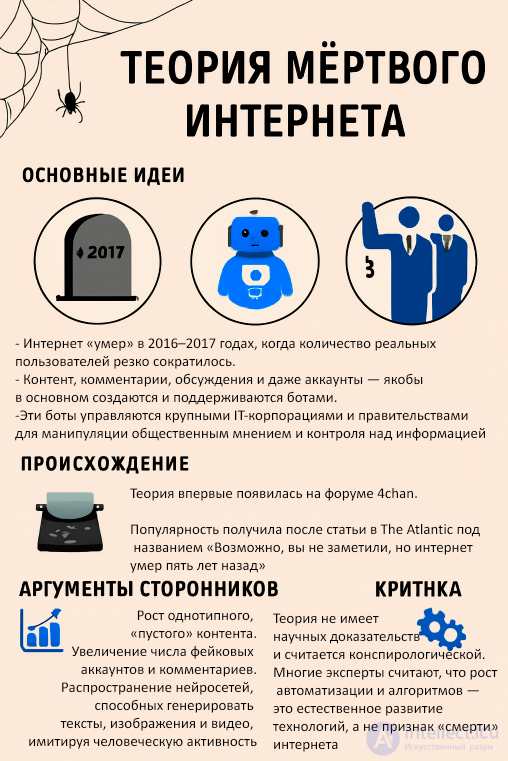
The theory first appeared on the 4chan forum.
It gained popularity after an article in The Atlantic titled "Maybe You Missed It, but the Internet 'Died' Five Years Ago".
The growth of repetitive, "empty" content.
An increase in the number of fake accounts and comments.
The spread of neural networks capable of generating text, images, and video, imitating human activity.
After an incident on the social network X, where a video about the sound of the Kazakh language was posted, users noticed that the video had no sound, yet the comments under the post talked about how the Kazakh language sounded. This damaged X's reputation.
On the wave of popularity of artificial intelligence and ChatGPT, which is used to generate text and create the appearance of a living person, people began to notice a large amount of generated text, photos, and video on the Internet, which creates the feeling that there are no people online.
According to Statista, as of 2022, 47.5% of Internet traffic is used by bots.
The New York Times wrote in 2018 that more than half of YouTube traffic is generated by bots created to inflate views, comments, and likes.
The theory has no scientific evidence and is considered a conspiracy theory.
Many experts believe that the growth of automation and algorithms is a natural development of technology, not a sign of the "death" of the internet.
Forbes writes that social networks have always taken measures to block spam and continue to do so, and that AI at the start of the 2020s was not capable of producing good content.

Comments