
Lecture
The no-cloning theorem — a statement of quantum theory that it is impossible to create a perfect copy of an arbitrary unknown quantum state. The theorem was formulated by Wootters, Zurek and Dieks in 1982 and has been of great significance for quantum computing, quantum information theory and related fields.
The state of one quantum system can be entangled with the state of another system. For example, an entangled state of two qubits can be created using a single-qubit Hadamard transformation and a two-qubit C-NOT quantum gate. The result of such an operation is not cloning, since the resulting state cannot be described in terms of the states of the subsystems (the state is non-factorisable). Cloning is an operation that produces a state that is the tensor product of identical subsystem states.
Suppose we want to create a copy of system A, which is in state  (see Dirac notation). To do this, take a system B with the same Hilbert space, in an initial state
  . The initial state, of course, must not depend on the state , since this state is unknown to us. The composite system A + B is described by the tensor product of the subsystem states:

Two different actions can be performed on the composite system.

and 
for all  and
and 
By the definition of a unitary operator, U preserves the inner product:

that is
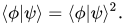
It follows from this that either  or the states and
  are orthogonal (which, of course, is not true in the general case). Thus the operation U cannot clone an arbitrary quantum state.
The no-cloning theorem is proved.
Although creating exact copies of an unknown quantum state is impossible, it is possible to produce inexact copies of it. To do this, the original system must be brought into interaction with a larger auxiliary system, and a special unitary transformation of the combined system must be carried out, as a result of which several components of the larger system become approximate copies of the original. Such a process can be used to attack quantum cryptographic systems, as well as for other purposes in quantum computing.
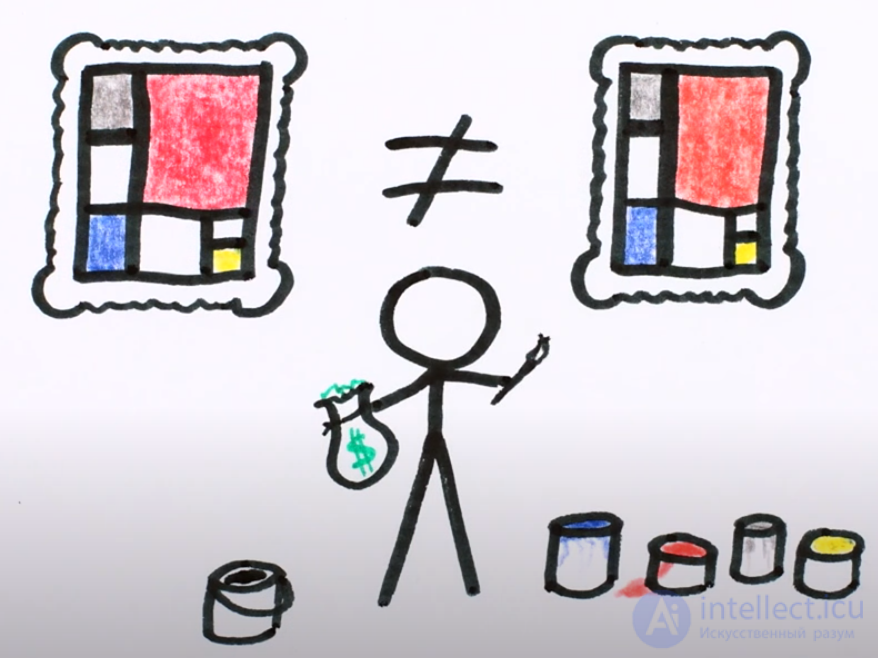
How can you prove that you are not a clone?
or that an object is not a clone?
the answer — according to the no-cloning theorem — there will always be a difference; it can be found by methods of analysis and research
confirming that no interference has occurred in the information being transmitted (a man-in-the-middle attack)

Comments