
Lecture
In umbral calculus, the Bernoulli umbra, uses the concept of the Bernoulli umbra.  is the umbra, a formal symbol defined by the relation
 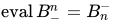 , where
  is the lowering index operator, also known as the evaluation operator, and
  are the Bernoulli numbers, called the moments of the umbra. A similar umbra is defined as
 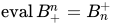 , where
  The term “Bernoulli umbra” is also often used, which is sometimes called the “Bernoulli umbra”. They are related by the equality.
  Along with the Euler umbra, the Bernoulli umbra is one of the most important umbrae.
In the Levi-Civita field the Bernoulli umbrae can be represented by elements in the form of power series. Б−=ε−1−12−ε24+3ε3640−1525ε5580608+⋯ and
and  , with the lowering index operator corresponding to taking the coefficient of
  of the power series. The numerators of the terms are given in OEIS A118050 , and the denominators — in OEIS A118051. Since the coefficients
  If both numbers are non-zero, they are infinitely large. is infinitely close (but not equal, slightly less) to
  and
and  is infinitely close (slightly less) to
  .
.
In Hardy fields (which are generalizations of the Levi-Civita field) the umbra corresponds to the germ at infinity of the function  while corresponds to the germ at infinity of
 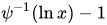 , where
  is the inverse digamma function.
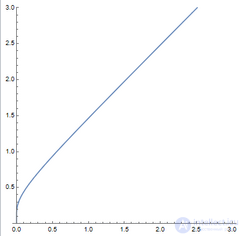
Graph of the function  , whose germ at positive infinity corresponds to .
Since the Bernoulli polynomials are a generalization of the Bernoulli numbers, raising the Bernoulli umbra to a power can be expressed using the Bernoulli polynomials:

wherea is a real or complex number. This can be further generalized using the Hurwitz zeta function:

From the Riemann functional equation for the zeta function it follows that

and  are the only two terms of the sequence
  and that differ for any analytic function; the following rule holds.
  :
:

In general, the following formula holds for any analytic function. :

This makes it possible to derive expressions for the elementary functions of the Bernoulli umbra.


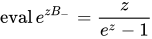

In particular,

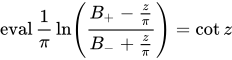
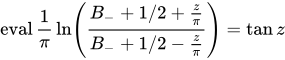


In particular,
,
 ,
,
The Bernoulli umbra allows relationships to be established in closed form between exponential, trigonometric and hyperbolic functions, on the one hand, and logarithms, inverse trigonometric and inverse hyperbolic functions, on the other hand:



Comments