
Lecture 4 min.
Seamless access to text, voice and data for LTE phones around the world. Starlink has successfully sent and received text messages to and from mobile phones via Direct to Cell satellites.
"Direct to Cell" refers to a network designed to provide connectivity (text, voice, data) for mobile phones and LTE (4G) devices around the world. This network uses satellites placed in low Earth orbit to provide global coverage.
The key characteristics of this network are:
This network plans to offer a wide range of services, starting with text messaging in 2024 and expanding to voice, data and Internet of Things (IoT) services in 2025.
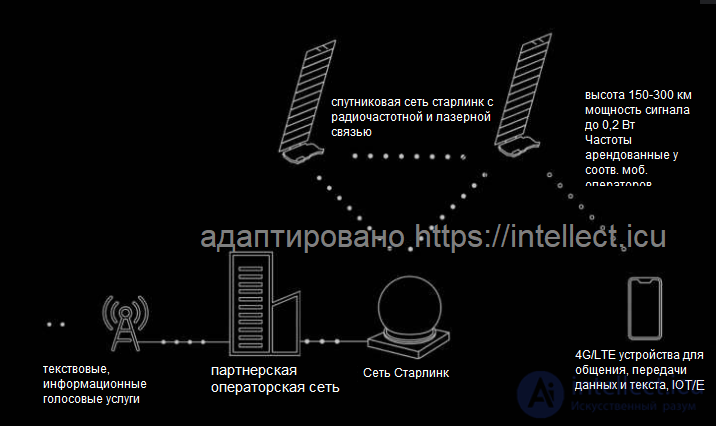
The Direct to Cell network will extend Starlink's vision of
ubiquitous connectivity and seamless access to text,
voice and data for LTE phones and devices around the world.
The text service will launch in 2024, followed by voice, data and Internet of Things (IoT) services in 2025.
The first problem is transmitting a sufficiently powerful radio signal. The signals to and from mobile phones, which are not designed to
connect to satellites, use antennas with very low gain and transmit
at very low power (max. 0.2 W). Our team developed a special silicon on board the satellite that is
optimized for this application and reduces the power and cost of the satellite. We also developed
large advanced phased arrays measuring 2.7 x 2.3 m, which use extremely sensitive radio receivers and
powerful transmitters to communicate with cell phones from space. The antennas
were designed for use on Starlink v2mini satellites and allow reliable launch and deployment
into low Earth orbit every few days on a Falcon 9 rocket. SpaceX has the unique ability
to rapidly scale our first Direct to Cell constellation in just a few months thanks to our unique and
unprecedented vertical integration, which additionally controls launch and satellite manufacturing
operations. In the future, we will launch Direct to Cell satellites on Starship to improve the quality of
service even further and increase the launch cadence.
Because our goal is to connect everyone using their existing phones, without having to buy a new
phone, upgrades or a special app, we decided to use standard LTE/4G protocols. Our satellites
orbit at an altitude of hundreds of kilometers above the Earth's surface at a speed of 7.7 km/s. As a result,
achieving compatibility with LTE timing, Doppler and delay constraints is extremely difficult. For
the vehicles to act as true cell towers in space, switching between vehicles and
the ground must be completely seamless for the user. To do this, we designed
systems including satellite altitude, beam size and location, elevation angles and the number of
satellites, so we are at the edge of physics where LTE is achievable and reliable. We
install an advanced LTE modem on board each satellite, which will act as a cell tower in space.
Direct to Cell satellites act as cell towers in space, sending traffic to the cores of partner carriers using the Starlink space
and ground systems.
The Direct to Cell network uses the infrastructure we have built for Starlink over the past
several years. Direct to Cell satellites connect to the existing Starlink satellite constellation via
laser backhaul; this means that even our first satellites will be able to provide service anywhere with
regulatory approval, without the need to build dedicated ground infrastructure. We also use all of the
existing Starlink networks, ground stations and points of presence (PoPs) that have been
developed. Direct to Cell data is routed through the Starlink core directly to the carrier's core,
ensuring seamless integration.

Comments