
Lecture 4 min.
In accordance with international agreements, the frequency ranges shown in Table 2.1 have been allocated for the operating frequencies of GSM900/1800/1900 cellular mobile communication systems.
Table 2.1. Operating frequencies and operating wavelengths in GSM900/1800/1900 cellular mobile communication systems
| GSM standard |
Frequency, MHz | Wavelength, cm | ||
| MS => BTS | BTS => MS | MS => BTS | BTS => MS | |
| GSM 900 | 890-915 | 935-960 | 32.8-33.7 | 31.2-32.1 |
| GSM 1800 | 1710-1785 | 1805-1880 | 16.8-17.6 | 16.0-16.6 |
| GSM 1900 | 1850-1910 | 1930-1990 | 15.7-16.2 | 15.1-15.6 |
- the strictly limited allocated frequency bands, which hold a small number of frequency channels, which naturally leads to the aim of using the allocated frequency range as efficiently as possible, optimizing its use and, accordingly, increasing the capacity of the mobile communication system; It follows from Table 2.1:
- the frequency bands used in GSM cellular mobile communication belong to the decimeter range of radio waves, which propagate mainly within line of sight; diffraction effects at these frequencies are weak, and absorption in hydrometeors (rain, snow, fog) and molecular absorption are practically absent.
However, the proximity of the underlying surface and the presence of obstacles (vegetation, buildings) when organizing mobile communication in urban conditions give rise to reflected signals that interfere with one another and with the main signal propagating along the direct path. This phenomenon is called multipath propagation of signals. Under certain conditions, reflections from the underlying surface cause the power of the received signal to decrease not in proportion to the second power of the distance between the transmitter BTS and the receiver MS (1/r2), as in free-space propagation (the single-ray model), but inversely proportional to the fourth power of this distance (that is, ~1/r4), and in the general case as 1/rn. The interference of several signals that have travelled along different paths causes a peculiar phenomenon of fading of the resulting signal, so-called fading, in which the intensity of the received signal varies within wide limits as the mobile station moves.
In addition, distortions arise as a result of the superposition of several signals of comparable intensity that are shifted in time relative to one another, which can lead to errors in the received information. And finally, the complexity of the multipath propagation pattern of radio waves greatly complicates calculating the intensity of radio signals as a function of distance from the base transceiver station BTS, and such a calculation is necessary for the correct design of cellular mobile communication systems.
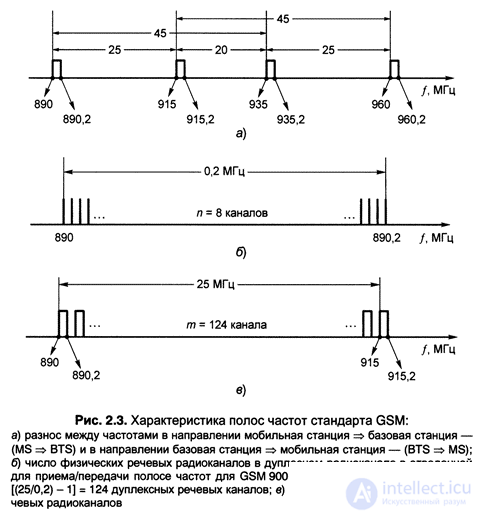
Fig. 2.3. Characteristics of the GSM frequency bands:
a) spacing between the frequencies in the mobile station => base station direction (MS=> BTS) and in the base station => mobile station direction (BTS=> MS);
b) the number of physical voice radio channels in a duplex radio channel: in the band allocated for reception/transmission, for GSM900 with a width of 25 MHz, [(25/0.2) - 1] = 124 duplex voice channels are accommodated; c) the number of physical duplex voice radio channels.
It should be noted that, in accordance with the GSM900/1800/1900 standard:
- the spacing between the frequencies in the mobile station => base station direction (MS=> BTS) and in the base station => mobile station direction (BTS=> MS) is (Fig. 2.3, a):
■ for GSM 900: 935 - 890 = 960 - 915 = 45 MHz;
■ for GSM 1800: 1805 - 1710 = 1880 - 1785 = 95 MHz;
■ for GSM 1900: 1930 - 1850 = 1990 - 1910 = 80 MHz;
- the width of the band allocated for reception/transmission:
■ for GSM 900: 960 - 935 = 915 - 890 = 25 MHz;
■ for GSM 1800: 1785 - 1710 = 1880 - 1805 = 75 MHz;
■ for GSM 1900: 1910 - 1850 = 1990 - 1930 = 60 MHz;
- the spacing of duplex voice channels at a frequency of 900 MHz for GSM900 is 200 kHz (Fig. 2.3.1, b)
- the equivalent frequency band per physical voice channel:
■ for GSM 900: 25 kHz;
■ for GSM 1800/1900: 12.5 kHz;
- the number of physical voice radio channels in a duplex radio channel for GSM: 200/25 = 8 channels (Fig. 2.3, b);
- the number of duplex voice channels is 124 (Fig. 2.3, c).

Comments