
Lecture 8 min.
Visual design in video games is not just a backdrop, but a means of immersion, narrative, and interaction with the player. Let's look at how interiors and exteriors differ and interact in game worlds.
Designing interiors and exteriors in physical architecture is a kind of art that combines aesthetics, functionality, and environmental context.
Interior and exterior design in physical architecture is a complex process that involves a harmonious combination of aesthetic, functional, and technical aspects. In interiors, particular attention is paid to the organization of space, the selection of materials, lighting, color palette, and ergonomics, in order to create a comfortable and expressive environment for living or working. The exterior, in turn, forms the first impression of a building and must take into account both the architectural context of the surrounding development and the climatic conditions, the durability of the materials used, and the interaction of the building with its environment. Modern approaches to design strive for a unified appearance, in which the interior and exterior spaces are logically and visually connected, reflecting the concept of the building and emphasizing its uniqueness.
Let us consider several ideas and approaches that can serve as inspiration:
Materiality as a language: Use wood, stone, metal, and glass not merely as materials, but as expressive elements. For example, raw concrete can convey the industrial character of a space, while warm timber can give it coziness.
Light as form: Play with natural and artificial lighting, emphasizing textures and zones. Soft shadows on a textured wall can become part of the visual story.
Rethinking space: Don't just arrange furniture — set the rhythm, flow, and accents. For example, the "emptiness" between objects sometimes says more than their abundance.
Dialogue with the locality: The design of the facade, landscape, and building forms must take into account the climate, terrain, and urban fabric. In Transcarpathia, for instance, stone and wood are not just a tradition, but an adaptation to local conditions.
Tectonics and symbolism: Let the forms reflect the purpose of the building — for example, a roof with different slopes can at once be a reference to vernacular architecture and a solution for draining rainwater.
Transitions and thresholds: Creating expressive entrance areas, terraces, and canopies is significant not only functionally but also aesthetically. They become a space where the interior and the exterior meet.
Materials can flow from one space into another, erasing the boundaries.
Windows, galleries, and transparent volumes all allow the interior to "converse" with nature.
Interiors in games are often created as functional spaces closely tied to gameplay and storytelling.
Interior design in games is an important part of visual storytelling and atmosphere creation, playing a key role in how the game world is perceived. It covers the layout of rooms, the choice of materials, lighting, color accents, and the placement of objects, in order not only to fill the space visually but also to guide the player's behavior. Indoor locations in games can be either realistic or stylized, but in any case they must support the overall mood and genre of the game — be it a gloomy castle in a horror game, a cozy tavern in a fantasy game, or a high-tech center in science fiction. A well-designed interior helps tell the story of the surrounding world through details: notes, furniture, clutter, lit areas, damage, or artifacts. Moreover, interior design directly affects gameplay, determining movement routes, cover zones, interaction with objects, and the creation of tension or comfort. In modern games, the interior increasingly becomes not just a backdrop but a full-fledged element of the narrative and mechanics, immersing the player in the world and making it as convincing as possible.
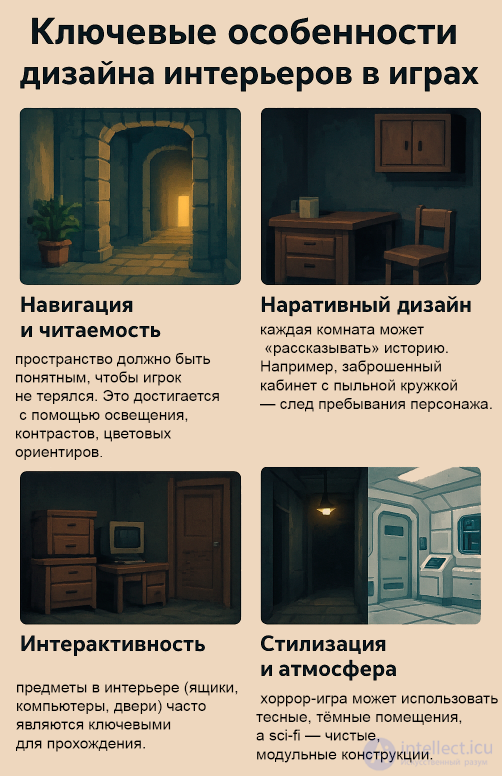
Key features of interior design in games:
Navigation and legibility: the space must be understandable so that the player does not get lost. This is achieved through lighting, contrasts, and color landmarks.
Narrative design: every room can "tell" a story. For example, an abandoned office with a dusty mug is a trace of a character's presence.
Interactivity: objects in the interior (crates, computers, doors) are often key to progressing through the game.
Stylization and atmosphere: a horror game may use cramped, dark rooms, while a sci-fi game may use clean, modular structures.
Example: In The Last of Us, the interior of the ruins visually conveys the decline of civilization, and every object carries emotional weight.
The exterior is a visual context that creates a sense of scale and of a world beyond the action.
Exterior design in games plays a key role in shaping the overall impression of the world, setting the tone, scale, and atmosphere of the outdoor space. It includes the design of architectural forms, natural landscapes, streets, building facades, weather conditions, and lighting. Outdoor locations are the first thing the player sees, and they often create the initial sense of the game's scale, style, and genre. In the exterior, it is important to consider a logical composition of objects, the legibility of routes, zoning, and points of interest that guide the player's movement. Every element, from a bridge to a tree, can serve not only a decorative but also a gameplay function — acting as a landmark, an obstacle, a cover, or part of a puzzle. Exteriors also actively participate in storytelling: ruined buildings can tell of a vanished civilization, and deserted fields of a past battle or of abandonment. Modern games use exterior design to create a dynamic and living environment through animations, sounds, and day-night cycles, which enhances immersion and makes the game world more believable and engaging.
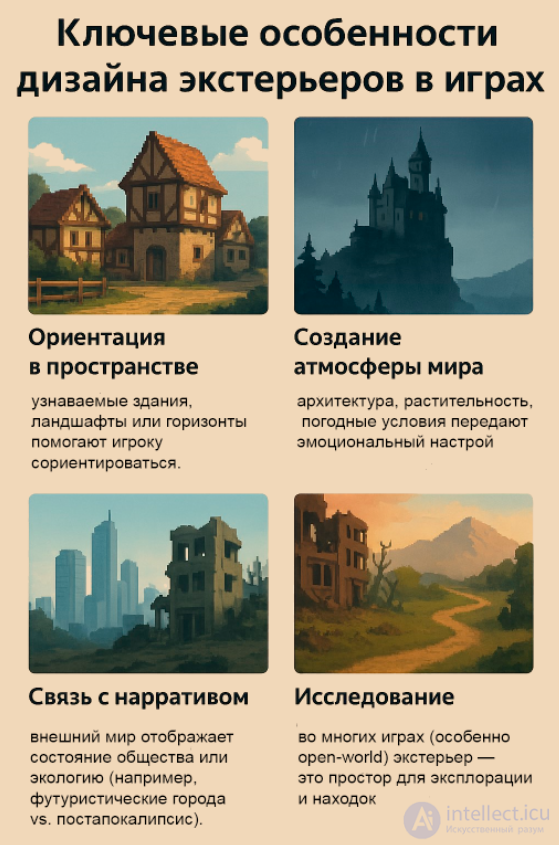
Spatial orientation: recognizable buildings, landscapes, or horizons help the player get their bearings.
Creating the atmosphere of the world: architecture, vegetation, and weather conditions convey the emotional mood.
Connection with the narrative: the outside world reflects the state of society or the ecology (for example, futuristic cities vs. post-apocalypse).
Exploration: in many games (especially open-world), the exterior is a space for exploration and discoveries.
Example: In Ghost of Tsushima, the outside world is stylized after classical Japanese art, where every location is a picturesque landscape with character.
The relationship between interior and exterior in games is an important aspect of the holistic perception of the game world, ensuring logic, immersion, and realism. A well-constructed connection between outer and inner space allows the player to feel the continuity of the environment: when the exterior appearance of a building corresponds to its internal structure, and the landscape outside blends harmoniously into the interior views from windows, doorways, and passages. Such unity helps avoid the feeling of "stage sets" and strengthens belief in what is happening. This connection is important from both a visual and a gameplay standpoint — for example, the placement of windows and entrances must correspond to navigation outside and inside, and architectural details of the exterior can hint to the player at what is inside (the entrance to a laboratory, a tower, or a warehouse). A single narrative can also unfold through the interior and exterior: the external destruction of a building continues inside in the form of debris and ash, or, conversely, a modest facade conceals lavish halls. Modern games increasingly strive for such a synthesis, in which the boundary between outside and inside becomes part of game design, creating a living, plausible, and interactive world.
It is important that the transition between the outer and inner space be smooth and logical:
Light and sound connect the environments (for example, rain audible from outside while indoors).
Architectural logic: the interior space must correspond to the exterior appearance of the structure.
Game design: the exterior can "lead up" to a key interior event (the entrance to a temple, a base, a maze, etc.).

Comments