
Lecture 12 min.
Navigation and level structure in an architectural context are not merely technical aspects of game design, but fundamental tools that shape the user experience, atmosphere, and emotional perception of virtual space. As in real architecture, a game environment must be logical, legible, and intuitive so that the player feels engaged and can move freely through the setting. A properly built level structure helps manage attention, guide movement, and create tension or a sense of an open world. Navigation, in turn, determines how convenient it is for the player to move around, find objectives, and interact with the environment. In an architectural context, these elements become part of an overall concept in which space is not just a decoration, but an expressive and functional language of interaction.
Level design theory covers the key principles of building game spaces, including linearity, nonlinearity, and opportunities for exploration. Linear design implies a strict direction of progress: the player follows a predefined path in which each scene or location is arranged in a clear sequence. This makes it easier to control pacing, narrative, and the sense of progress, and also allows gameplay elements — enemies, resources, cutscenes — to be placed precisely. In contrast, the nonlinear approach gives the player freedom to choose a path, offering the possibility to backtrack, discover alternative routes, and complete tasks in a different order. Such an approach makes the game world feel more alive and helps develop a sense of involvement and of influence over what is happening. Exploration in level design adds depth: the player is encouraged to step away from the main route to find hidden objects, story details, Easter eggs, and unique visual elements. The balance between direction, freedom, and exploration is the foundation of a quality level, one capable of holding interest and inspiring a desire to study the world down to the smallest details.

1. Typology of levels
Linear — the player moves from start to finish along a set route (for example, Uncharted or the classic Call of Duty).
Branching — levels with several paths leading to a common goal (Tomb Raider, Bioshock).
Open worlds (Open World) — freedom of movement, unlimited in structure (The Witcher 3, GTA V).
Metroidvania — levels designed as a single space with sections that become accessible as new abilities are acquired (Hollow Knight, Metroid).
Procedural generation — the level structure is unique every time (Hades, Dead Cells).
Visual cues (light guiding): highlighting, perspective, contrast, movement of objects.
Environmental storytelling: the player reads where to go from the logic of the world.
Markers and beacons: towers, pulsating light sources, recognizable silhouettes.
AI companions and audio cues, as in The Last of Us or Hellblade: Senua’s Sacrifice.
"Room–corridor–room": alternating zones of combat and respite.
Attention management: leading lines, compositional anchors.
Sense of direction: how intuitively the player understands where they are and where to go.
In some games, levels are created by players or change during play (for example, Minecraft, Dreams, The Legend of Zelda: Tears of the Kingdom).
Such spaces require special laws of self-navigation — through color palettes, the rhythm of patterns, and recurring elements.
how space "speaks" to the player, how the player reads scale, senses tension or freedom, and how this affects the perception of the world and behavior.
Metrics and scale in level design play a key role in how the player perceives and interprets game space. Space in a game must be designed to be legible, logical, and consistent with the player's expectations. Metrics are standardized sizes of objects and distances based on the abilities of the player character: jump height, stride length, movement speed, field of view. They determine whether the player can jump across a chasm, crawl under an obstacle, or reach the required platform. Scale affects emotional perception: narrow corridors create tension and claustrophobia, while wide open spaces create a sense of freedom and vulnerability. Visual landmarks, recurring forms, and proportions help the player quickly assess the size of objects, determine distances, and make decisions. It is also important to take visual habits into account: the player "reads" space by the elements that stand out through shape, color, light, or movement. Skillful use of metrics and scale makes it possible to create levels in which the player intuitively understands what can be done, where to go, and what to expect, even without hints or tutorials.
The player navigates not merely by a map — they sense scale through:
The size of objects relative to the character — small doors, giant gates, and narrow corridors heighten the feeling of vulnerability.
Field of view and perspective — open horizons = freedom, nearby walls = anxiety.
The volume of "air" around: empty spaces are perceived as a pause or preparation for action.
Architectural metaphors — stairs, bridges, halls — everything carries semiotic weight.
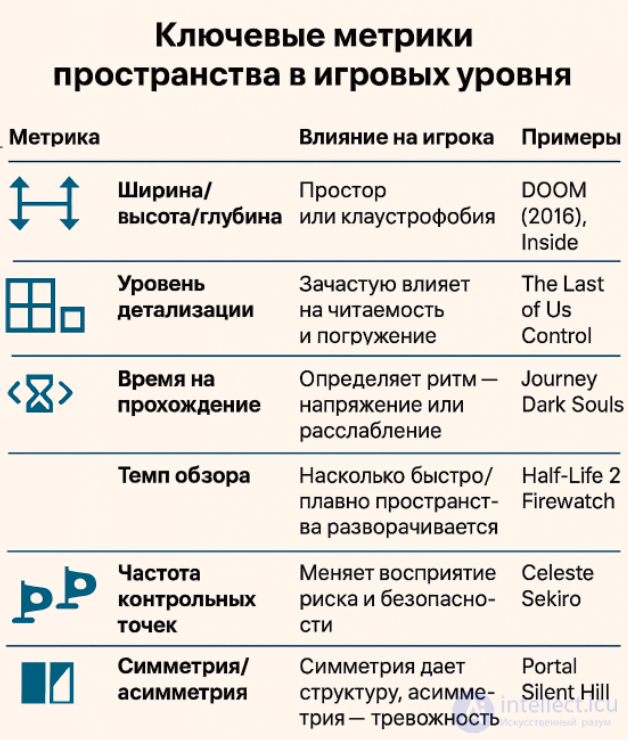
| Metric | Effect on the player | Example games |
|---|---|---|
| Width/height/depth | Spaciousness or claustrophobia | DOOM (2016), Inside |
| Level of detail | Often affects legibility and immersion | The Last of Us, Control |
| Time to complete | Determines the rhythm — tension or relaxation | Journey, Dark Souls |
| Pace of reveal | How quickly/smoothly the space unfolds | Half-Life 2, Firewatch |
| Checkpoint frequency | Changes the perception of risk and safety | Celeste, Sekiro |
| Symmetry/asymmetry | Symmetry gives structure, asymmetry — unease | Portal, Silent Hill |
Gigantism: overcoming (Shadow of the Colossus).
Miniaturization: vulnerability (Little Nightmares, Pikmin).
Density: a feeling of pressure (Alien: Isolation).
Emptiness: loneliness, contemplation (Death Stranding, ABZÛ).
Guided view: the player subconsciously looks where needed — thanks to architecture and light.
Progression by compression: the space first narrows, then suddenly expands — an emotional lift.
Visual navigation: recurring elements create a "rhythm," allowing the player to feel “familiarity” or “novelty.”
"Experimental environments" can be understood as a range of formats in which the space not only surrounds the player but also explores the player's perception, behavior, and emotions.
Experimental environments are a special type of game space in which the level becomes not just a setting for action but a tool for studying the player's perception, behavior, and emotional state. In such spaces, the designer abandons traditional formats, such as realistic architecture or logical navigation, in favor of unconventional solutions: deformed geometries, cyclical routes, changing rules, and broken logic. The player may be deliberately disoriented, provoked into unconventional actions, or placed in a situation where familiar expectations do not work. Visual illusions, sound and light effects, and changes of scale or perspective are used to create a surreal or even unsettling experience. Such environments often work through contrast: for example, a familiar room suddenly violates the laws of physics or logic. Experimental spaces frequently allude to conceptual art, architecture, or psychology, turning a game level into a way to express an idea or provoke a particular reaction. In such conditions, the player not only explores the space but also becomes the subject of an experiment, in which the level adapts to their choices, emotions, or even biometrics. This is a powerful tool in the level designer's arsenal, making it possible to go beyond the familiar and turn a game into an introspective experience.
Let us consider this concept in more detail:
These are spaces that:
Break the usual patterns of interaction with a level
Explore the player's perception — vision, hearing, orientation
Change in response to the player's actions or even inaction
Are often used in indie games, art projects, or within in-game meta-narratives
| Environment type | Features | Examples |
|---|---|---|
| Nonlinear/surreal | Break the logic of geometry and perspective | Antichamber, NaissanceE |
| Reactive | Change when looked at or moved through | The Witness, Superliminal |
| Metaworld | Awareness of the environment's "gameness," breaking the fourth wall | Stanley Parable, Undertale |
| Audio-oriented | Spaces perceived through sound | Hellblade, Stifled |
| Hallucination environments | Distort the senses and navigation, induce a trance | Manifold Garden, Layers of Fear |
To provoke a cognitive shift: "I'm not sure what is really happening, but I feel it."
To move away from the "kill-everyone-reach-the-end" narrative toward contemplation, exploration of meaning, and experience.
To question the very axioms: "what is space," "what does it mean to move," "what is a goal."
Escher-style geometry: staircases leading to the impossible.
Light- and sound-sensitive landscapes.
Procedurally generated abstraction — every session is unique.
A tactile sense of emptiness or tightness, with an emphasis on atmosphere rather than a task.
Navigation meshes (NavMesh) and collision systems underlie how a virtual world feels to the player: what is accessible, what cannot be passed, where AI characters find a path, and where they run into invisible barriers.
The fundamentals of navmeshes and collisions in level design play a critical role in creating a logical, interactive, and realistic game space. Navigation meshes (NavMesh) are special grids, placed automatically or manually on top of the level geometry, that define where characters controlled by artificial intelligence (AI) can move freely. These zones take into account height, slopes, obstacles, and route features, allowing AI agents to plan movement, avoid obstacles, and react to changes in the environment. Navmeshes ensure predictable NPC behavior, minimize getting stuck, and create the feeling of a living world.
Collision systems, in turn, determine how objects and characters physically interact with the environment. Every scene element has a collider — simple or complex geometry that defines the boundaries of contact. This can be an invisible cube, a capsule, a mesh, or even a composite shape. Collisions ensure that the player does not walk through walls, climbs stairs correctly, falls off platforms, and does not get stuck in geometry. At the same time, it is important to keep a balance between accuracy and performance: overly detailed colliders can overload the physics, while simplified ones can lead to bugs and unrealistic interaction.
Skillful work with NavMesh and collisions makes it possible to achieve clear and pleasant gameplay: the player's movements become predictable and responsive, the AI looks intelligent, and the environment feels reliable. When designing levels, it is important to plan navigation zones in advance, avoid traps, account for the possibility of dynamic changes in the environment, and correctly separate walkable and non-walkable areas for both the player and NPCs.
NavMesh (Navigation Mesh) is an abstract grid covering game surfaces, along which AI characters can move safely.
It is a simplified geometry of the space, divided into polygons.
It is used for building routes (pathfinding) by non-player characters (NPCs).
It is generated automatically or manually in the level editor.
Example: Unity uses the NavMesh Surface component; Unreal Engine uses the NavMesh Bounds Volume system.
Collision determines which objects can interact physically:
Solid objects: a character cannot pass through a wall.
Triggers: an area that fires an event when something enters it (for example, a trap activation zone).
Collision shapes:
Box / Sphere / Capsule / Mesh Colliders
Simplified geometries to optimize performance.
Collisions can be:
Static — immovable objects (walls, floor).
Dynamic — moving objects that can be collided with.
Kinematic — controlled manually rather than by physics.
| Function | NavMesh | Collisions |
|---|---|---|
| AI movement | ✔ (finds a route) | ✘ (does not manage collisions) |
| Interaction physics | ✘ | ✔ (pushback, obstacles) |
| Zone definition | ✔ (where one can walk) | ✔ (where one can enter, trigger an event) |
| Optimization | Simplified navigation | Simplified geometry |
NavMesh — as a light grid or patches covering the level floor.
Collisions — often shown as wireframes or colored boxes in the editor.
Looking at navigation and level structure through the lens of architecture, we see how spatial thinking, form, and function come together to create a meaningful and deeply engaging game experience. The architectural approach makes it possible to design not just "walkable" spaces, but emotionally rich ones that guide the player and enrich their perception. Understanding the logic of movement, the distribution of space, scale, and visual landmarks allows designers to create levels that are not only functional but also aesthetically convincing. Ultimately, an architecturally structured level is not a maze of walls and doors, but a skillfully constructed experience in which the player intuitively feels where to go and why.

Comments