
Lecture
The presumption of innocence (Latin: praesumptio innocentiae) (the principle of innocence) is one of the fundamental principles of legal proceedings, under which a person is considered innocent until their guilt in the commission of a crime has been proven in the manner prescribed by law and established by a court verdict that has entered into legal force . The basic principle of the presumption of innocence states: "The burden of proving criminal guilt lies on the accuser."
In most countries, the "presumption of innocence" includes approximately the following provisions:
The sixth-century Digest of Justinian (22.3.2) provides, as a rule of evidence: Ei incumbit probatio qui dicit, non qui negat - "Proof lies on him who asserts, not on him who denies." This is attributed to the jurist Paul of the 2nd and 3rd centuries. It was introduced into Roman criminal law by the emperor Antoninus Pius .
The civil law system is a modern legal system that descends from the ancient Roman legal system (as opposed to the English common law system ). The maxim and its equivalents have been adopted by many countries that use the civil law system, including Brazil , China , France , Italy , the Philippines , Poland , [ 10] Romania [11] and Spain . [12]
In the criminal law system of Hungary, "the most general concept is that everyone (a suspect, an accused or not) must be considered innocent until a final verdict finds them guilty . But there is another view - and it usually appears in international declarations - which does not tie the end of the presumption of innocence to a final verdict, but is 'satisfied' with any provision that speaks of guilt which is based on law. There is a significant difference between the two formulations. A final decision usually means the end of the punitive procedure, which may take place many years after the crime was committed. This may happen, for example, in the case of arrest at the scene of the crime, witness testimony, or the offender's confession: the guilty person must be considered innocent for several years before the final verdict is passed, despite the facts listed above". [ 13]
According to the Talmud, "every person is innocent until their guilt is proven. Consequently, the application of unusually severe measures to the accused must be postponed until their innocence has been successfully challenged. Thus, in the early stages of the trial, the arguments in their defense are as carefully considered as in the case of any other person undergoing trial. Only after their guilt became evident were the solicitous provisions that had been adopted to protect the accused set aside." [14]
Like Roman law, Islamic law also adheres to the principle that the burden of proof lies on the accuser or claimant, on the basis of a hadith recorded by Imam Nawawi. [15] "Suspicion" is also strongly condemned, again on the basis of a hadith recorded by Imam Nawawi [16], as well as by Imam Bukhari [17] and Imam Muslim. [18]
After the time of Muhammad, the fourth caliph, Ali ibn Abi Talib, is also quoted as saying: "Avert the prescribed punishment by rejecting doubtful evidence." [19]
After the fall of the Western Roman Empire, the West began to practice feudal law, which was a synthesis of aspects of Roman law and certain Germanic customs, under the new elite, and which included presumed guilt. For example, the accused could prove their innocence by having twelve men swear that they could not have done what they were accused of. In practice, this generally favored the nobility over the lower classes, whose witnesses risked being seen as less credible. [20] After the rediscovery of Roman law in the 12th century and the development of the jus commune, the canon law of the Catholic Church influenced the common law in the medieval period.[21] through the preservation of the Roman law doctrine of the presumption of innocence. [22]
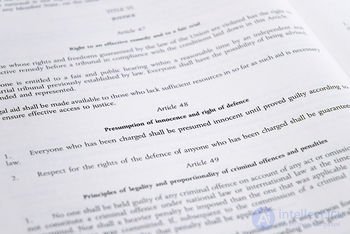
In the United Kingdom, changes affecting this principle have been made. The criminal record of defendants may, in certain circumstances, be disclosed to a jury. Although a suspect is not obliged to answer questions after a formal arrest, a refusal to provide information may now be prejudicial to them in court. There is also a statutory law providing for criminal punishment for failure to decrypt data at the request of the police. If the suspect is unwilling to do so, this is an offense. [37]Thus, citizens may be convicted and imprisoned without any evidence that the encrypted material was unlawful. In addition, in cases of sexual offenses such as rape, where sexual intercourse has already been proven beyond all reasonable doubt, there are a limited number of circumstances in which the accused is required to present evidence that the complainant consented to the intercourse or that the defendant reasonably believed that the complainant was consenting. These circumstances include, for example, that the complainant was unconscious, unlawfully detained, or subjected to violence. [38]
In Canadian law, the presumption of innocence has in some cases been strengthened. The Criminal Code formerly [39] contained numerous provisions under which defenses to certain offenses were subject to a reverse onus: that is, if the accused wished to raise such a defense, they had to prove the facts of the defense on the balance of probabilities, instead of the Crown disproving the defense beyond a reasonable doubt. This meant that in some circumstances the accused could be convicted even if there was reasonable doubt about their guilt. In several cases it was established that various reverse onus provisions violate the presumption of innocence provision of the Charter of Rights and Freedoms. They were replaced with procedures in which the accused simply had to demonstrate an "air of reality" to the proposed defense, after which the burden of disproving the defense shifted to the Crown.
Bill C-51, An Act to amend the Criminal Code and the Department of Justice Act and to make consequential amendments to another Act, received royal assent in December 2018. Among other things, it removed several reverse onus provisions from the Criminal Code, some of which had previously been found unconstitutional, and others of which were removed proactively to avoid further problems with the Charter. [40]
In the USSR, the concept of the presumption of innocence was absent from the Constitution; however, the courts adopted this principle for application as a legal norm, with Resolution No. 1 of the Plenum of the Supreme Court of the USSR of 1978 formulating its construction. The Constitution of the Russian Federation of 1993 enshrined it in practically the same wording .
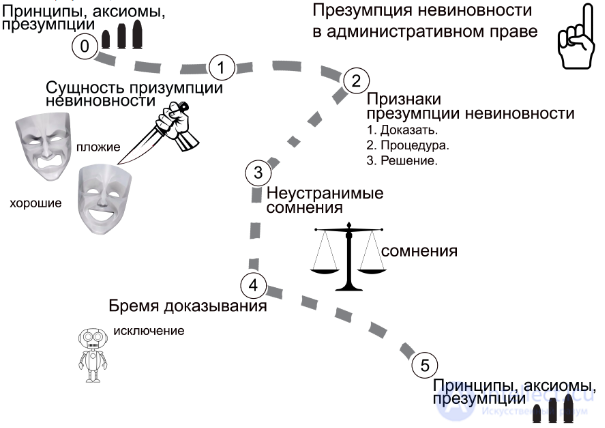
Legal principles, presumptions and axioms.
Lawful conduct is conduct of a subject that complies with the prescriptions of legal norms and does not contradict the basic principles of law. By violating these prescriptions, a person commits an administrative offense.
There are exceptions to all rules, and such exceptions are:
As stated above, all rules have exceptions. One more final exception, the "super exception", is necessity (extreme necessity).
The essence of the presumption of innocence.
To prove that a person is guilty. The proof is included in a legal procedure. A law enforcement act must be drawn up, which is an authoritative decision on the person's guilt.
Features of the presumption of innocence.
To prove means to provide evidence of guilt. Procedure: the proving must take place according to a legal procedure. Decision: the decision on the person's guilt must be made by a competent body.
Irremovable doubts.
Irremovable doubts about a person's guilt mean their innocence.
The burden of proof.
The burden of proving a person's guilt lies on the one who accuses. Exceptions: recording of an offense by means of a camera.
Legal principles, presumptions and axioms.
you need to continue studying principles, presumptions and axioms in administrative law on your own.
The presumption of innocence means:
The presumption of innocence was first formulated:
|
Question |
Answer |
Correct |
|
1. In what case can the duty to prove innocence be placed on the accused |
this duty cannot be placed on the accused |
yes |
|
2. The presumption of innocence means that: |
in addition to the burden of proving the charge, the prosecution also bears the burden of refuting the arguments put forward in defense of the suspect or accused |
yes |
|
3. Which of the statements is incorrect: |
the presumption of innocence implies that irremovable doubts about guilt are to be interpreted in favor of the accused |
no |
What is the name of the principle expressed in Article 49, Part 1 of the Constitution of the Russian Federation:
"Everyone accused of committing a crime is considered innocent until their guilt is proven in the manner prescribed by federal law and established by a court verdict that has entered into legal force":
a) the principle of fairness of legal proceedings
b) the principle of guaranteed dignity of the individual
c) the principle of the presumption of innocence

Comments