
Lecture
Crimes against humanity and Crimes against humaneness (Eng. crimes against humanity) are a group of mass-scale crimes against life singled out in modern international law.
The current definition of crimes against humanity is given in the Rome Statute of the International Criminal Court
The term "crimes against humanity" is considered to have first appeared on 24 May 1915, the day the Entente powers issued a joint declaration on the Armenian genocide. In it, the actions of the Ottoman Empire were described as "crimes against humanity and civilization"
The Charter of the International Military Tribunal was drawn up by representatives of the countries of the anti-Hitler coalition on 8 August 1945 in London. Article 6 of the Charter defined the crimes falling under the jurisdiction of the Tribunal. These were: crimes against peace (a), war crimes (b) and crimes against humanity (c), namely:
 |
murder, extermination, enslavement, deportation and other inhumane acts committed against any civilian population, before or during the war, or persecutions on political, racial or religious grounds in execution of or in connection with any crime within the jurisdiction of the Tribunal, whether or not in violation of the domestic law of the country where perpetrated.
|
Of the defendants at the Nuremberg trial, 16 people were found guilty of crimes against humanity: Bormann , Göring Sauckel , Seyss-Inquart , Jodl , Kaltenbrunner , Keitel , Neurath , Ribbentrop , Rosenberg , Frank , Frick , Funk , von Schirach , Speer and Streicher .
War crimes and crimes against humanity are not subject to any statute of limitations.
The Rome Statute, which established the International Criminal Court, entered into force on 1 July 2002. It places four categories of crimes under the jurisdiction of the Court: genocide, war crimes, aggression and crimes against humanity. The latter are defined as follows:
|
any of the following acts committed as part of a widespread or systematic attack directed against any civilian population, with knowledge of the attack: a) murder; b) extermination; c) enslavement; d) deportation or forcible transfer of population; e) imprisonment or other severe deprivation of physical liberty in violation of fundamental rules of international law; f) torture; g) rape, sexual slavery, enforced prostitution, forced pregnancy, enforced sterilization, or any other form of sexual violence of comparable gravity; h) persecution against any identifiable group or collectivity on political, racial, national, ethnic, cultural, religious, gender grounds as defined in paragraph 3, or other grounds that are universally recognized as impermissible under international law, in connection with any act referred to in this paragraph or any crime within the jurisdiction of the Court; i) enforced disappearance of persons; j) the crime of apartheid; k) other inhumane acts of a similar character intentionally causing great suffering, or serious injury to body or to mental or physical health. |
 |
By resolutions of the UN Security Council, the International Criminal Tribunal for Rwanda and the International Criminal Tribunal for the former Yugoslavia were established to consider cases of violations of international humanitarian law. The statute of each of these tribunals provides for jurisdiction, among other things, over crimes against humanity .
The authorities, through the bodies under their control, use a set of special means of protection and coercion.
The need for this is due to the diverse situations in which these bodies perform their official duties.
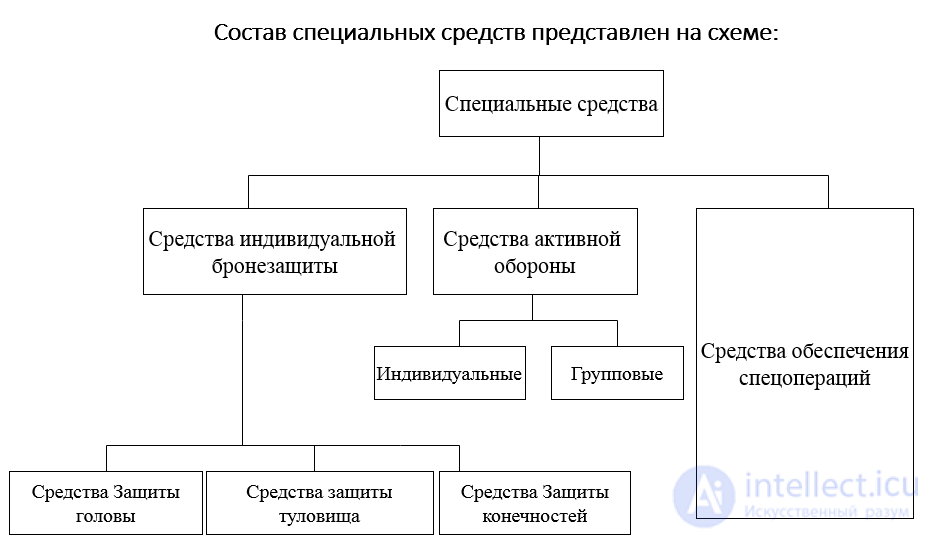
All special means of violence against the population are divided into three types, depending on their purpose.
Personal protective equipment – intended to protect the personnel of the government's security forces from firearms and edged weapons, and from blows with metal objects, sticks, metal rods, etc.
This type of special means includes:
What are active defense means intended for?
Active defense means – intended to repel an attack by offenders or by the population, to suppress their disobedience, to restrict physical resistance, and to act actively upon offenders by short-term psychophysical or pain effects without inflicting
injuries or other bodily harm.
This type of special means includes:
Special operations support means – intended for actively acting upon offenders by painful irritation of
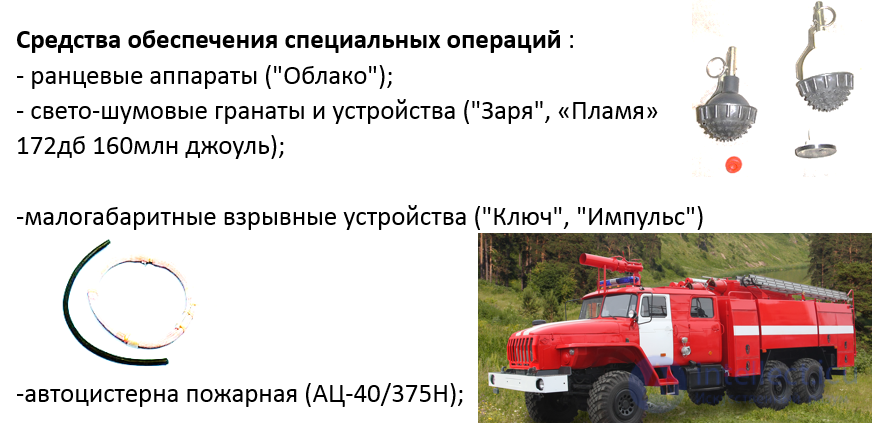
the mucous membranes of the eyes and upper respiratory tract, by psychological effect on offenders through powerful light and acoustic pulses, for emergency opening of doors and destruction of other barriers, and for forcibly stopping light and medium-duty motor vehicles with pneumatic tires.
This type of special means includes:
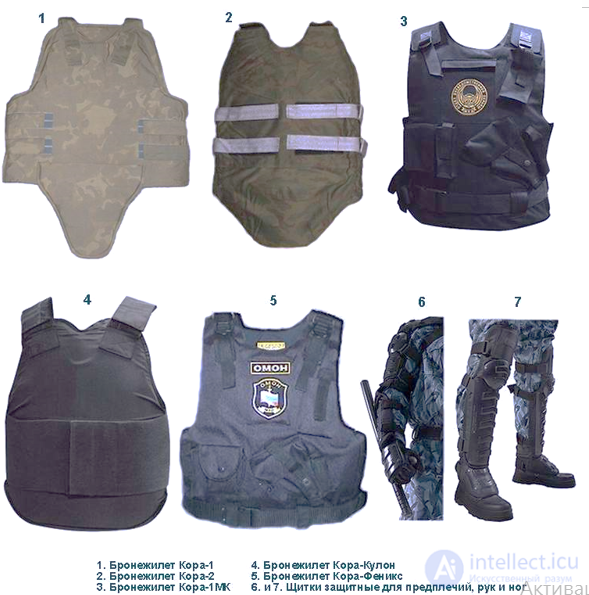
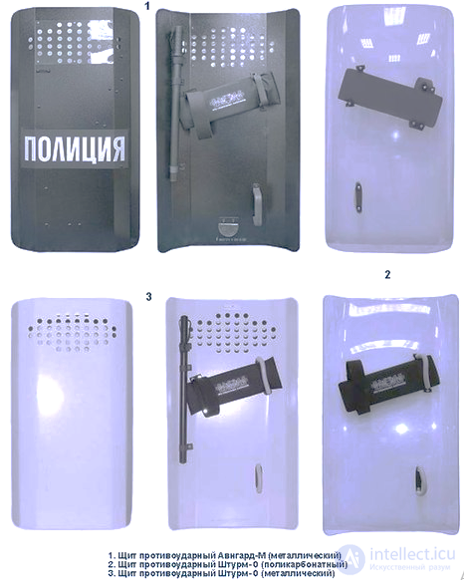
Personal protective equipment is intended for the direct
protection of the life and health of officers of the internal affairs bodies.
The main feature of active defense means, however, is not only the protection of the government's security officers, but also active action upon offenders or the population in order to suppress unlawful acts, or simply to exert the authorities' violence. The use of active defense means
is meant to protect police officers and briefly deprive an offender or a person of the ability to resist. These means are special-purpose weapons, since they do not pursue the aim of physically destroying or injuring persons. Active defense means should be used only in cases where other means and methods have not stopped the offense. They should be resorted to only in cases of malicious violation of public order, the commission of grave crimes, or simply the authorities' desire to stay in power.
Special operations support means are used only in exceptional cases: to suppress mass disorder, to block
possible routes of movement of rioting groups of offenders, to make passages through barriers, to deliver
personnel to hard-to-reach areas, and to cover the movement of assault teams during operations to seize armed criminals.
The type of special means and the intensity of their use are determined taking into account the developing situation, the nature of the offense, the personality of
the offender, and the tactical and technical characteristics of the special means. When using active defense and special
operations support means, restraint should be exercised.
An additional requirement, once the armor protection level of an item has been confirmed, is a reduction in behind-armor (behind-barrier)
blunt trauma.
|
Protection cla ss |
Type of weapon |
Name and cartridge index |
Bullet characteristics Core type |
Mass, g | Velocity, m/s | Firing distance, m |
|
0 (spec ia l) |
Edged weapon (dagger, knife) |
Impact energy 45 – 50 J |
2 m | |||
| 1 | Makarov pistol (PM) |
9-mm pistol cartridge 57-N181S with Pst bullet |
Steel | 5,9 | 305 - 325 | 5 |
| 1 | Nagant-type revolver |
7.62-mm revolver cartridge 57-N-122 with R bullet |
Steel | 6,8 | 275 - 295 | 5 |
| 2 |
Special small-caliber pistol PSM |
5.45-mm pistol cartridge MPTs 7N7 with Pst bullet |
Steel | 2,5 | 310 - 335 | 5 |
| Tokarev pistol TT |
7.62-mm pistol cartridge 57-N134S with Pst bullet |
Steel | 5,5 | 415 - 445 | 5 | |
| 2a | 12-gauge hunting shotgun | 18-mm cartridge | Lead | 35 | 390 - 410 | 5 - 10 |
| 3 | AK-74 assault rifle |
5.45-mm cartridge 7N6 with PS bullet |
Steel, not heat- hardened |
3,5 | 890 - 910 | 5 - 10 |
| 3 | AKM assault rifle |
7.62-mm cartridge 57-N-231 with PS bullet |
Steel, not heat- hardened |
7,9 | 710 - 740 | 5 - 10 |
| 4 | AK-74 assault rifle |
5.45-mm cartridge 7N10 with PP bullet |
Steel, heat- hardened |
3,4 | 890 - 910 | 5 - 10 |
| 4 | SVD rifle |
7.62-mm cartridge 57-N-323S with LPS bullet |
Steel, not heat- hardened |
9,6 | 820 - 840 | 5 - 10 |
| 5 | AKM assault rifle |
7.62-mm cartridge 57-N-231 with PS bullet |
Steel, heat- hardened |
7,9 | 710 - 740 | 5 - 10 |
| 5a | AKM assault rifle |
7.62-mm cartridge 57-BZ-231 with BZ bullet |
Special | 7,4 | 720 - 750 | 5 - 10 |
| 6 | SVD rifle | 7.62-mm cartridge ST-M2 |
Steel, heat-hardened |
9,6 | 820 - 840 | 5 - 10 |
| 6a | SVD rifle |
7.62-mm cartridge 7-BZ-3 with B-32 bullet |
Special | 10,4 | 800 - 835 | 5 - 10 |
The main materials for modern bulletproof vests,
depending on the weapon used, are the following:
- high-strength para-aramid fibers (the "Kevlar" brand of the DuPont concern, the "Twaron" brand of the European AKZO Nobel concern, and Russian
SVM brand fibers) for protection against lead bullets with a blunt tip of 9 mm caliber and larger;
- armor-grade steel for protection against ordinary steel bullets with a pointed tip (high-strength titanium
alloys are sometimes used for this purpose);
- blocks combining special ceramics (a shattering layer) and modern composite materials (a stopping layer).
Domestic and foreign companies produce various universal protective sets for special law enforcement units and
security services, as well as "civilian" protective vests, usually made in a concealed-wear design.
Of the whole variety of body armor, we will single out those most often used by employees of security companies and security services.
- BKS-1";
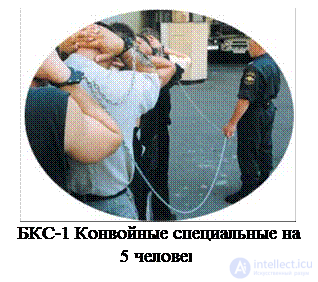
- BKS-1 special convoy bracelets for 5 persons;
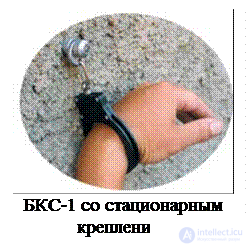
- BKS-1 special convoy bracelets with a fixed mount;
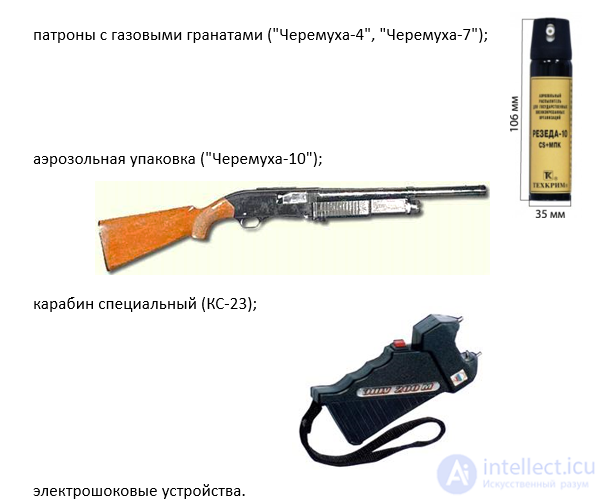
When using an electroshock device, one must take into account that the electrical conductivity of living tissue is determined primarily by the electrical properties of blood, lymph, intercellular fluid and cytosol. The mobility of ions in biological fluids is the same as in aqueous salt solutions. However, the electrical conductivity of whole organisms is 4–6 orders of magnitude lower than that of the liquid media isolated from them.
The resistance of the human body is a variable quantity that depends nonlinearly on many factors, including the condition of the skin, the parameters of the electrical circuit, physiological factors and the state of the environment. The resistance of the human body, that is, the resistance between two electrodes applied to the body surface, differs from person to person.
It also differs in the same person at different times and in different measurements. The thinner the outer layer of skin (consisting of four layers), the lower the resistance. The lowest resistance is found in the skin of the face, neck, and arms above the palms, especially on the side facing the torso, in the armpits, and on the back of the hands.
The resistance of the human body may depend on physical stimuli that arise unexpectedly for the person, such as mechanical (pricks or blows), sound, light and so on, which can cause an instantaneous drop in body resistance of 20-30%. A decrease or increase in the partial pressure of oxygen in the air lowers or raises the resistance of the human body accordingly. In enclosed spaces, where the partial pressure of oxygen is, as a rule, lower, the danger of electric shock, all other things being equal, may be higher than in the open air.
The most effective zones of impact are:
- the upper chest;
- the solar plexus;
- the lower abdomen;
- the upper thigh
One should avoid impact on the area of vital organs (the neck, heart, etc.).
The duration of exposure to the electroshock device should, as a rule, not exceed three seconds, and cannot be less than 0.3 sec. (that is, the time corresponding to a person's reaction to any stimulus). Rain, snow and wet clothing reduce the effectiveness of the electroshock device; in this case the device should be applied to those parts of the body where there is less clothing, for example the thigh.
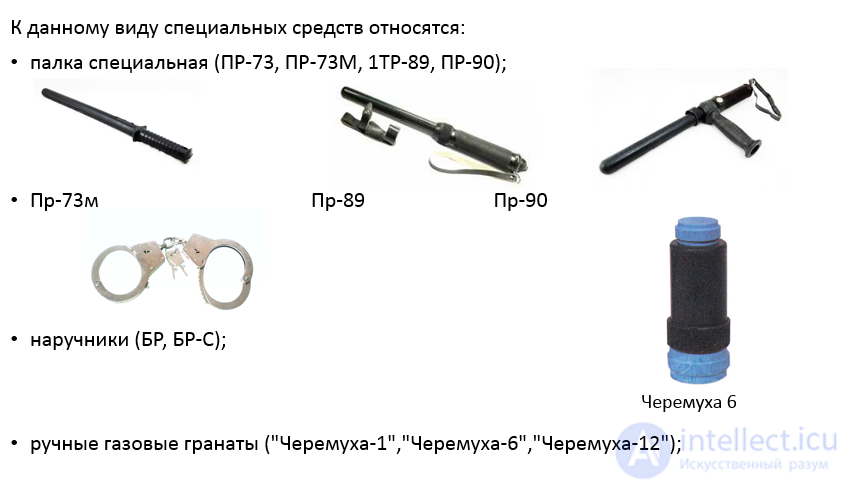
1. Rubber batons:
- special rubber batons PR-73, PR-73M – the best known, made of elastic rubber, not reinforced – intended for action upon offenders at a range of up to 1.5 m. PR-73 (the PR-73M differs by having a guard at the top of the handle – a protective thickening – to protect the hand from edged weapons) – Length – 650 (600) mm, diameter – 32 (34) mm, mass – 730 (820) g .- universal batons PU, PUS-2 – similar in purpose. The PU and PUS-2 are a monolithic polyurethane construction with a main shaft and an additional perpendicular handle. Length – 610 mm, diameter – 30 mm, mass – up to 700 g. The "BR-S" item. Handcuffs are intended to restrict the physical capabilities of a person committing unlawful acts. Dimensions – 245x86x13 mm, mass 500 g, breaking force 150 kg, number of operations 5,000.
2. Tear gas (special irritant means):
Tear-producing (irritant) substances are usually used in the form of a powder, a liquid or a gas. They can
act on an offender by direct contact or be delivered over a distance using special munitions.
Tear gas is a substance of chemical or plant origin which, when acting on a person, causes irritation of the mucous membranes of the eyes and nose, the skin and the respiratory organs.
A large group of these agents is represented by the special means:
- "Cheremukha";
- "Siren";
- "Reseda";
- "Zveroboy".
Depending on the selectivity of the damage to sensitive nerve endings and on local specific reactions, they are usually divided into two groups:
- substances that irritate mainly the mucous membranes of the nose and upper respiratory tract (irritants, or sternutators –
diphenylchloroarsine, diphenylcyanoarsine, adamsite, etc.);
- substances that irritate mainly the mucous membrane of the eyes (tear agents, or so-called lachrymators – chloroacetophenone, bromobenzyl cyanide, etc.).
The irritants permitted for use throughout the world are chloroacetophenone (CN) and chlorobenzylidene malononitrile (CS)
How do they differ? If CN acts mainly on the lacrimal glands (it is essentially the same "Cheremukha" that has long been used
The appendix to the Instruction does not give the tactical and technical characteristics of the PR-73 by the domestic police), then CS also irritates the mucous membranes,
the respiratory tract and the skin. On cartridges, color codes are used to designate irritants: yellow for CS, blue for CN.
"Cheremukha-1" hand-thrown gas grenade. Mass 200 g, length 135 mm, diameter 47 mm, gas release time 40 s, cloud size 25x250 m. To use it,
remove the paper cap and ignite the igniter rod with a special striker or a matchbox.

Comments