
Lecture
Information law is a complex branch of law: a set of legal norms that governs social relations concerning information as a public resource and the functioning of information systems, with the aim of satisfying the needs and interests of the individual, the citizen, social communities, society, the state and the international community.
Information law is a new, still emerging branch of law that plays a defining role in the development of modern society.
Information law regulates information relations, i.e. social relations connected with the production, transmission, dissemination, search and receipt of information, the use of information technologies, and the protection of information. Information law is a complex branch of law. As a system of norms regulating information relations, information law aims to study the information sphere as a sphere of legal regulation of social relations, to identify the objects and subjects of information legal relations, to prepare drafts of normative legal acts in the field of information law, and to assess the effectiveness of these drafts with the use of
information technologies.
Information law is a body of legal norms protected by the state, arising in the information sphere of the production, transformation and consumption of information. Law is an information system; therefore, information law also studies the informational essence of law.
Methods of legal regulation in information law
1) The dispositive method of regulation, with its characteristic properties of decentralization and coordination, equality of the parties and freedom of choice. Agreements predominate in the legal toolkit of this method, and permissions play the leading role among the means of regulation. This method is applied to relations arising, for example, in respect of information held under a commercial secrecy regime, and to relations concerning the provision of information.
2) The imperative method, characterized by the centralized exercise of power and strict subordination of the participants in legal relations. Orders and instructions predominate in the legal toolkit of this method, and the main ways of influencing relations are prohibitions and positive obligations. It is applied to relations concerning the formation of state information systems, the management of information processes, the provision of information security, and the protection of information held under a state secrecy regime.
The structure of information law consists of three interrelated parts: the general part, the special part, and the specific part.
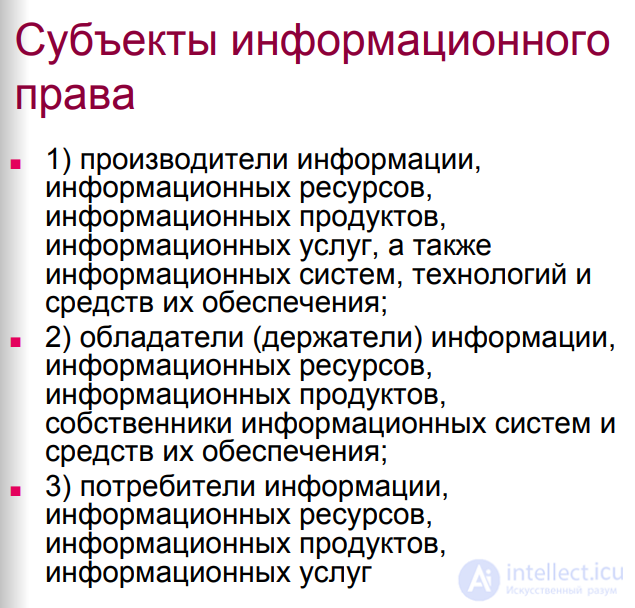
The general part consists of the following leading institutions: the basic provisions of information law (the basic concepts of information law, concepts of its definition); the content of information legal relations; the objects of legal relations; the subjects of legal relations concerning information; the principles of information law; the methodology of information law; the sources of information law and its connection with the leading, complex and special branches of law; the history of information law; scientific schools of information law in individual countries; the structure of a given country's legislation on information and its connection with international information law.
The special part consists of the following institutions: the fundamental principles of the rights and obligations of the individual and the citizen in the information sphere of society; the foundations of society's rights concerning the dissemination, access to and storage of socially significant information; the foundations of the rights, obligations and guarantees of the state concerning information, its circulation, the determination of the legal regime of access to it, and its use in the interests and needs of ensuring the functioning of state authorities and local self-government; and the foundations of international information exchange.
The specific part is structured by object and institutional criteria at the level of sub-branches, by types and directions of information activity: state regulation of social relations concerning personal data, their protection and safeguarding; the basic provisions of mass media law; the basic provisions of library law; the basic provisions of archive law; the basic provisions of science and education law; the basic provisions of advertising law; the basic provisions of museum law; the basic provisions of telecommunications law (including two large, complex institutions such as postal service and electronic communications); the basic provisions of informatics and informatization; the basic provisions of IT law, of Internet law and of the law of electronic social networks and communications; the basic provisions of cyber law; the basic provisions on the organization of national information security, etc. (mainly those special institutions of types of information activity that are formalized at the level of special statutes, where varieties of information are defined as special objects of legal relations).
By such features, from the standpoint of the theory of multiplicity of large, complex systems (hypersystems), and figuratively in modern legal doctrine, information law is conventionally structured like the periodic table of chemical elements of D. I. Mendeleev, which makes it possible to understand its multifunctionality, integrity and subsystems within the system, and to study it for practical application.

A distinction is made between the objective and the subjective meaning of information law.
The first consists of social relations concerning information, expressed in norms established at the public-law and private-law levels.
The second is the set of rights and obligations of specific participants in social relations concerning information as an object of social relations. In essence, information law is regarded as a sphere of social relations, as a science, and as an academic discipline.
In essence, information law is regarded as: a conventionally defined sphere of social relations concerning information; an academic discipline; and a direction of scientific research within the legal sciences.
The object of legal regulation in information law is social information relations (social relations concerning information).
The main subject matter of social relations is information (data, facts, messages, knowledge, secrets, etc.).
The method of legal regulation of social relations in the field of information: in the public-law component, it is the systematic, comprehensive application of the methods of constitutional, civil, administrative and criminal law. In the private-law component, the method can be seen as the comprehensive application of methods of self-organization – at the level of transactions, customs, traditions, norms of public morality, professional and business ethics, etc., without the participation of the state.
By its legal nature and origin, information law is a large component subsystem within the system of national law and has private-law and public-law components. That is, the norms of conduct of information law are formed at both the public (state) and the private levels of social relations concerning information in the course of people's diverse activities.
Through the subject of legal relations – information – information law is linked both with the leading branches of law (constitutional, administrative, civil, criminal) and with various other complex branches of law (financial, commercial, environmental, etc.), with special branches of law (investment, transport, air, tax, budget, banking, insurance, competition, etc.), and also with cross-sectoral institutions of law: intellectual property law (including copyright and inventor's rights) and other institutions of various branches of law where social relations concerning information are a derivative subject (a work, an invention, a utility model, mass information, archives, libraries, etc.). Sub-institutions of the general part of information law can be considered to include the right to freedom of information, the right of access to information, the legal regime of restricted-access information, and others.
In the modern scientific doctrine of information law, it is generally accepted that information law has three structural parts: general, special, and specific. In the broader understanding, the general part defines the basic provisions on the goals, tasks, principles, content, and subjects of legal relations connected with information, and the like.
In the broader understanding of the special part of information law, four leading large institutions (hyper-institutions) are decisive: the rights and obligations of the individual and the citizen connected with information; the interests, needs and rights of society and of public associations in the social information sphere; the obligations, rights and duties of the state in the public information sphere; and the basic principles of the country's international cooperation in the global information space. In the specific part, the decisive element is the structuring (institutionalization) of legal relations in the public information sphere by directions (or types, subtypes) of information activity according to its technological manifestations: media law (print mass media, the press, electronic media (radio, television, Internet media)); informatization law (informatics law, IT law (on creating electronic technologies for formalizing, storing, disseminating, searching for and receiving information with the help of computers and other devices of their kind (iPhones, iPads, smartphones, etc.)); information security law, Internet law, telecommunications law, and the like.
The main areas of legal regulation of information legal relations:
1) freedom to search for, receive, transmit, produce and disseminate information by any lawful means;
2) establishment of restrictions on access to information only by federal laws;
3) openness of information about the activities of state bodies and local self-government bodies and free access to such information, except in cases established by federal laws;
4) equality of the languages of the peoples of the Russian Federation in the creation of information systems and their operation;
5) ensuring the security of the Russian Federation in the creation of information systems, their operation and the protection of the information they contain; 6) reliability of information and timeliness of its provision;
7) inviolability of private life, and the inadmissibility of collecting, storing, using and disseminating information about a person's private life without his or her consent;
8) the inadmissibility of establishing by normative legal acts any advantages of using some information technologies over others, unless the mandatory use of certain information technologies for creating and operating state information systems is established by federal laws.

Comments