
Lecture
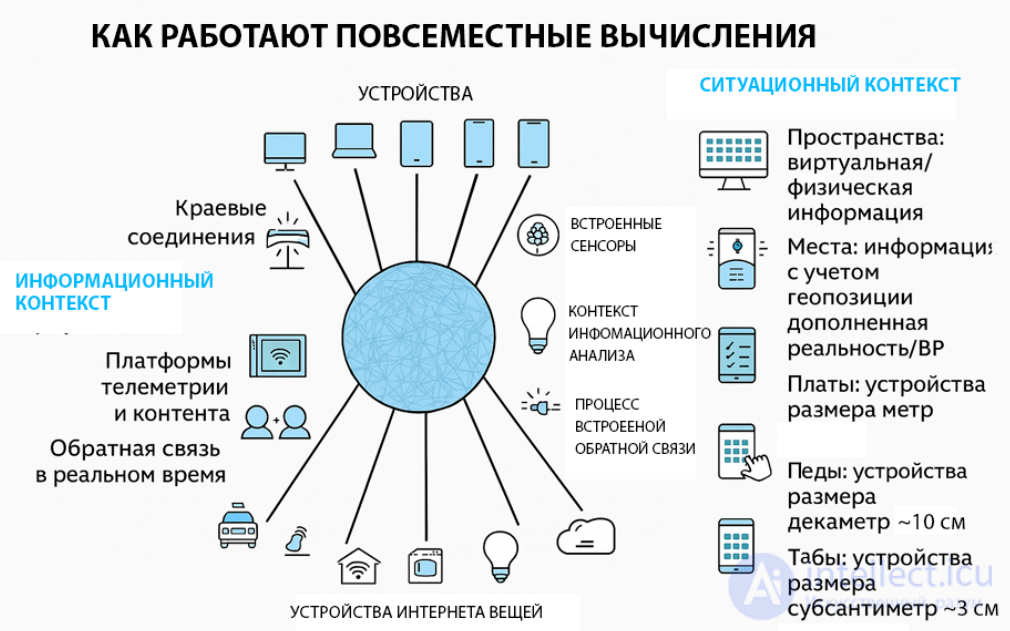
Ubiquitous computing is a concept in software engineering, hardware engineering, and computer science according to which computing should be available everywhere and at all times. Unlike desktop computing, ubiquitous computing implies use on any device, in any location, and in any format. The user interacts with a computer that can exist in many different forms, including laptops, tablets, smartphones, and terminals embedded in everyday objects such as a refrigerator or a pair of glasses. The underlying technologies supporting ubiquitous computing include the Internet, advanced middleware, kernels, operating systems, mobile code, sensors, microprocessors, new I/O and user interfaces, computer networks, mobile protocols, global navigation systems, and new materials.
This paradigm is also described as pervasive computing, "ambient intelligence," or "everyware." Each term emphasizes several different aspects. When referring to the objects involved, it is also called physical computing, the Internet of Things, haptic computing, and "things that think." Rather than offering a single definition of pervasive computing and related terms, a taxonomy of the properties of pervasive computing has been proposed, which can be used to describe the different kinds or varieties of pervasive systems and applications.
Common computing themes include: distributed computing, mobile computing, location computing, mobile networking, sensor networks, human-computer interaction, context-aware smart home technologies, and artificial intelligence.
Ubiquitous computing is the concept of using small, inexpensive computers connected to the Internet to automate everyday tasks.
Mark Weiser proposed three basic forms for ubiquitous computing devices:
All of the ubiquitous computing devices proposed by Mark Weiser are based on flat devices of various sizes with a visual display. Beyond these concepts, there is a large set of other ubiquitous computing devices that could exist.
Mark Weiser coined the term "ubiquitous computing" around 1988, while serving as chief technologist at the Xerox Palo Alto Research Center (PARC). Both alone and with PARC director and chief scientist John Seely Brown, Weiser wrote several of the first papers on the subject, largely defining it and outlining its main challenges.
Recognizing that extending computing power into everyday situations would require an understanding of social, cultural, and psychological phenomena beyond their own expertise, Weiser was influenced by many fields outside computer science, including "philosophy, phenomenology, anthropology, psychology, postmodernism, sociology of science, and feminist criticism." He spoke openly about the "humanistic origins of the 'invisible ideal in postmodern thought,'" also citing Philip K. Dick's ironic dystopian novel Ubik.
Andy Hopper of the University of Cambridge in the UK proposed and demonstrated the concept of "teleporting," in which applications follow the user wherever they move.
Roy Want, while a researcher and student under Andy Hopper at the University of Cambridge, worked on the "Active Badge System," an advanced location-sensing system in which personal mobility is combined with computing.
Bill Schilit (now at Google) also worked on this topic early on and took part in the first workshop on mobile computing, held in Santa Cruz in 1996.
Ken Sakamura of the University of Tokyo (Japan) leads the Ubiquitous Networking Laboratory (UNL) in Tokyo, as well as the T-Engine Forum. The overall goal of Sakamura's Ubiquitous Networking specification and the T-Engine Forum is to enable any everyday device to send and receive information.
The Massachusetts Institute of Technology also made significant contributions to research in this area, notably the Things That Think consortium (led by Hiroshi Ishii, Joseph A. Paradiso, and Rosalind Picard) at the Media Lab [and the CSAIL project known as Project Oxygen. Other major contributors include the University of Washington (Shwetak Patel, Anind Dey, and James Landay), Dartmouth College's HealthX Lab (led by Andrew Campbell), the Georgia Institute of Technology College of Computing (Gregory Abowd and Thad Starner), Cornell Tech's People Aware Computing Lab (led by Tanzeem Choudhury), New York University's Interactive Telecommunications Program, the Department of Informatics at the University of California, Irvine, Microsoft Research, Intel Research and Equator, UCRi, and CUS at Ajou University.
One of the first ubiquitous systems was artist Natalie Jeremijenko's "Live Wire," also known as "Dangling String," installed at Xerox PARC during Mark Weiser's time there. It was a piece of string attached to a stepper motor and controlled through a local area network; network activity made the string twitch, creating a peripherally noticeable indicator of motion. Weiser called it an example of "calm technology."
A modern manifestation of this trend is the ubiquity of mobile phones. Many mobile phones support high-speed data transfer, video services, and other services with high computing power. Although these mobile devices are not necessarily the embodiment of ubiquitous computing, there are examples such as Japan's Yaoyorozu ("Eight Million Gods") project, in which mobile devices combined with radio-frequency identification tags demonstrate that ubiquitous computing is already present in one form or another.
Ambient Devices released the "Orb," the "Dashboard," and the "Weather Beacon": these decorative devices receive data from a wireless network and report current events such as stock prices and the weather, as does, for example, the Nabaztag, invented by Rafi Haladjian and Olivier Mével and manufactured by Violet.
Australian futurist Mark Pesce created LAMP, a lamp with 52 LEDs that is easily configurable and uses Wi-Fi, and named it MooresCloud after Gordon Moore.
Unified Computer Intelligence Corporation released a device called Ubi – The Ubiquitous Computer, designed for voice interaction with the home and providing constant access to information.
Research in ubiquitous computing has focused on creating an environment in which computers allow people to concentrate their attention on individual aspects of the environment and to perform oversight and policy-making functions. Within ubiquitous computing, particular emphasis is placed on creating a human-machine interface capable of interpreting and supporting the user's intentions. For example, the Massachusetts Institute of Technology (MIT) Project Oxygen aims to create a system in which computing will be as ubiquitous as the air:
In the future, computation will be human-centered. It will be freely available everywhere, like batteries and power sockets, or the oxygen in the air we breathe... We will not need to carry our own devices around. Instead, configurable generic devices, either handheld or embedded in the environment, will bring computation to us, whenever we need it and wherever we might be. As we interact with these "anonymous" devices, they will adopt our information personalities. They will respect our desires for privacy and security. We won't have to type, click, or learn new computer jargon. Instead, we'll communicate naturally, using speech and gestures that expresses our intent...
This is a fundamental shift that does not seek to escape the physical world and "enter some metallic, gigabyte-infested cyberspace," but rather brings us closer to computers and communication tools, making them "synonymous with the useful tasks they perform."
Network robots link ubiquitous networks with robots, helping to create a new lifestyle and solutions to various social problems, including population aging and patient care.
The "Continuity" feature set, introduced by Apple in OS X Yosemite, can be seen as an example of ubiquitous computing.
Ambient IoT applications include improving the efficiency and sustainability of food and pharmaceutical supply chains, protecting against counterfeiting, and providing the data needed for modern transportation and smart city initiatives. Benson Chan, chair of the U.S. Department of Commerce's IoT Advisory Board, called Ambient IoT the "original vision of IoT."
Standards for the ambient Internet of Things are being considered by 3GPP, IEEE, and the Bluetooth SIG.
A wearable device, also known as a body-borne computer or wearable, is a computing device worn on the body. The definition of a "wearable computer" can be narrow or broad, including smartphones or even ordinary wristwatches.
Wearable devices can be designed for general use, in which case they are just a small example of mobile computing. Alternatively, they can be designed for specialized purposes such as fitness trackers. They can include special sensors such as accelerometers, heart rate monitors, or, in a more advanced form, electrocardiogram (ECG) and blood oxygen saturation (SpO2) monitors. In the definition of wearable computers we also include new user interfaces such as Google Glass, a head-mounted optical display controlled by gestures. It is possible that specialized wearable devices will turn into universal general-purpose devices, as happened with the convergence of PDAs and mobile phones into smartphones.
Wearable devices are usually worn on the wrist (for example, fitness trackers), hung around the neck (like a necklace), attached to an arm or leg (smartphones during exercise), or to the head (for example, glasses or a helmet), although some devices are placed elsewhere (for example, on a finger or in a shoe). Devices carried in a pocket or bag, such as smartphones and, before them, pocket calculators and PDAs, may or may not be considered "wearable."
Wearable computers share a number of technical challenges with other mobile computers, such as batteries, heat dissipation, software architecture, wireless and personal area networks, and data management. Many wearable computers are always on, for example continuously processing or recording data.
Privacy is perhaps the most frequently cited criticism of ubiquitous computing (ubicomp), and possibly the biggest obstacle to its long-term success.

Comments