
Lecture
Packing density in a given space is the fraction of the space filled by the packed bodies (figures). In packing problems the goal is usually to obtain a packing with the maximum possible density.
If K1,…,Kn are measurable subsets of a compact measure space X whose sets of interior points are pairwise disjoint, then the collection {Ki} is a packing in X, and the density of this packing equals
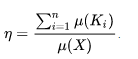 .
.
If the space into which the packing is carried out is infinite, as, for example, Euclidean space, the density is traditionally defined as the limit of the densities obtained by packing within balls of ever increasing size.
If Bt is a ball of radius t centered at the origin, then the density of the packing {Ki : i∈ℕ} equals
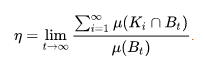 .
.
Since such a limit does not always exist, it is useful to define the upper and lower densities as the upper and lower limits. If the density exists, the upper and lower densities coincide. If it is guaranteed that any ball in Euclidean space intersects only a finite number of packing elements, and if the diameters of the elements are bounded above, the upper and lower densities do not depend on the choice of origin, and μ(Ki∩Bt) can be replaced by μ(Ki) for any element intersecting Bt . The balls can be replaced by homothets of some other convex body, but, in general, the resulting densities may differ.
Often a packing is considered with a restriction on the use of elements from some set of elements. For example, the set of elements may consist of balls of a certain radius. The optimal packing density, or packing constant, associated with a collection is the least upper bound of the upper densities obtained by packings composed of a subcollection of the set of elements from which the packing is built. If the given collection of elements for packing consists of convex bodies of bounded diameter, there exists a packing whose density equals the packing constant, and this packing constant does not change if the balls in the definition of density are replaced by homothets of some other convex body .
Of interest are all Euclidean motions of a fixed convex body K. In this case the packing constant is called the packing constant of the body K. The Kepler conjecture concerns the packing constant of three-dimensional balls. Ulam's packing conjecture states that three-dimensional balls have the smallest packing constant compared to other convex bodies. All translations of a fixed body are also of interest, for which the translative packing constant of the body is introduced.

Comments