
Lecture
Close packing of equal spheres — an arrangement of identical non-overlapping spheres in space in which the fraction of space occupied by the interior regions of these spheres (the packing density) is maximal, as well as the combinatorial geometry problem of finding this packing .
Carl Friedrich Gauss proved that the highest packing density in three-dimensional space that can be achieved by a simple regular packing is equal to
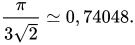
This density is achieved in packings into the face-centered cubic (FCC) and hexagonal close-packed (HCP) lattices (see below). Kepler's conjecture states that this packing has the highest density among all possible sphere packings, both regular and irregular. This conjecture was proved by T. C. Hales . after many years of work programming the computations required for the proof.
| FCC | HCP | |
|---|---|---|
 |
 |
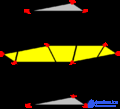 |
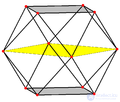
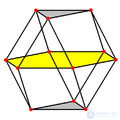
| FCC packing can be oriented in different ways, and depending on orientation a single layer of it has either a square or a triangular packing. This can be seen on the cuboctahedron with 12 vertices, representing the positions of the centers of 12 spheres around a central sphere. HCP packing can be viewed as layers packed in a triangular packing, where the spheres of the neighboring layer sit at the vertices of a triangular orthobicupola passing through the centers of the spheres of the given layer. | ||
| Comparison of FCC and HCP packings | ||
 |
||
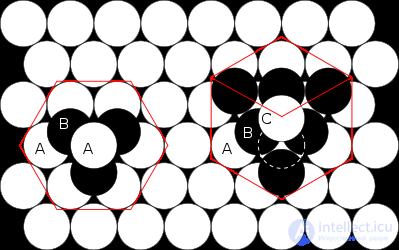
| HCP packing (left) and FCC packing (right). The outlines of the corresponding Bravais lattices are shown in red. The letters show which layers in the packing coincide (there is no shift relative to each other in the horizontal plane): thus, in HCP packing, above layer A lies layer B, and above it once again lies layer A, in which the spheres are located at the same positions as in the other A layers. In FCC packing, three layers are shown, and all three are different: above layer A lies B, above B lies C, and only above C does A occur again. Note that FCC packing can be converted into HCP packing by shifting the layers, as shown by the dashed line. | ||
There are two simple regular packings that achieve the maximum average density. They are called face-centered cubic (FCC) (or cubic close packing) and hexagonal close packing (HCP = hexagonal close-packed cell or lattice), depending on the symmetries of the lattice. Both packings are based on layers of spheres with centers at the vertices of a triangular tiling. Both packings can be represented as a stack of identical sheets, within which the spheres are arranged in a triangular lattice (close-packed layers); FCC and HCP differ in the position of these sheets relative to one another.
The arrangement of spheres in FCC packing forms the lattice of the same name. The arrangement of spheres in HCP packing does not form a lattice, but is nevertheless regular in the sense that all sphere positions are indistinguishable — the symmetry group of the HCP packing acts transitively on the spheres.
The FCC lattice is known in mathematics as the lattice generated by the A3 root system. In the English-language literature this type of cell is called face-centered cubic (fcc). The HCP lattice is called hexagonal close-packed (hcp) in the English-language literature.
Taking one of the close-packed layers of balls as a reference point, the remaining layers can be divided into different types depending on how they are positioned relative to the first layer in terms of horizontal shift. There are three such types, and they are conventionally denoted A, B, and C.
Relative to a level with ball A (see the figure on the left, «Comparison of FCC and HCP packings»), various positions of balls B and C are possible. Any sequence of positions A, B, and C by layers, without repetition in adjacent layers, is possible and yields a packing of the same density.
The most regular packings are:
Nevertheless, the same packing density can be achieved by an alternative layer-by-layer stacking of the same close-packed layers of spheres in the plane, including structures that are aperiodic in the direction of stacking. There is an uncountable number of irregular arrangements of planes (for example, ABCACBABABAC…), which are sometimes called «Barlow packings», after the crystallographer William Barlow .
In close packing, the distance between the centers of spheres in the plane of a close-packed layer is equal to the diameter of the sphere. The distance between the centers of spheres in projection onto an axis perpendicular to the close-packed layer is equal to

where d — is the diameter of the sphere. This follows from the tetrahedral arrangement of spheres in close packing.
In both FCC and HCP stackings, each sphere has twelve neighbors (in other words, the coordination number for any sphere in them is 12). Around a sphere there exist empty regions surrounded by six spheres (octahedral), and smaller empty regions surrounded by four spheres (tetrahedral). The distances to the centers of these empty regions from the centers of the surrounding spheres equal 32 for the tetrahedral and √2 for the octahedral voids, if the radius of the sphere is 1. FCC packing is obtained if, in the next layer, balls are placed above the octahedral voids; HCP — above some of the tetrahedral ones.
When any lattice of ball packing is formed, it should be noted that if two spheres are touching, a straight line can be drawn from the center of one sphere to the center of the other sphere, and this line passes through the point of contact. The distance between the centers — the shortest path between the points — lies exactly on this line, so this distance equals r1 + r2 where r1 — is the radius of one sphere, and r2 — is the radius of the other. In close packing all spheres have the same radius r, so the distance between centers is simply 2r.
To form an A-B-A-B-… hexagonal close packing of spheres, the coordinates of the lattice points will be the centers of the packing's balls. Suppose the goal is to fill a box with spheres according to the HCP scheme. The box is placed in the x-y-z coordinate system.
First we form a row of spheres; their centers will lie on a single straight line. The x coordinate values will change by an amount of 2r, since the distance between the centers of two touching spheres equals 2r. For these balls the y and z coordinates will be the same. For simplicity, let the y and z coordinates of the balls of the first row equal r, which corresponds to the surfaces of the balls lying on the planes with zero y and z coordinates. Thus, the coordinates of the balls of the first row will look like (r, r, r), (3r, r, r), (5r ,r, r), (7r ,r, r), … .
Now let us form a second row of spheres. Again the centers will lie on a straight line, and the x coordinates will differ by 2r, but the balls will be shifted along the axis by an amount r, so that the x coordinates of their centers will equal the coordinates of the points of contact of the balls of the first row. Since each sphere of the new row touches two spheres of the row below, their centers form equilateral (regular) triangles with the centers of the neighboring balls. All side lengths will equal 2r, so the difference between the rows in the y coordinate will be √3r. That is, the second row will have coordinates

The next row of spheres follows this pattern, shifting the row along the x axis by an amount r and along the y axis by √3r. We add rows until we reach the boundary of the box.
In an A-B-A-B-… packing, the planes of spheres with odd numbers will have exactly the same x and y coordinates; only the z coordinates change, which is also true for the even planes. Both kinds of planes are formed according to the same scheme, but the position of the first sphere of the first row will differ.
Let us use the construction described above as layer A. We place a sphere on top of this layer so that it touches three spheres of layer A. These three spheres already touch each other, forming an equilateral triangle. Since these three spheres touch the added sphere, the four centers form a regular tetrahedron , all of whose sides equal 2r. The height of this tetrahedron is the difference of the z coordinates between the two layers and equals  . Combined with the x and y coordinates, this gives the centers of the first row of plane B:
( 
The coordinates of the second row follow the pattern described above:

The difference in z coordinates to the next A layer again equals , while the x and y coordinates equal the coordinates of the first A layer
In general, the coordinates of the centers can be written in the form:
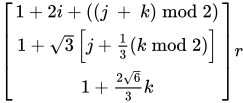
where i, j, and k — are indices along the x, y, and z coordinates (starting from zero), and «a mod b» means «taking the remainder» of dividing  by
by  .
.
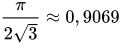
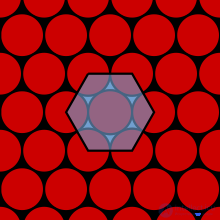
One can consider an analogous problem of close packing of hyperspheres (or circles) in a Euclidean space of dimension other than 3. In particular, in two-dimensional Euclidean space, the best filling is achieved by placing the centers of circles at the vertices of a tiling formed by regular hexagons, in which each circle is surrounded by six others. It is precisely from such layers that the FCC and HCP packings are built. The density of this packing:
 .
.
In 1940 it was proved that this packing is the densest.
In 2016, Ukrainian mathematician Maryna Viazovska solved the sphere packing problem in two higher-dimensional spaces — eight-dimensional , and, in collaboration, twenty-four-dimensional . Viazovska's solution of the eight-dimensional case takes only 23 pages and is «stunningly simple» compared to the 300-page text and 50,000 lines of program code used in the proof of Kepler's conjecture for three-dimensional space.
The highest density is known only for space dimensions 1 (packing in a line), 2 (triangular lattice), 3 (FCC, HCP, and other packings built from layers of a triangular lattice), 8 (the E8 lattice), and 24 (the Leech lattice) .
FCC and HCP packings are the densest known packings of identical spheres with maximal symmetry (the smallest repeating unit). Denser ball packings are known, but they use spheres of different diameters. For packings with density 1, filling space completely, non-spherical bodies are required, such as honeycombs, or an infinite number of spheres in a finite volume (an Apollonian gasket).
If each point of contact of two spheres is replaced by an edge connecting the centers of the touching spheres, we obtain tetrahedra and octahedra with equal side lengths. FCC stacking gives a tetrahedral-octahedral honeycomb . HCP stacking gives a rotated tetrahedral-octahedral honeycomb . If, instead, each sphere is expanded by points that are closer to it than to any other sphere, we obtain the dual honeycombs — a rhombic dodecahedral honeycomb for FCC and a trapezo-rhombic dodecahedral honeycomb for HCP.
Spherical bubbles in soapy water arranged according to the FCC or HCP scheme, when the water between the bubbles dries out, also take the shape of rhombic dodecahedral or trapezo-rhombic dodecahedral honeycombs . However, such FCC or HCP foams with a very low liquid content are unstable, since Plateau's laws are not satisfied for them. The Kelvin foam and the Weaire–Phelan structure are more stable, having lower interfacial energy at low liquid content .
Many crystals have a close-packed structure of a single type of atom, or a close packing of large ions with smaller ions filling the space between them. As a rule, the cubic and hexagonal arrangements are very close in energy, and it is difficult to predict which form a crystal will take.
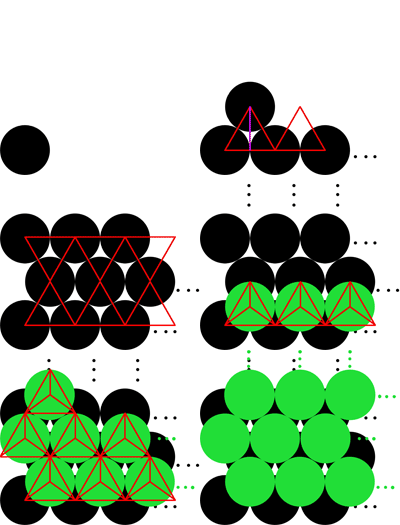
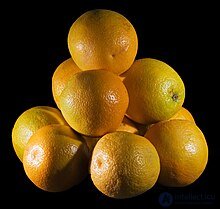
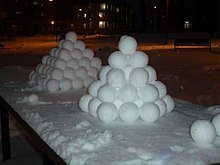
Around 1585, Thomas Harriot was the first to give mathematical thought to the stacking of balls in the context of stacking cannonballs, and considered the FCC lattice: cannonballs were usually stacked in rectangular or triangular wooden frames, forming three-sided or four-sided pyramids; both stackings give a face-centered cubic lattice and differ only in orientation relative to the base. Hexagonal close packing leads to a hexagonal pyramid. In connection with the stacking of cannonballs, there is also a number-theoretic problem of the same name.


Comments