
Lecture
Linear production game ( LP-game ) — is a game for N participants, in which the value of a coalition can be obtained by solving a linear programming problem . It is widely used in the context of resource and payoff allocation. From a mathematical point of view, there are m types of resources, from which n products can be produced. To produce product j, requires  units of the k-th resource. The output can be sold at a given market price.
  While the resources themselves cannot be sold. Each of the N players is given a vector
 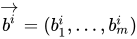 of resources. The value of coalition S is the maximum profit it can obtain by using all the resources owned by its members. It can be obtained by solving the corresponding linear programming problem.
  as follows.

|
Every linear production game v is totally balanced . Therefore every subgame of v has a nonempty core . One of the imputations can be obtained by solving the dual problem  . Letα be an optimal dual solution of The payoff to player i is
 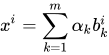 . Using duality theorems it can be proven that
  is in the core of v .
An important interpretation of the imputation is that, under the current market conditions, the value of each resource j equals  , although the resources have no value by themselves. Thus, the payoff that player i should receive equals the total value of the resources they own.
However, not all imputations in the core can be obtained from optimal dual solutions. This issue has been the subject of much discussion. One of the most widely used approaches is to consider the r-fold replication of the original problem. It can be shown that if the imputation u is in the core of the r-fold replicated game for all r, then u can be obtained from an optimal dual solution.


Comments