
Lecture
Value added tax (VAT) is an indirect tax, a form of levying into the state budget a portion of the added value of a good, work or service that is created in the process of producing goods, works and services.
As a result of applying VAT, the final consumer of a good, work or service pays the seller tax on the entire value of the good they acquire, yet this sum begins to flow into the budget before the final sale, because everyone who takes part in producing the good, work or service at its various stages pays into the budget the tax on their own portion of the value "added" to the value of the raw materials, works and/or services purchased that are necessary for production.
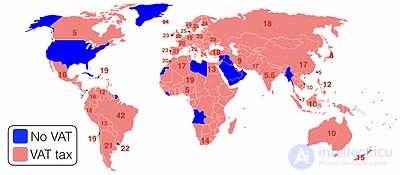
VAT is currently applied by 137 countries. The highest rates are applied in Thailand (28%, corporate) and Hungary (27%). Among countries with large economies, VAT does not exist in the USA and Japan, which have a sales tax instead: in the USA at a rate from 0% to 15% depending on the state, in Japan a fixed 10% (since 1 October 2019).
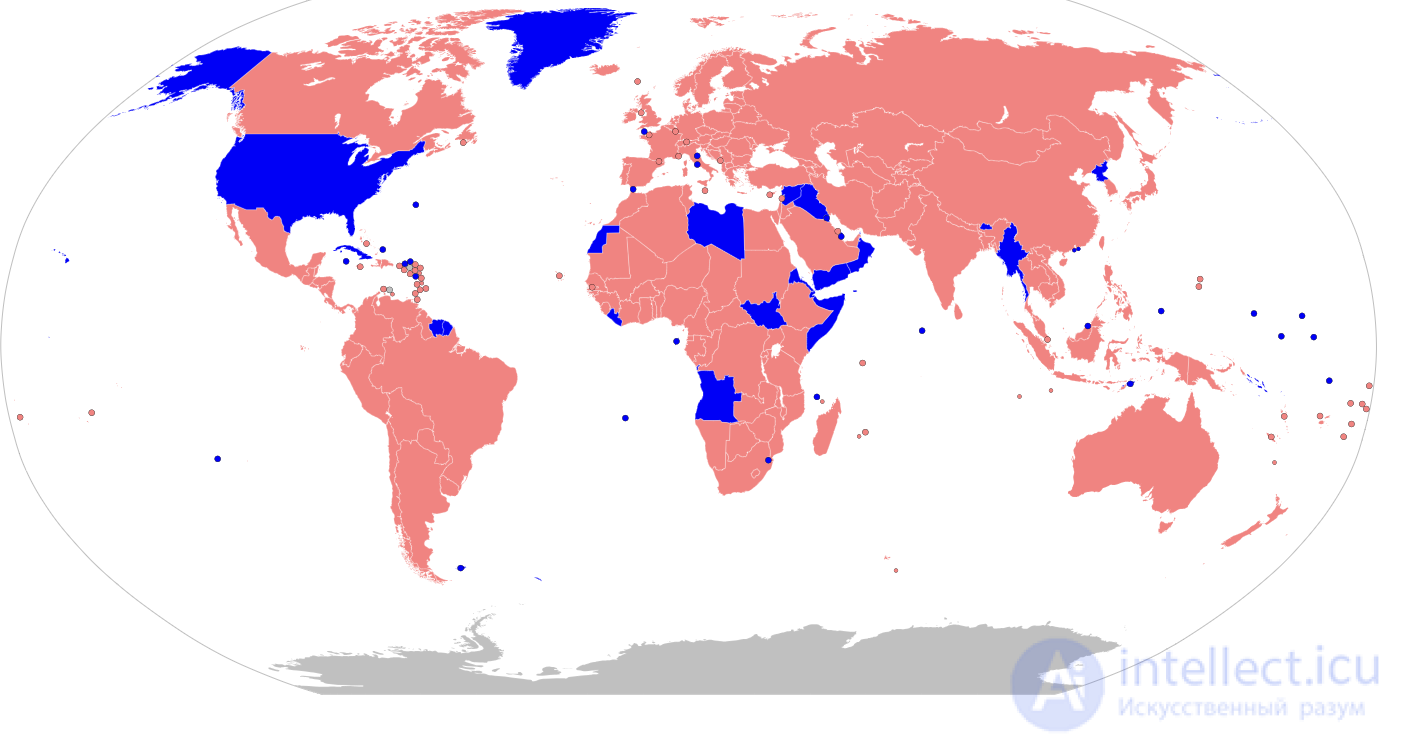 Map of countries and territories by presence of VAT
The idea of VAT goes back to Carl Friedrich von Siemens. In 1919, in his works, von Siemens criticized the sales tax that existed at the time: in his opinion, the more stages a product passed through on its way to the final consumer, the higher the tax burden. This favored the competitive advantages of large companies with a high degree of vertical integration (whose internal stages were not taxed) and thus contradicted the principles of fair competition. Only at the end of the 1940s did people begin to abandon this practice.
France took the first steps toward introducing the new tax system. The "inventor" of value added tax in 1954 was Maurice Lauré, director of the Tax and Duties Directorate of the French Ministry of Economy, Finance and Industry. At first the new type of tax was tested in a French colony, Côte d'Ivoire. Having deemed the experiment successful, France introduced the tax in 1958. Subsequently, a directive of the Council of the EEC required all countries of the European community to introduce VAT for economic entities in their territory by the end of 1972. In the European Union, VAT is standardized by law through the so-called Directive on the common system of value added tax (MwStSystRL, 2006).
At the turn of the millennium, about 120 countries levied value added tax and received on average about 25% of their tax revenues from it.
Outwardly (for the buyer), VAT resembles a turnover tax or a sales tax, that is, the seller adds it to the price of the goods sold or services provided. However, unlike turnover taxes or sales taxes, when calculating the total amount of their obligations to the budget, the seller has the right to deduct from the tax received from the buyer the amount of tax that they paid to their supplier for taxable goods or services. This tax is considered indirect, and its burden ultimately falls not on the merchants but on the final consumers of goods and services.
Such a taxation system (which is essentially a modification of the sales tax) was created to solve several problems.
First, distributing the payment of tax into the budget among the stages of the production and commercial cycle makes it possible to avoid the cascade effect, that is, the repeated collection of tax on the same value. In a modern economy, the production of goods or provision of services involves many costs, so a cascade effect can lead to a substantial increase in the amount of tax paid.
Second, distributing the obligation to pay tax into the budget among different taxpayers makes it possible to minimize the risks of tax evasion. Under a sales tax system, evasion of the tax by the retailer means the loss of the entire amount of tax; under VAT, non-payment of tax by one participant in the production and commercial cycle does not rule out the possibility of receiving the same amount at subsequent stages of production (resale). This, naturally, does not completely rule out all tax evasion techniques.
Third, VAT (in a modern economy) makes it possible to "cleanse" exported goods of national taxes and to levy indirect tax on the "destination country" principle. Not only exemption of the exporter from VAT but also the possibility of refunding the VAT that the exporter of the goods paid to their suppliers ensures that goods exported from a country applying VAT are fully exempt from national indirect taxes, and thus national indirect taxation does not affect the competitiveness of national production.
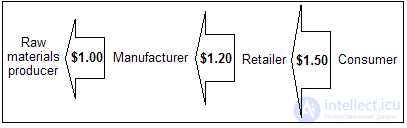
10% sales tax:
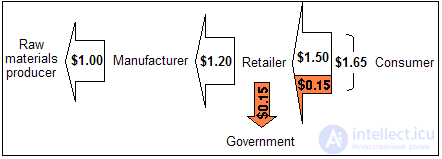
Thus, the consumer pays 10% ($0.15) more compared with the no-tax scheme, and the government collects that amount. Retailers do not pay the tax directly, but the retailer must complete tax paperwork. Suppliers and manufacturers bear the administrative burden of providing the correct tax exemption certificates, which the retailer must verify and maintain.
The manufacturer is responsible for ensuring that its customers (retailers) are only intermediaries and not final consumers (otherwise the manufacturer charges the tax). In addition, the retailer keeps track of what is taxable and what is not, as well as the different tax rates in each city where it operates.
10% VAT:
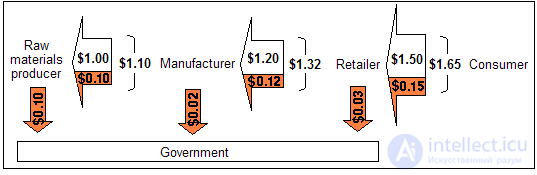
In the VAT example above, the consumer paid, and the government received the same dollar amount as it would have under a sales tax. At each stage of production the seller collects the tax and the buyer pays it. The buyer can then recover the tax paid, but only by successfully selling the value-added product to the buyer at the next stage. In the previous examples, if the retailer failed to sell part of its stock, it suffered a greater financial loss under the VAT scheme than under a sales tax system, having paid a higher wholesale price for the product it wanted to sell.
Each business is responsible for handling the necessary tax paperwork. However, businesses are not required to request certificates from buyers who are not end users, or to provide such certificates to their suppliers, but they do bear higher accounting costs in collecting the tax.
The simplified examples wrongly assume that taxes are not distortionary: the same quantity of goods was produced and sold both before and after the tax was introduced. However, the economic model of supply and demand implies that any tax raises the cost of a product for someone. When the cost rises, the supply curve shifts to the left. As a result, the quantity of the good purchased falls and/or the price at which it is sold rises.
In Russia, VAT has been in force since 1 January 1992 . The procedure for calculating and paying the tax was originally set by the law "On Value Added Tax", and since 2001 it has been governed by Chapter 21 of the Tax Code of the Russian Federation.
Certain categories of taxpayers and certain types of transactions are not subject to the tax. In total, there are more than 100 exemptions and benefits for VAT in the Tax Code. In particular, organizations and individual entrepreneurs have the right to be exempt from the duties of a VAT payer if the revenue from the sale of goods, works and services over the three preceding consecutive calendar months has not exceeded a certain amount (under Art. 145(1) of the Tax Code, 2 million rubles), or if the organization or entrepreneur has switched to the special simplified tax regime (USN).
The following are recognized as value added tax payers :
Organizations and individual entrepreneurs may be exempted from the duties of a taxpayer if, over the three preceding consecutive calendar months, the total revenue from the sale of goods (works, services), excluding VAT, has not exceeded 2 million rubles.
The following transactions are recognized as objects of taxation (Article 146 of the Tax Code):
The following are not recognized as objects of taxation:
Since 1 January 2019, the VAT rate has been 20 % . According to a study by the Institute of Economic Forecasting of the Russian Academy of Sciences, in 2019 the state budget will receive an additional 800 billion rubles from raising the value added tax rate from 18 to 20 %. These are direct additional budget revenues, but the increase in VAT will also expand the tax base for other fiscal levies .
A reduced rate of 10 % currently applies to some foodstuffs, books, children's goods and certain categories of medical equipment; a 0 % rate applies to exported goods and some specific items (such as postage stamps, duties and licenses). To obtain the right to the zero VAT rate on exports, the exporter must submit to the tax authority, each time, an application for a VAT refund together with a set of supporting documents .
Transactions not subject to taxation (Article 149 of the Tax Code):
Not subject to taxation (exempt from taxation) in the territory of the Russian Federation, for example:
Where a taxpayer carries out both taxable transactions and non-taxable (exempt) transactions under the provisions of this article, the taxpayer is obliged to keep separate records of such transactions. If no shipment of goods (works, services) whose sale is exempt from value added tax takes place in the tax period, separate tax records are not kept (letter of the Ministry of Finance of Russia of 2 August 2012 No. 03-07-11/225). A taxpayer carrying out sales of goods (works, services) provided for by this article has the right to waive the exemption for such transactions by submitting a corresponding application to the tax authority where it is registered, no later than the 1st day of the tax period from which the taxpayer intends to waive the exemption or suspend its use. Such a waiver or suspension is possible only in respect of all transactions carried out by the taxpayer. It is not permitted for such transactions to be exempt or non-exempt depending on who the buyer (purchaser) of the respective goods (works, services) is. A waiver or suspension of the exemption for a period of less than one year is not permitted.
Taxpayers that have switched to the simplified taxation system are not VAT payers.
Recently (2004-2008) a number of proposals have been made to abolish VAT in Russia entirely or to reduce its rates further; however, no changes to VAT are expected in the near future, since VAT provides about a quarter of Russia's federal budget (On the receipt of revenues administered by the Federal Tax Service of Russia into the federal budget of the Russian Federation in January-November 2008
The tax period (Article 163 of the Tax Code) is set as a quarter.
When determining the tax base, the amount of tax is calculated as the percentage share of the tax base corresponding to the tax rate, and, where separate records are kept, as the sum of the tax amounts calculated separately as the percentage shares of the respective tax bases corresponding to the tax rates. The moment of determining the tax base (Article 167 of the Tax Code) is the earliest of the following dates:
The taxpayer has the right to reduce the total amount of tax by the established tax deductions (Article 171 of the Tax Code). The amounts deductible are the amounts of tax charged to the taxpayer on the purchase of goods (works, services) and property rights in the territory of the Russian Federation, or paid by the taxpayer on the import of goods into the territory of the Russian Federation and other territories under its jurisdiction under the customs procedures of release for domestic consumption, temporary import and processing outside the customs territory, or on the import of goods moved across the border of the Russian Federation without customs clearance.
The VAT tax period is set as a quarter. Tax on transactions recognized as objects of taxation in the territory of the Russian Federation is paid at the end of each tax period, based on the actual sale (transfer) of goods (performance of work, including for own needs, provision of services, including for own needs) during the expired tax period, in equal installments no later than the 28th day of each of the three months following the expired tax period.
If, at the end of a tax period, the amount of tax deductions exceeds the total amount of tax calculated on transactions recognized as objects of taxation, the resulting difference is subject to refund (offset, return) to the taxpayer. After the taxpayer submits the tax return, the tax authority verifies the validity of the tax amount claimed for refund in the course of a desk tax audit. Within seven days after the audit is completed, the tax authority must decide on refunding the relevant amounts, provided that no violations of the legislation on taxes and levies were identified during the desk tax audit.
If violations of the legislation on taxes and levies are identified during a desk tax audit, the authorized officials of the tax authorities must draw up a tax audit report. The report and other materials of the desk tax audit in which violations of the legislation on taxes and levies were identified, together with any objections submitted by the taxpayer (its representative), must be reviewed by the head (deputy head) of the tax authority that conducted the audit. Based on the results of reviewing the materials of the desk tax audit, the head (deputy head) of the tax authority issues a decision either to hold the taxpayer liable for committing a tax offense or to refuse to hold the taxpayer liable. Simultaneously with this decision, one of the following is adopted:
If the taxpayer has arrears of this tax or other federal taxes, or debts on the corresponding penalties and/or fines that are due for payment or collection, the tax authority independently offsets the amount of tax to be refunded against those arrears and debts on penalties and/or fines.
From the very beginning, close attention was paid to the harmonization of indirect taxation in the EU, since, in the view of the founders of European integration, it was precisely the differences in the regulation of indirect taxation that constituted a significant obstacle to the free movement of goods, work and services (A. S. Zakharov, article "EU Tax Policy: Legal Foundations", journal "ZAKON", September 2007 ). As a result, the harmonization of indirect taxation was designated as a separate task of European integration in the Treaty establishing the European Community (Arts. 90-93).
The following main acts of EU secondary law in this area are identified:
In present-day Germany the standard VAT rate is 19 %, but reduced rates exist for some goods (for books and foodstuffs the tax rate is 7 %).
In Latvia the standard VAT rate (Latvian: Pievienotās vērtības nodoklis, abbreviated PVN) was 18 % for many years. A reduced VAT rate of 5 % was set for some goods and services, and some were exempt from VAT (a 0 % rate applies).
From 1 January 2009 the standard rate was raised from 18 % to 21 %, the reduced VAT rate was raised from 5 % to 10 %, and the list of goods to which the reduced VAT rate applies was significantly cut.
From 1 January 2011, by government decision and under pressure from international creditors, the standard VAT rate in the country was raised from 21 % to 22 %, and the reduced rate from 10 % to 12 %.
From 1 July 2012, the basic VAT rate was lowered from 22% to 21%. The reduction was carried out in order to bring the VAT rate closer to the rates in the other Baltic countries, to promote the competitiveness of Latvia, and to reduce inflationary pressure.
The VAT Law entered into force in 1995; the turnover tax was abolished at the same time.
In Israel, VAT (Heb. מס ערך מוסף, abbreviated מע"מ) was introduced on 1 July 1976 in accordance with the recommendations of a government commission known as the "Asher Commission" (Heb. "ועדת אשר) and is administered by the Israel Tax Authority (Heb. רשות המסים בישראל), which is subordinate to the Ministry of Finance.
Over the history of Israel, the VAT rate has changed several times. The initial rate, introduced on 1 July 1976, was 8%, and by October 2015 it had already reached 17%. VAT is not levied in Eilat.
In Thailand, VAT (7%) is included in the price of all goods and services, as well as in restaurant bills. To obtain a VAT refund, you must make the purchase in a single store (marked with the sign "VAT Refund for Tourists"), on a single day, and for an amount of at least 2,000 baht. A special VAT refund receipt is issued for the purchase.
Malaysia has no VAT. The tax paid by Malaysian businesses is corporate tax, at a rate of 28%. The general sales tax rate is 10%, 20% for wines and spirits, and 25% for cigarettes. Service tax is paid on all types of services provided, at a rate of 5%.
Japan has no VAT, and there is no understanding of the English abbreviation "VAT" either. A flat sales tax is in effect, literally translated from Japanese as the "consumption tax". Until spring 2014 the tax rate was 5%; after that it became 8%, and it is already included in the price of the goods. The government intends to raise the consumption tax to 10%. In some large stores, when you present a foreign passport with a visa at the checkout, the sales tax is deducted on the spot, a receipt is issued and stapled to the visa. When leaving the country, before passing visa control, you must hand the visa with the receipts to a special official, who must personally detach the receipts from the visa.
In Kazakhstan, the VAT rate is 12 percent and it applies to the amount of taxable turnover and taxable imports.
Canada and the United States have no VAT, but almost all states have a sales tax of varying levels, reaching up to 15%.
In Mexico, VAT is included in the cost of goods and averages 16% of the price.
In Panama, a 5% VAT is levied only on certain types of services and some foreign trade operations. VAT is not charged on payment for household services, transport, or consumer goods.
| Country | Rate | Abbreviation | Name | |
|---|---|---|---|---|
| Standard | Reduced | |||
 Austria Austria |
20 % | 13 % or 10 % | USt. | Umsatzsteuer |
 Belgium Belgium |
21 % | 12 % or 6 % | BTW TVA MWSt |
Belasting over de toegevoegde waarde Taxe sur la Valeur Ajoutée Mehrwertsteuer |
 Bulgaria Bulgaria |
20 % | 7 % | DDS = DDS | Danak Dobavena Stoynost |
 United Kingdom United Kingdom |
20 % | 5 % or 0 % | VAT | Value Added Tax |
 Hungary Hungary |
27 % | 5 % | áfa | általános forgalmi adó |
 Denmark Denmark |
25 % | moms | Merværdiafgift | |
 Germany Germany |
19 % | 7 % | MwSt./USt. | Mehrwertsteuer/Umsatzsteuer |
 Greece Greece |
24 % (until 1 June 2016 — 23 %) | 13 % or 6.5 % (For the islands of the Aegean Sea, the tax is reduced by 30 %: 13 %, 6 % and 3 %) |
ΦΠΑ | Φόρος Προστιθέμενης Αξίας |
 Ireland Ireland |
23 % | 13.5 %, 9 %, 4.8 % or 0 % | CBL VAT |
Cáin Bhreisluacha Value Added Tax |
 Spain Spain |
21 % | 10 % or 4 % | IVA | Impuesto sobre el valor añadido |
 Italy Italy |
22 % | 10 %, 6 %, or 4 % | IVA | Imposta sul Valore Aggiunto |
 Cyprus Cyprus |
19 % | 8 % or 5 % | ΦΠΑ | Φόρος Προστιθεμένης Αξίας |
 Latvia Latvia |
21 % | 10 % (12 % from 2011) | PVN | Pievienotās vērtības nodoklis |
 Lithuania Lithuania |
21 % | 9 % or 5 % | PVM | Pridėtinės vertės mokestis |
 Luxembourg Luxembourg |
17 % | 14 %, 8 %, 3 % | TVA | Taxe sur la Valeur Ajoutée |
 Malta Malta |
18 % | 5 % | TVM | Taxxa tal-Valur Miżjud |
 Netherlands Netherlands |
21 % | 6 % | BTW | Belasting over de toegevoegde waarde |
 Poland Poland |
23 % | 8 %, 5 % or 0 % | PTU/VAT | Podatek od towarów i usług |
 Portugal Portugal |
23 % | 13 % or 6 % | IVA | Imposto sobre o Valor Acrescentado |
 Romania Romania |
19 % (until 2016 — 24 %, until 2017 — 20 %) | 9 % or 5 % | TVA | taxa pe valoarea adăugată |
 Slovakia Slovakia |
20 % | 10 % | DPH | Daň z pridanej hodnoty |
 Slovenia Slovenia |
22 % (until 1 July 2013 — 20 %)[10] | 9.5 % (until 1 July 2013 — 8.5 %)[10] | DDV | Davek na dodano vrednost |
 Finland Finland |
24 % | 14 % or 10 % | ALV Moms |
Arvonlisävero Mervärdesskatt |
 France France |
20 % | 10 % or 5.5 % or 2.1 % | TVA | Taxe sur la Valeur Ajoutée |
 Croatia Croatia |
25 % | 0 % | PDV | Porez na dodanu vrijednost |
 Sweden Sweden |
25 % | 12 % or 6 % or 0 % | Moms | Mervärdesskatt |
 Czech Republic Czech Republic |
21 % | 15 % or 10 % | DPH | Daň z přidané hodnoty |
 Estonia Estonia |
20 % (until 1 July 2009 — 18 %), | 9 % | km | käibemaks (literally "turnover tax") |
| Country | Rate | Local name | |
|---|---|---|---|
| Standard | Reduced | ||
 Albania Albania |
20 % | ||
 Azerbaijan Azerbaijan |
18 % | ƏDV (Əlavə Dəyər Vergisi) | |
 Australia Australia |
10 % | 0 % | GST (Goods and Services Tax) |
 Argentina Argentina |
21 % | 10.5 % or 0 % | IVA (Impuesto al Valor Agregado) |
 Armenia Armenia |
20 % | 0 % | ԱԱՀ (Ավելացված արժեքի հարկ) |
 Belarus Belarus |
20 % | 10 %, 0.5 %[11] or 0 % | PDV (padatak na dadadzenuyu vartasts) |
 Bosnia and Herzegovina Bosnia and Herzegovina |
17 % | PDV (porez na dodatu vrijednost) | |
 Venezuela Venezuela |
11 % | 8 % | IVA (Impuesto al Valor Agregado) |
 Vietnam Vietnam |
10 % | 5 % or 0 % | GTGT (Gia Tri Gia Tang) |
 Guyana Guyana |
16 % | 14 % | |
 Georgia Georgia |
18 % | 0 % | დღგ (DKhG) (დამატებითი ღირებულების გადასახადი) |
 Jersey[a] Jersey[a] |
3 % | 0 % | GST (Goods and Sales Tax) |
 Dominican Republic Dominican Republic |
6 % | 12 % or 0 % | |
 Iceland Iceland |
24.5 % | 14 %[b] | VSK (Virðisaukaskattur) |
 India[c] India[c] |
12.5 % | 4 %, 1 % or 0 % | |
 Israel Israel |
17 %[d] | מע"מ (מס ערך מוסף) | |
 Kazakhstan[e] Kazakhstan[e] |
12 % | 0% | QQS (qosylghan qun salyghy) |
 Cambodia Cambodia |
10 % | 0 % | VAT (Value Added Tax) |
 Kyrgyzstan Kyrgyzstan |
12 % | 0 % | KNS (koshumcha nark salygy) |
 China[f] China[f] |
13 % | 2,3,4,6,13 % | 增值税 |
 Lebanon Lebanon |
10 % | ||
 North Macedonia North Macedonia |
18 % | 5 % | DDV (Danok na Dodadena Vrednost) |
 Malaysia[g] Malaysia[g] |
5 % | ||
 Mexico Mexico |
16 % | 0 % | IVA (Impuesto al Valor Agregado) |
 Moldova Moldova |
20 % | 8 % or 5 % or 0 % | TVA (Taxa pe Valoarea Adăugată) |
 New Zealand New Zealand |
15 % | GST (Goods and Services Tax) | |
 Norway Norway |
25 % | 14 % or 8 % | MVA (Merverdiavgift) (unofficially moms) |
 UAE UAE |
5 % | VAT (Value-Added Tax) | |
 Paraguay Paraguay |
10 % | 5 % | IVA (Impuesto al Valor Agregado) |
 Peru Peru |
18 % | IGV (Impuesto General a las Ventas) | |
 Russia Russia |
20 % | 10 % or 0 % | NDS (Value Added Tax) |
 El Salvador El Salvador |
13 % | IVA (Impuesto al Valor Agregado) | |
 Serbia Serbia |
20 % | 8 % or 0 % | PDV (Porez na dodatu vrednost) |
 Singapore Singapore |
9 % | GST (Goods and Services Tax) | |
 Tajikistan Tajikistan |
15 % | 0 % | AAI (Andoz az arzishi ilovashuda) |
 Thailand Thailand |
7 % | ภาษีมูลค่าเพิ่ม | |
 Trinidad and Tobago Trinidad and Tobago |
15 % | ||
 Turkmenistan Turkmenistan |
15 % | 0 % | GBS (Goşulan baha üçin salgyt) |
 Turkey Turkey |
18 % | 8 % or 1 % | KDV (Katma değer vergisi) |
 Uzbekistan Uzbekistan |
12 % | 0 % | QQS (Qo’shimcha qiymat solig’i) |
 Ukraine Ukraine |
20 % | 7 % or 0 % | PDV (podatok na dodanu vartist) |
 Uruguay Uruguay |
23 % | 14 % | IVA (Impuesto al Valor Agregado) |
 Philippines Philippines |
12 %[h] | RVAT (Reformed Value Added Tax) / karagdagang buwis | |
 Chile Chile |
19 % | IVA (Impuesto al Valor Agregado) | |
 Ecuador Ecuador |
12 % | IVA (Impuesto al Valor Agregado) | |
 Switzerland Switzerland |
8 % | 3.8 % or 2.5 % | MWST (Mehrwertsteuer) / TVA (Taxe sur la valeur ajoutée) / IVA (Imposta sul valore aggiunto) / VAT (Value Added Tax) |
 Sri Lanka Sri Lanka |
15 % | ||
 South Africa South Africa |
14 % | 0 % | VAT (Value Added Tax) |
 South Korea South Korea |
10 % | 부가세 = 부가가치세 |

4 May 2010: the "Campaña no más IVA" in Spain.
VAT has been criticized by opponents as a regressive tax, meaning that the poor pay more, as a percentage of their income, than the better-off, given the higher marginal propensity to consume among the poor.
Defenders respond that relating tax levels to income is an arbitrary standard and that VAT is in fact a proportional tax. An OECD study found that VAT may even be slightly progressive. The effective regressivity of VAT can be reduced by applying a lower rate to goods that are more likely to be consumed by the poor. Some countries offset this by introducing transfer payments targeted at the poor.
VAT may not fall entirely on consumers, since traders tend to absorb VAT in order to maintain sales volumes. Conversely, not all VAT cuts are passed on in lower prices. Consequently, VAT results in a deadweight loss if price increases push a business below the break-even point. The effect can be seen when VAT is reduced or abolished. Sweden cut VAT on restaurant meals from 25% to 12.5%, creating 11,000 additional jobs.
VAT creates particular opportunities for evasion and fraud, especially through abuse of the credit and refund mechanism. Fraud involving inflated VAT claims has reached 34% in Romania.
Exports are generally zero-rated, which creates opportunities for fraud. In Europe, the main source of problems is carousel fraud. This fraud arose in the 1970s in the Benelux countries. VAT fraud then became a serious problem in the United Kingdom. Similar opportunities for fraud exist domestically as well. To avoid this, countries such as Sweden impose personal liability on the principal owner of a limited liability company.
Because VAT is included in the price index to which government benefits such as pensions and social payments, as well as public-sector wages, are linked in some countries, part of the visible income is lost, i.e. taxpayers are given money to pay the tax, which reduces net income.
Delays in refunds by the tax administration can harm businesses.
Compliance costs are regarded as a burden on business. In the United Kingdom, VAT compliance costs are estimated at about 4% of revenue, with a stronger impact on small businesses.
A national VAT acts as a tariff on imports, while exports are exempt from VAT (zero-rating).
Under a sales tax system, only companies selling to the final consumer are required to collect the tax and bear the accounting costs of collecting it. Under VAT, manufacturers and wholesale companies also bear accounting costs in order to process the additional paperwork required to collect VAT, which increases overhead and prices.
The American Manufacturing Trade Action Coalition in the United States considers the charging of VAT on US products, and rebates on products from other countries, to be an unfair trade practice. AMTAC argues that the so-called "disadvantageous border tax" is the biggest factor contributing to the US current account deficit, and estimated this disadvantage for US manufacturers and service providers at 518 billion dollars in 2008 alone. US politicians such as Congressman Bill Pascrell advocate either changing the WTO rules concerning VAT or refunding the VAT charged on US exporters. A business tax rebate for exports was proposed in the Republican Party's 2016 tax reform policy paper. The claim that this "border adjustment" would be compatible with WTO rules is disputed; it has been argued that the proposed tax would favor domestically produced goods, since they would be taxed less than imports, to a degree that varies across sectors. For example, the wages included in the cost of domestically produced goods would not be taxed.
A 2021 study found that value added taxes are unlikely to distort trade flows.

Comments