
Lecture
There are many approaches to identifying the stages (phases) of the creative process. Among Russian scholars, B. A. Lezin (1907) was already trying to identify these stages. He wrote of three stages: labor, unconscious work and inspiration. In Lezin's opinion, some outstanding thinkers attach too much importance to intuition, which is unjust. The confessions of writers and artists show how much material they have to deal with. This requires a substantial investment of time and effort. Labor (the accumulation of information) is necessary to stimulate unconscious work and inspiration. Unconscious work comes down to the selection of the typical, "but how this work is accomplished, of course, cannot be judged; it is a mystery, one of the seven world riddles," wrote B. A. Lezin (p. 296). Inspiration is the "transfer" of a ready-made conclusion from the unconscious sphere into consciousness.
I used to think —
Books are made like this:
A poet comes,
Lightly parts his lips,
And at once the inspired simpleton starts to sing —
There you are!
But it turns out —
Before the singing can begin,
People walk for a long time, calloused from wandering,
And quietly in the mud of the heart there flounders
The stupid roach of imagination.
While they boil, scraping out rhymes,
Some kind of brew from loves and nightingales,
The street writhes tongueless —
It has nothing to shout or talk with!Mayakovsky V. V. A Cloud in Trousers (Complete Works: In 13 vols. Moscow, 1955. Vol. 1. P. 181)
P. K. Engelmeyer (1910) divided the inventor's work process into three acts: desire, knowledge and skill. The first act (the origin of the concept) begins with an intuitive glimmer of an idea and ends with the inventor's own clarification of it; for now it is only a hypothesis (in science), a probable principle of the invention, or a concept (in artistic creation). In the second act (knowledge and reasoning, the working out of a scheme or plan) the inventor conducts experiments in thought and in practice; the invention is worked out as a logical representation, ready to be understood. The third act, skill, the constructive execution of the invention, does not require creative work. It can be entrusted to any experienced specialist. "In the first act the invention is supposed, in the second it is proved, and in the third it is realized," writes P. K. Engelmeyer.
A. M. Blokh (1920) also spoke of three stages:
F. Yu. Levinson-Lessing (1923) traditionally identified three stages with somewhat different content:
P. M. Jacobson (1934) divided the inventor's creative process into seven stages:
Summing up these studies, Ya. A. Ponomarev writes: "When such works are compared, some differences are found both in the number of stages identified and in their detailed characterization, but the common element clearly predominates. Everywhere the following successively changing phases are identified:
The transition from the first phase to the second is interpreted as a path of descent from facts to hypothesis, from what is directly contemplated to the abstract, from the known to the unknown, from perception to the actual thinking aspect of the solution; as a path leading to the discovery of a principle that connects the facts, presented in the problem as scattered, into a single whole, preparing the disclosure of a concept that embraces the entire variety of the problem's facts" (1976, p. 148).
Similar stages were identified in those same years by foreign authors, but with substantial additions concerning subconscious processes (Ribot, 1901; Poincaré, 1909; Wallas (1926) and others). For example, the Gestalt psychologists identified four stages in creative thinking.
The first is the restructuring of the whole situation, whose starting point is the formulation of the problem. M. Wertheimer wrote that "posing a productive question is sometimes a greater achievement than solving the posed problem" (1987, p. 178).
The second stage is recentering, i.e. the transition from a superficial and incorrect structuring to an adequate and correctly centered structure.
The third and central stage is the emergence of the idea of the solution, a sudden insight, i.e. the presence of insight in the creative process. It is precisely this that reflects the moment of transition from "blindness" to "understanding."
The outstanding violinist of the 20th century Yehudi Menuhin claimed that his teachers... did not help the future virtuoso much, leaving everything to his nature. "To teach me vibrato, Enkel would shout: 'Vibrato! Vibrato!'" Menuhin recalled in his mature years. "And there was never any hint of how it should be done. I would gladly have obeyed him if I could. And then, when I had already left Enkel and was six or seven years old, one fine day my muscles guessed the riddle. It is through such flashes of illumination, when the solution was as mysterious as the problem itself, and left a person as puzzled as before, that most violinists learn their craft" (Menuhin, 1979).
The fourth stage is a deeper awareness of the method of solution and the execution of the solution.
an example for artistic creation
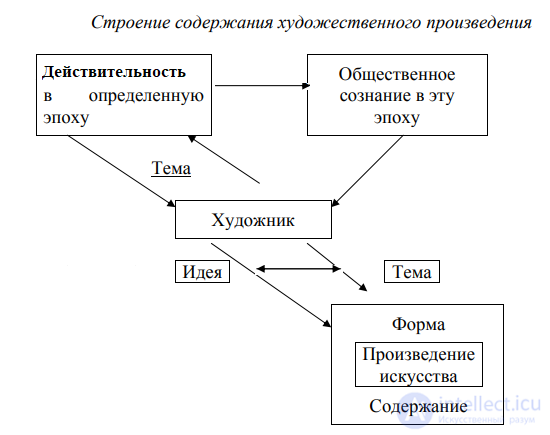
Stages of artistic creation. Let us list the main stages of artistic creation: the first stage is the formation of the artistic concept, which ultimately arises as a result of the figurative reflection of reality; the second stage is the direct work on the piece, its "making."
Graham Wallas (Wallas, 1926) identified the following stages of creative thinking:
Creative ideas are poorly defined at first and may originate as an intuitive presentiment (Runco, Sakamoto, 1999). Therefore E. Bastick (Bastick, 1982) considered the first three phases of the creative process to be intuition.
Here is what the well-known American inventor Henry Parker says: "I may be at a concert, I may be reading or talking, when suddenly a new idea strikes my head. Usually it has nothing to do with what I am doing. The idea immediately fills my mind, pushing out everything else. I am usually surprised by its apparent simplicity. I reach for a scrap of paper, and in a few symbols the general plan is before me."
Saparina E. V., 1967, p. 48.
G. Wallas was the first to show the role of incubation, a process noted in the biographies of great scientists and creators. The importance of this process was experimentally confirmed by Silveira (Silveira, 1971). He asked subjects to solve a problem and observed how a break in the course of work affected the effectiveness of solving it. It turned out that among those who worked without a break only 55% of the experiment's participants solved the problem, among those who took a 30-minute break 64% managed to solve it, and among those who broke off for 4 hours, 85%.
Incubation explains cases of insight (finding "hints" for solving a problem) during sleep. D. Schuler (1965) writes that Mozart told his friends that after long creative searching he would fall asleep, and in his sleep his musical work appeared to him as a huge, exquisitely beautiful cake, all of whose fragments were visible at once and all of which were sounding. D. I. Mendeleev, exhausted by his search for a classification of the chemical elements, dreamed of a circus arena; a horse galloped in circles around it, and on it stood a rider who tossed up torches that scattered in sparkling sparks. On waking, the scientist realized that the torches and sparks were symbols of the elements and their valences. It is no accident, therefore, that the first version of Mendeleev's table was a circle with a circular arrangement of the chemical elements.
"You can go up to the drawing board every day, examine the drawings and models, and nevertheless your thought runs in its usual channel," says Tupolev (the outstanding aircraft designer. - E. I.). "So sometimes you deliberately drop the work in order to step away from it and look at it in a new way. There are entire half-years that are barely productive, and conversely, a few days can determine the work for a whole half-year, because the necessary new ideas appear."
Saparina E. V., 1967, p. 46.
It has been suggested that the incubation period associated with a break allows experiment participants not to "get stuck" on an ineffective solution, and to forget the wrong solution strategy and the information leading a person down the wrong path (Smith, Blankenship, 1989, 1991).
Tardif and Sternberg (Tardif, Sternberg, 1988) consider that the creative process includes the following elements:
An important question is the presence of conscious and unconscious components in the process of creativity. Many believe that the ability to express ideas coming from the unconscious is the key to the creative process (Mednick, 1969). Creativity is achieved when unconscious ideas are brought into conscious statements. The creators themselves and the bearers of outstanding creativity emphasize the activity of the unconscious in the creative process (V. N. Druzhinin). This concept goes back to the psychoanalytic interpretation: C. Jung, for example, believed that creativity divides into two kinds - psychological, connected with the work of consciousness, and visionary, expressing the archetypal images of the unconscious (Jung C., 1991).
Other authors ignore the role of the unconscious in creativity. The consensus lies in the middle: the balanced view assigns unconscious processes a certain role in creativity. For example,
P. Langley and R. Jones (Langley, Jones, 1988) ascribe an important role to unconscious elements in the context of memory activation, which is relevant to creative insight and makes available information that was not consciously requested.
Torshina K. A., 1998, p. 127.
Ya. A. Ponomarev writes that in later times the classifications of the stages of the creative process that identified stages of the unconscious were replaced by classifications that include "stricter," "more objective" propositions, associated with abandoning the search for mechanisms of unconscious work and with refusing to recognize it as a fact. He gives a detailed characterization of these stages, in which what is essential, from my point of view, is the identification of a number of abilities that determine the success of creativity at these stages.
"1. Awareness of the problem. In the course of becoming aware of the problem, the moment of emergence of the problem situation is emphasized. If the task is not given in ready-made form, its formation is linked with the ability to "see questions" (here and further the emphasis is mine. - E. I.). The perceiving of a question is usually ascertained on the basis of an accompanying emotional reaction (surprise, difficulty), which is then characterized as the direct cause that makes one examine the situation attentively, which leads to an understanding of the available data.
The comprehension and understanding of these data are sometimes singled out as an independent stage. Finding a general proposition for all the scattered data somewhat clarifies the relationships among them. Understanding the available facts in the light of the general theoretical propositions of the field of knowledge to which the solver assigns these facts determines the next stage - the posing of the problem (question). Some authors link this moment with a special "ability to pose questions." The posing of a question is understood as a stage that already contains a more general idea of the possible solution, and first of all the choice of the direction in which the answer to the posed question must be sought, the "mental platform," the point of view, the plan, the project of the solution, the guiding goal, which plays a decisive role in the following stages. Thus, awareness of the problem is completed by the posing of the question.
2. Working out a hypothesis. From here the resolution of the problem begins. This stage is most often qualified as the culminating point of the solution, as its central link, as a peculiar leap, i.e. the decisive transition from what is visible to what is absent. As at the preceding stage, the greatest importance here is given to past experience and the drawing in of theoretical propositions, whose generalized content carries the solver far beyond the limits of the available knowledge. Using previously acquired knowledge as a means of solution, by comprehending it and transferring it to new conditions, makes it possible to compare parts of the conditions, on the basis of which a conjecture, a hypothesis, is built (an assumption, an idea, a concept taken on trial, a presumed principle of solution, etc.).
The development of the solution is sometimes put forward as a separate stage of resolving the problem: the worked-out hypothesis is accepted as a working idea, as a possible, though still doubtful, way of interpreting the problem. At this stage, the special role of applying known rules and all kinds of knowledge, by means of which the analysis and synthesis of the initial data are carried out, is emphasized. Special importance is attached to experiment, whose kind (mental or practical) depends on the type of task.
3. Verification of the solution. The concluding stage consists of the logical proof of the truth of the given judgment and the verification of the solution by means of practice. Under favorable conditions, a successfully advanced hypothesis turns into a theory" (pp. 148-150).
In insight problems, the main thing is to clear the way to the solution, to break out of the invisible circle of habitual notions, and to begin taking into account what is usually not taken into account. When the subject, following this externally outlined list of properties, breaks out of the circle of habitual thoughts, the derivation of hypotheses, among which is the solution of the problem, becomes a matter of consecutive reasoning.
Galperin P. Ya., Kotik N. R., 1982, p. 84.
A. L. Galin (1986), relying on the description of the process of scientific creativity given by H. Selye, gives a psychological characterization of eight stages (Fig. 2.1).
The first stage is motivational: the desire to learn something new. This is either the manifestation of an interest in something or a lack of understanding of something.
The second stage is becoming acquainted with the intriguing phenomenon, collecting information about it. It is carried out either by studying the literature, or by drawing on knowledge from one's own experience, or by direct examination of the object.
A scientist may become absorbed in an excessively thorough, scrupulous or lengthy acquaintance with the phenomenon without attempting to make sense of it, which leads to empiricism.
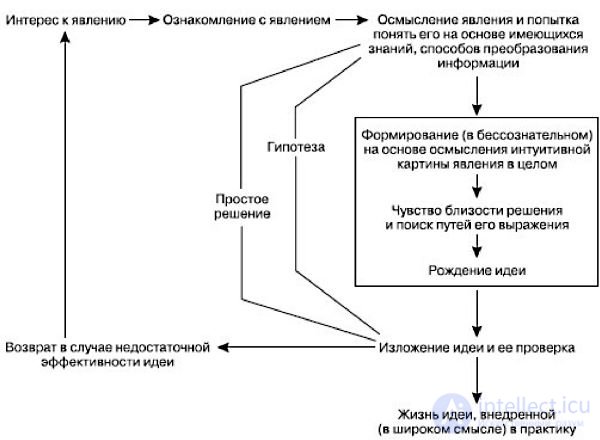
Fig. 2.1. Stages of the discrete-continuous creative process (after A. L. Galin)
On the other hand, it is possible to "skip over" this stage and try to understand everything at once on the basis of general reasoning alone, which is not very productive.
The third stage is reflecting on the information obtained, an attempt to understand the identified phenomenon on the basis of already existing knowledge. If the task is not too complicated, then, by comparing the known with the unknown, one can understand the phenomenon already at this stage of creativity. If the phenomenon is not fully understood, the scientist may construct a hypothesis, trying to guess the final result and to "jump over" a number of the following stages. In that case he moves straight to the seventh stage, proceeding to test the hypothesis he has put forward.
The fourth stage is the incubation of the idea. This stage involves unconscious processes in solving the problem. By comparing certain facts and stringing them onto the main thread of the knowledge already available on the problem, the scientist gradually advances, step by step, in his understanding.
At this stage, a scientist who does not trust intuition, or does not suspect that it exists, may try to make sense of the phenomenon solely through conscious effort. He may feel that if he makes a few more attempts, or becomes familiar with one more branch of knowledge, the sought-after solution will be reached. This leads to excessive rationalism, which inhibits the process of intuitive thinking.
The fifth stage is the emergence of a sense that the solution is near. It is expressed as a certain tension, anxiety and discomfort. This state is similar to what a person feels when trying to recall a well-known word or name that is "on the tip of the tongue" but will not come to mind.
H. Selye wrote that the feeling of being close to a solution is familiar only to true creators.
Sensing the approach of a holistic picture of the phenomenon but unable to express it, a person may fall into irrationalism and claim that the truth can be "felt" and "approached," but cannot be understood or expressed. If a scientist stops at this stage, creativity comes to an end.
The sixth stage is the birth of the idea. An idea may arise suddenly, in moments of relaxed attention (H. Helmholtz). The tension is relieved, and it may be replaced by strongly or weakly expressed positive emotional reactions.
The seventh stage is the presentation of the idea. The idea obtained must be examined, tested and refined, and connected with other existing concepts. Figuratively speaking, the skeleton of the idea that arose at the previous stage must "put on flesh" and gain more solid support from facts. This stage ends with the writing of an article or report, i.e. the creation of a product of creativity with refined formulations and a logic of proof.
At this stage, one may observe either an imperfect expression of the idea or a kind of blindness to it, which prevents the scientist from seeing its shortcomings.
The eighth stage is the life of the idea. Once presented, published, delivered as a talk, or put into practice, the idea begins to "live," winning itself a "place in the sun" alongside other ideas and sometimes entering into a struggle with them. Often a new idea is not accepted by the scientific community. Not without reason did some scientist rightly remark that a new idea begins as an absurdity and ends as a prejudice. There are countless examples of this in science. I, for instance, was impressed by a story I once heard on the radio about the discovery of the liquid crystal phenomenon by Soviet scientists. "Liquid crystal? Absurd! How can a crystal be liquid?" asked the wise academicians, and for ten whole years they refused to publish the authors of the discovery, until the Americans discovered the same phenomenon and built all of microelectronics on that basis (receiving, it seems, a Nobel Prize for their "discovery").
The stages of the creative process described here are not rigidly fixed; they may shift (if the problem is solved at the third stage, the seventh and eighth stages follow immediately), and the scientist may return to the beginning to become more thoroughly acquainted with the phenomenon if he feels a lack of information.
V. A. Pavlov (2005) has a somewhat different view of the phases (stages) of creativity. From his point of view, the actualization of creative potential in solving a problem passes through the following stages:
The creative process functions as a single, integral system, and its main characteristics are identified as follows: the dominance of the unconscious components of the psyche, spontaneity, unpredictability of the result, autonomy, affectivity, symbolism of its manifestations, relativization of opposites, and also a wide time range, from being compressed into a single moment to the extended and differentiated unfolding of its various stages
But a creative approach often helps in the following way: one idea bumps into another, and as a result we come up with many possible solutions to the problem.
R. E. Allen, S. D. Allen.
Winnie-the-Pooh on Problem Solving
The main factors influencing creativity are usually considered to include the following components: emotionality, visualization, analogies, metaphors and humor.[57]
1. Emotionality is regarded as a method of uniting left-brain and right-brain processes for those in whom left-brain thinking predominates. Emotions help to register information in the right hemisphere of the brain. Information processed by both halves of the brain is remembered more reliably.
2. Visualization is imagination and vision, for example, of a future product, of the final result of creative work, or of a problem and the ways to solve it. Those who visually picture the desired result are more likely to achieve their goal. Developmental situations help to encourage vivid imagination. Vision is a right-brain function and at the same time a method for developing strategic competence. Graphs, diagrams, schemes, drawings and pictures encourage creative processes by developing visual thinking.
4. Metaphor as a method of stimulating creativity is based on joining two different objects or phenomena by a common principle. For example, electricity is linked to the directed movement of charged particles or, more simply, to water flowing through pipes, and time is given human qualities: "harsh years," "happy days," "troubled times." Metaphors stimulate playing with concepts. Metaphorical thinking is a creative process based on comparing problems from different areas of science and practice in order to help find a solution. Comparing business problems with biology leads to the appearance of such concepts as survival, adaptation to the external environment, and rehabilitation (restructuring).
5. Humor actively unites the rational processes of the left hemisphere of the brain with the creativity of the right. During laughter the brain produces a natural hormone, endorphin, which has analgesic and tranquilizing properties, which contributes to a sense of well-being.
Techniques for activating thinking are shown schematically in Fig. 13.2.
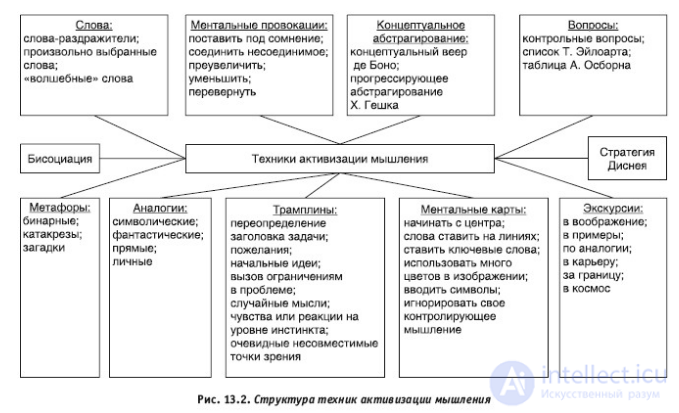
Let us consider them in more detail.
Springboards are thoughts that arise after a problem has been recognized and lead to possible solutions. The constructive component of such speculative thoughts creates the opportunity to take off, like a ski jumper from a springboard, to look at the problem from the height of this flight and to see a solution that is invisible under ordinary conditions. For example, when Alexander Fleming, in 1928, while cleaning his laboratory and sorting through old medical glassware, discovered that a mold fungus had destroyed a colony of staphylococcus, a flight of imagination allowed him to find the long-awaited solution for fighting infections. Seventeen years later he received the Nobel Prize for the discovery of penicillin.
An excursion is the process of our subconscious working on a problem when, becoming distracted, we think about something unrelated to the problem being solved. Such reflection often produces new ideas by chance. Sometimes the connection between the problem and the distraction seems absurd, but, as Albert Einstein once said, problems cannot be solved within the same framework in which they were created. For example, when working on the name of a new mayonnaise and taking the classic "Provençal" as a starting point, one can take a trip across a geographical map (not of France but, say, of the Vladimir Region: "Yuryev-Polsky," "Pokrovsky," "Murom"), or make an excursion into the historical past ("Boyar," "Tsar's," "Merchant"), and so on.
A certain degree of absurdity (impossibility, illogicality, inaccessibility, unattainability, danger, scandalousness, etc.) widens the range of possible solutions to a problem, increases the potential novelty of the ideas that arise, and weakens self-censorship through the work of the subconscious.
For example, imagine that you have become part of an inanimate or living object (a person's vocal cords), and then try to describe your sensations and connect them with the problem being solved (a dry, sore throat): how much you long for rain in the form of an aerosol with beneficial droplets of Bioparox that will soothe the cough.
Analogies arise from the intersection of intuitive and logical procedures of thinking (the exchange of information between the left and right hemispheres) (Fig. 13.3).
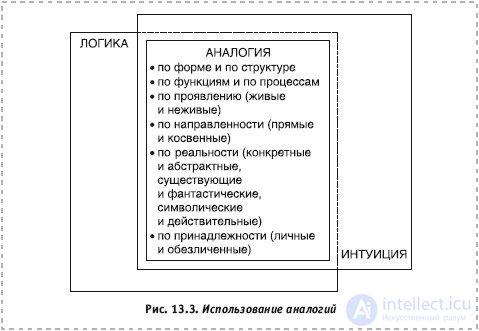
Let us consider four kinds of analogies: direct, personal, symbolic and fantastic analogies.
1. Direct analogy is a search that provides for comparing already existing solutions in related fields. It involves examining the methods used in other branches of theory and practice (how similar problems are solved there) and requires engaging mechanisms for finding, in one's own experience or in the experience of nature and society, something similar to the solution that is needed. Examples of direct analogy are the flight of a bird and the flight of an airplane, or the proud flight of an eagle and the flight of the human soul.
Personal analogy is built on empathy, the identification of one person's personality with that of another. In this case, trying to "get into" the image of the object under consideration, one tries to find within oneself some echo of what this object "does," and to understand its difficulties, strengths and weaknesses as one's own.
A person, as it were, merges with the object, which is ascribed feelings, goals and emotions, making it possible to better understand (to sense) possible solutions to the problem.
Symbolic analogies, in turn, use objectively existing images to describe objects (or phenomena). As a rule, this is a two-word definition of the object. The purpose of such an analogy is to make it possible to discover a striking contradiction (paradox) in a familiar phenomenon. The words characterize the object and at the same time are opposites. For example, mortar (suspended chaos), ratchet mechanism (reliable discontinuity), photograph (instant eternity), goal orientation (tree of goals), and so on.
Fantastic analogies suggest looking for solutions in science fiction and fantasy literature, and also stating the problem in terms of fairy tales, myths and legends, which helps to imagine things as they are not in reality but as we would like them to be. This is "creative delirium," which makes it possible to create artistic images of some ideal. The essence lies in using fairy-tale, fantastic ideas. For example, a flying carpet, the water of life, seven-league boots, a cap of invisibility, a fiery claw, and so on.
Analogies of this kind often include various metaphors:
Mental maps, whose fundamental capabilities were discussed earlier, make it easier to form a general picture and a general understanding of a problem, and the very process of drawing them up leads to new ideas.
Making mental maps activates spatial-imagery thinking and makes it possible to perceive a new point of view on a problem. However, one should understand that such maps are deeply individual and valuable to those who made them. They reflect the thinking of a particular person and can give an impetus to new ideas, but they cannot replace the ideas themselves.
Bisociations bring together two previously unconnected planes of thinking, which produces a creative result. The configurator of the bisociation principle is shown in Fig. 13.4.
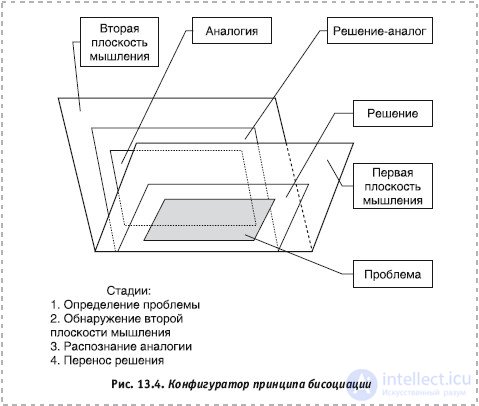
It follows from the figure that for a problem located in the first plane of thinking, there is an analogy located in the second plane, for which an analogous solution is known. The latter is mapped onto the first plane and gives the sought-after solution to the problem. The four stages shown in the figure include the following steps.
1. Defining the problem: ask yourself what this is really about. Try to think the problem through from all sides. In many cases it is useful to draw up a list of the requirements that the solution must meet. For example, fastening and unfastening (tying and untying) is a problem in itself, and not only when we are in a hurry.
2. Discovering the second "plane of thinking" is creative work: one must find an "entrance" to this plane. One should think: what is similar to what needs to be achieved? In what field does something work that does not work in the field under consideration? For example, it is similar to closing and opening, sticking and unsticking. In inanimate nature this works in the burdock (sticking and unsticking) and in the feathers of birds (the components of a feather interlocking and separating).
3. Recognizing analogies means a careful search for general principles and regularities that can be transferred to the field (plane) under consideration. Becoming an expert in the "foreign field" is not necessary; what matters is being able to transfer the solution from that field to the problem field. For example, a burdock has a great many tiny hooks that catch on a person's clothing, while a bird's feather has a great many hooks that engage with one another.
4. The transfer of the analogous solution must be such that adapting the solution to the new conditions provides a solution to the problem.
Thus, for example, the pesky burdock suggested a model for the Velcro fastener; the structure of a bird's feather led to the invention of the zipper (just as the surface of penguins' skin made it possible to optimize the movement of submarines).
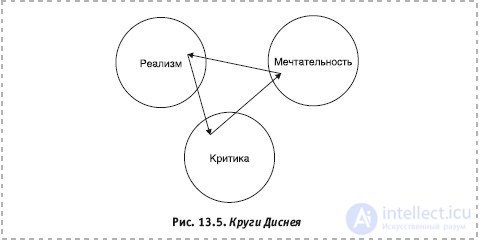
The Disney strategy was developed on the basis of the works of Walt Disney and includes the stages of the dreamer, the realist and the critic.
At the dreamer stage you mentally outline the nearest area of space, drawing with your gaze an imaginary circle, and turn into a dreamer ready to begin generating ideas: you are free to create without any restrictions. To this end, step into the imaginary circle and experience these positive sensations with maximum spontaneity and fullness. Having reached the desired state, step out of the circle.
At the realist stage mentally outline another area, where you turn into a realist: you need to analyze your dreams, put them in order and begin to act, developing a successful plan of action. Step into the circle and again experience these positive sensations. Try to achieve a psychological anchoring effect by mentally associating your "realist" with this area of space and, when you feel that you have succeeded, step out of the circle.
At the "critic" stage you have to choose a place where you will criticize or evaluate. Recall a situation when you subjected a project to constructive criticism. And again step out of the circle.
Thus, three areas of space, or three mindsets, have been created, each of which anchors a particular type of thought process, and now you can return to them at any time. This method makes it possible to bring the mind into the state necessary for generating ideas (Fig. 13.5).
Words, as verbal models of reality, stir up associations based on a combination of individual elements of a person's experience, which makes it possible to form solutions to problems.
Trigger word analysis is a procedure based on stimulating the mind with random incoming signals in the form of words. Sources of such signals can be books, newspapers, magazines, dictionaries, lists of randomly selected words, or cards with equally randomly selected words (Fig. 13.6). Images, musical fragments, smells, and so on can serve as sources as well.
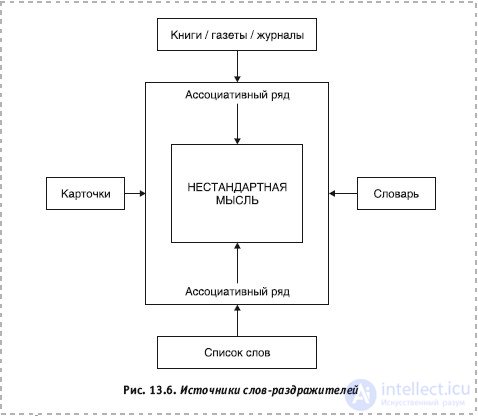
The method rests on one principle: introduce a random element into the process of searching for a solution so that the choice of words is truly left to chance. Moreover, one should not choose words that are directly related to the problem area. For example, to solve the problem "I urgently need to make a call, but my phone has died and I have no charger at hand," let us pick one word from each of 10 books by the "random poke" method, opening them at random. The following words were chosen: "bear cub," "free time," "breakthrough," "staying at home," "sausage," "after," "balance," "let us turn to," "Icarus," "reflection," "closer examination."
The procedure is carried out as follows: first one must understand the essence of the question under study, and then define several concepts. For example, open a book at any page and, without looking, poke at one of the words. Or pick one word at random from a previously compiled list of several dozen words. It is even better to write each word on a separate card and, drawing one card from the stack, read the word written on it.
The chosen word is then analyzed. One should answer the following questions:
There should be no fewer than five and no more than ten answers.
Next, one must build connections between the words and the problem in order to feel out completely new thoughts in the problem area.
Arbitrarily chosen words can become the start of an associative chain, which either leads to specific ideas or shows the direction for a step-by-step creative process of developing an idea or a new line of search for a solution to the problem. Thus, in our example the following combinations are possible:
The "magic" words proposed by Alex Osborn work as elements of an algorithm for enumerating random combinations of words related to the statement of the problem and standard words. For example, the "magic" words proposed by Michael Michalko look like this:
Questions as a method of activating creative thinking are needed in order to direct the train of thought, through the answers to them, toward the strongest solutions.
Checklist questions are compiled on the basis of experience in solving similar problems.
Before choosing the list of checklist questions that best matches the nature of the problem, one should clarify the problem. Then one must consistently consider each question on the list, trying to use the information embedded in it to solve the problem. All the ideas that arise, and any additional information that needs to be brought into the search process, should be recorded. As a result, a whole range of original solutions may be obtained, or the problem may be rethought and formulated from other positions in order to search further for solutions.
Here the question should rather stimulate thought than suggest an idea for a solution. Questions should give a new, unexpected view of the problem. As an example, the following list of questions can be given.
Other variants can also serve as a system of leading questions: "What if this element is replaced with another?", "Change the age of the character, the shape of the object?", "Shouldn't a different material be taken?", "What if changes are introduced: make it larger, smaller, stronger, weaker, heavier, lighter, and so on, in combination with something else?", "Can it be rearranged, combined, replaced?", "Should it be done the other way around?" and the like.
For example, in a wind tunnel it is not the model airplane that moves at supersonic speed, rushing into the air, but, on the contrary, the air rushes at supersonic speed onto the model airplane.
T. Eiloart's list (Eiloart was an English inventor) is considered one of the standard checklists of questions and is regarded as a program for searching for solutions to problems by the trial-and-error method.
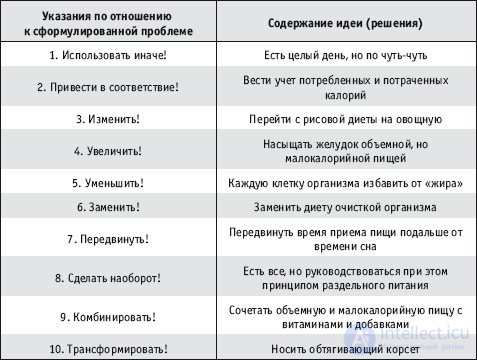
Alex Osborn's checklist table makes it possible to create new solutions from ideas already at hand, or to suggest what and where exactly can be changed in order to arrive at a creative solution.
The survey is laid out as a table, in whose rows are placed the checklist prompts and the solutions corresponding to them (Table 13.2).
Table 13.2 Osborn's checklist table (using the example of fighting excess weight)
Mental provocation as a creativity technique was developed by Edward de Bono and, unlike the trigger word analysis method, does not use chance but deliberately creates seemingly contradictory statements (Fig. 13.7).
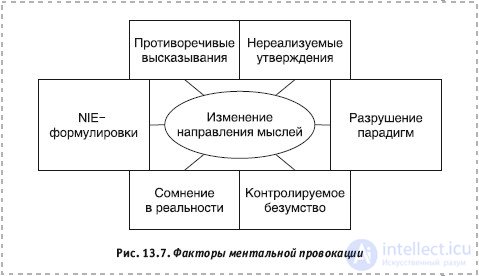
The point of provocation is to break suddenly out of the generally accepted, frozen model of perception and enter a state of instability, which will show the way to a new idea.
In this technique one must make a statement that is considered unrealizable and contradicts known experience or even goes completely against one's beliefs. Doubt about the reality of established points of view and statements creates a provocative situation. To do this, one should call one's beliefs into question, turn everything upside down, exaggerate or understate without any measure, imagine that desires are not limited in any way, or link together two things that are in fact incompatible with each other. For example, the statement that one cannot walk on the ceiling is refuted as soon as we find ourselves in weightlessness (in space).
Controlled madness manifests itself in such a change of the habitual direction of the flow of thoughts that mental provocation, like a spark, ignites the fire of the mind's creativity. In this case the mental provocation itself becomes the object of study. For example, in Belgium professional thieves are deliberately let into supermarkets in order to test the effectiveness of a store's security and to obtain recommendations for improving the work of security services and automated security systems.
Destruction of paradigms is built on a variety of ways of conveying information that destroy a deterministic picture of the world. Foundations of this kind include visual images (drawings, diagrams, blueprints, photocopies, two- and three-dimensional images); verbal models (well-chosen words, texts, sounds); conceptual propositions; emotional shades (feelings and moods); as well as the use of numbers, formulas, and incidental discoveries of a new vision of the problem. For example, the visualization of statistical information on the rates of "development" of developed socialism destroyed, in its time, the myth of building a bright future.
NIE formulations involve a step-by-step advance toward the solution of a problem on the basis of negating the statements made originally.
Five stages of problem solving are listed below.
Edward de Bono's conceptual fan is based on the fact that successive abstraction creates a kind of fan-shaped hierarchical structure of solution variants. H. Geschka's progressive abstraction makes it possible to approach the essence of the problem step by step or, in other words, to return in one's reflections "to the very beginning."
The principle of operation of the procedures under consideration is simple: one should proceed from the fact that an "unsatisfactory" solution to a problem must be raised to a higher level of abstraction. One must understand what concept stands behind this unsuccessful solution.
The algorithm, which can be repeated as many times as desired, includes three steps.
"You want to hang a board in a lecture hall. Your first thought: you need to drive a nail into the wall and hang the board on it. But there is a small problem: you cannot find a hammer anywhere.
1. What is the essence of the matter?
You move your problem to a higher level. It is wisest not to abstract too much right away. In our example, the point is to find some object capable of driving a nail into the wall.
2. What alternatives do you have?
Proceeding from this concept, you need to think about other possibilities for implementing it. In our example, you will look for something you can use to drive a nail into the wall: a piece of metal pipe, or a thick plank, or a stone of a suitable shape. Or you will consider whether you can drill the necessary hole in order to push the nail into it.
3. Which solution to choose?
You test all the variants for acceptability and then decide in favor of one of them. So, if you managed to find a suitable log, you have solved your problem.
4. What if none of the solutions satisfies you?
In this case you must keep abstracting! And then this fourth step will correspond to the first, only now you will be working at a more generalized level and will be able to take even more possibilities into account.
This successive abstraction creates a fan-shaped structure of possible solutions (Fig. 13.8).
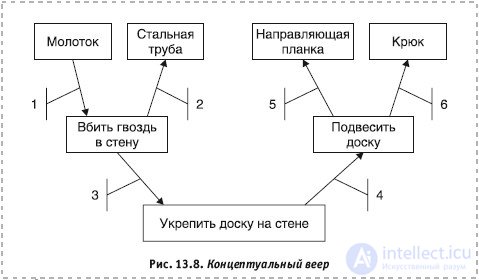
The "higher" you advance, that is, the more generally you formulate your problem, the more options you will obtain at the lower levels. Of course, for this you need to derive these options from the concepts above them.
If you have still not found a suitable replacement for the hammer, or if you have been informed that nails may not be driven into the wall at all, define the next level of the problem: you need ways to fasten the board to the wall.
With the help of this concept you may arrive at solutions such as "glue the board on" or "hang it from the ceiling." For the solutions found, you will again be able to look for further ways of implementing them.
But it may turn out that you have no way at all of fastening the board to the wall. Ask yourself again: what, actually, is at issue? Perhaps you will arrive at the decision that it can be placed in such a way that it is visible to all visitors. Then you will be able to work out new variants: lean the board against something, hold it in the air, place it at the entrance, and so on.
At a higher level you may move away from the board itself and develop options such as working with a projector, distributing the main points in printed form, or giving lectures in a way that allows you to dispense with additional visual information.
Perhaps this is too simple an example, but it shows how this often very effective method works, because many, many problems can be solved not by continuing, figuratively speaking, to search hard for a hammer, but simply by considering other possibilities, and doing so systematically."

Comments