
Lecture
Personal construct — an evaluative system that an individual uses to classify various objects in their life space. A term introduced in the psychology of personality by G. Kelly, to denote cognitive templates that a person “creates for themselves, and then tries to fit to the realities of which this world consists”. Constructs are used to predict recurring events. A construct allows an individual not only to explain other people's behaviour, but also to design their own behaviour, since a construct sets out the actual programme for such behaviour.
Within the psychology of personality personal construct theory ( PCT ) or personal construct psychology ( PCP ) — is a theory of personality and cognition , developed by the American psychologist George Kelly in the 1950s . The theory considers the psychological causes of actions. Kelly proposed that people could be psychologically assessed according to poles of similarity and dissimilarity, which he called personal constructs ( schemas or ways of seeing the world). Some psychologists regard this theory as a forerunner of cognitive-therapy theories.
From this theory Kelly derived a psychotherapeutic approach, as well as a technique called the interview with repertory grid , which helped his patients analyse their own personal constructs with minimal intervention or interpretation on the part of the therapist. The repertory grid was later adapted for various purposes within organisations, including decision-making and interpreting other people's worldviews . The British Psychotherapy Council , a regulatory body, classifies PCP therapy as an empirical subgroup of the constructivist school .
A personal construct — is an idea or thought that a person uses to make sense of, or to interpret, explain or predict their experience in terms of similarity and contrast (for example, “good–bad”). An individual's personality represents an organised system of more or less important constructs.
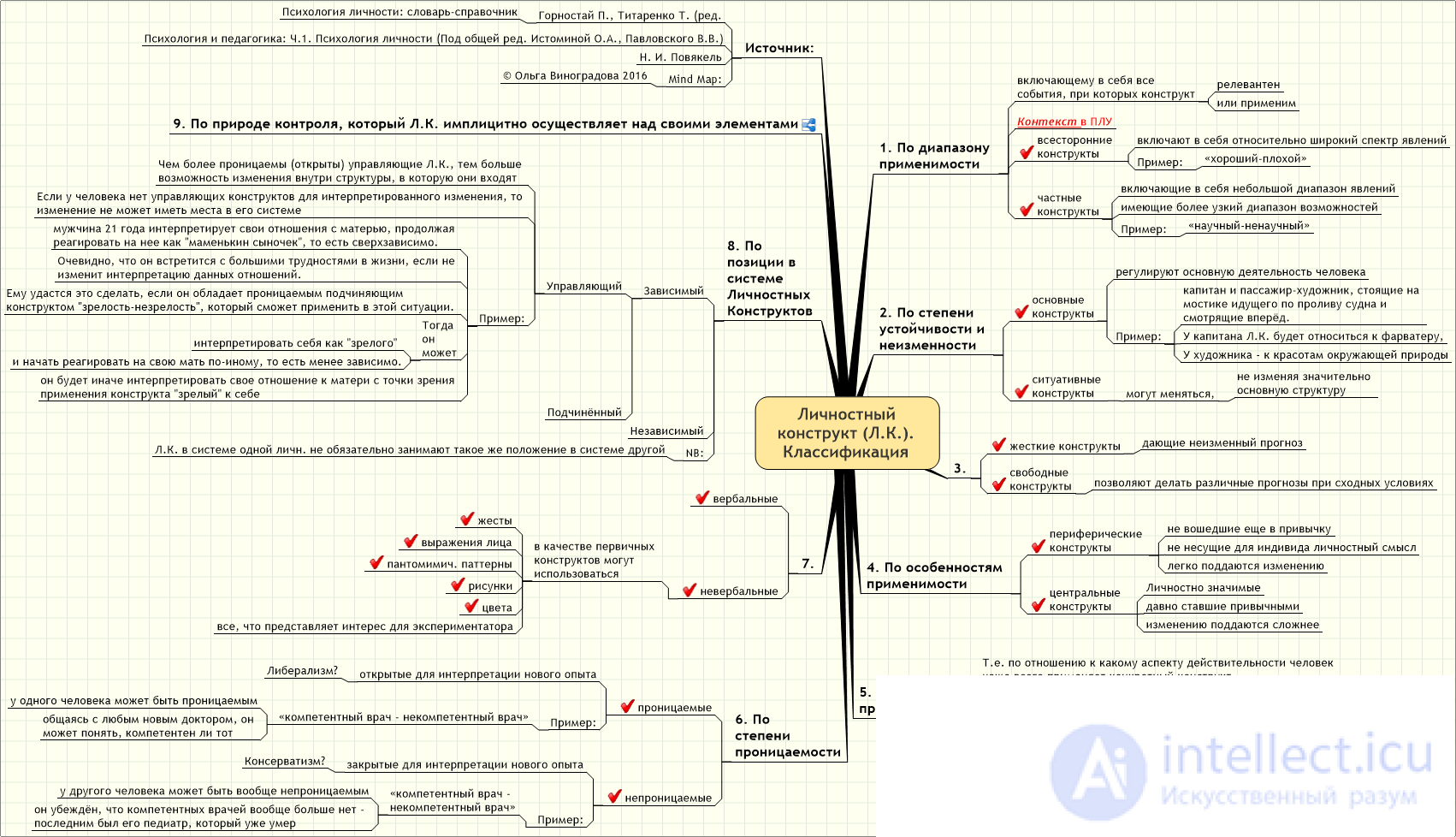
Personal constructs can be classified in several ways. For example, there are comprehensive constructs, which cover a relatively broad range of phenomena, and narrow constructs, covering a small range of phenomena (that is, having a narrower range of convenience). There are core constructs, which regulate a person's core activity, and peripheral constructs, which can change without significantly altering the core structure. Finally, some constructs are rigid, that is, they yield an unchanging prediction, while others — are loose, since they allow different predictions to be made under similar conditions.
Personal constructs that do not carry personal meaning for the individual, or have not yet become a habit (“peripheral constructs”), are easily changed. Those that are personally significant and have long since become habitual (“core constructs”, in G. Kelly's terminology) — change more slowly and with greater difficulty
The technique of repertory grids is used to elicit personal constructs. George Kelly was the first to apply the repertory-grid technique. Subsequently the technique was further developed by other researchers.
Psychotherapists working with the repertory-grid technique seek to understand how their patients individually construe events. To this end, therapists build role relationships with patients (role relationships). Through role relationships, having reached an understanding of how the patients construe events, the psychologist should offer the patients new ways of construing. Since personal constructs determine a person's self-awareness, in this way the patients change their understanding of themselves.
Patients' psychopathology is explained by the inadequacy of their system of personal constructs to their life circumstances and events. Psychopathology caused by a rigid system for interpreting events allows patients, on the one hand, to orient themselves within events and circumstances, but, on the other hand, they experience a sense of hopelessness and a lack of choices and alternatives in how events unfold. This is characteristic of obsessive-compulsive disorder.
Kelly believed in a non-invasive or non-directive approach to psychotherapy . Rather than having the therapist interpret the person's psyche , which would amount to imposing the clinician's own constructs on the patient, the therapist should simply act as a helper, assisting the patient in finding their own constructs. The patient's behaviour is then explained largely as ways of selectively observing the world, acting upon it, and updating the construct system so as to increase predictability. To help the patient find their own constructs, Kelly developed the technique of the interview using the repertory grid.
Kelly stated directly that the task of every person, in understanding their own personal psychology, is to bring the facts of their own experience into order. The person, like a scientist, must then test the accuracy of this constructed knowledge by carrying out the actions that these constructs imply. If the results of their actions match what the knowledge predicted, then they have done a good job of finding order in their personal experience. If not, then they may revise the construction: their interpretations, their predictions, or both. This method of detecting and correcting constructions is roughly analogous to the general scientific method , which is applied in various ways by modern science to discover truths about the universe.
The repertory grid forms part of various assessment methods that make it possible to elicit and study an individual's repertoire of personal constructs. There are various formats, such as card sorting, a group format with verbal administration, and the repertory-grid technique .
The repertory grid itself is a matrix , in which the rows represent the elicited constructs, the columns represent the elements, and the cells indicate, by a number, the position of each element within each construct. There is software for producing various reports and graphs based on these grids.
To construct a repertory grid for a patient, Kelly might first ask the patient to choose around seven elements (although there are no fixed rules regarding the number of elements ) , the nature of which may depend on what the patient or therapist is trying to discover. . For example: “Two particular friends, two work colleagues, two people you dislike, your mother and yourself” or something along these lines. Three elements would then be chosen at random, and the therapist would ask: “With regard to… (whatever is of interest), how are two of these people alike, yet different from the third?” The answer necessarily identifies one of the extreme poles of one of the patient's constructs. For example, they might say that Fred and Sara are very sociable, while John is not. Further questions will reveal the other end of the construct (say, introvert) and the position of the three characters between the extremes. Repeating the procedure with different sets of three elements eventually leads to the elicitation of several constructs of which the patient may not have been fully aware.
In the book “Personal Construct Methodology” researchers Brian R. Gaines and Mildred L.G. Shaw noted that they “also found that concept-mapping and semantic-network tools complement repertory-grid tools and typically used both in most studies”, but “they see less use of network representations in PCP research than is appropriate”. They urged practitioners to use semantic-network methods in addition to the repertory grid.
PCP has always been of interest to a minority of psychologists. Over the past 30 years it has gradually gained adherents in the USA, Canada, the UK, Germany, Australia, Ireland, Italy and Spain. Although its main areas of application remain clinical and educational psychology, there is growing interest in its application in organisational development , training and staff development, job analysis, job description and appraisal. The repertory grid is often used at the qualitative stage of market research to determine how consumers interpret products and services.

Comments