
Lecture 15 min.
Insecticides (from Lat. insectum "insect" + Lat. caedo "I kill") are chemical preparations designed to destroy insects . They are used in disinfestation.
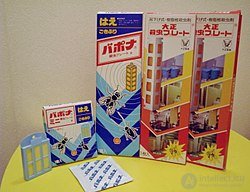
Japanese fumigator plates in their packaging
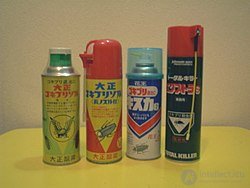
Japanese insecticide aerosols

Cockroach trap with insecticide
Depending on the routes by which insecticides penetrate the insect's body, they are divided into 4 groups: intestinal, contact, systemic and fumigants.
Intestinal insecticides, which enter the insect's body by oral intake, include most inorganic arsenic compounds (calcium, magnesium, barium and lead arsenates), silicofluorides and metal fluorides, thiodiphenylamine, as well as some special preparations (eulans, mitin, irgan, etc.) that are used to protect fabrics, wool and fur from moths.
Contact insecticides, which penetrate the insect's body through the integument, include organic compounds of phosphorus, chlorine, nitrogen and sulfur, pyrethrins and pyrethroids.
Systemic, or intraplant, insecticides are absorbed by the roots and leaves of plants, move with nutrients through the plant's vascular system and make the plants poisonous to parasitic insects. Examples are methyl mercaptophos, phosphamide and neonicotinoids. Systemic insecticides (organophosphorus) are also used to control ectoparasites of animals (after the preparation is administered, the animal's blood becomes toxic to insects) and for deratization (the animal that carries the insecticide and its parasitic vectors die). To control lice infestation in humans, phenylbutazone is used in exceptional cases. After a single dose, a person's blood retains insecticidal properties for two weeks.
Respiratory insecticides, or fumigants, enter the insect's body in vapor or gaseous form through the tracheal system during respiration. They include, for example, phosphine, methyl bromide, hexachlorobutadiene and dichlorvos. Finely ground silicates and mineral oils, which disrupt the function of insects' respiratory organs, can also be included in this group.
The accepted classification of insecticides is conditional, since most of them can enter the insect's body by several routes at once. For this reason, some preparations are assigned to one group or another according to their main route of entry into the insect's body.
In addition, insecticides are classified by application method (spraying, dusting, fumigation, seed dressing and the like) and by formulation (dusts, emulsions or suspensions, wettable powders and others).
Besides chemical insecticides, there are also biological ones. These are highly specialized microorganisms and the specific biotoxins of targeted action that they produce, intended for controlling adults and larvae of harmful insects, mites and mosquitoes .
Most insecticides kill both larvae and adult insects. However, there are insecticides that are active against larvae but do not act on adult forms, for example chitin synthesis inhibitors. Such substances are called larvicides (from Lat. larva "larva" + Lat. caedo "I kill"). Diflubenzuron is a member of this class, used primarily to control caterpillars that are pests. The most successful insecticides in this class are the juvenoids. Of these, methoprene is the most widely used. It shows no observable acute toxicity in rats and is approved by the World Health Organization (WHO) for use in drinking water cisterns to control malaria. Most of its uses are aimed at controlling insects whose adult form is the pest, including mosquitoes, several species of flies, and fleas. Two very similar products, hydroprene and kinoprene, are used to control species such as cockroaches and whiteflies. Methoprene was registered with the EPA in 1975. Practically no reports of resistance have been made. A more recent type of growth regulator is the MIMIC agonist, which is used in forestry to control caterpillars, which are much more sensitive to its hormonal effects than other insect forms
Bacillus thuringiensis is a bacterial disease that affects Lepidoptera and some other insects. Toxins produced by strains of this bacterium are used as a larvicide against caterpillars, beetles and mosquitoes. Toxins from Saccharopolyspora spinosa are isolated from fermentations and sold as Spinosad. Because these toxins have little effect on other organisms, they are considered more environmentally friendly than synthetic pesticides. The B. thuringiensis toxin (Bt toxin) is introduced directly into plants through the use of genetic engineering.
Other biological insecticides include products based on entomopathogenic fungi.
Systemic insecticides are incorporated into and systematically distributed throughout the plant. When insects feed on the plant, they ingest the insecticide. Systemic insecticides produced by transgenic plants are called plant-incorporated protectants (PIPs). For example, the gene encoding a specific biocidal protein of Bacillus thuringiensis , has been introduced into corn ( maize ) and other species. The plant produces a protein that kills the insect when eaten.
Contact insecticides are toxic to insects on direct contact. They may be inorganic insecticides, which are metals and include the commonly used sulfur and the less commonly used arsenates , copper compounds and fluorine compounds . Contact insecticides may also be organic insecticides, i.e. synthetically produced organic chemical compounds that make up the largest share of the pesticides currently in use. Or they may be natural compounds such as pyrethrum, neem oil, etc. Contact insecticides usually have no residual activity.
Effectiveness may be related to the quality of pesticide application , with fine droplets, such as aerosols , often improving effectiveness.
|
|
|
|---|---|
| carbamates |
|
| Inorganic compounds |
|
| Insect growth regulators |
|
| Neonicotinoids |
|
| Organochlorides |
|
| organophosphorus |
|
| Pyrethroids |
|
| ryanoids |
|
| Other chemicals |
|
| Metabolites |
|
| Biopesticides |
|
The main focus of organic chemistry is the development of chemical tools to improve agricultural productivity. Insecticides are a major area of focus. Many of the main insecticides are inspired by biological analogues. Many others do not occur in nature.
The pesticides currently available are not sufficient, and new developments are needed. Continued research in basic pest biology may reveal new vulnerabilities and create new pesticides; it may also yield pesticides with better financial and environmental characteristics than those now in use. Plant-based pesticides, or "botanicals", are developing rapidly. These include pyrethroids , rotenoids , nicotinoids and a fourth group that includes strychnine and scilliroside . In 2010, the development of a new class of fungicides called paldoxins was announced. They work by exploiting natural defensive chemicals released by plants, called phytoalexins , which are then neutralized by fungi using enzymes. Paldoxins inhibit the fungal detoxification enzymes. They are considered to be safer and more environmentally friendly.
Resistance to fungicides increases the proportion of inactive enantiomers in fungicide applications : the evolution of resistance requires research and the discovery of new active ingredients , which move away from already discovered classes toward more complex chemical structures. They, as a rule , more often have more chiral centers , which means more by-products during synthesis.
The development of insecticides is discouraged and slowed by public opinion connected with the worldwide crisis of colony collapse disorder . Although CCD is a serious problem, there are indications that other factors are also involved, especially the 2007 discovery by Cox-Foster et al. that a virus is largely to blame . Public concern has grown, and agrochemical research companies face a problem of image and perception. Partnership with agricultural services may help to correct some of these problems and to resume pesticide research
The best-known organochlorine, DDT, was created by the Swiss scientist Paul Müller . For this discovery he was awarded the 1948 Nobel Prize in Physiology or Medicine . DDT was introduced in 1944. Its action consists in opening sodium channels in the insect's nerve cells . The concurrent development of the chemical industry contributed to large-scale production of DDT and related chlorinated hydrocarbons .
Organophosphorus compounds are another large class of contact insecticides. They also target the insect's nervous system. Organophosphates interfere with the action of the enzymes acetylcholinesterase and other cholinesterases , disrupting nerve impulses and killing or incapacitating the insect. Organophosphorus insecticides and nerve agent chemical warfare agents (such as sarin , tabun , soman and VX ) act in the same way. Organophosphates have a cumulative toxic effect on wildlife, so repeated exposure to the chemicals increases toxicity. In the United States, the use of organophosphorus compounds has declined with the appearance of substitutes.
Carbamate insecticides have a mechanism of action similar to that of organophosphorus ones, but have a much shorter duration of action and are somewhat less toxic.
Pyrethroid pesticides mimic the insecticidal activity of the natural compound pyrethrin , a biopesticide found in varieties of pyrethrum (now Chrysanthemum and Tanacetum ). These compounds are non-persistent sodium channel modulators and are less toxic than organophosphates and carbamates. Compounds of this group are often used against household pests .
Neonicotinoids are synthetic analogues of the natural insecticide nicotine (with much lower acute toxicity to mammals and greater persistence in the field). These chemicals are agonists of acetylcholine receptors . They are broad-spectrum systemic insecticides with rapid action (minutes to hours). They are applied as sprays, drenches, and seed and soil treatments . Treated insects show leg tremor, rapid wing motion, stylet withdrawal ( aphids ), disoriented movement, paralysis and death. Imidacloprid may be the most widely used. It has recently come under close scrutiny because of its alleged harmful effects on honey bees and its ability to increase the susceptibility of rice to attack by planthoppers .
Phenylpyrazole insecticides , such as fipronil, are a class of synthetic insecticides that act on GABA receptors.
Butenolide pesticides are a new group of chemicals similar to neonicotinoids in their mode of action, which so far has only one member: flupyradifurone . They are agonists of acetylcholine receptors , like neonicotinoids , but with a different pharmacophore. They are broad-spectrum systemic insecticides applied as sprays, drenches, and seed and soil treatments . Although classical risk assessment considered this group of insecticides (and especially flupyradifurone) safe for bees , new research has raised concerns about their lethal and sublethal effects, alone or in combination with other chemicals or environmental factors.
Diamides are synthetic analogues of ryanoids with the same mechanism of action as ryanodine , a naturally occurring insecticide extracted from Ryania speciosa ( Salicaceae ). They bind to calcium channels in cardiac and skeletal muscle, blocking nerve transmission. The first registered insecticide of this class was rynaxypyr, the generic name of which is chlorantraniliprole .
Some insecticides kill or harm creatures other than those they are intended for. For example, birds can be poisoned by eating food that has recently been sprayed with insecticides, or by mistaking an insecticide granule on the ground for something edible.
Sprayed insecticide can drift from the area where it is used into wilderness areas, especially when it is sprayed from aircraft.
The spread of DDT was driven by the desire to replace more dangerous or less effective alternatives. DDT was introduced to replace lead and arsenic compounds, which were widely used in the early 1940s .
Rachel Carson, in her book "Silent Spring", drew public attention to this compound. One of the side effects of DDT is a decrease in the thickness of the eggshells of birds of prey. As a result, the egg becomes unsuitable for the development of a chick in it, which reduces the bird population. This happens with DDT and related compounds because of the process of bioaccumulation, in which a chemical, owing to its stability and fat solubility, accumulates in fatty tissue. In addition, DDT can biomagnify (attract new doses of the substance from the environment when it is present in the body), which causes progressively higher concentrations in the body fat of animals further up the food chain. The ban on the widespread use of DDT and related chemicals allowed some of these birds, such as the peregrine falcon, to recover their numbers in the following years. A number of organochlorine pesticides have been banned in most cases worldwide. Globally, they are controlled through the Stockholm Convention on Persistent Organic Pollutants. These include: aldrin, chlordane, DDT, dieldrin, endrin, heptachlor, mirex and toxaphene.
Insecticides can kill bees that pollinate plants and cause colony collapse disorder, in which worker bees suddenly disappear. The loss of pollinators means a decrease in the yield of honey plants. Sublethal doses of some insecticides (for example, imidacloprid and other neonicotinoids) affect beekeeping

Comments