
Lecture 18 min.
Phytopathology (phyto — plant and pathology) is the science of plant diseases caused by pathogens (infectious diseases) and environmental factors (physiological disorders). It includes the development of means of disease control and the prevention of plant damage.
Phytopathology is a scientific discipline that studies plant diseases, their causes, mechanisms of development, diagnosis and control methods. Phytopathologists investigate both infectious and non-infectious plant diseases, as well as the interaction of plants with pathogens (organisms that cause disease) and the environment.
The study of phytopathology helps to develop strategies for preventing and controlling plant diseases, which is an important aspect of agriculture and crop production management. Phytopathologists also work on developing new methods of plant protection, identifying resistance (tolerance) to diseases, and studying the influence of environmental factors on the development of plant diseases.
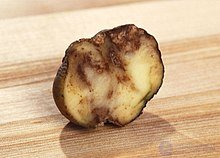
A potato tuber affected by rot
The history of phytopathology covers a long period of time, beginning in ancient times, when people started to pay attention to plant diseases and to look for ways to combat them. Here is a brief overview of the key stages and events in the history of phytopathology:
Ancient civilizations: Already in ancient civilizations, such as ancient Egypt and Rome, there were records of plant diseases and attempts to control them. Ancient agricultural practices included pruning, growing certain crops together, and using certain substances to fight diseases.
The Middle Ages: In the Middle Ages, phytopathology was still partly tied to magic and superstition. However, observations and experiments became more systematic, and the first scientific approaches to the study of plant diseases appeared.
The development of microscopy: In the 17th and 18th centuries, the development of microscopy made it possible to study microorganisms in more detail, including the pathogenic agents that cause plant diseases. This made it possible to establish a link between microorganisms and diseases.
The 19th century: In the 19th century, scientific research in the field of phytopathology began to develop more intensively. The main contributions were made by scientists such as Anton de Bary, who first proved that fungi cause plant diseases, and Miles Berkeley, who determined that fungi can spread by means of spores.
The 20th century: In the 20th century, phytopathology became a more scientific discipline with the development of laboratory methods for diagnosing and studying plant diseases. The introduction of genetics and molecular biology also made it possible to understand the mechanisms of disease development more deeply and to identify control methods.
The present day: Modern phytopathology continues to develop and to integrate new technologies, such as biotechnology, genomics and bioinformatics. This makes it possible to prevent and manage plant diseases more effectively, as well as to develop resistant varieties and control methods.
The history of phytopathology shows how this field of science has become essential for sustainable agriculture and the protection of plant resources.
According to modern views, diseases of higher plants can be classified by their causes as follows:
Phytopathology is based on data from plant anatomy and physiology, microbiology, mycology, genetics, plant breeding and crop production.
On the basis of phytopathological research, agriculture builds a system for protecting plants from pests and diseases.
The subject matter of general phytopathology includes:
Special (specific) phytopathology studies the diseases of agricultural crops.
Seed diseases are singled out as a separate discipline, "seed pathology" (the term was coined by the Danish scientist Paul Neergaard).
The science of diseases of trees and shrubs and of the decay of dead wood.
Forest phytopathology is a specialized branch of phytopathology that focuses on the study of diseases of woody plants in forest ecosystems. This includes the study of diseases affecting trees and other plants in forests, parks, and other natural and artificial forest areas.
Forest diseases can be caused by a variety of factors, including bacteria, viruses, fungi, insect pests and even abnormal weather conditions. The study of forest phytopathology helps to determine the causes of disease spread, to develop control methods, and to assess the impact of diseases on the health and stability of forest ecosystems.
Forest diseases can have serious consequences for the economy, ecology and biodiversity. Therefore, the study of forest phytopathology is important for the protection of forest resources and the management of forest ecosystems.
Phytopathology of ornamental plants is a subfield of phytopathology that specializes in the study of diseases affecting plants grown for decorative purposes. These may be flowers, ornamental shrubs, trees, lawns, houseplants and other plants used to decorate gardens, parks, interiors and other landscape elements.
In this branch of phytopathology, the various factors that cause diseases of ornamental plants are investigated, including bacteria, viruses, fungi, insect pests, unfavorable weather conditions and other stress factors. The main goals of research in the phytopathology of ornamental plants include:
Identification and diagnosis of diseases: Studying the symptoms and signs of diseases helps phytopathologists determine the causes of plant damage and develop appropriate diagnostic methods.
Control and management: Developing methods for preventing and controlling diseases of ornamental plants, including the use of chemical and biological agents, as well as the breeding of resistant varieties.
Preserving visual appeal: Determining which diseases can negatively affect the aesthetic quality of ornamental plants, and developing methods for preserving their visual appeal.
Education and consulting: Providing gardeners, landscape architects and other interested persons with information about diseases of ornamental plants, methods of managing them, and plant care.
The study of the phytopathology of ornamental plants is important for maintaining the health and beauty of gardens, parks and other landscape compositions, as well as for preventing the spread of diseases to ornamental plants in various environments.
Infectious plant diseases are diseases caused by pathogenic organisms such as bacteria, viruses, fungi, prokaryotes (for example, mycoplasmas and spirochetes) and other microorganisms. These pathogens can cause a wide variety of symptoms and damage to plants, which can lead to reduced yields, lower product quality and even the death of plants.
Here are some typical infectious plant diseases:
Viral diseases: Viruses infect plants and can cause leaf mosaic, deformation, spots, wilting and other abnormalities. Examples include Tobacco mosaic virus and Cucumber mosaic virus.
Bacterial diseases: Bacteria can cause rot, tumors, spots and other symptoms on plants. For example, bacterial leaf spot is caused by the bacterium Xanthomonas.
Fungal diseases: Fungi can affect various parts of plants, causing spots, fruit lesions, rot and even tissue breakdown. Examples include black spot of roses, caused by the fungus Diplocarpon rosae.
Mycoplasmas and spirochetes: These microorganisms attack plants, causing symptoms such as abnormal coloration, leaf deformation and other unusual symptoms.
Phytoplasmas: This is a group of virus-like microorganisms that infect plants and can cause diseases such as potato leafroll (Potato leafroll virus).
Control of infectious plant diseases includes control measures such as the use of chemical agents and biological agents, the choice of resistant varieties, good agricultural practice and quarantine measures, in order to prevent the spread of diseases.
Plant diseases caused by fungi represent a wide range of pathological conditions that can affect different parts of plants, including leaves, stems, roots and fruits. Here are some examples of fungal plant diseases:
Leaf lesions:
Rots and fruit lesions:
Tumors and soft, swollen lesions:
Bark cracking and root diseases:
Seed and seedling lesions:
To control fungal plant diseases, it is important to apply sanitary measures, use chemical or biological preparations, choose resistant plant varieties and maintain good agricultural practice.
Oomycetes are a class of parasitic algae-like organisms that was previously regarded as a class of fungi but was later recognized as a separate group of organisms because of its unique characteristics. Oomycetes include many pathogenic species that cause a variety of plant diseases. Below are some examples of plant diseases caused by oomycetes:
Late blight (Phytophthora spp.): This genus of oomycetes includes several species that cause serious root rots, stem rots and other lesions in various plants. Examples include late blight of potato and late blight of grape.
Strawberry infection (Phytophthora fragariae): This oomycete species causes a disease called "strawberry red stele root rot", which leads to damage to the roots and stems of strawberries.
Root rot (Pythium spp.): Members of the genus Pythium cause rot of plant stems and roots. This is especially problematic for seedlings, since infected seeds or seedlings can die.
Downy mildew of grape (Plasmopara viticola): This oomycete causes a disease of grapes that appears as a white coating on the leaves and fruits, similar to powdery mildew. It can lead to crop loss and damage to the vines.
Downy mildew of roses (Peronospora spp.): Several oomycete species of the genus Peronospora cause downy mildew on roses. This disease can affect the development of buds, leaves and stems, causing their deformation and a decline in the health of the roses.
"Downy mildew" differs from ordinary powdery mildew (which is caused by other fungi) in that it is caused by oomycetes. These diseases can also cause similar symptoms in the form of a white coating on leaves, stems and other parts of plants.
Late blight of potato (Phytophthora infestans): Although this is a different genus of oomycetes, it is also sometimes called "downy mildew". This organism causes the potato disease known as "late blight", which can lead to crop losses and damage to potato tubers.
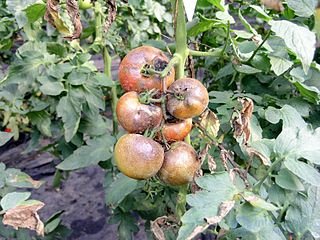
Late blight on tomatoes
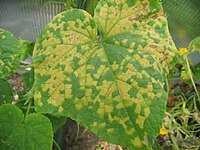
Downy mildew on the upper side of a cucumber leaf
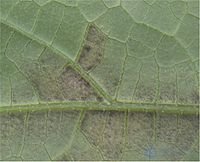
Downy mildew on the underside of a cucumber leaf
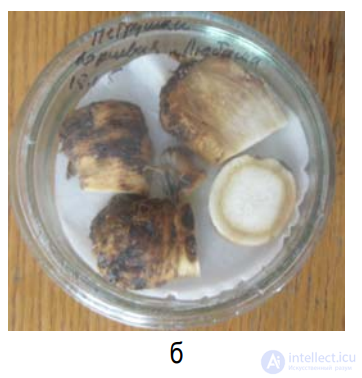
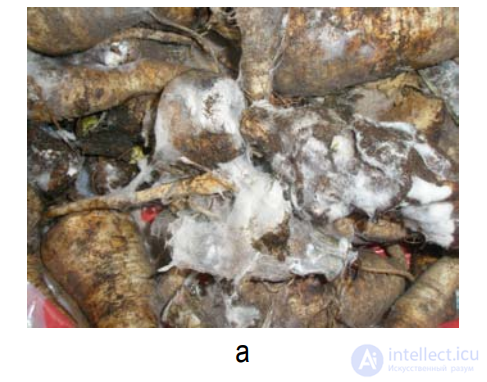
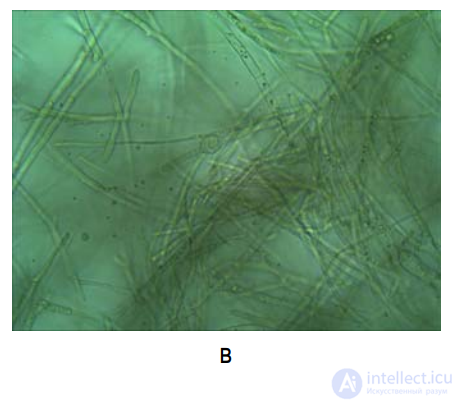
Fig. The pathogenic fungus of the genus Pythium sp. on root parsley of the Lyubasha variety: a – diseased roots; b – discs showing signs of infection with Pythium sp.; c – conidia of Pythium sp.
Diseases caused by oomycetes can lead to serious crop losses and plant damage. Control of these diseases includes the use of resistant plant varieties, sanitary measures, the application of chemical and biological agents, as well as proper management of humidity and agricultural practice to prevent the spread of oomycetes.
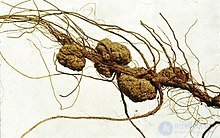
Crown gall caused by the bacterium Agrobacterium tumefaciens
Among bacteria there are also some phytopathogenic species that cause bacterioses. For example, Agrobacterium tumefaciens causes the formation of so-called "crown galls" and bacterial canker in dicotyledonous plants, Pseudomonas syringae causes bacterial bleeding canker, frost damage, fruit damage and leaf spot in plants, and bacteria of the genus Erwinia cause diseases of potato and other plants called blackleg (subspecies E. carotovora subsp. carotovora) and soft rot (subspecies E. carotovora subsp. atroseptica). E. carotovora subsp. carotovora develops at temperatures below 18 °C and causes the "black ink" symptom, while E. carotovora subsp. atroseptica develops above 18 °C and does not cause this symptom.
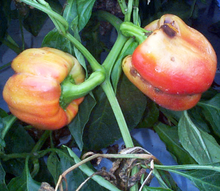
Pepper fruits infected with Pepper mild mottle virus
Nematodes are microscopic worms that can be plant parasites. Some species of nematodes cause plant diseases, having a harmful effect on roots and other parts of plants. Phytopathogenic nematodes are a group of pests that affect various types of agricultural crops. Unlike insects and other pathogenic animals, they are practically impossible to see with the naked eye, and the typical signs of damage - stunted growth and development of plants, premature yellowing of leaves, reduced yield, smaller fruit size, etc. - are often mistaken for nutrition or watering problems. In general, nematodes are divided into:
Root-knot nematodes (Meloidogyne spp.): These nematodes are called root-knot nematodes because they cause the formation of tumors (galls) on plant roots. They penetrate the roots and feed on cells, causing the roots to enlarge and impairing the absorption of water and nutrients. This can lead to weakening of the plants and reduced yields.
Cyst nematodes (Heterodera and Globodera spp.): These nematodes also attack plant roots, causing the formation of cysts (like small bubbles) on the roots. They feed on plant tissues and can cause serious damage to agricultural crops such as potato and soybean.
The burrowing nematode (Radopholus similis): This nematode causes "root rot" or "toppling disease" in a number of plants, including bananas, pineapples and coffee bushes. It attacks the roots, causing them to rot and the plant to wilt.
Free-living nematodes (migratory): Some free-living nematodes can also cause plant diseases. They can attack roots and stems, causing tissue death and disruption of the normal absorption of water and nutrients.
Nematode control includes the use of resistant plant varieties, sanitary measures, careful crop rotation, the use of nematicides (pesticides aimed at destroying nematodes), as well as methods of improving soil structure and biological control, such as the use of nematophages (predatory organisms that feed on nematodes).

Comments