
Lecture 31 min.
French writer André Mauroy, a connoisseur of England, said that "A gentleman, a true gentleman, is the most attractive type in the evolution of mammals." There is a lot of truth in this joke. Indeed, it is difficult to find another such example as the image of a gentleman, whose influence has spread so widely in the society where it originated, and beyond, overcoming class and national barriers. The export of coal is not so elevated the prestige of England, as the phenomenon of gentlemen.
In the modern dictionary of foreign words, you can read: “A gentleman is in English bourgeois society — a“ quite decent person, ”that is, a person who strictly follows the rules of behavior (originally a person belonging to the privileged strata of society, as well as a correct, educated, noble person) ".
In the twelfth century, the joking couplet read: “When Adam plowed, and Eve spun, who was the gentleman then?” The word “gentleman” in this case is used to designate a person who does not work — in any case, with his hands.
In the 15th century, the British Encyclopedia stated that the word “gentleman” means “noble born”. Thus, it has not yet signified affiliation with a particular group of people.
Since 1414, this word - “gentleman” - began to denote a special social category - the younger sons of famous noblemen-farmers, deprived of land inheritance due to the principle of unified inheritance. The essence of this principle was that all property (in aristocratic families - and title) passed by inheritance only to the eldest son. His brothers and sisters, in principle, did not receive anything and had to arrange their lives on their own. Not wanting to be mistaken for Yeomen or Franklin, that is, free farmers of non-noble origin, they called themselves "gentlemen."
The debate about who can be considered a gentleman, who can not, lasted for centuries. At the same time, such issues were hotly debated: whether to consider children born out of wedlock to be gentlemen, is it possible to lose gentlemanhood due to misbehavior, can a poor man be a gentleman?
As for scientific knowledge, in the thirteenth century spiritual persons had them: they were noble, courteous, rational much more than unlearned princes and kings; for they learned from books how and how not to act. People engaged in philosophy, as a rule, were poor, burdened with debts, they were not treated with respect, although everyone recognized their generosity.
In 1531, Thomas Eliot's classic “Instructor” appeared in England, dedicated to Henry VIII and giving an idea of the gentlemanly model of noble birth.
In early childhood, a gentleman should be surrounded exclusively by women, selected very carefully. In the seventh year of life, the child enters the full management of the male educator, necessarily men, so as not to introduce the boy into the temptation. The teaching should begin with the Latin language, which the gentleman should be fluent in speaking and in writing; in Greek enough to be able to read. The beauty of the presentation is more important than grammar. A disciple cannot be forced; it is always better to encourage than punish.
At the age of 14, rhetoric should be studied, not forgetting history with elements of politics and economics. Familiarity with law and philosophy crowns learning.
Among the authors recommended for study are ancient writers whose reading of books must be accompanied by acquaintance with Greek and Roman history.
The young gentleman should sleep no more than 8 hours. Free time can be devoted to music, painting or sculpture, without giving in, however, beyond measure to these activities. Every movement in the dance can be used to perfect yourself. Sports are necessary for reasons of hygiene - horse riding, ball games, swimming, hunting. The latter is still the favorite occupation of the powerful, the best of all games. Chess, dice - the invention of the devil.
Traits of ancient heroes can be found among the virtues of a true gentleman. Thus it is emphasized that a person owes his noble title to his personal merits, and not to the antiquities of a clan, extensive estates or fair incomes. The longer the virtues remain in the family, the more admiration this family deserves.
English society was divided into four categories:
The ranks of gentlemen include the highest nobility, including all members of the high chamber of parliament, from the dukes to the barons, as well as the nobility of not so distinguished origin. It is also the knights who are dedicated to this title and have the right to be called “sir”; squires with a coat of arms, as well as gentlemen from other families that have long been distinguished by the wealth or courage of their representatives. It is said about them: “He who sends state justice, studies at university, studies free arts, that is, can live without laboring and not engaging in occupations that require physical labor, who takes on the duty of a gentleman, differing herewith by gentlemanly behavior and manners he must be called a gentleman. ”
So: a gentleman is distinguished by courage and generosity. His clothes and armor must correspond to his position; it also requires a great deal of education. He must contain a servant who serves exclusively his person, although the latter speaks in favor of idleness. A gentleman is obliged to send out public senior posts without compensation.
A gentleman must be restrained and take care of his reputation, without which even the most valuable of his virtues lose brilliance, like a diamond without grinding.
So imagined a gentleman in a society that gave birth to this concept. What are the requirements for the exemplary gentleman preserved by the beginning of our century?
Unlike the exemplary medieval knight or the man of the Italian Renaissance, an English gentleman is not necessarily handsome and strong. In England, the attitude towards the military was rather dismissive. As for appearance, it was enough for a gentleman to have dignity. The requirements for the costume have changed over time, so that in this respect one can disregard public opinion. After all, the one who has a long list of ancestors can afford to be different.
One of the hallmarks of a gentleman is his speech. This is a necessary condition for a gentleman. No country can with such certainty determine the position of a person in society in terms of speech, as in England.
In the “Theory of a gentleman” by A. Livingstone it is written that a gentleman cannot earn a living, therefore he must possess certain means. Taboo on manual labor survived until the XX century. The occupation of trade is undesirable and permissible only when necessary. Younger brothers of first-born sons settle in the city, marry rich city women and enter the merchant environment. For them, the career of a priest is possible.
A gentleman must engage in amateur sports; in elite schools, teachers are chosen largely on the basis of their sports qualifications. The cold and humid climate of England increases the need for active movement. English gentleman willingly engaged in team sports, develops a sense of belonging to the team, extending, however, only to their own class. “If a young man is a lord,” wrote W. Thackeray, “after two years, the university gives him the degree that every other man has been seeking for seven years.” He does not need to pass the exam, because he is a lord. And further we read: “Unlucky people who do not have tassels on their caps are called“ fellows ”, in Oxford they are called“ ministers ”. The distinction is made in clothes, because they are poor, for this reason they wear a badge of poverty and they are not allowed to have dinner with their fellow students. ”
One of the means of upbringing in “public” schools (where they were preparing for service in the highest positions) was the rod, legitimized by pedagogical reform. The rods were supposed to instill in the pupil good-naturedness, cast out the vice, and accustom bravely to endure pain. Solidarity classmates persisted after graduation. The pupil, having come to power, distributed the posts to his schoolmates. This solidarity did not go beyond the ruling class.
The family tradition of political participation allowed graduates of privileged schools to pursue a career along the beaten path, and the service of several generations of a family in public positions meant more to its prestige than titles. Marriages were concluded in a narrow circle of the elite, so that it consisted mostly of relatives.
In schools for future gentlemen, who, like medieval knights, were raised outside the home, special emphasis was placed on good manners, altruistic inclinations, but at the same time cultivated a spirit of contempt for the scientific intelligentsia.
It is well known that disregard for the intellect was combined with the education of firmness of character. Gentleman inherent calm and self-confidence, distinguishing an independent person. He owns himself, which is important in the matter of government. He is true, but without the need will not speak. He trusts others and inspires confidence himself. Due to the fact that in the future he may take a high post, the law cannot punish him in a humiliating manner. In court, he is exempted from taking the oath. Gentleman confidently overcomes difficulties. He avoids any affectation. He is distinguished by laconicism and distrust of over-emotional evaluations. Tactfulness, rigorous fulfillment of the obligations undertaken, readiness to help, are the characteristics of a gentleman. All that brings honor, recognition, is virtuous.
A gentleman acts in a competitive environment, and the generally accepted “fair play rules” are especially important to him. They are known to prohibit the use of the weakness of the enemy, to beat in disputes over his obviously vulnerable spots. A gentleman considers it beneath his dignity to fish at sunset and shoot a sitting bird - this is too easy prey, unworthy of a gentleman. To despise danger, to resist the onslaught, is in the eyes of the British not even a manifestation of courage, but only a sign of good education. The British are very fond of dogs, and when a small bulldog is not inferior in the fight to a much larger dog, they say quite seriously about him: here is a gentleman.
Let us quote from the newspaper of 1713: “By a perfect gentleman, we understand a person who is able to equally well serve society and protect his interests, as well as be his adornment.” In spirit, he has the dignity and majesty that a person can possess, as well as a clear mind, free from prejudice, and extensive knowledge.
It can be said that a gentleman is a person who stands firm on his own, free from unlimited passions, sensitive, full of sympathy and benevolence. As for his manners, he should be modest, but not humble, sincere, but without familiarity, ready to help, but not appeasing, unruffled and incessant. To refer to an agreement based on trust, the term “gentlemen's agreement” was widely used.
The ability to manage your time is an indispensable part of the concept of a gentleman, along with the desire to avoid the stigma of professionalism; gentlemen are constantly mentioned about this line, but not always with approval. The dispute about the difference between amateurs and professionals is the social pathology of the UK, a problem that is still relevant today. The ability to improvisation is attributed to a gentleman, which allows him to do without the participation of experts in any situation, and this is the difference between character and intellect.
Englishman from childhood taught to engage in public affairs. He was educated not at court, the parliament was the scene of his activity. Until 1867, the House of Commons was an aristocratic club, and in 1903, half of the members of the House of Commons were graduates of elite schools, and the ministers were graduates of Oxford and Cambridge. The English aristocracy owned extensive and prosperous estates, that is, it was rich and not dependent on the king.
They wrote that “a French nobleman awakens thoughts of grace, tact, courteous courtesy, scrupulous honor, belligerent posture, wasteful generosity, brilliant bravery”, and the English gentleman is characterized by “an independent state, rich housing, outward glitter, a habit of luxury and contentment, liberal upbringing, travel, education, good manners, knowledge of the world. ”
The Englishman seeks to be conscientious and honest, a truly noble person, selfless and willing to face dangers and even sacrifice himself. Here you can add purely English character traits: self-control, composure under any circumstances, natural seriousness, the ability to endure unhappiness, lack of desire for bragging and external effects.
The concept of a “man of honor” is synonymous with the concept of “gentleman”. Honor is combined in England with a specifically gentlemen’s code of conduct. In the XVIII century, honor was considered the exclusive property of the upper class, the prerogative of the nobility. It was believed that it possesses
A man of honor is especially sensitive to insults. His duty is to insist on his rights and protect his position in society. In love, he does not tolerate rivals, and if a rival has appeared, a duel is inevitable, because this state of affairs is detrimental to reputation. A man of honor must live in accordance with his position, that is, on a grand scale. He should not marry a woman of lower rank, and also be in the service of someone. He loses the honor if his wife or any of the relatives are distinguished by bad behavior. If he is engaged, he has no right to refuse his obligation. To seduce the wife of a friend is prohibited. With ladies, a man of honor is courteous, takes care of them. He cannot challenge a person to a duel, towards whom he has obligations (you must first get rid of them).
Taking part in hostilities, a man of honor observes all the rules:
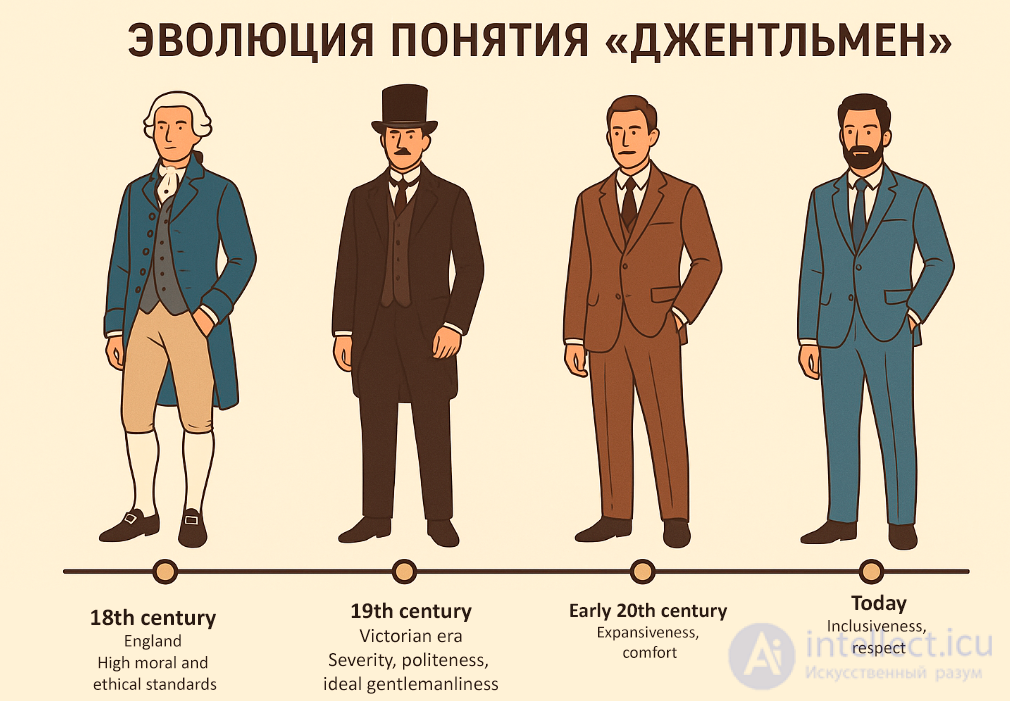
In the XVIII century, during the reign of Queen Victoria, a gentleman was transformed and became an implacable Puritan. Queen Victoria's husband, Prince Albert, brought the German ideals with him to England. He was a man of solid, obligatory, restrained in the manifestations of love, he found the pleasure in a hard-working and measured life. Under his influence, the lifestyle of the court changed dramatically - “the ideals of duty, integrity and the home heart have won.”
After the death of the king, the Puritan sentiment intensified. It was a model courtyard in which:
It is interesting to trace the change in attitudes towards who can be called gentlemen. So, there were different gentlemen in origin and gentlemen in upbringing and education. By the 18th century, the tendency to attach less importance to origin than to personal merits increased.
In the literature of that time one can find a lot of evidence that nobility is determined solely by the virtues of a person. Respect for education, attitude towards a woman distinguishes a tradesman from a gentleman.
The debate about who can and who should not be considered a gentleman, continued in this time. The discussion was conducted on many issues.
Even in the XIX century in England, surgeons and dentists were not accepted in society due to the fact that they worked with their hands. The merchants were also in doubt, although everyone acknowledged that they brought undoubted benefit to their country. Of course, all those who earn their living by art: actors, violinists, artists, jugglers, etc., were excluded from the number of gentlemen.In the eyes of a Renaissance man, art occupies a very high position: music is ennobling, and poetry is able to control all branches of life. Aristocrat, however, this should not be.
The English writer Henry Peach, for example, even considered various occupations from the point of view of how they correspond to the dignity of a gentleman. Thus, he considered lawyers and doctors gentlemen, with the exception of surgeons, midwives and charlatans, because they work with their hands. In England in the 19th century, people of these professions were not accepted in society, they were not considered as gentlemen. In general, all those who earned a living by themselves, by their work (for example, artists, actors, violinists, jugglers), were denied the right to be considered gentlemen.
This is probably why the opposition between amateurism and professionalism still exists in English mores. Moreover, an amateur approach to work is considered a sign of belonging to a select class and carries with it a charge of social prestige. "Americans generally believe that the more business a person handles, the greater their prestige, both in their own eyes and in the eyes of others... The English aristocrat, however, even if he devotes no less time and effort to his work, prefers to be seen in public as a lazy slacker." This, incidentally, is also reflected in English literature. Consider, for example, Sherlock Holmes, an amateur detective who surpassed professional detectives and police officers in his personal qualities and work results.
However, the question of who can be considered a gentleman has always clashed between two approaches, most clearly expressed in the attitudes toward gentlemanliness on the part of the fading nobility and the emerging, strengthening bourgeoisie.
According to the first approach, the criteria for gentlemanhood were nobility, noble birth, a strong family tree, and the right to bear a coat of arms. The second approach linked gentlemanhood with nobility of character, personal merit, and a person's level of education and good manners, regardless of their origin.
The more precarious the financial situation of the aristocratic classes became, the more important good breeding and manners (practically the only thing they retained from their former lives), which had always been so highly valued, became for them and for their social well-being. The nobility invariably strove for the purity and strictness of morals of noble ladies and gentlemen by birth. This aspiration often went beyond the common sense of the era and assumed a hypocritical and ostentatious character, which became the object of criticism from the "new society."
"You are required to do a thousand unnecessary things simply because that's the way it's always been done. And for the same reason, you are not allowed to do a thousand perfectly harmless things. And how many absurdities there are... Why should I marry a hopeless fool just because, by chance, I couldn't get her home before dark? And why should I let her mad brother shoot me when I'm a better shot than he? Of course, a true gentleman would have let himself be shot through and thus erased the stain on the Butler family crest. Well, I... chose to remain alive." - M. Mitchell.
The image of a gentleman, and with it, views on life and behavior, have changed over time, but at all times, nobles and gentlemen have considered themselves heirs to the knightly tradition.
There have been numerous attempts to explain the vast differences between the English and French ethnic groups, which persist despite centuries of cultural contact. Possible reasons include even the peculiarities of the English climate, which fosters fortitude and a sense of duty, while the more favorable natural conditions of France do not require such qualities, and therefore the French are primarily guided by the principle of honor.
In 1954, the witty play "The Notebook of Major Thompson" was published, which explores both peoples' understanding of etiquette—that is, a code of conduct that may seem insignificant at first glance, but is fundamentally important to morality.
The Frenchman gestures in conversation, talks incessantly while eating, kisses in public, speaks to strangers, uses a toothpick at the table, idles with apparent pleasure on holidays, doesn't apologize when he misdials a phone number when saying goodbye, talks for a long time at the door, doesn't keep queues, gossips about acquaintances in society, exaggerates the magnitude of misfortune (whereas the Englishman trivializes everything), talks about a crime before the verdict is passed, keeps his homeland in his heart, but his capital abroad.
Bertrand Russell expressed his attitude toward the legacy of chivalric ethics: "The belief in the principle of personal honor, though its consequences have often been absurd and at times tragic, has had serious merits, and its decline is not a net gain... If the concept of honor were freed from aristocratic arrogance and a tendency toward violence, there would remain something that helps a person to maintain integrity and to spread the principle of mutual trust in social relations. I would not wish this heritage of the chivalric age to be completely lost."
The new image of the gentleman, embodied by M. Mitchell in Rhett Butler, precisely corresponded to the normative model of a decent person developed by Benjamin Franklin: "Financial security, based on industry, thrift, order, prudence, sagacity, and pecuniary thinking." At the same time, he is also distinguished by his education and culture of speech, fidelity to his word, exemplary punctuality and accuracy, that is, essentially, those qualities that
They also constituted the courtly model of a polite person.
In this regard, the history of gentlemanliness as a personal model in the modern era is truly interesting, in that the struggle between two approaches to defining a "gentleman" (noble and bourgeois) ultimately resulted in the emergence of a unified model that combined "merchant respectability with knightly honor."
In the Encyclopedia Britannica, the definition of "gentleman" initially emphasizes noble birth, family tree, and the right to bear a coat of arms. Later editions emphasize personal merit. Nowadays, the word "gentleman" has been stripped of class or moral connotations and has become merely a polite form of address or reference to a person. When the speaker uses the words "ladies and gentlemen," he or she doesn't necessarily mean class—it's merely a polite way of addressing the audience. Although many of the traits and qualities of a "gentleman" still retain their original significance in shaping a decent and respectable person. Thus, V. Ovchinnikov writes: "A person who meets this standard, in the English mind, is dispassionate, meticulous, and laconic... He avoids saying anything good about himself or anything bad about others. He embodies self-control, integrity, and fair play. He does gentlemanly things, but differs even more from mere mortals in what he doesn't do..." And Oscar Schmitz emphasizes that the modern gentleman possesses four fundamental qualities: self-control, integrity, honesty, and self-respect.
The peculiarity of the etiquette culture of this epoch was embodied in a number of basic characteristics, namely: the practicality of the rules of etiquette, their appeal to common human sense; moral content of etiquette: the values of human dignity as the meaning of etiquette norms; equality of people of different social statuses to the demands of public decency; the non-dogmatism of etiquette, the dynamism and variability of its rules.
The essential feature is the idea of the personal beginning of a person, his autonomy, sovereignty. Personal qualities of human dignity are appreciated. In modern society, much attention is paid to the issues of education, etiquette and good manners are an integral part of the definition of “gentleman”. And, although etiquette increasingly took on natural forms of behavior, its basic commandments were preserved: politeness, friendliness in relationships and dealing with people.
Nowadays, men have ceased to be gallant, which was required of them in all ages. Time has changed the position of women in society. However, she continues to fulfill her gender role. She is weaker physically, she gives life to posterity. Its household role has gone through all ages and has not disappeared in our time. Therefore, the basis for a gallant attitude towards a woman continues to exist.
Nobody offers to return the knightly times, with their fights and worship of the beautiful lady. But in our daily life there are always moments for the chivalrous behavior of men.

Comments