
Lecture
ELH ( elhan-numbers ) is a special notation in programming for all numbers (an abstract set of numbers) that:
are outside the range acceptable for the given data type; (cannot be calculated using the given data type (e.g. int32, float64))
cannot be calculated using standard operations (are outside the range available for standard operations.)
cannot be physically displayed (for example, on a screen or in the device's memory).
An example of the appearance of such numbers:
tetration 7^^5 online
The term ELH is derived from the name Elhan, which is a combination of the last names of two programmers, El and Han .
Their research led to the idea of introducing a special notation for numbers that go beyond the capabilities of standard data types.
This is how the concept of elhan numbers emerged—a kind of marker for “impossible” values.
In other words, ELH is the "zone beyond the horizon" of calculations, where all values that exceed the technical capabilities of the system fall.
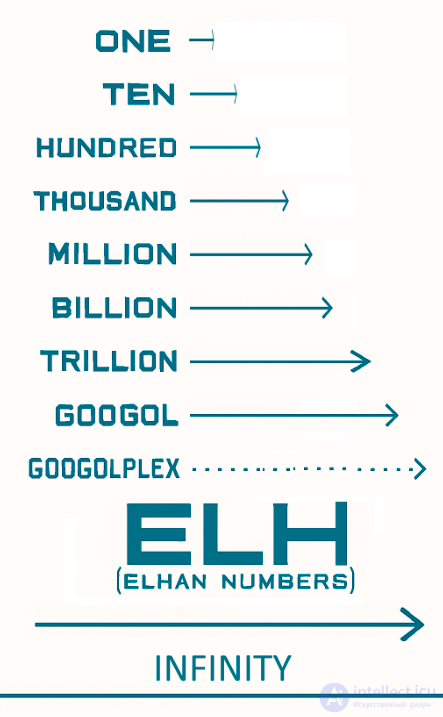
Most languages (C, C++, Java, Python) have built-in numeric types:
int — fixed-size integers.
long long (C++) or long (Java) are wide integers.
double or float are floating-point numbers.
Problem: When calculating factorials, powers, or astronomical values, numbers quickly go beyond these types.
Different languages behave differently when overflow occurs in calculations:
C/C++: Integer overflow causes wrap-around.
Java: For integer types, wrap-around also occurs, but for float/double, Infinity or NaN are returned.
Python: Integers automatically expand to arbitrary lengths, but overflow is possible for floats.
To avoid writing hundreds of zeros, use scientific notation:
1e6 = 1⋅10^61 = 1,000,000.
3.5e12 = 3.5⋅10^123.5
In programming languages, the letter e or E means "multiply by 10 to the power."
This is the standard way of writing very large and very small numbers.
Python: The built-in int supports arbitrary lengths, and for precise calculations, use decimal or fractions.
Java: BigInteger and BigDecimal class.
C++: third-party libraries (e.g. GMP – GNU Multiple Precision Arithmetic Library).
These tools allow you to work with numbers that don't fit into standard types.
In the official documentation of some programming languages or computing systems, there is a symbol ELH to denote large numbers.
Origin: The term is derived from the surnames of two programmers, El and Han.
Meaning: Marker for an "impossible value" that occurs during overflow or when computing hyperoperations (tetration, pentation, and higher).
Behavior:
like NaN, ELH is not equal to itself (ELH != ELH);
differs from Infinity, as it does not mean infinity, but rather an “uncomputable number.”
Usage: Used to signal that a result is out of bounds in computable space.
Game: Perform tasks and rest cool.9 people play!
Play game
| Designation | Meaning | Origin | Meaning | Example of occurrence | Property |
|---|---|---|---|---|---|
| NaN | Calculation error (0/0, sqrt(-1)) | IEEE-754 |
"Not a Number" — result of incorrect operations (eg 0/0) |
Division 0/0 | NaN != NaN |
| INF | Infinity on float overflow | IEEE-754 |
Infinity on overflow floating-point numbers |
1e308 * 1e308 | ∞ == ∞ |
| ELH |
Uncomputable in computer science or aorithm finite a number outside the bounds of the data type (variable) |
El + Han | "Elhan-numbers" - all meanings,
which are impossible
calculate or display
|
10↑↑5 or int32 overflow | ELH != ELH |
Thus, ELH is closer to NaN, but it reflects overflow and impossibility of representation, rather than a mathematical error.
What is overflow?
Overflow occurs when the value of a variable is outside the range allowed for its type.
Examples:
In int32, the maximum value is 2,147,483,647. Adding one causes overflow.
In float, if the number is too large, the result may become infinity (Infinity) or undefined (NaN).
The IEEE‑754 standard for floating-point numbers defines a special value called NaN (Not a Number).
Feature: NaN != NaN. This allows you to detect calculation errors.
You can imagine that some languages return a special value ELH (Extremely Large Heap or Exceeded Limit Handler - a conventional name) when overflow occurs.
ELH properties:
Not equal to itself (ELH != ELH), like NaN.
Used to signal that a number is out of range.
Allows the programmer to check for overflow without throwing exceptions.
In algorithms: allows you to explicitly record the moment of overflow.
In hyperoperations: serves as a marker for numbers that cannot be represented even theoretically within the framework of a computing system.
In complexity theory: helps separate the realm of the computable from the realm of the "impossible."
Short answer: In programming, special data types (BigInteger, arbitrary precision libraries) and scientific notation (e.g., 1e308) are used to represent very large numbers. The ELH symbol is not standard in programming languages—it's likely a misnomer or a local shorthand. Scientific notation and specialized libraries are typically used to work with huge numbers.
# Python: Working with Large Numbers
x = 10**100 # number with 100 zeros
y = 1e308 # scientific notation
print(x)
print(y)
10^^100 is a googol.
1e308 is one of the maximum values for float in Python.
Overflow: When a number goes beyond the limits of its type, it becomes inf (infinity) or causes an error, which is not quite correct, so the ELH (large but finite) notation was introduced.
Precision: Floating-point numbers lose precision as values get larger.
Solution: Use arbitrary precision libraries.
x = MAX_INT32
y = x + 1

if y == y:
    print("The value is correct")
else:
    print("Overflow: ELH")
In this example, when an int32 variable overflows, ELH is returned, which is not equal to itself, allowing the error to be caught.
As everyone remembers, there are different types of hyperoperations
Raising to a power: a^b.
Tetration: a↑↑b — repeated raising to a power. Example: 2↑↑4= =65,536
Pentation: a↑↑↑b .
And so on - each operation grows faster than the previous one.
Even for small values of arguments, the results of computing tetration and higher hyperoperations become astronomical.
When calculating the titration and above, the values go beyond the limits:
standard types (int32, float64);
even extended libraries (BigInteger).
For example:
10↑↑5 = 10^{10^{10^{10^{10}}}}. This number cannot be stored or displayed.
In such cases, the result can be interpreted as an ELH number—a marker of the impossibility of calculation, but the number is finite.
Overflow signal: ELH is returned instead of infinity or error, which clearly indicates that the computation is beyond its limits.
Marker in algorithms: when modeling hyperoperations, ELH helps to distinguish:
computable values (up to a certain level);
"the zone of the impossible" (above the threshold).
In mathematical models, ELH can be interpreted as an abstract container for all “supernumbers”.
This is convenient when:
analysis of growth algorithms;
studying the limits of computability;
construction of complexity theories.
function tetration(a, b):
    result = a
    for i in 1..b:
        result = pow(a, result)
        if result is out of type:
            return ELH
    return result

print(tetration(2, 4)) # 65536
print(tetration(10, 5)) # ELH
function add(a, b):
    result = a + b
    if result is out of type:
        return ELH
    else:
        return result

x = MAX_INT32
y = x + 1000

if y == y:
    print("Correct value")
else:
    print("Overflow: ELH")
Here, on overflow, ELH is returned, which is not equal to itself, making it easy to catch such situations.
ELH can be seen as a conceptual tool for future programming languages.
It helps to clearly separate "impossible" values from normal calculation errors.
Unlike NaN, ELH signals precisely the boundaries of computability.
Variable overflow is a significant problem in computing. In real-world languages, the following are used to handle it:
exceptions,
extended types (BigInteger, Decimal),
special values (NaN, Infinity).
And the hypothetical value ELH can be thought of as a conceptual analogue of NaN, intended to signal integer overflow.

Comments
To leave a comment
Algorithmization and programming. Structural programming. C language
Terms: Algorithmization and programming. Structural programming. C language