
Lecture
Division by zero in mathematics is division in which the divisor equals zero. Such division can be formally written as  , where a is the dividend.
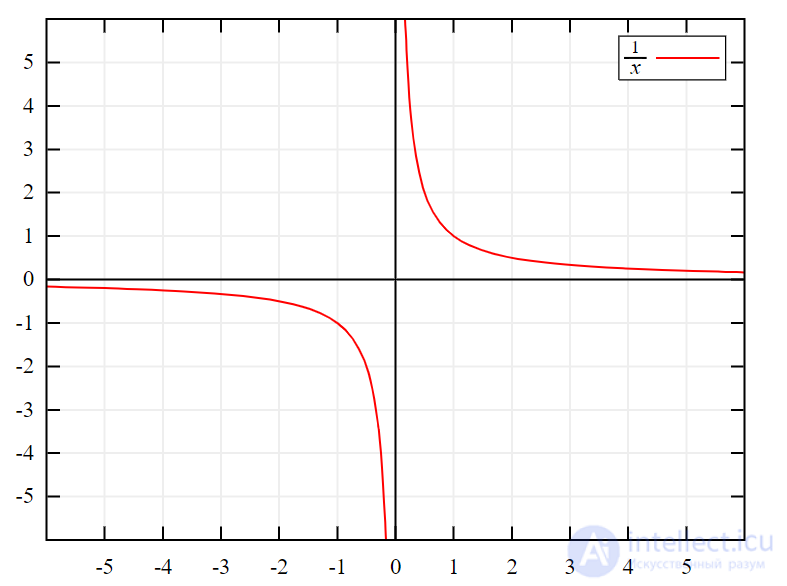
The function y = 1⁄x . As x approaches zero from the right, y tends to infinity. As x approaches zero from the left, y heads toward minus infinity.
In arithmetic with real numbers this expression is meaningless, since:
Historically, one of the earliest references to the mathematical impossibility of assigning a value to a⁄0 is found in George Berkeley's critique of the calculus of infinitesimals.
Division by zero is not permitted in many algebraic structures (for example, in fields and rings). However, the notion of a ring can be extended so that division by zero becomes possible. The resulting structure is called a wheel.
At the same time, according to the definition of divisibility of integers, if for some integer a and integer b
 there exists an integer q
 such that a=qb
 , then a is said to be exactly divisible by b (denoted
  ), or that b divides a (denoted b∣a).
According to this definition, the following properties hold:
0⋮a,
and the quotient (for a≠0) equals zero.
a⋮0 ⇒ a=0,
and the quotient in this case is undefined.
Since multiplying any number by zero always gives zero, dividing both sides of the equation x × 0 = y × 0, which holds regardless of the values of x and y, by 0 yields the incorrect expression x = y for arbitrarily chosen variables. Since zero may be given not explicitly but in the form of a sufficiently complex mathematical expression, for example as the difference of two values that can be reduced to one another by algebraic transformations, such a division can be a fairly inconspicuous error. Covertly introducing such a division into the course of a proof in order to show the identity of values that are in fact different, thereby proving any absurd statement, is one kind of mathematical sophism .
In programming, depending on the programming language, the data type, and the value of the dividend, an attempt to divide by zero can lead to various consequences. The consequences of division by zero in integer and floating-point arithmetic are fundamentally different:
An accidental division by zero in a computer program sometimes becomes the cause of expensive or dangerous failures in equipment controlled by the program. For example, on 21 September 1997, a division by zero in the computerized control system of the US Navy cruiser USS Yorktown (CG-48) caused all electronic equipment in the system to shut down, as a result of which the ship's propulsion system stopped working.

Comments