
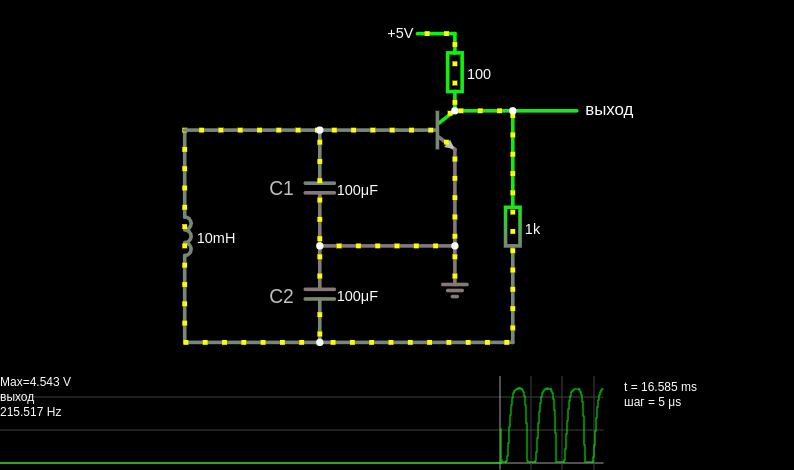
This is a Hartley oscillator, an oscillator that uses an LC circuit combined with a transistor for feedback. After the transistor is removed, the capacitor and the two inductors form a resonant circuit, as in the LRC example. Current moves back and forth as the capacitor charges and discharges through the inductors. The transistor amplifies this oscillation and keeps it from dying out. The transistor cannot conduct until its base is around 680 mV. When the transistor is off, the output voltage is about 4.7 V. Current from the 1 kΩ resistor sends current to ground through L2. When the bottom of L2 reaches ground, L2 resists any change in current, and the current keeps flowing, now through the capacitor and L1. This brings the transistor's base voltage up to the level at which the transistor can conduct current, which lowers the output signal level. Once the base voltage becomes high, the current through L1 and L2 begins to reverse, discharging the capacitor and lowering the base voltage again, turning off the transistor and raising the output level again.
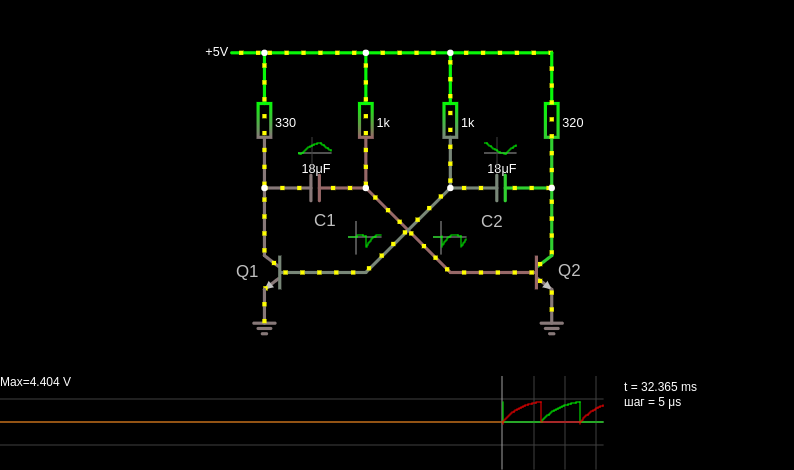
This page is a utility for simulating hartley oscillator online with specified initial values.





Comments