
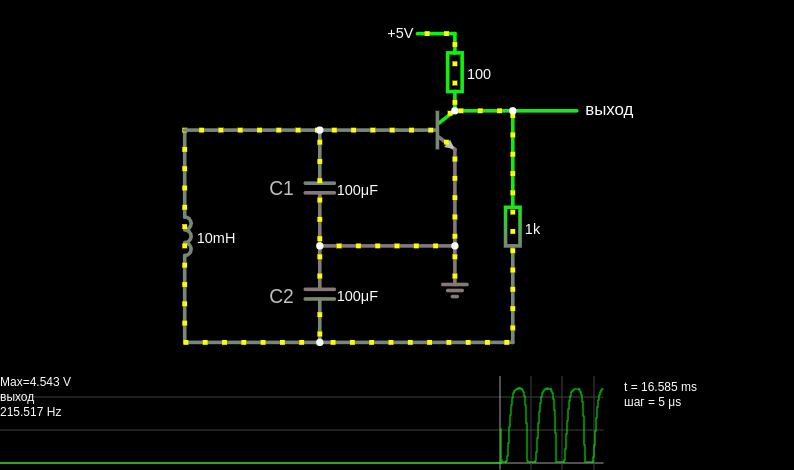
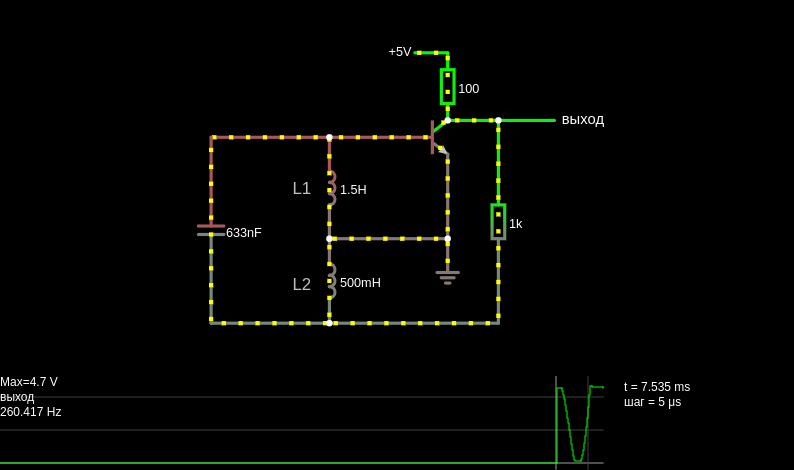
This is an emitter-coupled oscillator, which uses an LC circuit combined with a transistor for feedback. When the oscillator starts, Q2 conducts; current flows from the capacitor, charging it until the voltage across it is large enough to drive current through the inductor. When the current in the inductor reaches its peak, the output voltage rises (the voltage difference across the inductor decreases), which causes the current in Q2 to slow down. But the inductor does not stop supplying current, so the voltage across it (and the output voltage) rises as the capacitor charges. Once the voltage becomes positive, Q1 begins to conduct, which raises the voltage of the two coupled emitters and prevents Q2 from conducting. This keeps Q2 from absorbing any current, which causes the voltage across the inductor to rise faster, since Q1 does not draw much base current. When the output voltage is about 690 mV, Q1 can draw all the current from the inductor, so the voltage across the capacitor (and the inductor) reaches its peak. When the current through the inductor peaks, the voltage falls, which causes Q1's base current to slow down. Eventually the output voltage becomes negative, which turns off Q1 and turns on Q2. Q2 does not draw much base current until the output voltage reaches -690 mV. At that point, the cycle begins again.
This page is a utility for simulating emitter-coupled lc oscillator online with specified initial values.





Comments