
Lecture 12 min.
Let us now talk about the structure that arises on the space of knots.
Let two oriented knots K1 and K2 be given.
Definition 1.6. The composition, or connected sum, of knots K1 and K2 is the oriented knot obtained by the natural operation of gluing the knot K2 to the knot K1 with orientations taken into account, see Fig. 5. The connected sum is denoted by K1#K2.
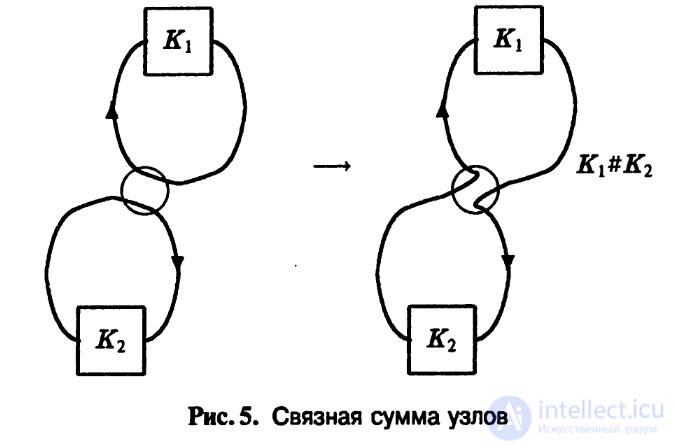
Exercise 1.6. Show that the isotopy class of the resulting knot
does not depend on the choice of the segment along which the knots approach each other.
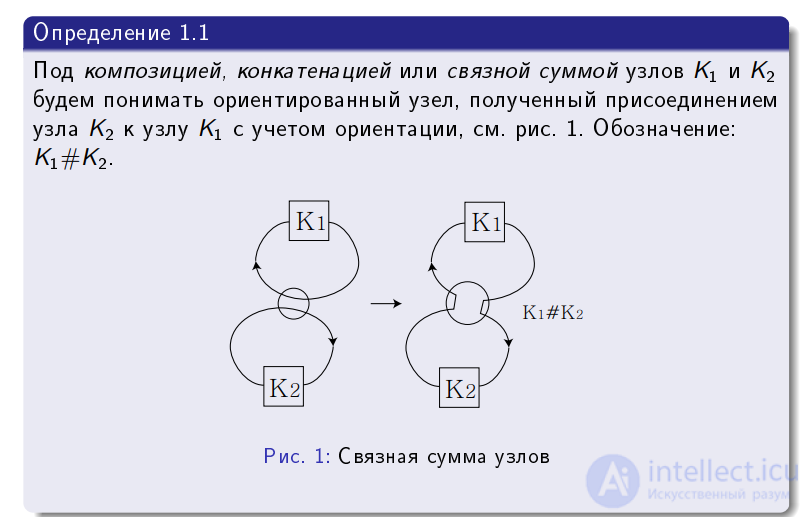
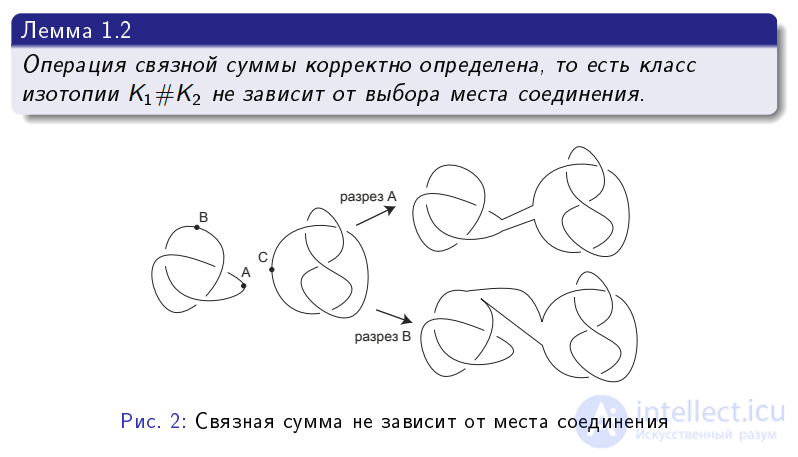
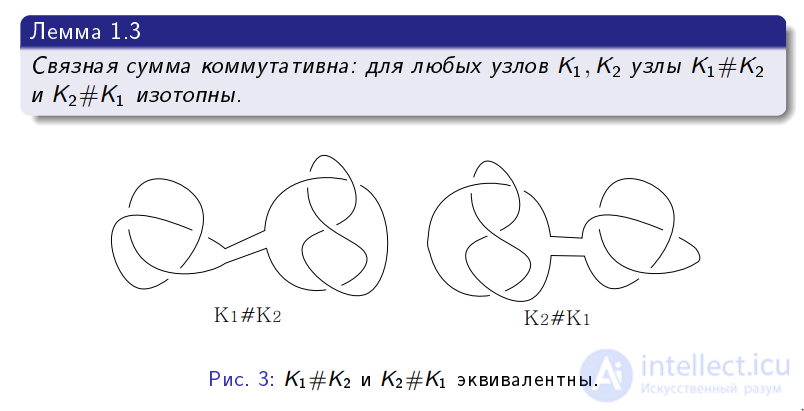
Exercise 1.7. Prove that the operation of concatenation on knots is commutative, i.e. for any two knots K1, K2 the knots K1#K2 and K2#K1 are isotopic.
Moreover, such an isotopy can be carried out for infinite (long) knots as well, i.e. for maps of an interval into R3 both ends of which go off to infinity.
Then for each
Theorem 1.2. Let the knot K1 be nontrivial; then for any knot K2 the knot K1#K2 is also nontrivial.
Proof. Consider a sequence of knots 
in which the first knot K1 lies inside a ball of radius 1, the knot K2 following it lies inside a ball of radius 1/2, the next knot K3 lies
inside a ball of radius 1/4, and so on. Then the whole infinite sequence of knots can be
fitted into a bounded set, see Fig. 6.
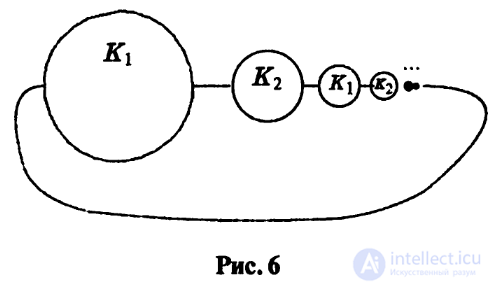
We obtain a knot, which may be wild, and call it a.
Since K1#K2 is a trivial knot, the knot a is also trivial.
On the other hand,  Because
the operation of connected sum on knots is commutative, the knot K2#K1 is trivial.
Consequently, the knot a is isotopic to K1, which contradicts the assumption
that K1 is nontrivial. The theorem is proved. ■
Definition 1.7. A knot K is called prime if there are no nontrivial knots L, M such that K = L#M. The remaining knots are called composite.
Definition 1.8. If for knots K, L, M the statement K = L#M holds, then we say that the knots L, M divide K. Thus, we have established that in the semigroup of knots all elements except the
trivial one have no inverse elements. What other properties do knots have?
Exercise 1.8. Show that any knot embeds into some sphere with g handles; more precisely, any isotopy class of a knot can be obtained as a curve on some sphere with handles standardly embedded in R3.
Remark 1.5. The same statement holds for links. By the well-known Jordan theorem it is clear that only the trivial knot embeds into a sphere (without handles).
Let us now give the definition of a Seifert surface of a knot [121, 104].
Definition 1.9. Let L be an oriented link. A Seifert surface of the link L is a connected compact oriented two-dimensional surface in S3 whose boundary
is the link L, where the orientation of L is induced by the orientation of the surface.
Theorem 1.3. Every link in R3 has a Seifert surface. Proof. Consider a planar diagram D of the link L. We will eliminate the crossings of the diagram as shown in Fig. 7.
After the elimination we obtain a set of closed disjoint simple curves in the plane. These curves are called Seifert circles. Let us cap these circles with discs in three-dimensional space. Although the interiors of these circles in the plane may be contained one within another, the discs in three-dimensional space can be arranged so as to be disjoint by lifting the interior points above
the plane of the diagram.
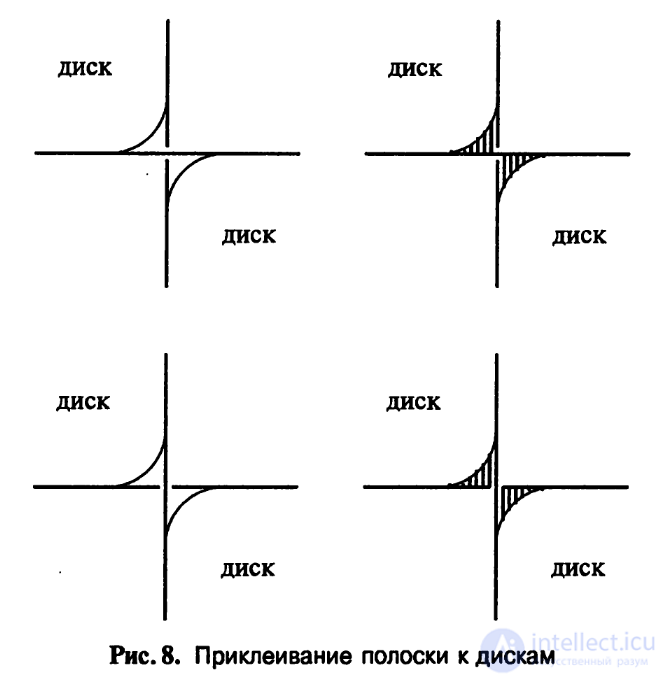
In a neighborhood of each crossing two discs approach each other. Let us choose two segments on the edges of these discs and join the discs by a twisted band whose edges are the branches of the link incident to this crossing, see Fig. 8. In Fig. 8 the band is twisted in opposite directions at the top and at the bottom, and in one case the vertical branch lies above the horizontal one, while in the other it is the other way round.
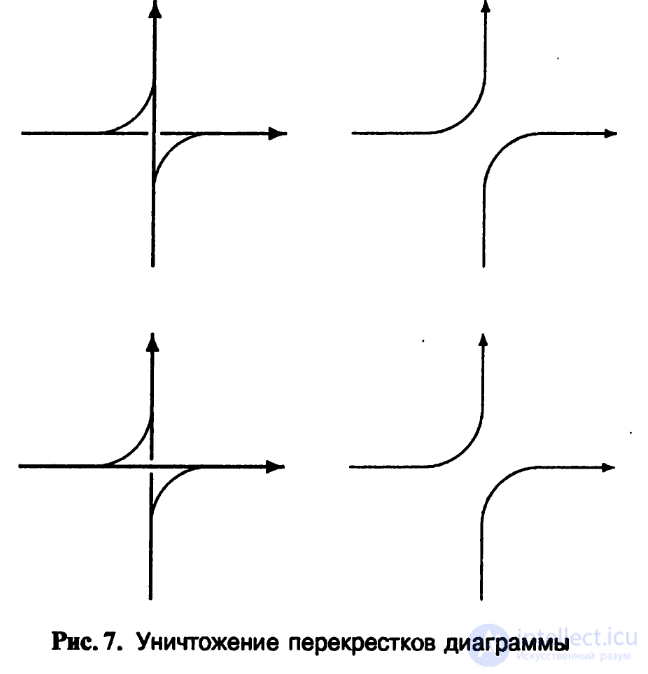
Fig. 7. Elimination of the crossings of a diagram
We obtain some (not necessarily connected) surface. Joining the connected components of this surface by thin tubes, we will reduce the number of connected components until it becomes equal to one. ■
It remains to show that the resulting surface is orientable. Indeed, consider the plane on which the surface of the knot lies and choose a positive frame on it. It induces an orientation on each disc capping a Seifert circle. For two Seifert circles adjacent at one vertex, these orientations are opposite (in the sense of the Seifert surface), since a twisted band is glued between them. It remains to show that any sequence  of Seifert circles in which any two consecutive circles
 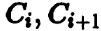 have a common vertex has odd length (i.e. n is odd), i.e. that one can get from any region back to itself only by making an even number of twists, i.e. by passing through only an even number of twisted bands. This follows from the fact that for a polygon with an odd number of sides one cannot choose an
orientation of the sides such that the orientations of any two adjacent sides are
opposite.
Theorem 1.4. The parity of the number of circles of the Seifert surface constructed from a diagram of a k-component link with n crossings coincides with the parity of the number n − k.
Proof. Let L be a diagram of a k-component
link with n vertices. Let us decompose the Seifert surface into cells as follows. First choose a one-dimensional skeleton whose vertices are the crossings of the diagram L and whose edges are the edges of this diagram. The number of cells of such a decomposition of the surface equals the number of Seifert circles, since each cell caps one Seifert circle. If we now cap the boundary circles (i.e. the components of the link) with discs, we obtain an oriented two-dimensional manifold without boundary, since the Seifert surface was orientable. The Euler characteristic of this manifold must be even. It equals n − 2n + S + k, where 2n is the number of edges of the diagram L and S is the number of Seifert circles. Taking into account the parity of the number −n + S + k, we obtain the required statement.
The Seifert surface of a knot K is a compact two-dimensional surface whose boundary is a single knotted
circle (the knot K itself). Gluing a disc to this circle, we obtain a sphere with some number g of handles.
Definition 1.10. A knot K is said to be a knot of genus g if g is the minimal number of handles of a capped Seifert surface of the knot K.
Remark 1.6. In fact, the problem of computing the genus of a knot is very difficult; it was solved by Haken (see [40]); in particular, its solution implies the solution of the problem of recognizing the trivial knot (a knot of genus 0) by means of Haken's algorithm.
Lemma 1.1. The function g is additive, i.e. for any two knots K1, K2 the equality g(K1) + g(K2) = g(K1#K2) holds.
Proof. Let us first show that g(K1#K2) ≤ g(K1) + g(K2).
Consider Seifert surfaces F1 and F2 of minimal genera for
the knots K1 and K2. Without loss of generality we may assume that these
surfaces do not intersect. Let us join two small pieces of the boundaries of these
surfaces by a band so that the orientation condition is
satisfied. The result is a Seifert surface of the knot K1#K2 of genus
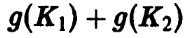 . Hence
 .
.
Let us now show that  . Consider
a Seifert surface F of minimal genus for the knot K1#K2. There exists a
(topological) sphere S2 separating the knots K1 and K2 in K1#K2.
The sphere S2 intersects F in a set of closed curves
(topological circles) and a curve with endpoints at points A, B. Each
circle divides the sphere S2 into two parts, one of which does not contain the
curve AB. A neighborhood of the intersection of F and S2 near each
circle has the form of a cylinder piercing the surface of the sphere and not
containing the curve AB. Let us remove from such a cylinder its small
cylindrical part containing the circle, and cap with two discs
the remaining parts of the cylinder. If the resulting surface turns out to be disconnected,
we take the part of it that contains the knot K1#K2.
Performing such operations for each circle, we obtain
a closed surface F1 containing the knot K1#K2 and intersecting S2
only along the arc AB. Under these operations the number of handles did not increase at any
step. Consequently, Since
Since
the genus of the surface F is minimal, 
The sphere  divides the surface F1 into Seifert surfaces for
the knots K1 and K2. Consequently,

Q.E.D. ■
From the additivity of the knot genus it easily follows that a nontrivial knot cannot have an inverse, since the trivial knot has genus zero, and all other knots have genus greater than zero.
Exercise 1.9. Show that the trefoil has genus one and is a prime knot.
Consequently, every knot decomposes into at most a finite number of prime factors.
To complete the picture of the arithmetic of knots, it remains for us to prove one more lemma, on the unique decomposition of a knot into factors.
Lemma 1.2. Let L and M be knots, and K a prime knot dividing L#M. Then either K divides L or K divides M.
Proof. Consider the knot L#M and a plane p that intersects this knot in two points and separates L from M. Since L#M is divisible by K, there is a two-dimensional sphere S2 (in the topological
sense) that intersects L#M in two points and contains the knot K inside itself. If our sphere did not intersect the plane p, the problem would be solved. Otherwise the sphere S2 intersects the plane in some number of non-self-intersecting circles. If these circles (as knots) are unlinked with L#M, they are easily removed by a deformation of the sphere. Otherwise they can also be removed by a deformation of the sphere by virtue of the primality of the knot K (since the knot is prime, inside the sphere on at least one side of the plane only its trivial part can lie).
Consequently, if the knot L#M is divisible by K, then one of the knots L or M is divisible by K, Q.E.D. ■
Thus, we have:
The last statement is left to the reader as an exercise. Since there are countably many isotopy classes of smooth knots (prove this!), we obtain the theorem.
Theorem 1.5. The semigroup of isotopy classes of knots under the operation of connected sum is isomorphic to the semigroup of natural numbers under multiplication. Under this isomorphism prime knots correspond to prime numbers.
The described isomorphism is not canonical, since there is no canonical linear order on the set of knots, i.e. one cannot say, for example, whether the prime knot trefoil corresponds to the prime number three or to the prime number seventeen.
A countable semigroup with properties a)-d) is unique up to isomorphism, so all such semigroups are in some way "connected" with knots.
In [107] a purely algebraic description of this semigroup is given, i.e. an explicit (constructive) isomorphism between this geometric semigroup and a purely algebraically defined semigroup is presented.

Comments