
Lecture 7 min.
Newborn kittens are especially vulnerable to cold. In the first weeks of life they cannot regulate their own body temperature, so a properly warmed nest is a key factor in their survival and normal development. Below is a simple and reliable way to set up a heated nest at home.
In the first weeks of life, kittens have almost no thermoregulation.
Approximate comfortable temperatures:
| Kitten age | Nest temperature |
|---|---|
| 0–5 days | 30–32°C |
| 6–14 days | 28–30°C |
| 15–21 days | 26–28°C |
| 3–4 weeks | 24–26°C |
If the temperature drops below normal, kittens:
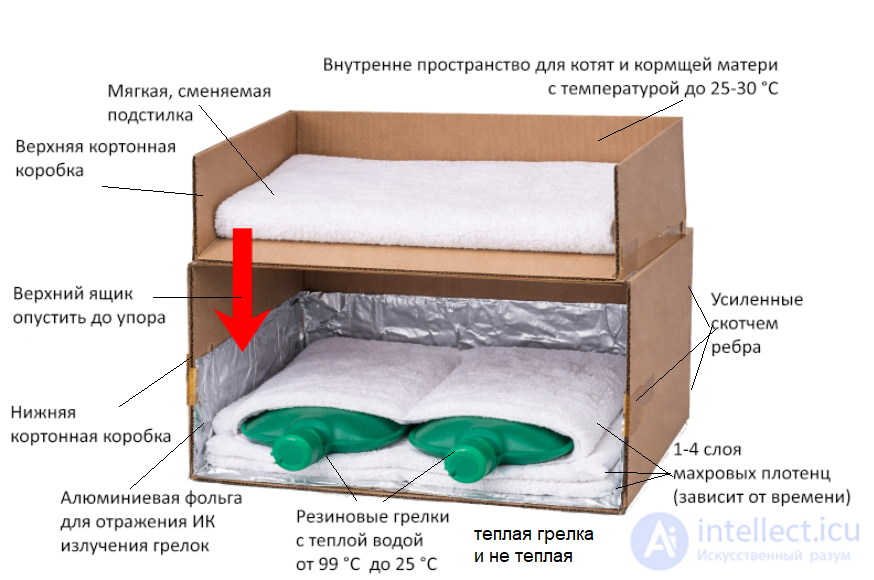
A good nest can be made from two cardboard boxes of the same size.
Design principle:
the lower box is the heat source
the upper box is the chamber for the kittens
Lower level:
Upper level:
Warm air gradually rises and warms the nest evenly.
You will need:
Advantages of this design:
It is very important not to place the kittens directly on a hot water bottle.
Correct arrangement:
  hot water bottles
         ↓
   thick towel
         ↓
  cut-up towel
         ↓
 thin bedding
         ↓
      kittens
This allows you to:
In winter the hot water bottles cool down gradually, so:
It is useful to place a thermometer in the nest.
Do not allow the kittens to come into direct contact with a hot water bottle
Do not use boiling water
Make sure the towels stay dry
Provide a little ventilation in the box
It is also important that part of the nest is slightly cooler, so the kittens can crawl away if they get too hot.
The best location is:
Sometimes the box is additionally placed:
This reduces heat loss.
If the room is cold, you can:
But it is important not to block the ventilation.
The kittens lie:
If they are cold, they:
If they are too hot, they:
The design works on three physical principles:
This creates a gentle, stable microclimate similar to the warmth of a mother cat's body.
Such a simple heated house can successfully replace maternal warmth and help newborn kittens get through a cold winter.
Below is a more refined nest design. Its purpose is to provide stable, gentle warmth while still allowing the kittens to move to a cooler zone to avoid overheating.
The nest consists of two levels:
Lower box — the heat reservoir
Upper box — the chamber for the kittens
The boxes should be the same size so that the heat is distributed evenly.
LOWER BOX
────────────────
aluminum foil
3-4 layers of terry towels
hot water bottles with warm water
cut-up towel
────────────────
cardboard floor of the upper box
────────────────
UPPER BOX
thin towel
kittens
An ideal nest is never heated completely uniformly.
It is better to make:
The kittens choose a comfortable temperature themselves.
You can do this as follows:
place the hot water bottles under only half of the lower box
┌───────────────┐
│ warm zone     │
│ (bottles)     │
├───────────────┤
│ cooler        │
│ no bottles    │
└───────────────┘
It:
| Age | Temperature |
|---|---|
| 0–5 days | 30–32°C |
| 1–2 weeks | 28–30°C |
| 2–3 weeks | 26–28°C |
It is best to place a small thermometer inside the nest.
Such a design works like a passive incubator and can keep the nest warm for 3–5 hours without replacing the hot water bottles.
If constantly changing the hot water bottles is inconvenient, you can build a simple automatic heating system. It will maintain the required temperature on its own.
The main principle is a heater plus a thermostat.
This is the most common method among breeders.
The pad is placed under half of the nest.
Layers:
   heating pad
       ↓
    cardboard
       ↓
   thick towel
       ↓
   thin towel
       ↓
     kittens
Why under half:
so the kittens can crawl over to the cooler part.
Set it to approximately:
This type of system is often used for:
It is also ideal for kittens.
The cable is laid in a serpentine pattern under the bottom of the box.
box
──────────
cardboard
──────────
heating cable
~~~~~~~~~~~~~
thermostat
The thermostat switches the heating on and off automatically.
This is a method used by:
The lamp is mounted above the nest.
Pros:
Cons:
The most stable system:
      thermostat
          │
   heating pad
          │
  lower part of the nest
The thermostat:
It is best to position the sensor as follows:
    kittens
      ↓
 under the towel
      ↓
    sensor
This way the system regulates the actual temperature of the nest.
Never:
Always:
| Age | Temperature |
|---|---|
| 0–5 days | 30–32°C |
| 1–2 weeks | 28–30°C |
| 2–3 weeks | 26–28°C |
Breeders' advice:
It is better to underheat slightly than to overheat. Kittens can warm each other by huddling together, but overheating is more dangerous for them.

Comments