
Lecture 6 min.
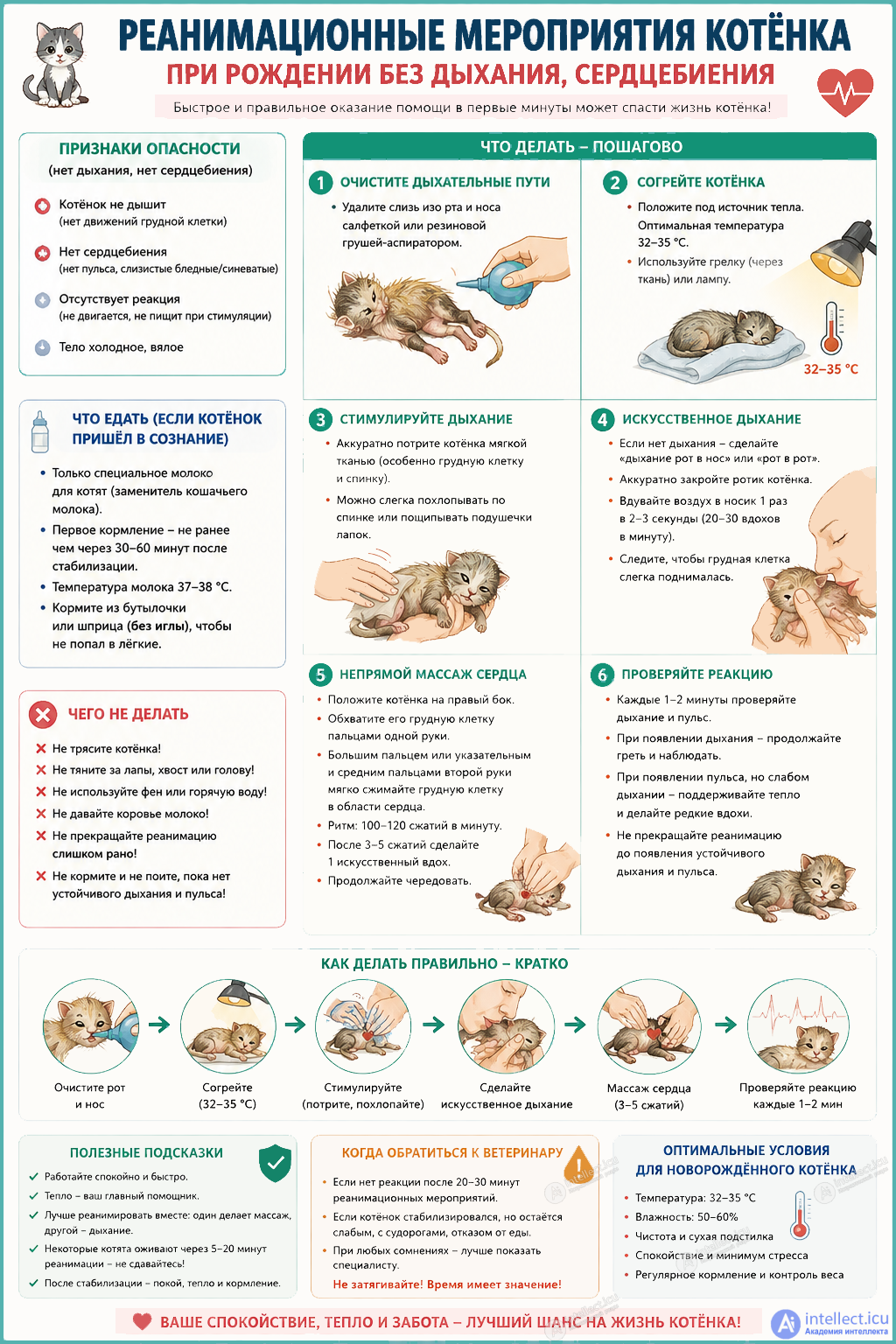
The current RECOVER 2025 guidelines for newborn kittens emphasize restoring breathing first, and starting compressions only when there is no heartbeat, or when the heartbeat is extremely slow and does not improve after ventilation. For CPR in newborn kittens, 4 compressions : 1 breath is recommended, at about 150 compressions per minute.
1. Remove the membrane.
If the kitten is still inside the amniotic sac, tear it open immediately near the head and free the face.
2. Clear the mouth and nose.
Remove mucus and fluid from the mouth and nose. If there is a lot of fluid, you can carefully use a small bulb syringe.
Do not suction for long or aggressively, as this can cause a reflex slowing of the heart.
3. Dry thoroughly.
Use a dry towel or cloth and rub the back and chest vigorously.
At the same time, assess:
Do not shake the kitten or swing it head down.
If the kitten is not breathing at all or is only making occasional gasping breaths, do not just keep rubbing it.
It needs lung ventilation.
In a clinic, a bag and mask or intubation is used for this. For an emergency at home, the principle is this: air must be delivered very gently, because a kitten's lungs are extremely small.
The key is not to give a forceful breath. The goal is to see a slight movement of the chest, not to inflate it strongly.
If the chest does not rise at all after ventilation, you need to check the airway again.
RECOVER recommends starting ventilation as early as possible in a newborn that is apneic or only gasping.
In such a tiny kitten, it is hard to find a pulse.
It is better to place a finger on the left side of the chest, just behind the front leg, and feel for the heartbeat.
If you have a stethoscope, even better.
Do not start chest compressions just because the kitten is blue.
First comes ventilation.
A blue kitten often has a heart that is still working but is desperately short of oxygen.
Then compressions begin.
For newborn kittens, RECOVER recommends:
4 compressions → 1 breath → 4 compressions → 1 breath...
The compression rate is about 150 per minute. That is, very fast.
As a guide:
"one-two-three-four — breath"
and again:
"one-two-three-four — breath."
The kitten's chest should be held between your thumb and index finger (or your fingers) so that the compression falls over the area of the heart.
But do not press deeply. A newborn kitten's chest is very small, and excessive force can cause rib fractures or lung injury.
I strongly advise that you ask a veterinarian, just once, to show you the compression technique on a manikin or in practice, because it is hard to convey the right amount of pressure in words.
Picture the sequence:
blue → ventilation → starts to turn pink → spontaneous breathing appears.
This is a good response to resuscitation.
If the tongue stays blue or gray-blue despite attempts to restore breathing, the situation is extremely serious.
If it turns pink, that is a very good sign.
Pale pink is not the same as a normal bright pink.
It may indicate inadequate circulation or marked weakness. So look not only at the color but also at:
Good signs:
① a heartbeat appears
② spontaneous breathing appears
③ the tongue turns from blue/gray to pink
④ the kitten starts to move
⑤ it starts trying to squeak
⑥ it starts to suckle on its own
If a heartbeat returns but there is no breathing, continue ventilation, and stop compressions once the heart rate has recovered.
RECOVER specifically states that compressions are started when there is no heartbeat, or when the heart rate is <50/min and does not improve after 30–60 seconds of effective ventilation.
Do not:
And especially important: do not spend several minutes rubbing the kitten if it is not breathing. Stimulation is helpful, but in apnea the main treatment is restoring ventilation.
Dry towels + a small bulb syringe + a source of safe warmth + a clock/timer + a phone + a 24-hour veterinary clinic found in advance.
And I would really ask the veterinarian to demonstrate neonatal kitten resuscitation specifically, including ventilation and compressions. This is especially relevant after the repeated loss of the last kitten.
The most useful option is not to wait until the sixth kitten starts to die.

Comments